
Goal Setting Strategies: 7 Steps to Proven Success
Actionable insights to align your OKRs with everyday performance management-from proven frameworks to the tools that power them.
Summary
Goal setting strategies are systematic approaches that help individuals and organizations define clear, measurable objectives and create actionable plans to achieve them. These strategies transform vague aspirations into concrete targets with specific timelines and accountability measures. Whether you’re aiming for personal growth or organizational success, effective goal setting strategies align your efforts with your vision, increase focus, and significantly boost your chances of success. By implementing proven frameworks like SMART goals, WOOP, or OKRs, you create structure around your ambitions and establish the momentum needed to turn plans into measurable results.
What Are Goal Setting Strategies?
Goal setting strategies are frameworks and methodologies designed to help you establish clear, achievable objectives that align with your values and organizational mission. These are not merely wishful thinking—they’re systematic processes that break down ambitious visions into manageable, measurable steps.
At their core, goal setting strategies serve as a roadmap. Instead of wandering aimlessly toward success, you’re following a clearly marked path. The best strategies combine clarity of intent with flexibility in execution. They require you to define not just what you want to achieve, but why it matters, when you’ll achieve it, and how you’ll measure progress along the way.
The effectiveness of goal setting strategies lies in their ability to combat ambiguity. Research from Gartner reveals that when employees understand organizational goals and how their work connects to them, 52% report an increase in discretionary effort—the willingness to go above and beyond baseline expectations. This alignment between personal objectives and organizational priorities creates a powerful motivational force that transforms how teams perform.
Why Are Goal Setting Strategies Important?
In today’s competitive landscape, effective goal setting strategies have shifted from a “nice-to-have” to a business imperative. The statistics tell a compelling story: organizations that apply structured goal-setting practices are 20 to 25% more productive than those operating without clear objectives. Companies leveraging SMART goals report a 12% increase in overall productivity, translating directly to improved bottom-line performance.
Beyond productivity, goal setting strategies drive engagement and retention. Gallup’s research found that only 21% of employees globally are engaged at work—a staggering figure that underscores how many organizations struggle with alignment and clarity.
When employees have clearly defined goals that connect to organizational strategy, engagement increases measurably. Teams with collaborative goal-setting approaches show a 20% increase in individual performance.
For leadership, effective goal setting strategies reduce costly misalignment. Gartner’s research demonstrates that organizations driving team performance through aligned objectives increase their likelihood of exceeding revenue and profitability goals by two fold.
This isn’t coincidental; when people know what they’re working toward and understand how their contributions matter, they make better decisions, collaborate more effectively, and sustain effort through challenges.
Achieve Your Goals Faster
See how Worxmate can help your team set clear goals and achieve faster results. Book your free demo today and experience the power of AI-driven OKRs in action.
What Are the 7 Steps of Goal Setting?
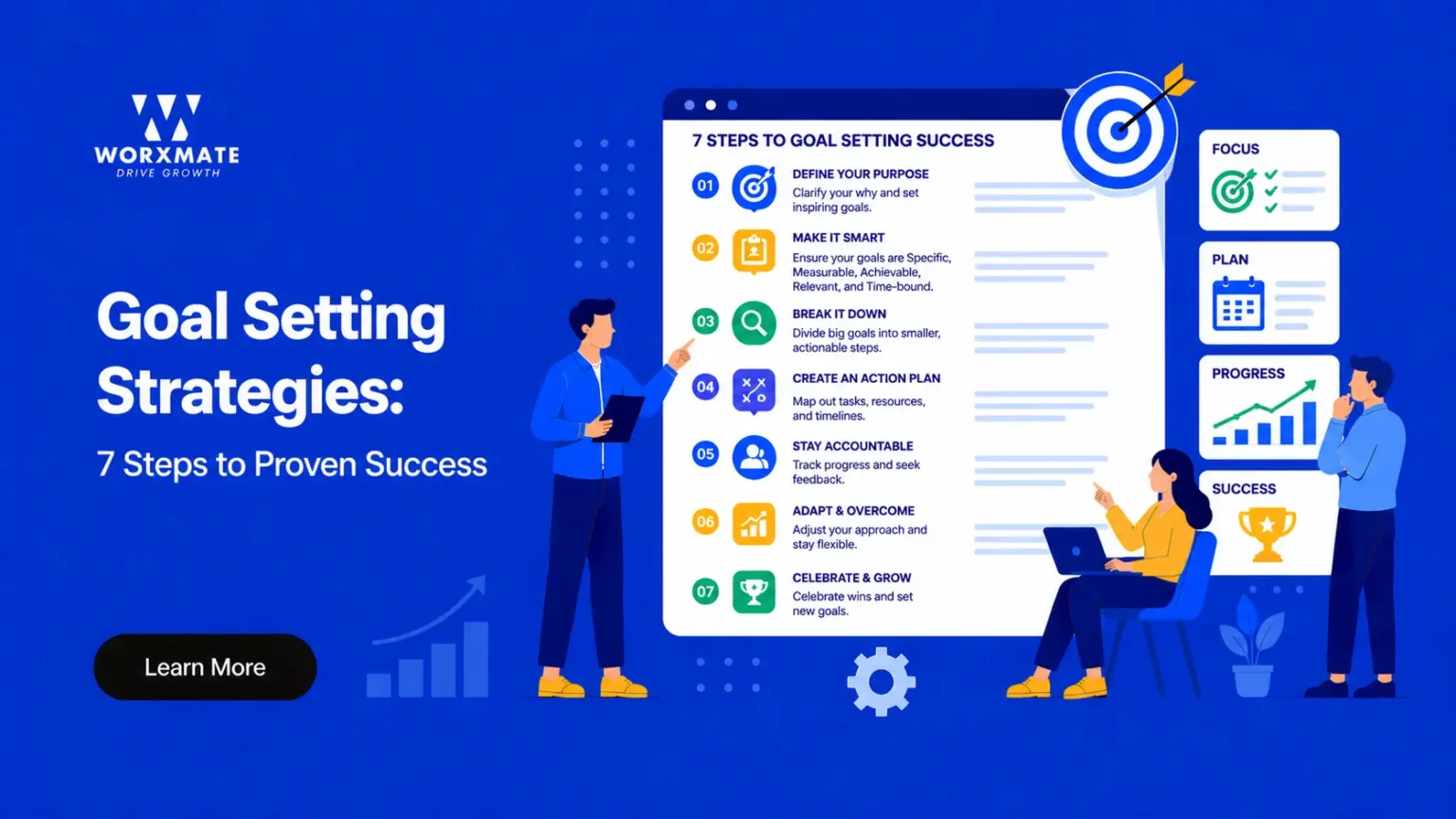
The seven-step goal-setting process provides a structured approach to turning aspirations into achievements. This methodology, refined across decades of performance management research, guides you from initial vision through successful completion.
-
Step 1: Define Your Vision
Begin by understanding what you truly want to achieve. This requires honest reflection about your values, strengths, and aspirations. Are you aiming to enhance team productivity, expand your market share, or develop your leadership capabilities? Write your vision clearly—vagueness at this stage cascades through your entire goal-setting process, undermining subsequent steps.
-
Step 2: Assess Your Current Situation
Conduct an honest evaluation of where you stand. What barriers exist? What resources do you have available? What obstacles might slow your progress? This assessment grounds your goals in reality rather than fantasy, making them more achievable and actionable.
-
Step 3: Set SMART Goals
Transform your vision into Specific, Measurable, Achievable, Relevant, and Time-bound objectives. Instead of “improve team performance,” aim for “increase project completion rates by 15% within Q2 through daily standup meetings and clear task assignments.” This specificity creates clarity and enables progress tracking.
-
Step 4: Create an Action Plan
Develop the tactical steps required to reach each goal. Break larger objectives into smaller milestones. If your goal is to increase sales by 20%, your action plan might include daily prospecting activities, weekly client check-ins, and monthly strategy adjustments. Detail matters—it transforms intention into habit.
-
Step 5: Track Your Progress
Establish a cadence for reviewing progress toward your goals. Research shows that weekly check-ins with accountability partners increase success rates substantially. Use visible scoreboards or digital dashboards to maintain focus and quickly identify where adjustments are needed.
-
Step 6: Review and Adjust
Goals don’t exist in a vacuum. Markets shift, priorities change, and unexpected challenges emerge. Build flexibility into your goal-setting process. Salesforce’s V2 MOM framework, for instance, allows employees to adjust goals quarterly in response to changing business priorities while maintaining overall alignment.
-
Step 7: Celebrate and Learn
Acknowledge progress, no matter how incremental. Celebrating milestones maintains motivation and reinforces the behaviors that drive success. When goals are achieved, analyze what worked. When they fall short, extract lessons for future goal-setting cycles.
How Do SMART Goals Work?
SMART goals represent the most widely adopted framework in performance management and personal development. Each letter corresponds to a critical dimension that transforms vague aspirations into concrete objectives.
- Specific: Define precisely what you want to accomplish. “Improve customer satisfaction” is too broad. “Increase customer satisfaction scores from 78 to 85 by implementing a new feedback system” is specific and actionable.
- Measurable: Include quantifiable metrics that allow you to track progress objectively. Numbers eliminate ambiguity—you either achieved 85 or you didn’t. This clarity drives accountability and enables data-driven adjustments.
- Achievable: Ensure your goal is realistic given available resources, time, and constraints. An achievable goal challenges you to stretch without breaking. Research on effective goal-setting shows that moderately difficult goals outperform both easy targets (which lack motivational power) and unrealistic stretches (which demoralize).
- Relevant: Align your goals with broader organizational strategy and your personal values. When goals align with organizational priorities, employees report significantly higher engagement. Relevance creates the “why” that sustains effort through difficulties.
- Time-bound: Establish clear deadlines. Without temporal boundaries, goals drift indefinitely. A deadline creates urgency and forces prioritization. “By end of Q2” is infinitely more powerful than “eventually.”
The SMART framework’s power lies in its completeness. A study by Dominican University of California found that people who wrote down their goals were 42% more likely to achieve them. Adding accountability mechanisms—sharing goals with someone who checks in regularly—nearly doubled success rates to 76%.
What Are Goal Setting Techniques?
Beyond SMART goals, several complementary goal setting techniques enhance your goal-setting effectiveness. Understanding these approaches allows you to select methodologies aligned with your specific challenges and context.
WOOP (Wish, Outcome, Obstacle, Plan): This goal setting technique acknowledges that obstacles are inevitable. Begin with your wish—what do you want? Visualize the ideal outcome in detail. Then, realistically identify obstacles that might prevent success. Finally, create specific contingency plans for each obstacle. This approach, popular among behavioral researchers, dramatically improves follow-through by mentally preparing you for challenges.
FAST Goals: An evolution of SMART, FAST emphasizes Frequently discussed, Ambitious, Specific, and Transparent goals. Organizations using FAST frameworks report superior execution because frequent discussion keeps goals top-of-mind and creates accountability through visibility.
OKRs (Objectives and Key Results): This framework separates ambitious aspirations (objectives) from measurable outcomes (key results). OKRs excel in dynamic environments where priorities shift quarterly. Unlike traditional cascading goals that can become ossified, OKRs maintain flexibility while preserving alignment.
Visualization: Mental rehearsal of goal achievement activates neurological patterns similar to actual performance. Athletes have long used visualization; high-performing professionals increasingly do the same. Spending five minutes daily visualizing successful goal achievement increases motivation and clarifies the specific actions required.
Accountability Partnerships: Sharing goals with an accountability partner creates external motivation and provides course-correction feedback. Research shows that people with accountability partners achieve goals at dramatically higher rates than solitary goal-setters.
Case Study: How Salesforce Revolutionized Goal Setting with V2MOM
Salesforce faced a common challenge: despite clear organizational strategy, individual and team goals frequently misaligned with broader priorities, wasting resources and creating frustration. To address this, they developed V2MOM—Vision, Values, Methods, Obstacles, and Measures—a comprehensive framework that cascades throughout their organization.
- The Challenge: Traditional top-down goal cascading resulted in employees passively receiving goals rather than actively owning them. Goal misalignment was costly and pervasive.
- The Solution: V2MOM requires each employee to define how their individual objectives align with the organization’s vision and values. The framework then requires specifying the methods (how you’ll achieve it), anticipating obstacles (what might prevent success), and establishing measures (how you’ll know you succeeded).
The Results: By implementing V2MOM, Salesforce achieved:
- Bidirectional goal visibility: Employees could see leadership goals cascading down; leaders could see frontline goals cascading up. This transparency eliminated blind spots.
- Maintained relevance: Goals were refreshed quarterly, allowing teams to adapt to changing business conditions without losing alignment.
- Increased ownership: Employees who design their own goals (guided by organizational vision) demonstrate significantly higher commitment and follow-through.
The Salesforce case demonstrates that effective goal setting strategies require both structure and flexibility—clear frameworks that guide thinking while allowing contextual adaptation.
Achieve Your Goals Faster
See how Worxmate can help your team set clear goals and achieve faster results. Book your free demo today and experience the power of AI-driven OKRs in action.
Elevate Goal Achievement with OKR Software
While these goal setting strategies provide the frameworks for success, implementation at scale requires technology infrastructure. OKR software platforms transform goal-setting from annual exercises into living, breathing organizational processes.
These systems enable real-time visibility into goal progress, facilitate cross-team alignment, and automate impact reporting—removing administrative burden while enhancing focus.
Leading organizations use OKR software to cascade organizational vision through quarterly goal cycles, maintain bidirectional visibility between leadership and frontline teams, and track leading indicators that predict success.
The result: teams move faster, decisions become more aligned, and strategic initiatives gain organizational momentum that dispersed, misaligned efforts could never achieve.
Conclusion
Goal setting strategies represent far more than abstract management theory—they’re practical systems that dramatically increase your likelihood of achieving important objectives while boosting employee engagement and organizational performance.
Whether you leverage SMART goals, OKRs, or hybrid approaches, the fundamental principle remains constant: clear, aligned, measurable objectives create structure that channels effort effectively.
Organizations that have implemented sophisticated goal-setting processes—like Salesforce with V2MOM or Rich with bottom-up alignment—consistently outperform competitors on financial and engagement metrics.
The opportunity before you is clear: implement a goal-setting strategy aligned with your organizational context, embed it into quarterly rhythms with regular check-ins and accountability, and watch as alignment drives discretionary effort, innovation, and sustained competitive advantage.
To scale this process across your organization while maintaining flexibility and visibility, consider implementing an OKR software platform that automates cascading, tracking, and reporting. The combination of strategy and technology infrastructure creates the conditions for exceptional execution.


Written by
An OKR Coach with 20+ years of implementation experience, Madhusudan has guided over 50 organisations through successful OKR transformations, training more than 500 leaders. Learn more about Worxmate.
Frequently Asked Questions
Goals represent broader, longer-term aspirations (e.g., “become an industry leader in customer service”). Objectives are more specific, measurable, and shorter-term (e.g., “reduce average customer response time from 48 to 24 hours by Q3”). In practice, these terms are often used interchangeably, though objectives typically feed into larger goals.
Research supports quarterly goal reviews as optimal. This frequency allows meaningful adjustment to changed circumstances while maintaining enough stability for sustained focus. Weekly check-ins on progress toward goals maintain momentum and enable real-time tactical adjustments without abandoning overarching direction.
Only about 8% of people achieve their annual goals—a sobering statistic highlighting how poor most goal-setting execution is. However, organizations implementing structured goal-setting processes with regular reviews and accountability mechanisms achieve substantially higher completion rates (often 40-60%).
Use the “moderate difficulty” principle: goals should challenge you significantly but remain achievable with focused effort. Break ambitious objectives into quarterly milestones, celebrating each achievement. This approach maintains motivation while building momentum toward larger targets.
Alignment is achieved by cascading high-level corporate objectives down to the team and individual levels, ensuring every contributor understands how their specific output drives the company’s mission. Using a platform like Worxmate allows you to visualize these dependencies, ensuring that individual efforts directly support the primary business goals.
Manual tracking often leads to goal decay; enterprise software automates the process by providing real-time visibility into progress and accountability. By centralizing your strategy in a platform like Worxmate, you eliminate ambiguity and ensure that the 7-step framework is consistently applied across the entire organization.
Momentum is lost when goals are set at the start of the year and then ignored until the next review cycle. To sustain progress, organizations must integrate goal tracking into daily workflows, using regular check-ins and automated progress updates to keep objectives top-of-mind.
The key is to frame ambitious goals as milestones within a structured action plan rather than static, daunting targets. By breaking large objectives into smaller, measurable steps, you provide teams with frequent wins that maintain motivation and prevent the feeling of being overwhelmed.
When employees see a direct connection between their daily tasks and the company’s success, their sense of purpose and discretionary effort increases significantly. Providing this clarity through structured goal management is a proven strategy for boosting engagement and reducing turnover in high-performance enterprise environments.