 WORXMATE
The email arrived on a Monday morning.
A Strategy Head at a mid-sized company — 18 months into their OKR journey, second consulting firm engaged, third software platform trialled — wrote two sentences that I have seen in some form more times than I can count:
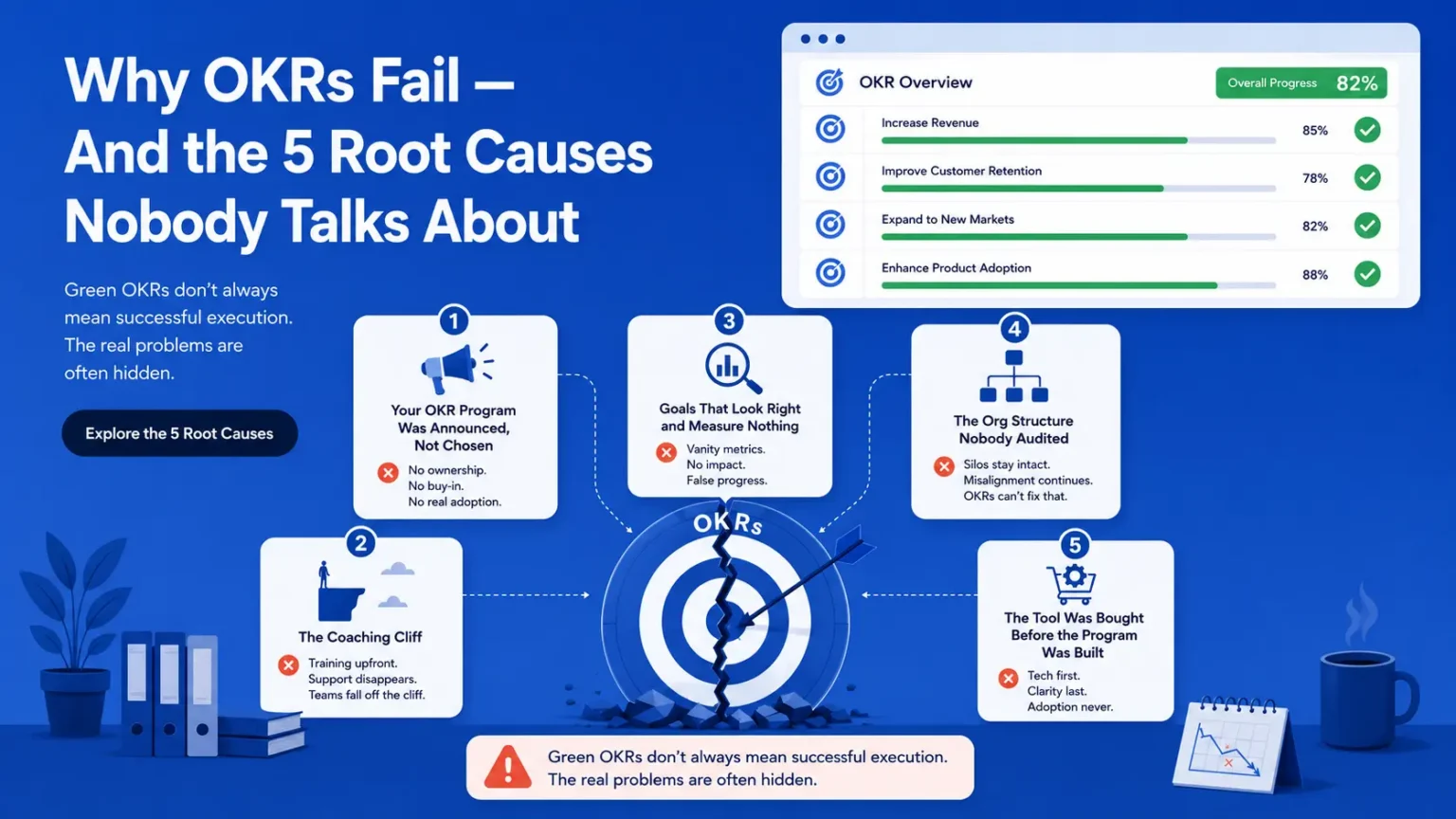
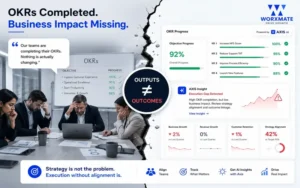
“Our teams are completing their OKRs. Nothing is actually changing.”
That is not an OKR problem. That is a much older problem dressed in OKR language. And it is the exact reason I want to explore why OKRs fail in this article.
Across 10 years of OKR implementation — 50+ organisations, enterprise to startup, across APAC, the Middle East and Europe — I have watched companies pour genuine energy into OKR programs and walk away with dashboards full of green circles and businesses that have not moved. The difference is never the framework. It is never the software. It is almost always one of a handful of failure modes that show up so consistently, across so many different industries and leadership cultures, that I now look for them in the first week of every new engagement — before a single OKR is written. Read more in our OKR how-to guides for the implementation steps that prevent these failure modes from taking hold.
About the Author
I am Madhusudan Nayak — Maddy to most people I have worked with over the last two decades. I spent 20+ years in strategy execution before I wrote a single OKR with a client. For the last 10 years I have led OKR coaching programs inside enterprise organisations, high-growth SMBs and early-stage startups. I have trained 500+ leaders across more than 10 industries. Before co-founding Worxmate, I served as Business Head at Profit.co — part of the journey from zero to $11 million in funding. Everything in this article comes from that experience. Not from research. From being in the room when things broke.
Root Cause 1: Why OKRs Fail When They Are Announced, Not Chosen
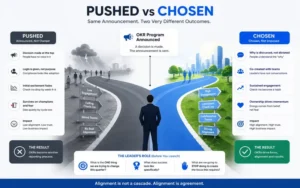
Here is how the majority of OKR programs begin. A CEO attends a conference, reads a book, or watches a competitor announce that they are running OKRs. A decision is made. An announcement follows. A platform is purchased. A go-live date is set. And on that date, hundreds or thousands of people receive a login and an instruction to write their OKRs.
What happens next is entirely predictable. Adoption looks reasonable in weeks one and two — because compliance looks like adoption when you cannot yet tell the difference. By week four, check-in rates are dropping. By week six, the program is surviving on the energy of the internal champion and the fear of the quarterly review. By cycle two, it is quietly dying.
Not because the people were resistant. Not because OKRs do not work. Because nobody answered the question every single employee was silently asking from the moment the announcement landed:
What is in it for me?
I call it the pushed vs chosen test. A pushed OKR program is one where the decision was made above the people who have to live it. A chosen OKR program is different — the organisation was sensitised. Leaders at every level had real conversations about why the company was adopting this framework, what problem it was solving, and what it meant specifically for their team.
I saw this as clearly as I have ever seen it in a fast-growing retail company in APAC — aggressive expansion mode, hiring leadership at every level. In the first session, I invited the CEO to share his top three priorities so the leadership team could begin writing their OKRs. Forty-five minutes passed. He could not define them clearly. What followed was a two-day war room session before a single OKR could be written.
The right lesson from that story: if the CEO cannot define the top three priorities of the business in a focused conversation, nobody below him can write a goal that genuinely connects to those priorities. Sensitisation is not a training session. It is a real conversation at the top of the organisation that forces the clarity that cascading demands — before the cascading begins.
What to do about it
Before your OKR program launches, the CEO or most senior leader needs to answer three questions clearly enough that anyone in the organisation could understand them: What is the one thing we are trying to change this quarter? What does success look like specifically? And what are we going to stop doing to create the focus this requires?
Until those questions have clean answers, no OKR program will produce genuine alignment. Because alignment is not a cascade. Alignment is agreement. And you cannot agree on something that has not been clearly stated. Do not launch the software until this is done.
Root Cause 2: The Coaching Cliff
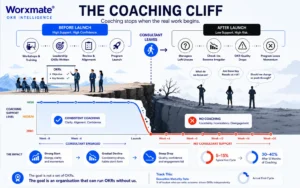
The majority of OKR programs that fail do not fail because the organisation was resistant to change. They fail because the coaching stopped at exactly the moment the real work began.
I call this the Coaching Cliff.
A consultant is engaged. Workshops are run with the leadership team. The C-suite writes their OKRs. The consultant reviews the goals, runs a final alignment session. The program looks solid. The invoice is paid. And then the consultant leaves.
What follows — in the weeks and months after that departure — is where OKR programs actually live or die. Every manager needs to run a meaningful check-in conversation every week. Every team lead needs to make a real-time judgment about whether a Key Result is at risk. Every department head needs to decide whether a goal should be renegotiated or pushed through. None of that was covered in the workshop.
I have walked into enough failed OKR programs as the second or third consultant to know exactly what the archaeology looks like. The C-suite OKRs from cycle one are usually well-written. Go one level down, and the quality drops. Go one more level to the manager layer — and in the worst cases, the OKRs exist only because someone was told they had to exist.
Showing a leadership team how to write OKRs is showing them the path up the mountain. Teaching them to climb is an entirely different engagement.
The goal of an OKR coaching program should not be a set of well-written goals at the end of cycle one. The goal should be an organisation that can run cycle two — and cycle three — with materially less external support than cycle one required.
What to do about it
Before you engage any OKR consultant, ask one question: what does this engagement produce at the end that did not exist at the beginning? If the answer is a set of OKRs, walk away. The right answer involves named individuals inside your organisation who can run a check-in conversation, quality-review a Key Result, and facilitate a retrospective — without external support.
The metric to track is what I call the Execution Maturity Rate — the percentage of leaders who can independently write a genuine outcome-driven goal without coaching support. In a typical first-cycle implementation this sits between 5% and 15%. In well-coached organisations after 12 months, it reaches 30% to 40%. Our OKR consulting programs are structured around moving that number — not just delivering a workshop.
Root Cause 3: Goals That Look Right and Measure Nothing
There is a specific kind of OKR failure that is harder to diagnose than the others because on the surface, everything looks fine. The check-in rates are reasonable. The goals are updated. The quarter-end scores are mostly green. And yet the business has not moved.
This is the output trap.
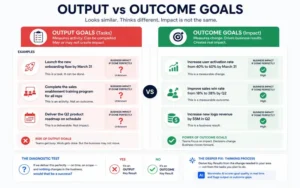
A leadership team sits down to write their Key Results. They have been through the training. They understand — in theory — that Key Results should be measurable outcomes, not tasks. And then they write things like this:
- “Launch the new onboarding flow by March 31”
- “Complete the sales enablement training program for all reps”
- “Deliver the Q2 product roadmap on schedule”
Every single one of those is a task. Something that can be completed regardless of whether it changed anything in the world. Launch the onboarding flow — done. Did it improve activation rates? Unknown. The Key Result does not require you to find out.
I encountered this in one of the clearest forms I have ever seen it inside a large IT services organisation — 70,000+ employees. The leadership team had a history of strategic meetings that were consistently frustrating. People in the room with no real answers. No visibility into what was blocking progress. What became clear quickly: these were sharp people who had spent their careers delivering things. They were exceptionally good at outputs. The concept of an outcome was not how they had been trained to think.
The intervention that shifted this was not a longer explanation of what outcome-based Key Results are. It was a game. I asked the leadership team to look at goals from their own business some output-led, some outcome-driven — and identify which was which. The moment the room started debating whether “launch the new pricing model” was an output or an outcome was the moment the thinking shifted. This is a specific example of why OKRs fail; it wasn’t a skill issue, but a thinking issue.
Output Key Results are not inherently bad. The problem is not that teams write them. The problem is that they cannot tell the difference between the two types — and therefore cannot use them correctly.
The diagnostic question
Run every Key Result through this test: if your team delivers this perfectly — on time, on scope — and nothing changes in the business, would that be a success? If yes, you have written an output Key Result. Whether that is right depends on your situation. But you need to know which one you are writing, and why.
The deeper fix is the Thinking Process — teaching leaders to derive their Key Results not from what they plan to do, but from reading their manager’s goals and asking: what would have to change in my area for that goal to move? Worxmate’s AI-assisted goal writing is built specifically around this scoring goal quality in real time and surfacing the output-vs-outcome gap before the cycle begins.
Root Cause 4: The Org Structure Nobody Audited
This is the root cause that I have never seen addressed in any OKR book, any certification program, or any consultant’s standard engagement framework. It comes from 20 years of strategy execution work — not from learning OKRs.
The root cause: the organisation is trying to cascade goals through a structure that was not designed to deliver the strategy it is now pursuing.
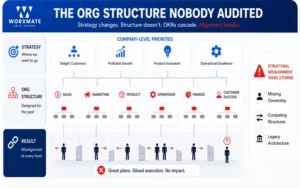
An organisation designs its structure at a particular point in time, in response to a particular set of priorities. Then the strategy changes. The structure does not. And then, without changing the structure, they introduce OKRs. Each function writes OKRs that reflect their structural mandate. The strategic priority — the one that requires all of them to work differently together — sits as a company-level Objective with no structural home below it.
The cascade looks complete. The alignment map looks connected. And the strategy fails to execute — not because the goals were poorly written, but because the organisation was never structured to deliver them.
The structural misalignment problem takes three common forms:
- Missing ownership: A strategic priority exists that no single function fully owns. Customer experience is the most common example.
- Competing structures: Two functions are incentivised to optimise for different outcomes that are in tension with each other.
- Legacy architecture: The organisation is structured around how the business was built, not how it needs to grow.
What to do about it
Before your next OKR cycle begins, run a structural audit against your strategic priorities. For each company-level priority, ask: which function owns the outcome? Not contributes to it — owns it. If the answer is “everyone,” you have identified a structural gap. That gap will not be resolved by writing a better OKR.
Worxmate’s Nexus Organisational Intelligence model maps structural alignment across the organisation — identifying where cascade health is breaking down, where cross-functional dependencies are creating friction, and where the organisation’s design is working against its strategic priorities.
Root Cause 5: The Tool Was Bought Before the Program Was Built
This is the root cause that the OKR software industry will never write about, but it is a primary reason why OKRs fail in the real world.
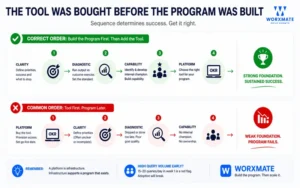
The sequence is remarkably consistent: a decision is made to implement OKRs. Demos are scheduled. A platform is purchased. Licences are provisioned. A go-live date is set. And somewhere in that entire sequence, the most important work never happened.
Nobody defined what a good OKR looks like for this organisation. Nobody ran the output-vs-outcome diagnostic. Nobody identified the internal champion who would carry the program forward. Nobody answered the question every employee would be asking from day one. The platform arrived. The program did not.
There is a signal I watch for in the first week of any implementation: query volume. If the team is raising 15 to 20 support queries per day in week one, adoption is going to break within the next few weeks. Not might break — will break. High query volume tells you the tool has more complexity than the team’s current level of OKR literacy can absorb. By week four, the queries drop — not because the confusion has been resolved, but because the team has stopped trying.
A platform is infrastructure. Infrastructure serves a program that already exists. Infrastructure for a program that does not yet exist is just cost and complexity.
The sequencing that actually works looks like this:
- Clarity first: What are we trying to change? What does success look like specifically? What are we going to stop doing?
- Diagnostic second: Run the output-vs-outcome exercise with the leadership team using their own business scenarios before anyone writes a goal in any system.
- Capability third: Identify and develop the internal champion who will carry the program independently. Before the platform goes live.
- Platform fourth: With the above conditions in place, the platform evaluation becomes a genuinely useful exercise — because you now know what you need the platform to do.
The organizations that get this sequencing right almost always succeed with OKRs. If you are mid-implementation and recognizing your organization in this description, the sequencing can be corrected. Our OKR consulting programs are built for both scenarios — first-time implementations and recovery programs where a failed implementation needs to be diagnosed and rebuilt on a foundation that will hold.
How to Know If Your OKR Program Is Actually Working
Most organisations measure OKR program success the wrong way. They track goal completion rate. They count check-in compliance. These are process metrics — they tell you whether the activity happened, not whether it changed anything.
Here is the only metric that matters in the long run: what percentage of your leaders can independently write a genuine outcome-driven goal today — without a coach in the room, without a template?
I call this the Execution Maturity Rate. In a typical first-cycle implementation it sits between 5% and 15%. In organizations running a well-coached program for twelve months, it reaches 30% to 40%. That movement is the only honest evidence the program has produced something durable.
Track that number from cycle one. Set a target for where it should be in twelve months. Build your coaching investment and platform selection around moving it. Everything else is a proxy.
Where to Go From Here
f you have read this far, you have likely recognized your organization in at least one of these root causes. Understanding why OKRs fail is the first step to fixing them. Most organizations that have struggled with OKRs will recognize two or three. That is not a failure of the framework. It is a failure of the conditions the framework was implemented into. And conditions can be changed.
If you need to get the implementation right — clarity before software, diagnostic before goals, capability before platform — our OKR consulting programs are structured specifically around that sequencing. The engagement does not end when the C-suite’s OKRs are written. It ends when your organization can run cycle three without us.
If you are ready to evaluate the platform — and the conditions above are in place — Worxmate was built directly from the failure modes in this article. Every feature exists because a real organization experienced a real version of one of these problems. The DEEP AI™ framework — Define, Execute, Evaluate, Plan — is the architecture of the product, not a marketing layer on top of a goal-tracking tool.
Explore pricing, book a demo, or read more in our OKR how-to guides before making any decisions.
The software is the infrastructure. The coaching is the capability. Get both right — in the right order — and OKRs work. Every time.


Written by
An OKR Coach with 20+ years of implementation experience, Madhusudan has guided over 50 organisations through successful OKR transformations, training more than 500 leaders. Learn more about Worxmate.