WORXMATE
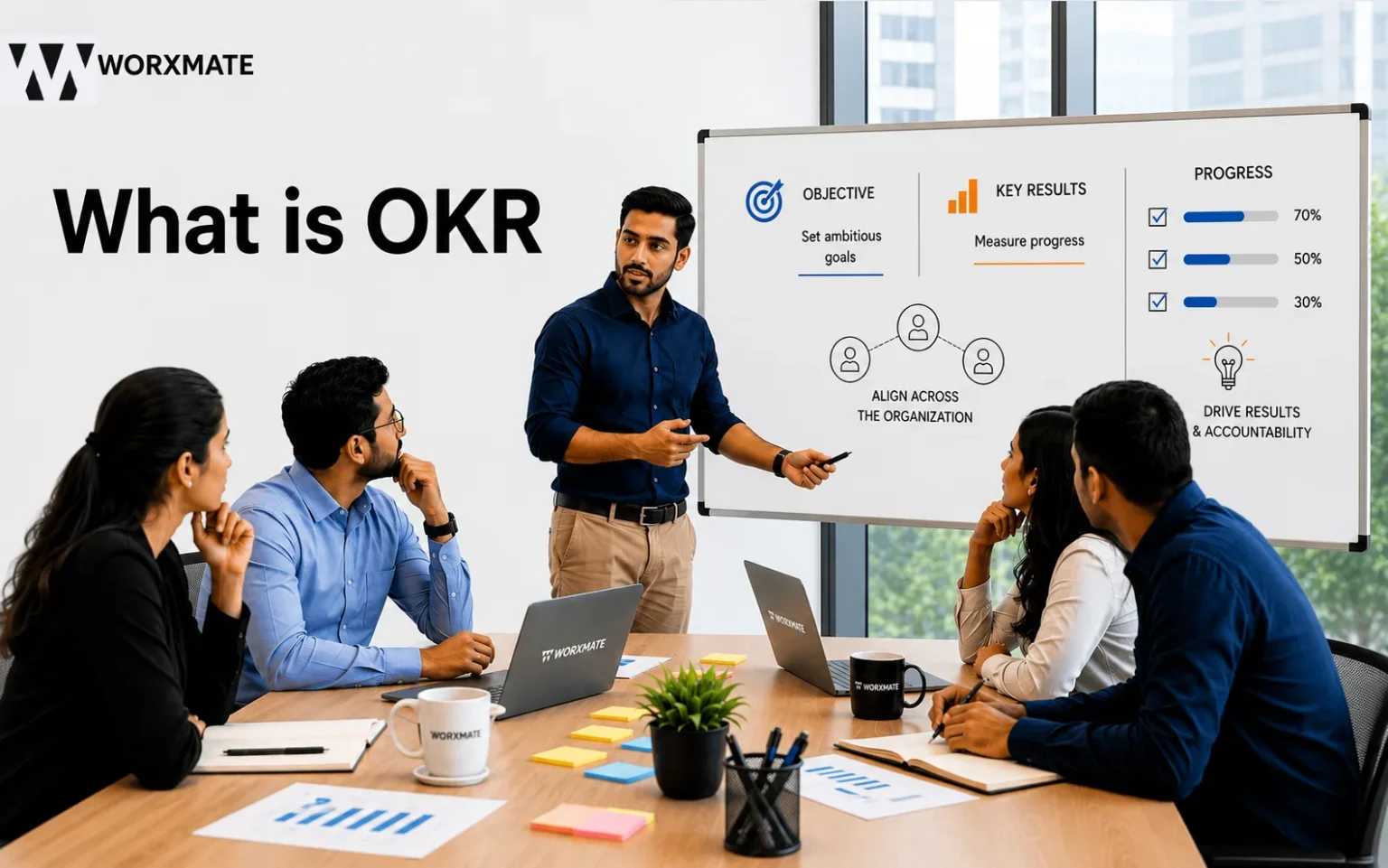
What is OKR?
An OKR (Objectives and Key Results) is a goal-setting framework that pairs a qualitative objective what you want to achieve with a small set of measurable key results that define how you’ll know you’ve achieved it. The format is deliberately simple: one sentence, one number.
What’s not simple is getting an organisation to write objectives that describe outcomes instead of activity which is where most OKR programs quietly break. I’ve watched this exact gap sink a program before it even started: forty-five minutes into the first alignment call, a CEO running a fast-growing retail company across APAC still couldn’t name his top three priorities. Not from a lack of opinions about where the business needed to go he had plenty. He’d simply never had to compress that vision into three outcomes an entire organisation could cascade from. The call ended without a conclusion. It took a two-day war room before a single OKR got written. That gap between having a strategy and being able to state it as something a team can execute against is the actual problem OKRs exist to solve. Everything else is implementation detail.
I’ve spent 10 of my 20+ years in strategy execution specifically inside OKR implementations more than 50 organisations across IT services, fintech, retail, energy, manufacturing and telecom, and over 500 leaders trained directly. This article covers what an OKR actually is, where the framework came from, how it differs from KPIs and SMART goals, and because a definition alone won’t tell you this why the majority of OKR programs stall out within a year of launch.
What Does OKR Stand For?
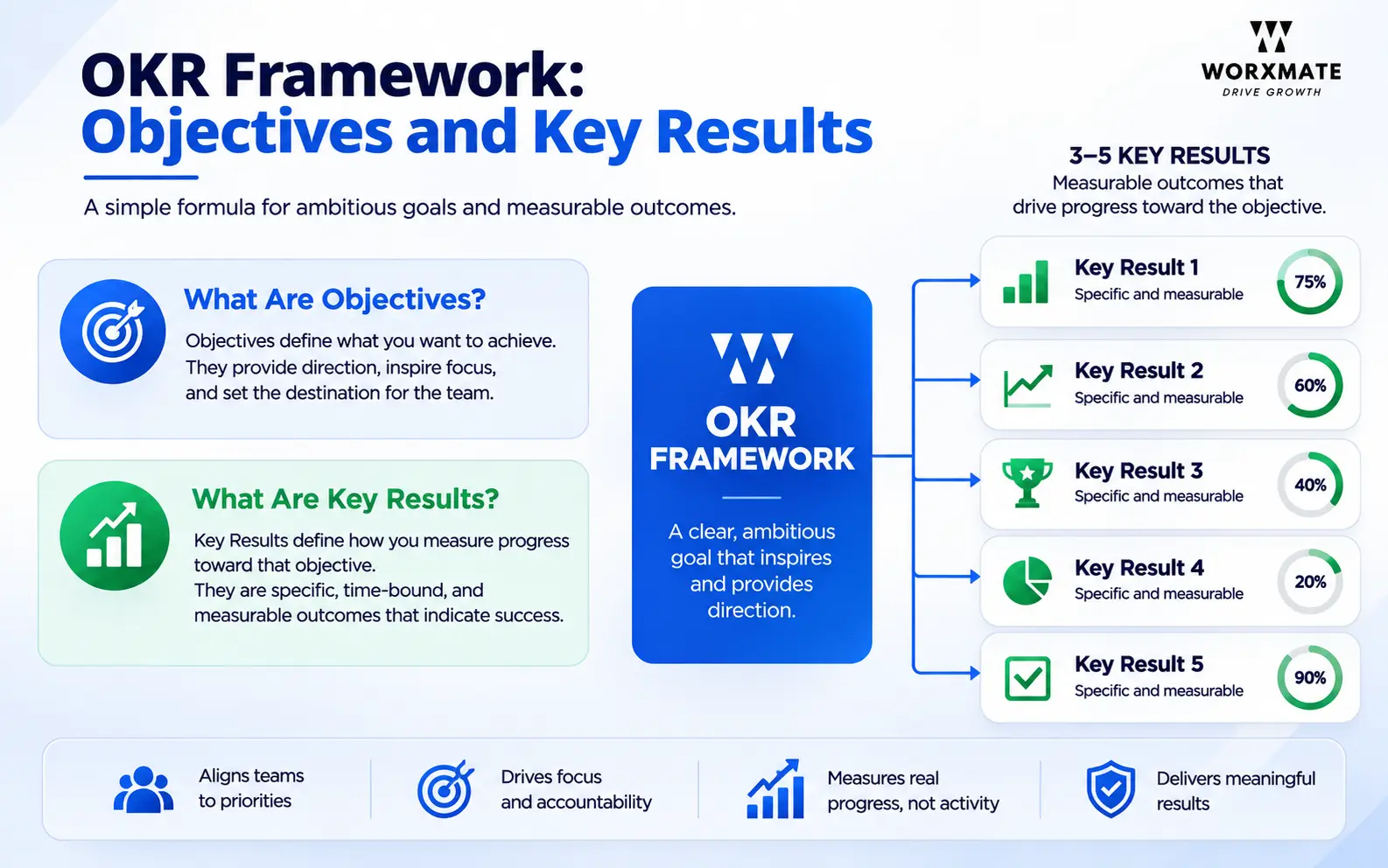
OKR stands for Objectives and Key Results. The name describes the entire mechanic: an Objective is the destination, Key Results are the coordinates that prove you arrived.
The OKR Formula
Every OKR follows the same structure:
“I will [Objective] as measured by [Key Results].”
The objective is short, direction-setting, and written in plain language. The key results are specific, numeric, and time-bound. If a key result can be hit without the objective actually being true, it’s not a real key result it’s a task wearing a KR’s clothes.
What Are Objectives? What Are Key Results?
What Makes a Good Objective
A good objective is clear enough that someone outside the team could read it and understand what “done” looks like in direction, if not in number. It should be ambitious enough to require real change in how the team works, not a restatement of business-as-usual. And it should trace back to something the organisation has actually decided matters this cycle not a department’s default agenda.
What Makes a Good Key Result
A good key result is a number that moves because reality changed, not because someone updated a spreadsheet. It’s specific, it’s verifiable without argument at the end of the cycle, and it’s aggressive enough that hitting it required a real decision, not routine execution. Three to five key results per objective is the practical ceiling beyond that, you’re tracking activity, not outcomes.
Where Did OKRs Come From? A Short History
Andrew Grove and Intel
The OKR framework is generally attributed to Andrew Grove, who built it at Intel in the 1970s and documented it in his 1983 book High Output Management. Grove’s version was called iMBO Intel Management by Objectives and it was built around the same core idea that survives today: objectives without a measurable result attached are just intentions.
John Doerr and Google
John Doerr encountered the framework as a young Intel salesperson sitting in one of Grove’s courses in 1975. Two decades later, working at Kleiner Perkins, Doerr introduced OKRs to a 40-person startup called Google in 1999. The framework scaled with the company and became one of the most publicly documented management systems in Silicon Valley which is also why “what is an OKR” so often gets answered with “the thing Google uses,” when the more useful answer is the mechanic underneath it.
OKR vs KPI vs SMART Goals: What’s the Difference
This is the question almost everyone learning OKRs asks next, and it’s worth answering precisely instead of vaguely.
OKRs vs KPIs
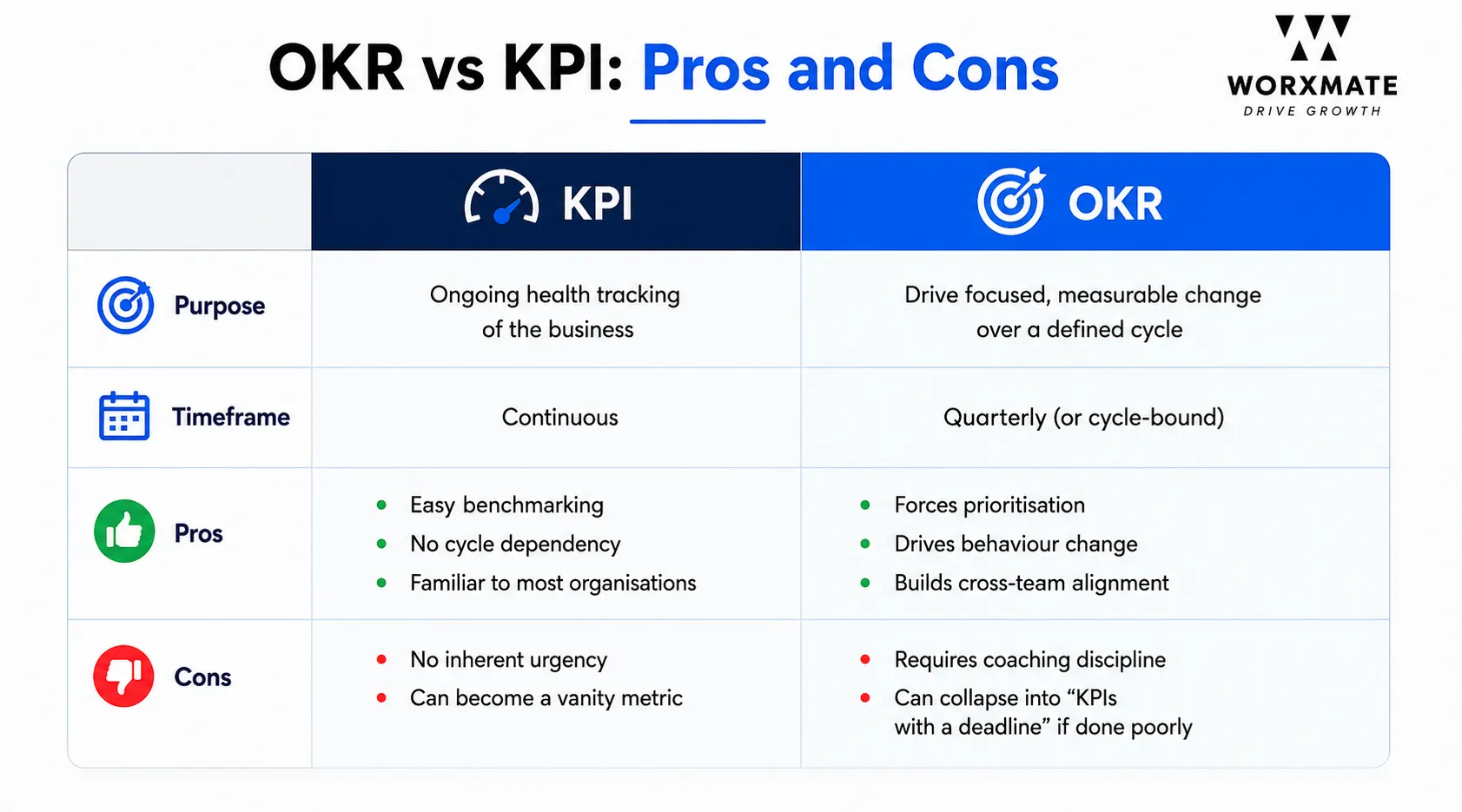
A KPI (Key Performance Indicator) is a metric you monitor on an ongoing basis revenue, churn, uptime, response time. It tells you the health of something that’s already running. An OKR is a temporary, cycle-bound commitment to change a specific outcome. KPIs are the dashboard. OKRs are the decision to move one of those dials on purpose, for one cycle, because it matters more than the others right now.
Weighing the OKR vs KPI pros and cons comes down to this: KPIs give you continuity the same numbers, tracked the same way, quarter after quarter, so you always know where you stand. OKRs give you direction a forcing function that says this number, specifically, needs to move this cycle, and here’s what proves it did. The tradeoff is real. Lean only on KPIs and you get visibility without urgency; nothing ever demands to change. Lean only on OKRs and you lose the baseline that tells you whether last quarter’s win is holding.
In my experience across implementations where this distinction wasn’t made clear early, teams write “KPIs with a deadline” and call them OKRs a target that sits comfortably inside normal operating range instead of one that requires a real change in behaviour. The OKR vs KPI pros and cons only resolve once a team understands that these aren’t competing systems: one measures the business as it runs, the other decides what has to change about it right now.
See also: OKR vs KPI: The Full Comparison
OKRs vs SMART Goals
SMART goals (Specific, Measurable, Achievable, Relevant, Time-bound) are a goal-writing quality standard, not a system. You can and should write SMART key results. But SMART goals don’t distinguish between an objective and the evidence for it, and they don’t have OKRs’ cadence of short cycles, transparent visibility, and cross-team alignment built in. Think of SMART as a checklist you run against a single goal. Think of OKRs as the operating system that decides which goals get written in the first place and how the whole organisation sees them at once. If you’re still setting individual SMART goals for employees alongside OKRs, that’s not a conflict a well-written Key Result often is a SMART goal; the OKR is just the layer that tells you which ones are worth writing in the first place.
Want to get better at writing the SMART goals underneath your OKRs? How to Set SMART Goals: 15 Examples walks through the mechanics in more depth than makes sense to repeat here.
See also: SMART Goals vs OKRs: The Full Comparison
Committed OKRs vs Aspirational OKRs
Not every OKR is meant to be finished. This distinction alone prevents a lot of unnecessary conflict during scoring.
When to Use Committed OKRs
Committed OKRs — sometimes called roof-shot goals are expected to hit 100%. They represent the work that must happen this cycle regardless of appetite for risk: compliance deadlines, committed customer deliverables, foundational infrastructure. Organisations under financial pressure or operating in regulated environments tend to lean more heavily on committed OKRs, because the cost of missing one is immediate.
When to Use Aspirational (Moonshot) OKRs
Aspirational OKRs — moonshots, stretch goals, 10x goals are intentionally set beyond what the team expects to fully complete. A team landing at 70% on a genuinely aspirational OKR has often produced more real progress than a team hitting 100% on a safe one. The risk is teams quietly writing moonshot language around committed-goal ambition, so nobody has to have the harder conversation about what “stretch” actually requires. Most organisations run a blend a few committed OKRs to protect what must happen, one or two aspirational OKRs to protect what could happen.
Why OKRs Exist — The Problem They’re Built to Solve
-
The Alignment Problem
Without a shared, visible objective, every team quietly optimises for its own definition of progress. Marketing chases leads. Product chases velocity. Sales chases anything closable this quarter. None of it is wrong on its own, and none of it adds up to the same outcome. OKRs force the organisation to write down, in public, what actually matters this cycle which is the only way cross-functional dependencies get surfaced before they become a crisis in week ten instead of a conversation in week one.
-
The Focus Problem
Most teams don’t fail from lack of effort. They fail from having eleven priorities that are all “top priority.” A recommended ceiling of 2–4 objectives per team, with 3–5 key results each, isn’t a stylistic preference it’s a forcing function. If your OKR list runs past five, you haven’t prioritised yet. You’ve just made a longer to-do list and called it strategy.
-
The Accountability Problem
A bottom-up OKR process — where teams write their own key results against leadership objectives, rather than receiving a fully cascaded list surfaces frontline knowledge leadership rarely has visibility into. Senior leaders typically see a small fraction of the problems actually happening on the ground. An OKR process that only flows top-down never captures that fraction; one that lets teams write against the objective, in their own language, does.
Why Most OKR Programs Fail in Year One
Here’s the part most explainer content skips, because it’s easier to describe the framework than to admit how often it doesn’t work.
The Execution Maturity Rate
Goal completion rate is the metric every dashboard shows, and it’s close to meaningless. A team can complete 80% of its OKRs and produce no material change in the business if those OKRs were never genuinely outcome-driven to start with. The metric that actually tells you whether a program is working is what I call the Execution Maturity Rate — the percentage of leaders who can independently write a genuine outcome-driven OKR without coaching, without a template, and without a quality review. In a typical first-cycle implementation, that number sits between 5% and 15%. In organisations that run well-coached programs consistently for 12 months, it climbs to 30–40%. That climb not the completion percentage is the real signal.
Worxmate tracks this metric across its client base in the OKR Execution Maturity Framework: 2026 Benchmark, if you want to see how your organisation’s maturity curve compares to the 5–15% / 30–40% range.
The Coaching Cliff
The most common failure pattern isn’t a bad framework — it’s coaching that stops at the C-suite. Leadership gets trained, writes strong OKRs, and the program is declared launched. Then it’s handed to middle management, who were never taught how to run a real check-in, challenge a soft key result, or surface a blocker honestly, and the program dies quietly within a quarter below the leadership layer. I call this the Coaching Cliff, and it predicts OKR program failure more reliably than any feature comparison between software tools. The organisations that get past it are the ones that treat coaching as a program requirement at every layer, not a leadership perk.
How to Write an OKR: Step-by-Step
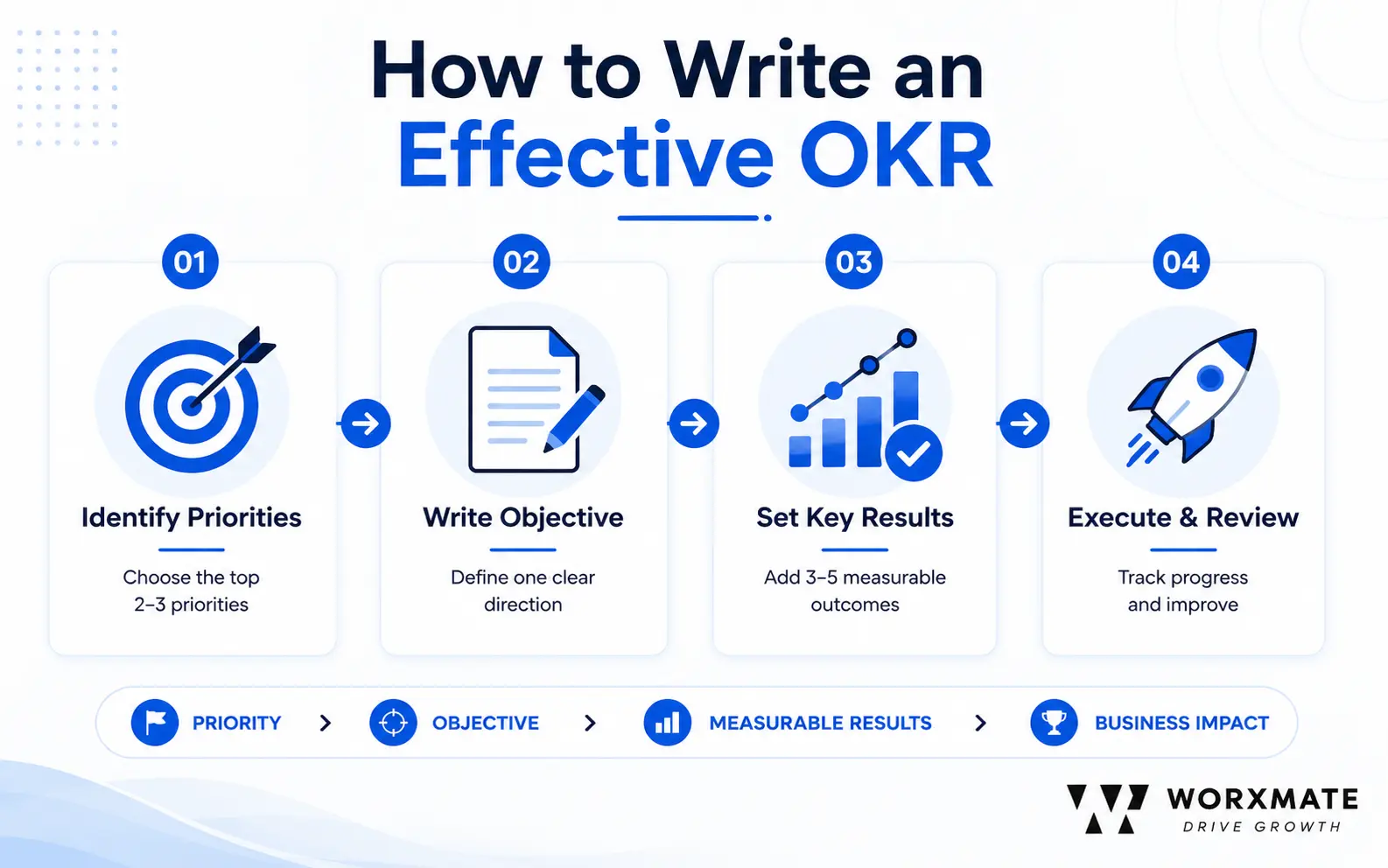
Step 1: Identify 2–3 Priorities Before Writing Anything
Before an objective gets written, ask what would make the biggest difference this cycle, and what needs to change from where things stand today. If the honest answer list runs past five, narrow it before moving on an OKR built on an unprioritised list inherits that lack of focus permanently.
Step 2: Write the Objective
Convert the priority into a short, direction-setting statement. It should be concrete enough to guide decisions and ambitious enough that achieving it requires something to actually change.
Step 3: Write 3–5 Key Results
For each objective, write the measurable evidence that would prove it’s true. Each key result should be independently verifiable at the end of the cycle — no debate, no interpretation required.
A Worked OKR Example
Objective: Make our product demo the reason deals close, not the reason they stall.
Key Results:
- KR1: Raise demo-to-close conversion from 18% to 30%
- KR2: Cut average sales-cycle length from 45 to 30 days
- KR3: Reduce demo-stage drop-off from 25% to 10%
Notice the objective describes a change in outcome demos causing closed deals not an activity like “improve the demo deck.” The key results are the only proof that the objective actually happened.
The OKR Cycle: Weekly Check-ins, Quarterly Reviews, Annual Planning
OKRs run on a nested OKR cadence, not a single deadline. Most organisations set quarterly OKRs underneath an annual strategic planning, so short cycles stay connected to long-term intent instead of drifting quarter to quarter. Inside the quarter, weekly check-ins keep key results current a five-minute update on status and blockers, not a status meeting. At the end of the quarter, a retrospective scores each key result honestly and asks what should carry into the next cycle and what shouldn’t. Skipping the retrospective is the fastest way to turn OKRs into a scoring ritual instead of a learning one.
OKR Examples by Team
| Team | Objective | Key Results |
| Marketing | Build a brand recognised as the category’s clearest voice | Grow qualified organic traffic by 40%; land 3 earned media features; run 2 webinars with 500+ registrants |
| Sales | Grow revenue without growing acquisition cost | Close $1M in new deals; lift upsell rate to existing accounts by 20% |
| Product | Make reliability a competitive advantage, not a support ticket | Cut critical bugs by 50%; hit 99.9% uptime |
| HR | Turn engagement scores into a retention advantage | Raise engagement score from 70% to 85%; hit 95% survey participation |
Want role-specific inspiration beyond these four? Each team’s OKRs get more nuanced once you’re past the basics:
- 10 OKR examples for marketing heads, covering brand awareness through to lead generation
- OKR examples for sales heads, built around revenue and pipeline velocity
- 10 simple OKR examples for product managers, from reliability to roadmap delivery
- 10 HR OKR examples, spanning retention, engagement, and talent acquisition
OKR Case Studies: What Implementation Actually Looks Like
The framework above is straightforward. What it looks like inside a real organisation is messier, and more useful to see honestly.
At a 70,000-person IT services company, the leadership team under one SBU head could describe their business in detail but couldn’t say what was actually blocking progress. The turning point wasn’t a slide deck it was a live exercise using their own real business scenarios to separate output-led goals from outcome-driven ones. Once that gap was visible, leaders wrote OKRs against 2–3 real BU-level priorities in the room, in real time. Two to three quarters later, they could identify root causes fast enough to act on them and had cut initiatives that consumed effort without producing outcomes.
At a European fintech startup around 100 people, the CEO and CPO were fluent in metrics but couldn’t articulate outcomes. Every goal was KPI-shaped activity that produced numbers without clarity on what needed to change. The unlock was a single question: “What’s the one big thing you want to resolve?” The answer was the product demo experience. A Product Lead and an Account Executive were then made jointly accountable for one shared key result cross-functional co-ownership that hadn’t existed there before, and it forced a dependency conversation the organisation had never had.
Common OKR Mistakes (and What They Cost You)
Writing OKRs as a list of tasks with numbers attached is the most common mistake it makes a program look like it failed when it was never outcome-driven to begin with. Close behind it: writing too many objectives because nobody was willing to say no to a competing priority, which quietly recreates the exact lack of focus OKRs were meant to fix. A third: letting fear of failure shape the key results themselves leaders who worry that missing an ambitious target reads as poor performance tend to write safe, easily completable key results and call them stretch goals. And the mistake with the longest tail: stopping coaching at the C-suite and assuming the framework will cascade on its own. That’s the Coaching Cliff again, and it’s why a well-designed framework can still produce a program that quietly stops working by month four.
Do You Need OKR Software?
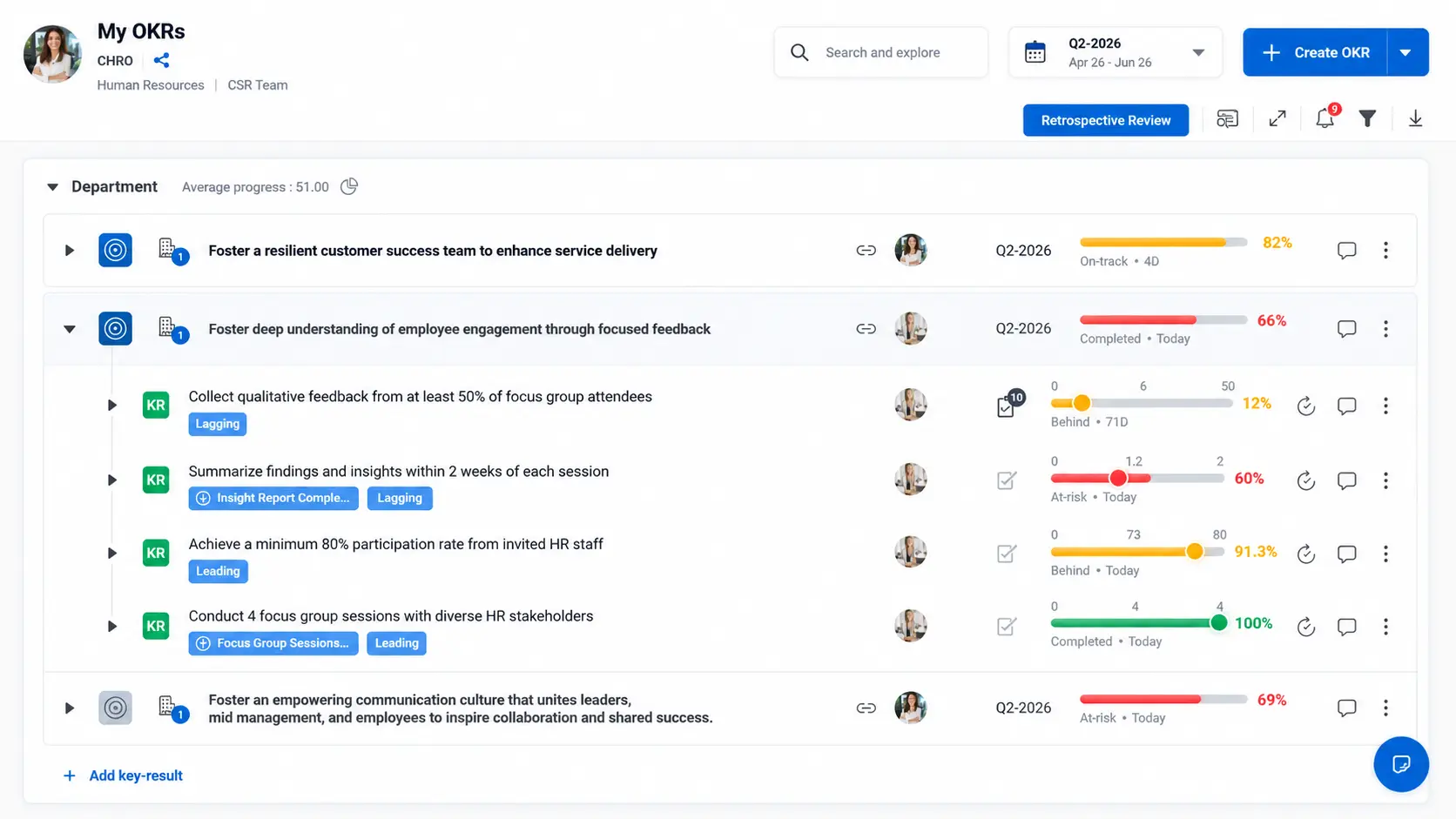
A spreadsheet can hold OKRs for a single team for a single quarter. It cannot hold cross-functional dependency visibility, at-risk detection before a deadline, or a defensible historical record of what got learned across cycles the things that actually make a program improve year over year instead of restarting from zero each time. Platforms built specifically for OKRs treat the OKR as the product, not a feature bolted onto an HR system. That distinction matters more the moment you’re running this across more than one team.
If you’re still weighing this out, Spreadsheet vs OKR Software: What’s Better? walks through exactly where spreadsheets hold up and exactly where they break.
Where This Leaves You
An OKR is a simple structure — one objective, a few measurable key results. Getting the format right takes an afternoon. Getting an organisation to write outcome-driven objectives at scale, and keep writing them honestly cycle after cycle, is the actual work, and it’s where most programs quietly stall.
If you’re ready to run this in a system built for it rather than a spreadsheet — one with the dependency visibility and at-risk detection a growing OKR program needs — Worxmate’s OKR software is built around exactly that, and you can see it directly with a live demo.
If what’s missing isn’t the tool but the capability behind it — leaders who can write a genuine outcome-driven OKR without a template — that’s a coaching problem before it’s a software one, and it’s what Worxmate’s OKR consulting is built to close. The software is the infrastructure. The coaching is the capability. Most organisations need both, in that order.


Written by
An OKR Coach with 20+ years of implementation experience, Madhusudan has guided over 50 organisations through successful OKR transformations, training more than 500 leaders. Learn more about Worxmate.