 WORXMATE
Quick Answer
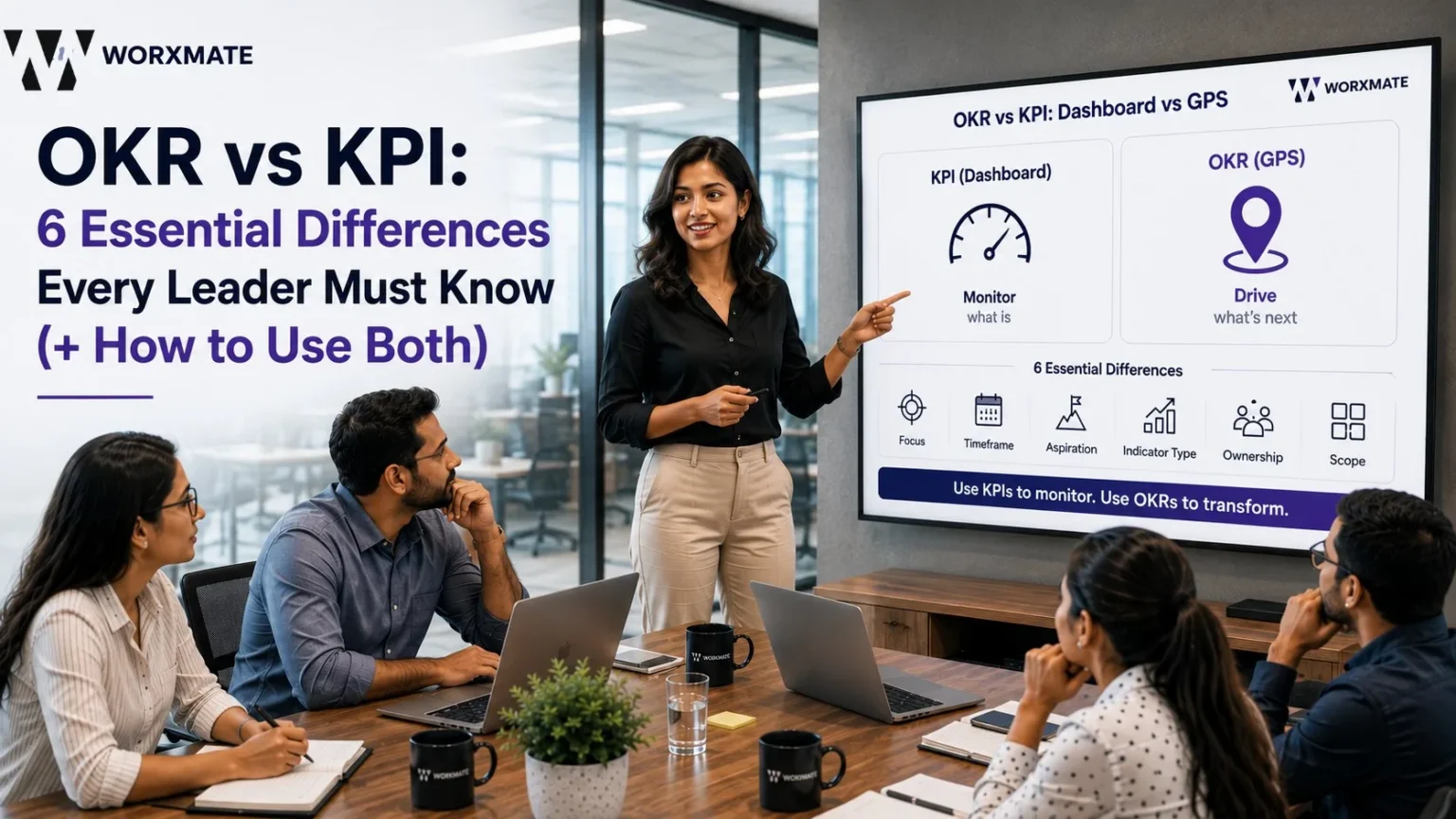
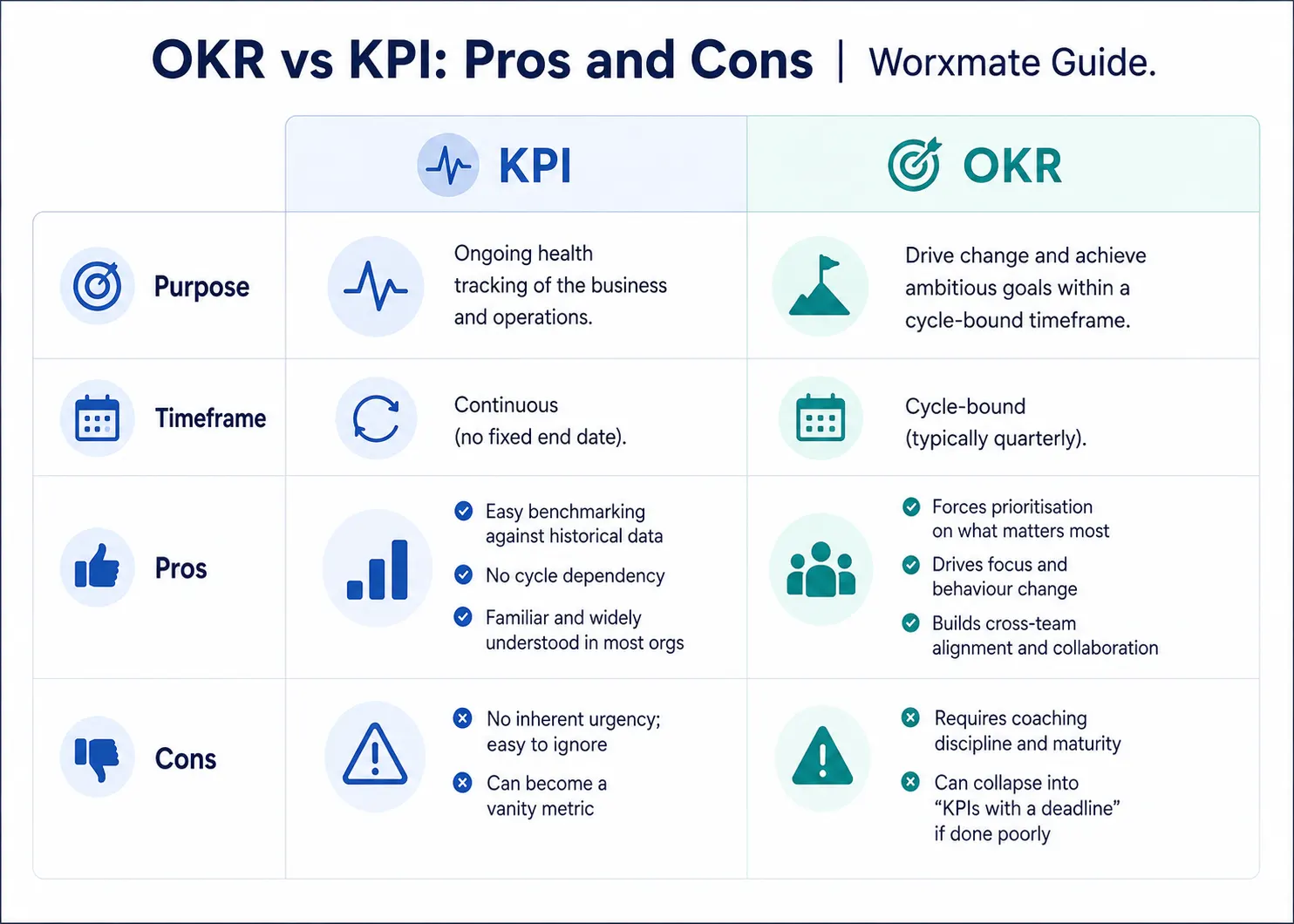
OKRs and KPIs measure different things, not competing versions of the same thing. A KPI (Key Performance Indicator) is an ongoing metric that tells you whether a process is healthy, like Monthly Recurring Revenue or Time to Hire. An OKR (Objectives and Key Results) is a time-bound framework that pushes a team toward a specific strategic change over a quarter. KPIs are the dashboard. OKRs are the GPS. In my experience coaching 50+ organisations through this, the ones that win run both, using KPIs to flag what’s broken and OKRs to fix it.
A few years ago I sat down with the CEO and CPO of a European fintech, around 100 people, generating revenue, trying to figure out why growth had stalled despite a wall of dashboards. Every number they showed me was a KPI. Ticket volume. Deal velocity. Feature releases per sprint. The room was full of activity, and none of it was clearly connected to what the business actually needed to change.
So I asked the question I ask every leader I coach in the first session: what’s the one big thing you’re trying to fix? For that CEO, it was product demo experience. We spent the next hour asking “so what” until a KPI on a dashboard turned into a real, owned outcome. That gap, between tracking a metric and committing to a change, is the entire OKR vs KPI question. Everything below is what I’ve learned answering it, across roughly 50 organisations, ten industries, and three continents, over the last ten years.
A quick note on where this comes from: I’ve spent 20+ years in strategy execution and the last 10 specifically coaching OKR implementations, across pharma, fintech, manufacturing, retail, IT services, energy and mining, in APAC, the Middle East and Europe. I built the DEEP AI™ framework (Define, Execute, Evaluate, Plan) out of that field work, and I still run 1:1 coaching sessions with leadership teams every week. What follows isn’t theory. It’s the pattern I watch repeat, industry after industry, when a team confuses a dashboard for a destination.
What Are OKR and KPI?
Here’s how I open this conversation with every leadership team on day one. A Key Performance Indicator (KPI) is a standalone metric used to evaluate the health of a process that’s already running. KPIs are retrospective by nature. A sales team tracking Monthly Recurring Revenue (MRR) isn’t trying to change how it sells, it’s confirming the business is financially sound.
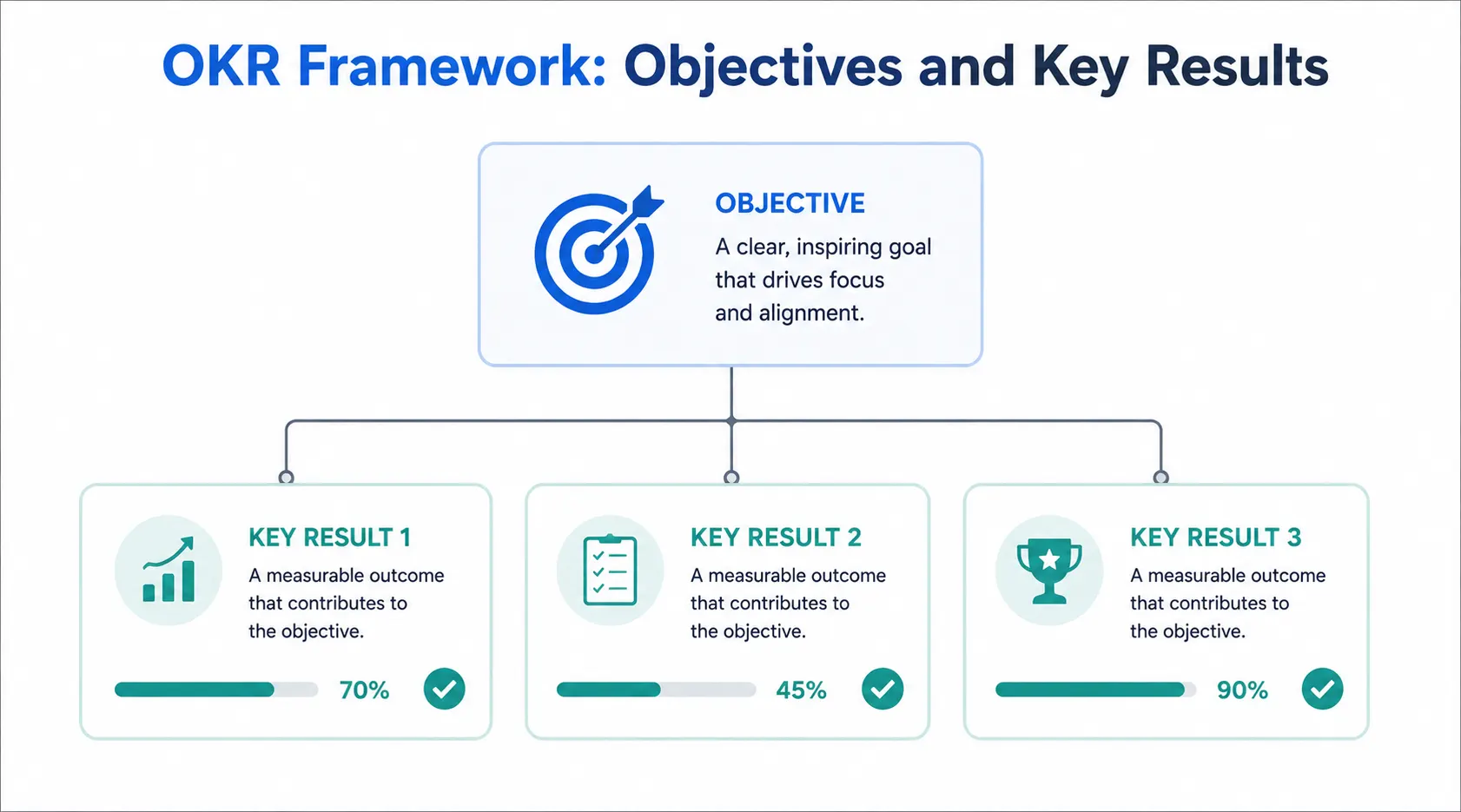
Objectives and Key Results (OKRs), the framework Google and Intel made famous, work differently. An OKR pairs a qualitative, inspirational Objective with a small set of quantitative Key Results that prove the objective was met. Where a KPI measures the result of a process, an OKR measures the process of deliberate change. Worxmate’s full breakdown of what an OKR is, with the framework and examples is worth reading if this is genuinely new territory for your team. John Doerr, who wrote Measure What Matters, frames OKRs as stretch goals that feel slightly out of reach, because that discomfort is what forces real innovation instead of incremental tuning.
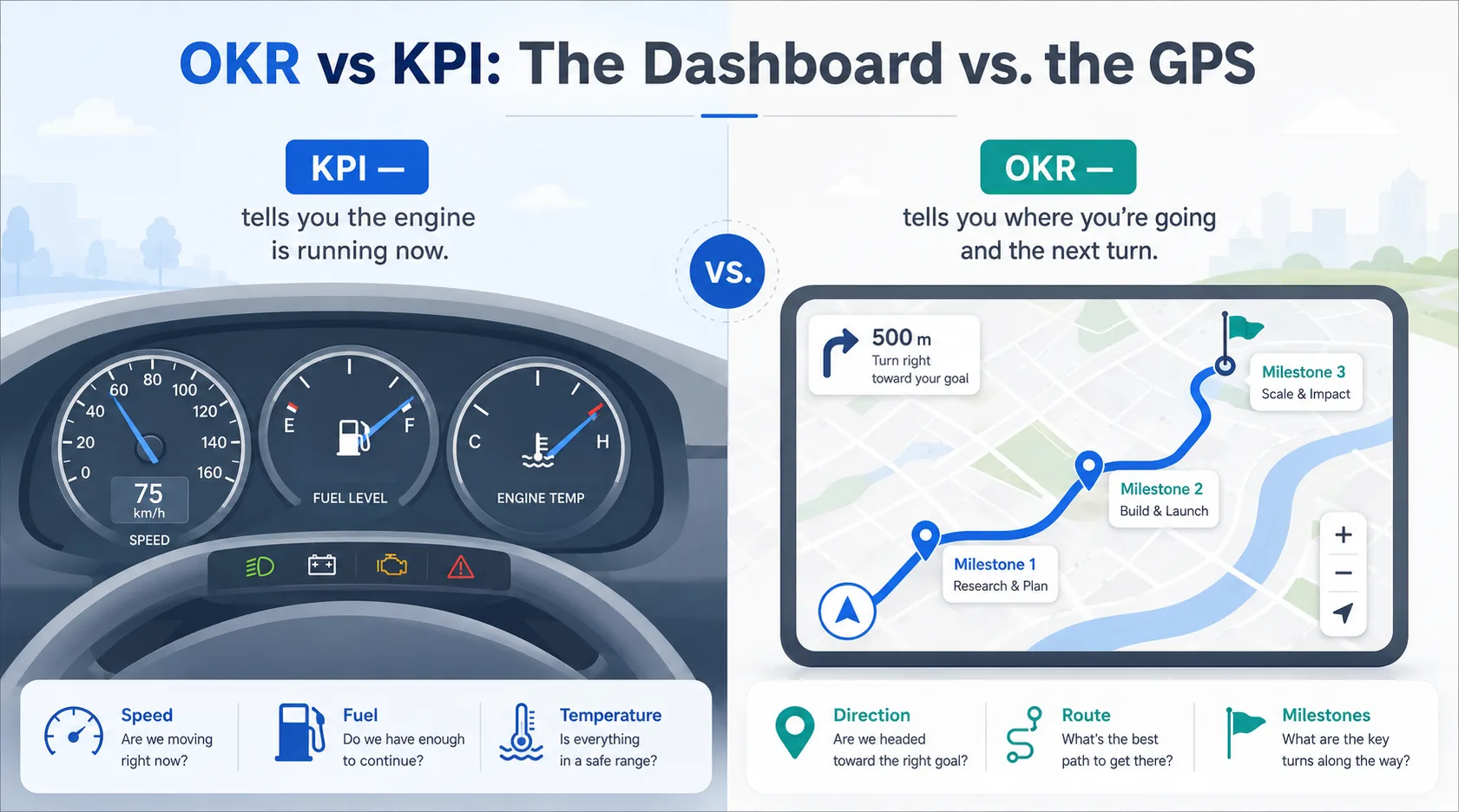
The analogy I use in almost every workshop: KPIs are your car’s dashboard, fuel level, speed, engine temperature, right now. OKRs are the GPS, telling you where you’re headed and the specific turns that get you there. I’ve never met a leadership team that needed convincing they need one or the other. Where they get stuck is realising they need both, at the same time, without confusing which is which.
What This Looks Like in Practice
When I coach a team through writing their first real OKR, this is the pairing I put on the whiteboard:
- Objective: Improve customer satisfaction: Key Result: Achieve an NPS of 75+ by end of quarter
- Objective: Improve customer satisfaction: Key Result: Cut ticket resolution time 20% vs. last quarter
- Objective: Drive revenue growth: Key Result: Grow sales revenue 15% year-over-year
A KPI doesn’t need an Objective attached to it at all. It just needs to be watched: Revenue, Customer Acquisition Cost (CAC), Employee Turnover Rate, Website Traffic. Worxmate has a full breakdown of what separates a real, measurable Key Result from a vague aspiration here: measurable goals.
In my experience, most first-cycle OKR failures aren’t conceptual, they’re formatting failures. A team understands what an OKR is supposed to do in principle, then writes a Key Result that’s really a task (“launch the new onboarding flow”) instead of an outcome (“cut time-to-first-value for new users from 9 days to 4”). I still catch this in almost every first workshop I run, regardless of how senior the room is.
6 Key Differences Between OKRs and KPIs
According to McKinsey, organisations that align their goals with strategic priorities are 1.4 times more likely to report successful performance management outcomes. I’ve seen that alignment start, or stall, right here, because it’s impossible to align a goal you can’t correctly classify as one or the other.
| Dimension | OKR | KPI |
| Primary focus | Strategic growth and transformation | Operational health and stability |
| Timeframe | Quarterly cycles, temporary by design | Ongoing, tracked indefinitely |
| Aspiration level | Ambitious — 70% success is often a win | Achievable — 100% is the expectation |
| Outcome type | Leading indicator (predicts future performance) | Lagging indicator (reflects past performance) |
| Direction of goal-setting | Top-down objective, bottom-up key results | Usually set top-down by leadership |
| Scope | Broad, cascades across teams, forces cross-functional ownership | Specific and departmental |
A KPI that misses target usually signals a process problem, something in a stable operation broke. An OKR that lands at 70% completion, if the target was genuinely ambitious, is often a sign the program is working exactly as designed. I’ve watched leaders confuse these two standards more times than I can count, either punishing a team for an ambitious swing or letting a broken process slide because “it’s just a KPI.” Both mistakes cost you talent.
Finally, consider the “Lagging vs. Leading” nature of OKR vs KPI. KPIs are often lagging indicators—they tell you what happened last month. OKRs act as leading indicators. By focusing on the specific activities required to move a metric, OKRs provide a roadmap for future performance. For example, a KPI might be “Revenue,” but an OKR Key Result might be “Conduct 50 discovery calls with enterprise-level prospects,” which is a leading indicator that revenue will eventually increase.
For the formal breakdown of how an Objective and Key Result is structured, Worxmate has a full guide here: Objectives and Key Results (OKRs) explained.
When to Use KPIs for Consistent Performance Tracking
KPIs remain the bedrock of every organisational performance system I’ve helped build. Reach for them when the goal is to monitor the health of a department or process that’s repetitive, predictable, and essential to daily operations. Without them, there’s no baseline for whether “business as usual” is actually functioning. The teams that get this right almost always have a real-time performance dashboard running in the background, not a slide someone updates the night before the Monday review.
Achieve Your Goals Faster
See how Worxmate can help your team set clear goals and achieve faster results. Book your free demo today and experience the power of AI-driven OKRs in action.
Monitoring Operational Efficiency
Units Produced per Hour in manufacturing, Time to Hire in recruiting: these don’t need to change quarter to quarter. They need to stay inside an acceptable range.
Tracking Long-Term Financial Health
Gross Margin, EBITDA, Cash Flow. These financial indicators act as the constraints an OKR has to operate inside. I tell every CFO I work with the same thing: an ambitious growth OKR isn’t worth pursuing if the core financial KPIs are trending toward a crisis, which is why finance needs a seat in the room when quarterly Objectives get set, not a report after the fact.
Managing Individual Accountability
For highly task-oriented roles, a call centre agent’s Average Handle Time or Customer Satisfaction Score is a fairer, more objective evaluation tool than wrapping their day-to-day in a strategic framework it was never built for. The one thing I coach every manager on here: a missed KPI is a process conversation, not a character judgment. Handled the wrong way, it turns into exactly the kind of conflict between manager and employee that has nothing to do with the number itself.
Gallup’s research finds only 22% of employees strongly agree their performance is managed in a way that motivates outstanding work. That’s the failure mode I see in almost every KPI-only culture I walk into: the numbers are accurate, but employee engagement is nowhere near where it should be, nobody feels like they’re building toward anything.
When to Use OKRs for Strategic Growth and Innovation
OKRs earn their place when an organisation needs to break out of steady-state thinking, launching a product, entering a new market, running a transformation where the path isn’t known yet.
Driving Cross-Functional Alignment
While KPIs live inside a department, an Objective like “Launch our Enterprise Tier by Q3” forces marketing, sales, and engineering to align their Key Results toward one shared goal. That horizontal pull across silos is exactly what goal alignment is supposed to produce. In every engagement I’ve run, cross-functional cooperation, not individual effort, is what separates the OKR programs that stick from the ones that fade by month three.
Achieve Your Goals Faster
See how Worxmate can help your team set clear goals and achieve faster results. Book your free demo today and experience the power of AI-driven OKRs in action.
Encouraging Ambitious Thinking
I ask teams to set objectives that are 30% beyond what feels achievable, the same instinct that let companies like Adobe and Microsoft pivot entire business models. When people aren’t punished for missing an ambitious Key Result, they take the risks that actually move the business. Worxmate’s guide to stretch goals covers how I calibrate that ambition without setting a team up to feel like it failed.
Focusing on Outcomes Over Outputs
A KPI tracks the output (“publish 10 blog posts”). An OKR tracks the business outcome (“grow organic traffic 40%”). If the 10 posts don’t move traffic, the team has to pivot, which is the entire point of running OKRs in the first place.
I hold every team I coach to a rule of three: no more than three Objectives per quarter, no more than three Key Results per Objective. That constraint is what separates the vital few strategic goals from the useful many operational metrics, and it’s the single fastest way to stop a program from bloating by the second run through a typical OKR cycle.
Why the Hybrid Model Breaks in Practice
OKR vs KPI looks clean on a slide. In my client work, most organisations blend the two badly in their first cycle, and the failure pattern repeats closely enough that I can usually predict it by week two.
The most common mistake I see: a leader writes a Key Result that’s actually a KPI wearing a disguise. A finance leader used to budget cycles, or a sales leader used to pipeline targets, takes a metric they already track (revenue, churn, ticket volume), puts a stretch percentage on it, and calls it an OKR. It’s still an output. Nothing about how the team gets there has changed. I’ve seen this happen with brilliant leaders. It’s not a failure of intelligence, it’s what happens when a new framework gets handed to someone without anyone translating it through the lens of their own function first. That’s why I run 1:1 coaching rather than group training whenever I can. A finance leader and a product leader need the framework explained in two completely different languages.
I saw this most clearly inside a 70,000-person IT services organisation I worked with. The leadership team below the SBU Head genuinely didn’t know how to drive performance in their own markets, every strategic review produced the same frustration: people in the room with no idea what was actually blocking progress. The breakthrough came from a live exercise I ran, asking leaders to sort a list of their own real goals into “output” and “outcome” piles. Watching a room of senior leaders get that exercise wrong in real time, using their own business, did more to shift their thinking than any slide deck could have.
The number that actually reveals whether an organisation has made that shift isn’t goal completion. I track something I call the Execution Maturity Rate: the percentage of leaders who can independently write a genuine outcome-driven goal, without a template, without a coaching review. In a typical first-cycle implementation, that sits between 5% and 15%. In organisations I’ve coached for 12 months or more, it climbs to 30-40%. A team can complete 80% of its OKRs and still be hiding a program where nobody has actually learned to think in outcomes.
A dashboard with a beautifully cascaded OKR tree looks like alignment. It isn’t. Alignment is agreement between teams on what matters, why it matters, and how each team’s work connects to the teams around them. A tool can display that agreement once it exists. It can’t create it. That’s a line I use in almost every kickoff I run.
If the goal is moving from a KPI-only culture to a KPI-plus-OKR culture, that translation, from output to outcome, is the actual work. The software holds the record of it. It doesn’t do it for you. This is exactly why I built Worxmate’s OKR consulting practice the way I did: for the gap between a leadership team that has read the framework and one that can actually write in it.
There’s a specific moment where I’ve watched most programs die, I call it the Coaching Cliff. I’ve written the full pattern up separately: why OKR coaching fails after the workshop ends. Leadership gets coached, writes strong OKRs, and the rollout looks like a success at the top of the org chart. Then the coaching stops there, and the framework gets handed to middle management with a login and a deadline instead of the same 1:1 translation the C-suite got. The program collapses below the leadership layer within a quarter, not because those managers are less capable, but because nobody equipped them to run real OKR check-ins or surface a blocker honestly. I’ve watched this exact pattern play out in a $45 billion Middle East energy company and in a 100-person European startup. Company size doesn’t change it. Coaching depth does.
The Hybrid Approach: Integrating OKRs and KPIs
The organisations I’ve seen scale well don’t treat OKR vs KPI as either/or. They run both in one system: KPIs provide steady-state monitoring, OKRs drive the strategic leaps. A Customer Success team might carry a permanent KPI for Net Promoter Score. If NPS holds steady at 70, I don’t push them to write an OKR for it. If it drops to 50, that becomes the trigger for a quarterly OKR: “Restore Customer Trust and Excellence,” with Key Results like cutting average response time from 4 hours to 1, and building a proactive feedback loop for churned accounts.
That’s the mapping strategy I walk every client through: identify the red KPIs on your dashboard, turn the underperforming area into a qualitative Objective, set a stretch version of the same metric as the Key Result, then use Worxmate’s performance management software and a proper task management system to track the activities that actually move it. This is also where organisational alignment gets tested in real time. Your KPI dashboard tells you where to point the OKR cycle, and resource allocation should follow from that data, not from whichever team argues loudest in the planning meeting.
This is also the point where I push clients away from the annual review cycle entirely. If your KPI is only reported quarterly and your OKR is only checked at the end of the cycle, you’ve built a system that reacts too late to matter. Continuous performance management is what closes that gap, weekly signal instead of a quarterly surprise.
I saw a version of this play out with an APAC retail company in aggressive expansion mode. The OKR framework was already in place and the intent was genuinely there, but in the first alignment call I asked the CEO to name his top 3 priorities so leaders could start writing OKRs against them. In 45 minutes, he couldn’t define them clearly, not because he wasn’t sharp, but because nobody had ever asked him to compress his vision into three outcomes an entire organisation could cascade from. We ended that meeting without a conclusion and spent two full days in a war room before a single OKR got written. Two quarters later, that same leadership team had clear cross-functional alignment, budget tied directly to the growth model, and dependencies surfaced weeks before they would have otherwise been discovered mid-cycle.
Two More Examples of OKR vs KPI Done Right
A 250-Person SaaS Company: 25% Increase in Quarterly Output
I often point clients to this example because it’s such a clean before-and-after. The company had a robust KPI system for every department, but engagement was flat and employees felt like cogs hitting repetitive weekly targets. They kept the essential operational KPIs (system uptime, churn) and layered in quarterly, cross-functional OKRs that forced Product and Marketing to share objectives for the first time. Within two quarters: a 25% increase in quarterly output measured by completed high-impact projects, and a 40% rise in engagement scores. Deloitte’s research backs the pattern I see repeatedly in the field: organisations using high-performance frameworks like OKRs are 3.5 times more likely to land in the top quartile of their industry’s financial performance.
Google and Sears: The Dual-Focus Model
It’s worth remembering that when John Doerr introduced OKRs to Larry Page and Sergey Brin (a system he’d learned at Intel), Google didn’t retire its KPIs, it kept them running underneath. For every OKR like “Improve the user experience of Search,” there were dozens of KPIs tracking latency, index size, and click-through rates. Gallup and McKinsey research shows employees who receive quarterly progress check-ins are 90% more likely to be engaged, and that dual focus, ambitious strategy layered on obsessive measurement, is a large part of what fuelled that growth. It’s the same pattern I try to build into every program I run, just at a very different scale.
How to Choose the Right Framework for Your Team
The right OKR vs KPI balance depends on team maturity, industry volatility, and current strategic need. For most mid-market companies I work with, a roughly 70/30 split toward KPIs is normal, stability first, growth layered on top. A team in a steady state, accounting during a standard fiscal year, for example, should lead with KPIs: accuracy, compliance, timeliness. I only introduce OKRs there when there’s a specific strategic problem, like implementing a new ERP system.
A team in a disruptive state, a startup-within-the-company, a new service line, doesn’t have standard KPIs yet. OKRs give it the structure to experiment and learn fast. Once that line matures, the permanent KPIs reveal themselves on their own.
This is the checklist I actually use with clients:
- Is the goal about maintaining or growing? Maintain = KPI. Grow = OKR.
- Is the path to the goal known or unknown? Known = KPI. Unknown = OKR.
- Is the timeframe permanent or temporary? Permanent = KPI. Temporary = OKR.
- Does it need collaboration or individual effort? Collaboration = OKR. Individual = KPI.
For a deeper look at how this plays out across an annual planning cycle rather than one quarter at a time, see Worxmate’s guide to strategic planning. And if you’re still building the underlying goal management muscle across your organisation, that’s the foundation this whole checklist sits on.
Where This Goes Next
OKR vs KPI isn’t a decision you make once. It’s a distinction I’ve had to re-teach every single leadership team I’ve worked with, quarter after quarter, dashboard on one side, GPS on the other.
Explore Worxmate’s comprehensive collection of OKR articles if you want to go deeper on any single piece of this, cadence, alignment, coaching, before you commit to a platform or a consultant.
If your KPIs are solid and you’re ready to add a structured OKR cycle on top of them, take a look at Worxmate’s OKR software, built around the DEEP AI framework I mentioned earlier, Define, Execute, Evaluate, Plan, and book a demo to see it against your own metrics.
If the real gap is that your leadership team can’t yet translate a KPI into a genuine outcome-led Key Result, the platform isn’t the first problem, I’ve watched enough programs fail to say that with confidence. That’s what OKR consulting is for: coaching the shift from output thinking to outcome thinking before the software has anything real to track.
The software is the infrastructure. The coaching is the capability. Most organisations need both, in that order. That’s been true in every single engagement I’ve run over the last ten years.


Written by
An OKR Coach with 20+ years of implementation experience, Madhusudan has guided over 50 organisations through successful OKR transformations, training more than 500 leaders. Learn more about Worxmate.