
Summary
Implementing effective startup engineering OKRs involves defining clear, aspirational objectives and pairing them with 2-4 measurable key results that track outcomes, not just outputs. The process requires strong alignment across product and engineering teams, regular check-ins, and a culture of learning and adaptation to ensure engineering efforts directly contribute to overall business growth.
For fast-paced startup environments, well-crafted startup engineering OKRs provide the necessary focus and agility to scale development, manage technical debt, and ensure product-market fit. This guide outlines a proven, step-by-step approach to setting and leveraging these critical goals for engineering excellence.
For any startup, the engineering team is the engine of innovation and growth. Yet, without clear direction, even the most talented engineers can find themselves working on initiatives that don’t directly move the business forward. This is where startup engineering OKRs (Objectives and Key Results) become indispensable. They offer a powerful framework to align technical efforts with strategic business outcomes, ensuring every line of code, every feature developed, and every system optimized contributes meaningfully to the company’s success.
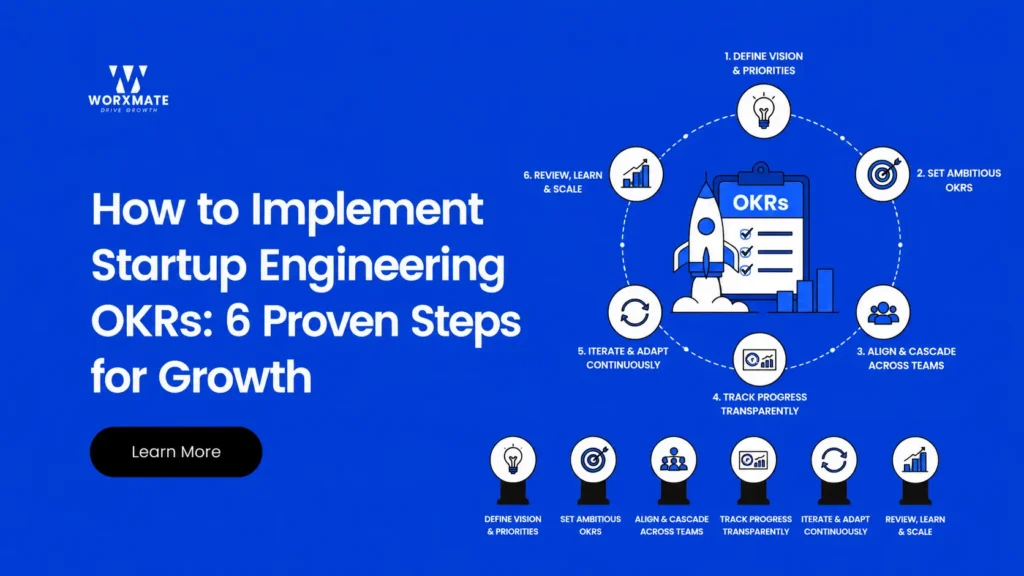
Startup engineering OKRs provide a common language for progress, fostering transparency and accountability within the engineering department and across the organization. They help prioritize tasks, manage resources effectively, and keep everyone focused on what truly matters for scaling. This article will walk you through six proven steps to implement and manage startup engineering OKRs, transforming your technical vision into measurable achievements and sustained growth.
Step 1: Understand the Foundation of Startup Engineering OKRs
Before diving into creation, it’s crucial to grasp what startup engineering OKRs are and why they’re vital for your team. Objectives are ambitious, qualitative goals that inspire your team, while Key Results are measurable, quantitative metrics that define success for that objective. For engineering teams, this means moving beyond simply shipping features to focusing on the impact those features have.
This framework is particularly beneficial for startups, which often operate in dynamic environments where priorities can shift rapidly. According to a Deloitte study, companies using OKRs are 10% more likely to achieve their strategic goals, demonstrating their effectiveness in driving focus and alignment. Implementing OKRs helps clarify the “why” behind engineering tasks, connecting daily work to the broader company vision and fostering a sense of shared purpose.
Pro Tip: Educate your entire engineering team, from junior developers to senior architects, on the core principles of OKRs. Use real-world examples from companies like Google or Spotify to illustrate how Objectives and Key Results function in a tech context, emphasizing the shift from output-focused metrics to outcome-driven business outcomes.
Step 2: Craft Inspiring Objectives for Your Startup Engineering Team
An effective Objective for a startup engineering team should be ambitious, qualitative, and time-bound, typically set quarterly. It should answer the question: “What do we want to achieve?” These objectives should be challenging, pushing the team beyond their comfort zone, yet still achievable within the given timeframe. Avoid making them too technical; instead, frame them around business value or user impact.
For instance, instead of “Migrate database to AWS RDS,” a better objective might be “Enhance product reliability and scalability to support rapid user growth.” This objective is inspiring, clearly communicates value, and provides a broader umbrella for various technical initiatives. Effective performance goals start with a compelling Objective.
Pro Tip: Involve engineering leadership and key stakeholders in the objective-setting process. This collaborative approach ensures that objectives are not only technically sound but also strategically aligned with product and business goals, fostering strategic alignment from the outset.
Step 3: Define Measurable Key Results for Startup Engineering OKRs
Key Results are the measurable indicators of whether you’ve achieved your Objective. They must be quantitative, specific, and challenging, answering: “How will we know if we’ve achieved our Objective?” For startup engineering OKRs, this often means focusing on metrics that reflect user experience, system performance, or development efficiency rather than just task completion.
For the Objective “Enhance product reliability and scalability to support rapid user growth,” Key Results could be: “Reduce average page load time from 3.5 seconds to under 1.5 seconds,” “Achieve 99.9% uptime for core services,” and “Decrease critical bug reports by 50%.” Each Key Result clearly defines a target and a metric, making progress unambiguous. Learn more about how to write OKRs effectively.
Pro Tip: Aim for 2-4 Key Results per Objective. Too many KRs dilute focus, while too few may not adequately capture the success of the Objective. Ensure Key Results are truly outcome-focused; for example, “Increase deployment frequency” is an output, but “Reduce time to recovery from critical incidents by 70%” is an outcome.
Step 4: Illustrate Diverse Startup Engineering OKRs with Practical Examples
Seeing practical startup engineering OKRs can help your team visualize how they apply to different functions. These examples demonstrate how to translate strategic goals into actionable, measurable outcomes for various engineering disciplines:
- Frontend Team Objective: Elevate user engagement through a seamless and intuitive interface.
- KR1: Increase average session duration from 5 minutes to 8 minutes.
- KR2: Reduce user-reported UI/UX friction points by 40%.
- KR3: Achieve a 70% feature adoption rate for key new functionalities.
- Backend Team Objective: Build a robust and scalable infrastructure to support future growth.
- KR1: Decrease API response time for critical endpoints from 500ms to 200ms.
- KR2: Improve system uptime to 99.99%.
- KR3: Reduce infrastructure costs by 15% through optimization.
- SRE/DevOps Team Objective: Foster a culture of operational excellence and rapid incident resolution.
- KR1: Reduce Mean Time To Resolution (MTTR) for critical incidents from 60 minutes to 15 minutes.
- KR2: Automate 80% of routine operational tasks.
- KR3: Increase successful deployment rate to 98%.
These examples highlight outcome-driven thinking. For more detailed guidance, explore OKR examples for various departments.
Step 5: Avoid Common Pitfalls and Optimize Your Engineering OKRs
Even with a clear understanding, engineering teams can stumble when implementing OKRs. One common pitfall is confusing outputs with outcomes. Shipping a new feature (output) is not the same as improving user retention (outcome). Another mistake is setting too many OKRs, which leads to diluted focus and burnout. John Doerr, author of “Measure What Matters,” recommends a maximum of 3-5 Objectives per quarter, each with 3-5 Key Results.
To optimize your startup engineering OKRs, foster a culture of continuous OKR check-ins and retrospectives. Regularly review progress, identify blockers, and be prepared to adjust OKRs as market conditions or priorities shift. According to Gallup data, highly engaged teams are 21% more profitable, underscoring how clear goals and regular feedback boost motivation and performance. Prioritize learning over simply achieving 100% on every KR.
Pro Tip: Encourage radical transparency. Share engineering OKRs across the entire company, not just within the tech department. This helps other teams understand engineering priorities and fosters cross-functional collaboration, which is crucial for startup success.
Step 6: Leverage Worxmate to Streamline Your Startup Engineering OKRs
Managing startup engineering OKRs across a growing team can quickly become complex when relying on spreadsheets or disparate tools. This is where a dedicated OKR and performance management platform like Worxmate proves invaluable. Worxmate provides a centralized, intuitive system to set, track, and align Objectives and Key Results, specifically designed for mid-market companies and startups.
With Worxmate, engineering leaders can easily visualize progress against Key Results in real-time, conduct efficient OKR check-ins, and ensure individual and team contributions are aligned with strategic company goals. The platform simplifies the entire OKR cycle, from planning to real-time tracking, allowing your engineering team to focus more on building and less on administrative overhead. Discover how OKR software can revolutionize your goal-setting.
Pro Tip: Integrate Worxmate into your existing workflows. Use its reporting features to generate insights for quarterly reviews and leadership discussions, demonstrating the tangible impact of your engineering efforts on business growth. This data-driven approach strengthens the case for continued investment in engineering initiatives.
Unlock Goal Clarity and Accelerate Employee Growth
Looking to drive goal clarity and employee growth? Discover how Worxmate’s AI-powered Performance Management Software can help.
Implementing startup engineering OKRs is not just about setting goals; it’s about embedding a culture of strategic focus, accountability, and continuous improvement within your technical teams. By following these six proven steps, you can ensure your engineering efforts are not only innovative but also directly contribute to the sustainable growth and success of your startup. From crafting inspiring objectives to leveraging powerful tools like Worxmate, the journey to engineering excellence through OKRs is within reach.
Ready to accelerate your engineering goal-setting journey? Start your free trial with Worxmate today and discover how our Performance Management software can transform your strategy into measurable results.