

Summary
Setting effective revenue operations OKRs involves defining clear objectives that unify sales, marketing, and customer success efforts, supported by measurable key results. The best revenue operations OKRs focus on optimizing the entire customer journey, from lead generation to retention, driving predictable and sustainable revenue growth.
This guide outlines a proven, step-by-step approach to developing and implementing revenue operations OKRs that enhance cross-functional alignment, improve operational efficiency, and accelerate your company’s financial performance.
In today’s competitive landscape, siloed departments are a relic of the past. Modern growth demands a unified approach to the entire customer lifecycle, and that’s where Revenue Operations (RevOps) steps in. RevOps integrates sales, marketing, and customer success functions, ensuring seamless handoffs and a consistent customer experience. But simply having a RevOps team isn’t enough; you need a strategic framework to guide their efforts and measure their impact.
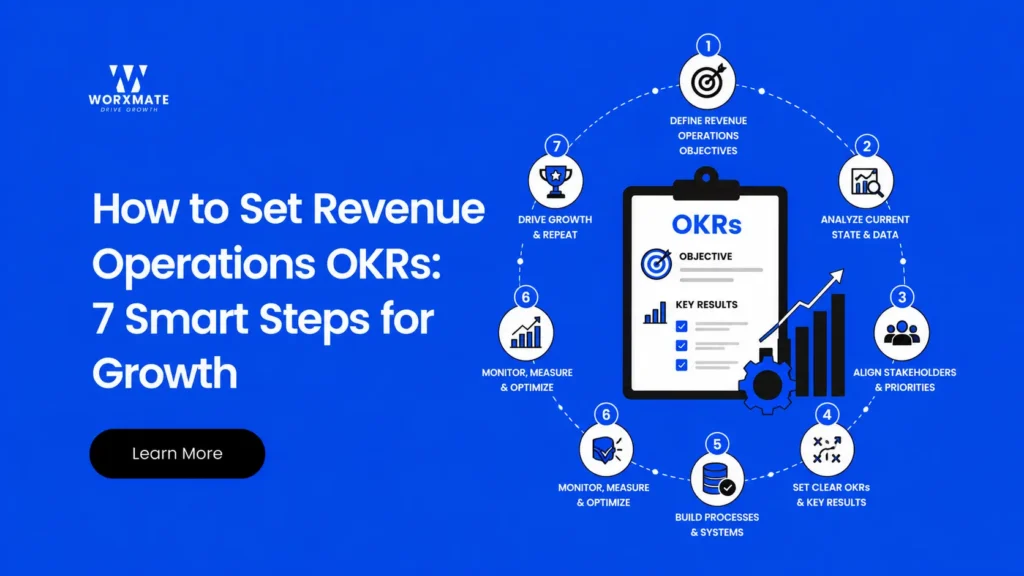
Objectives and Key Results (OKRs) provide this critical framework. By setting clear objectives and key results for your RevOps function, you can ensure every activity contributes directly to overarching business goals. This article will walk you through 7 smart steps to set impactful revenue operations OKRs, driving alignment and accelerating your path to sustainable revenue growth.
Step 1: Define Revenue Operations Needs for OKRs
Begin by clearly articulating what Revenue Operations means for your organization and identifying the core challenges it aims to solve. This foundational step ensures your revenue operations OKRs are strategic and address real pain points.
Why it matters: A clear definition prevents scope creep and ensures everyone understands RevOps’s role. According to Gartner, organizations with fully implemented RevOps strategies see 10-15% higher revenue growth than those without. This highlights the critical need for well-defined objectives from the outset.
Pro tip: Conduct workshops with leaders from sales, marketing, and customer success to align on RevOps’s purpose and initial priorities. Focus on identifying areas where lack of alignment or inefficient processes are actively hindering revenue growth.
Step 2: Establish the 3 Pillars of Revenue Operations OKRs
Structure your revenue operations OKRs around the three core pillars of RevOps: Data & Analytics, Process Optimization, and Enablement. This ensures comprehensive coverage of all critical operational areas.
Why it matters: These pillars represent the operational levers RevOps pulls to drive efficiency and effectiveness across the revenue engine. Focusing your revenue operations OKRs here ensures a holistic approach. McKinsey research consistently shows that companies excelling in data-driven decision-making and process efficiency significantly outperform competitors.
Example:
- Objective: Enhance data integrity and accessibility for revenue teams.
- Key Result 1: Reduce data entry errors in CRM by 20% by end of Q2.
- Key Result 2: Implement a unified reporting dashboard with 95% user adoption by end of Q2.
Step 3: Craft Revenue Operations OKR Examples for Sales Alignment
Develop specific revenue operations OKRs that foster stronger collaboration and efficiency within your sales organization and its interaction with other teams. These OKRs should focus on improving the sales funnel and conversion rates.
Why it matters: Sales alignment is crucial for maximizing revenue generation. Misaligned sales processes can lead to lost opportunities and wasted resources. Effective sales strategy and OKRs help streamline the journey from lead to closed deal.
Example:
- Objective: Improve sales team efficiency and close rates.
- Key Result 1: Increase lead-to-opportunity conversion rate by 15% through improved lead scoring by end of quarter.
- Key Result 2: Reduce average sales cycle length by 10 days by optimizing CRM workflows.
- Key Result 3: Achieve 90% sales team adoption of new sales enablement tools by month’s end.
Step 4: Develop Revenue Operations OKR Examples for Marketing & Lead Gen Efficiency
Create revenue operations OKRs that optimize marketing efforts and improve the quality and quantity of leads passed to sales. These should directly contribute to the top of the funnel and marketing ROI.
Why it matters: Marketing’s impact on revenue is undeniable, but often hard to quantify effectively without clear goals. These OKRs bridge the gap between marketing activities and revenue outcomes, driving business growth strategy.
Example:
- Objective: Optimize marketing’s contribution to qualified pipeline.
- Key Result 1: Increase Marketing Qualified Leads (MQLs) by 25% while maintaining lead quality.
- Key Result 2: Improve lead scoring accuracy, resulting in a 20% increase in MQL-to-SQL conversion rate.
- Key Result 3: Reduce customer acquisition cost (CAC) by 10% through targeted campaign optimization.
Step 5: Design Revenue Operations OKR Examples for Customer Success and Retention
Formulate revenue operations OKRs that enhance customer satisfaction, reduce churn, and drive expansion revenue. These OKRs focus on the post-sale journey, which is critical for long-term growth.
Why it matters: Retaining existing customers is often more cost-effective than acquiring new ones. Strong customer engagement strategy and RevOps OKRs ensure customer success teams are aligned with revenue goals. According to Harvard Business Review, increasing customer retention rates by just 5% can increase profits by 25% to 95%.
Example:
- Objective: Maximize customer lifetime value and retention.
- Key Result 1: Increase Net Revenue Retention (NRR) by 5% through proactive customer health monitoring.
- Key Result 2: Reduce customer churn rate by 10% by implementing an improved customer onboarding process.
- Key Result 3: Achieve an average CSAT score of 90% across all customer interactions.
Unlock Goal Clarity and Accelerate Employee Growth
Looking to drive goal clarity and employee growth? Discover how Worxmate’s AI-powered Performance Management Software can help.
Step 6: Track RevOps Performance with Software
Implement a robust OKR and performance management software, like Worxmate, to effectively track, monitor, and report on your revenue operations OKRs. This ensures real-time visibility and accountability.
Why it matters: Manual tracking in spreadsheets is prone to errors and lacks the dynamic insights needed for agile RevOps. Dedicated software facilitates OKR tracking metrics, fosters organizational alignment, and provides a single source of truth for all revenue operations OKRs. Worxmate’s platform, for instance, offers AI-powered insights that can highlight areas of underperformance or opportunities for optimization within your revenue operations strategy.
Pro tip: Integrate your OKR software with your CRM and marketing automation platforms for automated data flow, reducing manual updates and providing a comprehensive view of revenue operations performance. This helps in understanding how well your revenue operations OKRs are performing.
Step 7: Avoid Common Pitfalls in Setting Revenue Operations OKRs
Be aware of and actively mitigate common mistakes that can derail your revenue operations OKR efforts. This proactive approach ensures your RevOps strategy remains effective.
Why it matters: Even well-intentioned OKR initiatives can fail without careful execution. Avoiding these pitfalls ensures your revenue operations OKRs drive actual progress. For example, a common mistake is confusing outputs with outcomes, which can lead to busy work instead of impactful results. According to a study by Gallup, only 2.3% of employees strongly agree that their organization’s performance management system helps them set better goals, underscoring the challenge of effective goal setting.
Pro tip: Avoid setting too many OKRs, making Key Results activities instead of measurable outcomes, or failing to regularly review and adjust your revenue operations OKRs. Regular OKR reviews and check-ins are essential for staying on track and making necessary pivots.
Implementing a robust framework for revenue operations OKRs is no longer optional; it’s a strategic imperative for any mid-market company seeking sustainable growth. By following these 7 steps, you can ensure your RevOps function is not just operational, but truly optimized for performance, alignment, and revenue acceleration. Remember, well-defined revenue operations OKRs are the compass guiding your entire revenue engine.
Ready to accelerate your revenue operations OKRs journey? Start your free trial with Worxmate today and discover how our Performance Management software can transform your strategy into measurable results.