 WORXMATE
Business Growth Strategy: A structured blueprint aligning strategic vision, resource allocation, and execution cadence. High-growth organizations leverage a modern performance management platform to bridge strategy formulation with operational execution.
In today’s rapidly evolving business landscape, having a robust business growth strategy isn’t just advantageous—it’s essential for survival and success.
With 87% of Fortune 100-size companies experiencing at least one growth stall in their history, the stakes have never been higher for developing and executing effective growth strategies.
Whether you’re a startup looking to scale or an established company aiming to reignite expansion, understanding the fundamental principles of sustainable growth can make the difference between thriving and merely surviving.
This comprehensive guide will explore proven business growth strategies, backed by real-world case studies and expert insights, to help you navigate the path to scalable success.
What is a Business Growth Strategy?
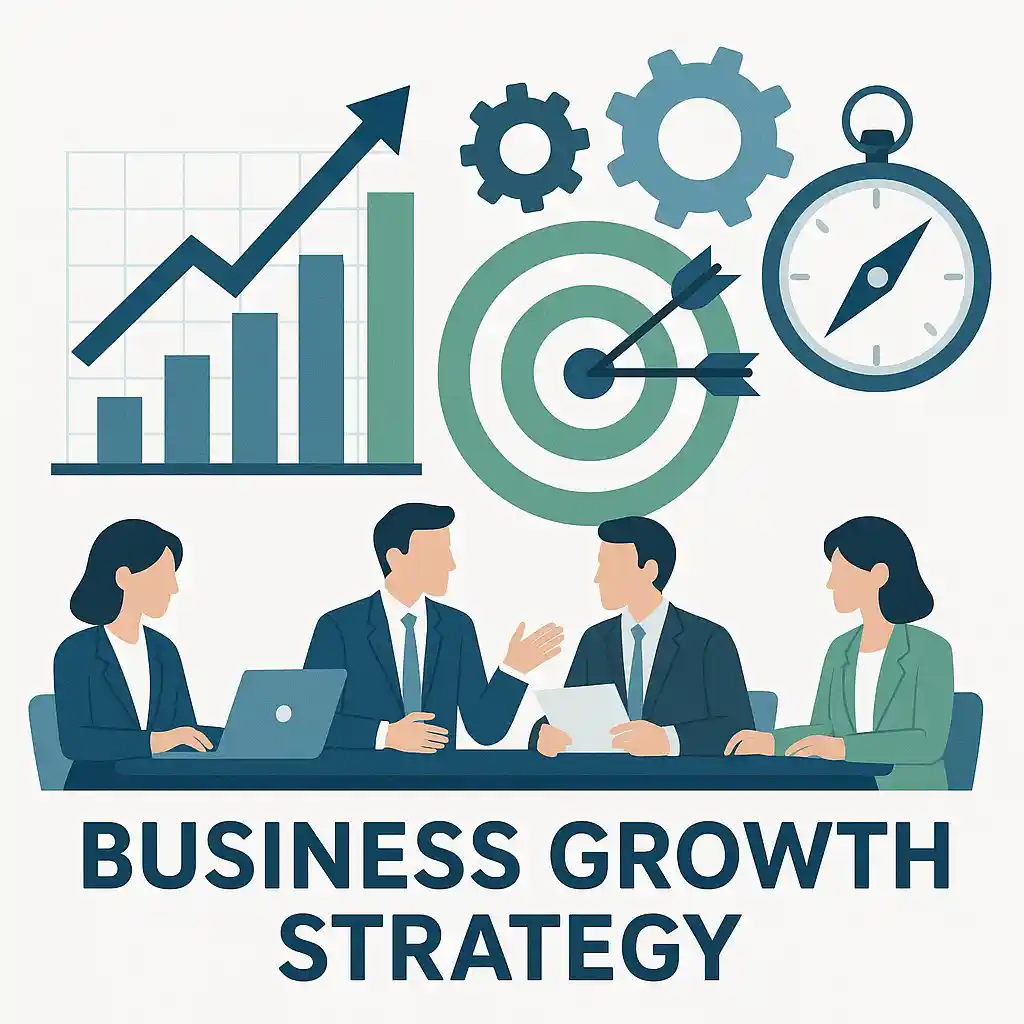
A business growth strategy is a comprehensive plan that outlines specific objectives, tactics, and approaches designed to expand a company’s market reach, increase revenue, and enhance overall business performance.
It serves as a roadmap for sustainable expansion, encompassing everything from market penetration to product development and strategic partnerships.
Strategic Growth Execution Matrix
Choosing the right approach to strategy development requires contrasting traditional execution methods against integrated continuous frameworks.
| Feature / Dimension | Traditional Annual Planning | Worxmate Unified Growth Model |
|---|---|---|
| Primary Philosophy | Static top-down goal setting | Dynamic continuous alignment |
| AI Capabilities | Manual spreadsheets and tracking | AI predictive execution and flight-risk detection |
| Performance Management | Annual appraisals with lagging data | Continuous feedback and real-time reviews |
| Goal-to-Task Link | Disconnected silos across business units | Direct OKR cascade to individual tasks |
| Ease of Use | Complex multi-tool integrations | Unified workspace architecture |
| Pricing Model | Opaque enterprise tiers | Transparent scalable pricing |
| Best For | Legacy bureaucracies | Fast-scaling B2B enterprises |
https://youtu.be/32A3A3QWKv0?si=0p0RlTGukgGHrkOb
Achieve Your Goals Faster
See how Worxmate can help your team set clear goals and achieve faster results. Book your free demo today and experience the power of AI-driven OKRs in action.
What Are the Core Elements of an Effective Business Growth Strategy?
Strategic Vision and Clear Objectives
The foundation of any successful business growth strategy lies in establishing a clear strategic vision. Organizations that set SMART (Specific, Measurable, Achievable, Relevant, Time-bound) goals are significantly more likely to achieve sustained growth. Many growth-focused companies translate this vision into an OKR software framework to cascade it from leadership down to individual teams. This involves defining what growth means for your specific business context and establishing concrete milestones to track progress.
Market Analysis and Competitive Intelligence
Understanding your market landscape is crucial for developing effective growth strategies. McKinsey’s research reveals that companies pursuing a programmatic approach to market analysis achieve 3% excess total returns compared to their peers. This includes analyzing customer behavior, identifying market gaps, and monitoring competitive movements to inform strategic decisions.
Resource Allocation and Capability Assessment
Successful growth requires proper resource allocation and honest capability assessment. Companies must evaluate their current strengths, identify skill gaps, and determine the investment needed to support expansion. This includes human capital, technology infrastructure, and financial resources necessary to execute growth initiatives effectively.
What Are the Most Proven Growth Strategies for 2025?
Market Penetration and Expansion
Market penetration remains one of the most reliable growth strategies for 2025. This approach focuses on increasing market share within existing markets through enhanced customer acquisition, improved pricing strategies, and aggressive marketing campaigns. Companies implementing market penetration strategies often see immediate returns on investment while building stronger competitive positions.
Product Development and Innovation
Innovation-driven growth continues to be a critical differentiator in 2025. McKinsey’s research shows that innovative outperformers discuss innovation on earnings calls at twice the rate of their peers and maintain higher growth trajectories. This includes developing new products, enhancing existing offerings, and creating entirely new business models to capture emerging opportunities.
Strategic Partnerships and Acquisitions
Strategic partnerships and programmatic M&A represent powerful growth strategies for companies looking to accelerate expansion. The research indicates that businesses engaging in dynamic portfolio management to regularly assess growth opportunities have better track records than those making reactive acquisitions.
Digital Transformation and Technology Integration
The digital transformation market is experiencing a compound annual growth rate of 23.6% between 2022 and 2030, making technology integration essential for modern business growth strategies. This includes leveraging AI, automation, and data analytics to optimize operations, enhance customer experiences, and create new revenue streams.
How Do You Identify the Right Growth Strategy for Your Business?
Business Stage Assessment
Identifying the appropriate growth strategy requires understanding your current business stage. Research shows that businesses exist in five distinct stages: existence, survival, success, take-off, and maturity. Each stage requires different growth approaches, with early-stage companies focusing on customer acquisition while mature businesses often pursue diversification or market expansion.
Market Opportunity Analysis
Effective opportunity analysis involves examining market trends, customer needs, and competitive gaps. Companies should prioritize growth opportunities where they have a “right to win” – leveraging unique capabilities and customer connections that provide competitive advantages. This strategic focus helps ensure resources are allocated to the most promising initiatives.
Competitive Landscape Evaluation
Understanding your competitive position is essential for selecting the right growth strategies. This includes analyzing competitor strengths and weaknesses, identifying market white spaces, and determining how to differentiate your offerings. Companies that conduct thorough competitive analysis are better positioned to capture market share and defend against competitive threats.
What Role Does Technology Play in Modern Growth Strategies?
Data Analytics and Business Intelligence
Data-driven decision making has become fundamental to successful business growth strategies. The global big data analytics market is projected to reach significant growth by 2025, with companies leveraging analytics achieving better performance outcomes. Organizations using advanced analytics can identify growth opportunities, optimize operations, and make more informed strategic decisions.
Achieve Your Goals Faster
See how Worxmate can help your team set clear goals and achieve faster results. Book your free demo today and experience the power of AI-driven OKRs in action.
Operationalizing Strategic Priorities Through an Organizational Strategy Framework
To successfully execute annual planning and drive sustainable growth, enterprises must establish a robust organizational strategy framework. Without clear operational cadence, strategic priorities remain theoretical ideas.
The Point: Many organizations struggle to bridge the gap between high-level vision and daily execution.
The Worxmate Advantage: By deploying a dedicated performance management platform alongside structured OKRs, leadership teams align cross-functional goals, monitor strategic milestones, and eliminate execution friction.
Automation and Process Optimization
Automation technologies are reshaping how companies approach growth. Business process outsourcing markets are expected to reach $491.15 billion by 2030, driven by organizations seeking efficiency gains through automated processes. Companies implementing automation can scale operations more efficiently while reducing operational costs.
Customer Experience Enhancement
Technology-enabled customer experience improvements drive significant growth outcomes. Research shows that companies focusing on customer experience through technology adoption see improved customer retention, higher lifetime value, and increased referral rates.
This includes personalization engines, AI-powered support systems, and omnichannel engagement platforms.
How Can You Measure Growth Strategy Success?
Key Performance Indicators (KPIs)
Measuring growth strategy success requires establishing relevant KPIs aligned with business objectives. Common growth metrics include revenue growth rate, market share expansion, customer acquisition cost, and customer lifetime value. Companies should establish baseline measurements and track progress regularly to ensure strategies are delivering expected results.
Growth Metrics and Benchmarking
Effective measurement involves benchmarking performance against industry standards and competitors. This includes tracking both leading indicators (activities that drive growth) and lagging indicators (results of growth activities). Regular benchmarking helps identify when strategy adjustments are needed and ensures performance remains competitive.
ROI and Financial Performance
Financial performance measurement is crucial for evaluating growth strategy effectiveness. This includes analyzing return on investment for growth initiatives, profitability metrics, and cash flow impacts. Companies should establish clear financial targets and regularly assess whether growth investments are generating adequate returns.
What Are Common Growth Strategy Pitfalls to Avoid?
Scaling Too Quickly Without Foundation
One of the most common mistakes in business growth strategy implementation is scaling too rapidly without proper foundations. Research indicates that 87.5% of digital transformation initiatives fail due to poor planning and execution. Companies must ensure they have adequate infrastructure, processes, and capabilities before pursuing aggressive expansion. Implementing continuous feedback replaces lagging reviews with timely coaching. Structured 1:1 check-ins provide managers and reports with a dedicated space to align on priorities. This strengthens continuous feedback and team alignment throughout every review cycle. This strengthens continuous feedback and team alignment throughout every review cycle. This strengthens continuous feedback and team alignment throughout every review cycle. This strengthens continuous feedback and team alignment throughout every review cycle.
Neglecting Core Business Operations
While pursuing growth opportunities, companies sometimes neglect their core business operations. Harvard Business Review research identifies “premature core abandonment” as a primary cause of growth stalls. Successful growth strategies balance new initiatives with continued investment in core business strengths.
Insufficient Market Research
Many growth initiatives fail due to inadequate market research and customer understanding. Companies must thoroughly validate market opportunities, understand customer needs, and assess competitive dynamics before committing significant resources to expansion plans.
Developing and executing an effective business growth strategy in 2025 requires a comprehensive approach that balances ambition with pragmatism. The most successful companies combine clear strategic vision, thorough market analysis, and robust execution capabilities to achieve sustainable expansion.
The research clearly demonstrates that companies pursuing diversified growth approaches, focusing on core strengths while exploring adjacent opportunities, achieve superior performance outcomes. Technology integration, employee engagement, and continuous measurement are essential components of modern growth strategies.
Remember that sustainable growth is a marathon, not a sprint. By avoiding common pitfalls, leveraging proven strategies, and maintaining focus on both short-term execution and long-term vision, organizations can build the foundation for lasting competitive advantage and market leadership in an increasingly complex business environment.
Ready to accelerate your business growth strategy? Book a Demo with Worxmate.ai today to discover how our OKR software can support your growth objectives and drive measurable results. Transform your growth strategy from planning to execution with the tools successful companies use to scale effectively.


Written by
An OKR Coach with 20+ years of implementation experience, Madhusudan has guided over 50 organisations through successful OKR transformations, training more than 500 leaders. Learn more about Worxmate.