

Summary
In the world of business performance, you need both a map and a speedometer. OKRs (Objectives and Key Results) define where you want to go—they are the ambitious, qualitative goals that drive innovation. KPIs (Key Performance Indicators) tell you how your engine is running right now—they are the quantitative measures of operational health. Understanding the distinction between strategic ambition and operational maintenance is the cornerstone of sustainable growth and high-performing teams.
Introduction
Imagine driving your car at night. You have a destination in mind—a new city you want to reach by morning. That’s your ambition. But to get there safely, you constantly glance at your speedometer and fuel gauge to ensure the engine isn’t overheating. You can’t reach the destination without a working engine, and a perfectly running engine is useless if you don’t know where you’re going.
This is the exact dynamic between OKRs vs KPIs. Yet, in countless boardrooms, these two concepts are used interchangeably, leading to confusion, misaligned teams, and stagnant growth. For a smart leader, knowing the difference isn’t just about semantics—it’s about survival. By mastering the difference between OKR and KPI in business, you can ensure your team is not just busy, but productive; not just active, but strategic. Let’s cut through the alphabet soup and look at the five distinctions that will change how you lead.
Achieve Your Goals Faster
See how Worxmate can help your team set clear goals and achieve faster results. Book your free demo today and experience the power of AI-driven OKRs in action.
Book a DemoObjectives and Key Results (OKR)
In the 1970s, OKRs gained popularity as a goal-setting framework emphasizing clarity, focus, and alignment within organizations. At its core, OKRs consist of two main components: objectives and key results.
Objectives represent the overarching goals that an organization or team aims to achieve within a defined period. They are qualitative and aspirational and provide direction for the organization’s efforts. Objectives should be ambitious yet achievable, inspiring individuals to strive for excellence and aligning their actions with the organization’s mission.
Key Results are measurable milestones or outcomes that indicate progress toward achieving the objectives. These quantifiable metrics clearly show whether the desired outcomes have been accomplished. Key results serve as concrete benchmarks against which performance can be evaluated and adjusted as needed.
The magic of OKRs lies in their simplicity and flexibility. By focusing on a limited number of objectives and associated key results, organizations can maintain clarity of purpose and ensure alignment across teams and departments. OKRs encourage a culture of transparency, accountability, and continuous improvement, as progress is tracked openly and regularly reviewed.
-
Examples of OKRs:
Objective: Improve customer satisfaction
-
- Key Result: Achieve a Net Promoter Score (NPS) of 75 or higher by the end of the quarter.
- Key Result: Lower customer support ticket resolution time by 20% compared to the previous quarter.
Objective: Drive revenue growth
-
- Key Result: Boost sales revenue by 15% year-over-year.
- Key Result: Expand customer base by acquiring 100 new clients within six months.
Key Performance Indicators(KPI)
KPIs are metrics used to evaluate the ongoing performance of business operations. While OKRs focus on achieving specific objectives, KPIs measure progress and assess the effectiveness of processes, activities, and initiatives.
KPIs are often tied to organizational goals and objectives but are more granular and focused on day-to-day operations. They serve as performance benchmarks, allowing organizations to track progress, identify areas for improvement, and make data-driven decisions.
Unlike OKRs, which are outcome-oriented, KPIs are more process-oriented, measuring the efficiency, productivity, and effectiveness of various aspects of the business. They provide actionable insights that enable managers and stakeholders to monitor performance in real-time and take corrective actions when necessary.
-
Examples of KPIs:
- Revenue: Total sales revenue generated over a specific period.
- Customer Acquisition Cost (CAC): The cost incurred to acquire a new customer.
- Employee Turnover Rate: The percentage of employees who leave the organization within a given time frame.
- Website Traffic: The number of visitors to a company’s website within a specified period.
Understanding the Differences: OKRs vs KPIs
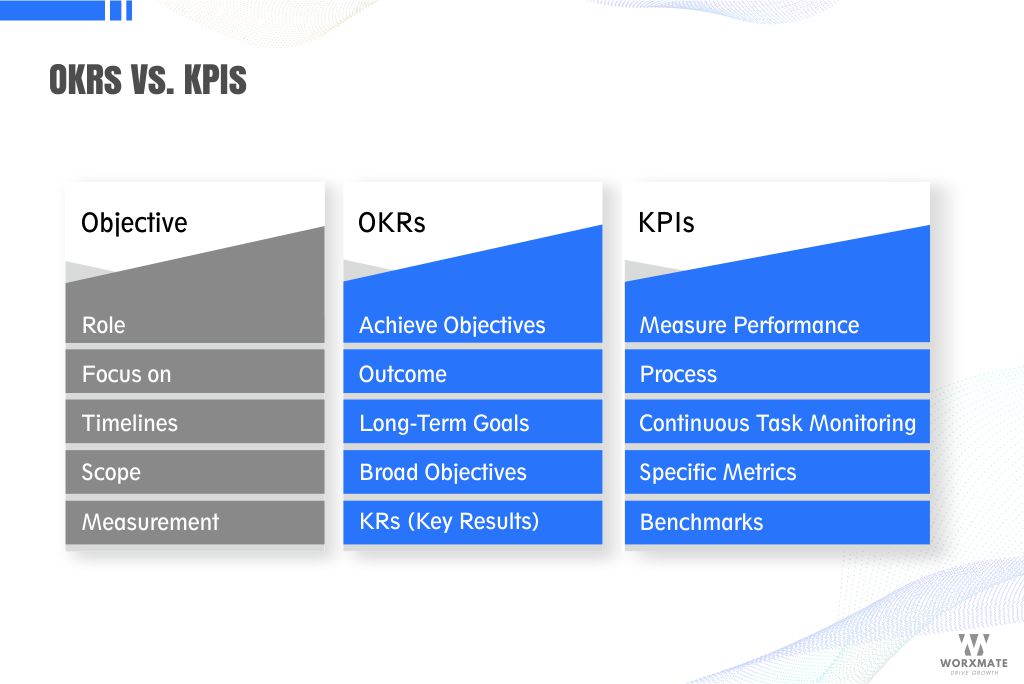
While both OKRs and KPIs share the common goal of driving organizational performance, the differences between OKRs vs KPIs lie in their distinct characteristics and functions:
| Objective | OKRs | KPIs |
| Role | OKRs focus on achieving specific objectives and outcomes that align with the organization’s overarching mission and vision. They emphasize the end results that the organization seeks to accomplish within a defined period. | KPIs concentrate on measuring the ongoing performance of business operations. Rather than focusing solely on the end goal, KPIs provide insights into the efficiency, effectiveness, and productivity of various processes and activities within the organization. |
| Focus | OKRs are outcome-oriented, prioritizing the attainment of desired results. They set ambitious targets and encourage individuals and teams to push beyond their comfort zones to achieve them. | KPIs are process-oriented, focusing on the day-to-day activities that contribute to overall performance. By monitoring specific metrics related to these activities, organizations can gain visibility into the health and effectiveness of their processes and make informed decisions to optimize them. |
| Timelines | OKRs are usually set on a quarterly or annual basis, aligning with the organization’s strategic planning cycles. They provide a roadmap for achieving long-term objectives and are reviewed periodically to track progress and make necessary adjustments. | KPIs are continuously monitored to track performance trends and identify areas for improvement in real-time. This continuous monitoring allows organizations to adapt quickly to changing circumstances and maintain agility in their operations. |
| Scope | OKRs have a broader scope, encompassing high-level organizational goals that cascade down to individual teams and employees. They provide a framework for aligning everyone’s efforts toward common objectives and fostering collaboration across the organization. | KPIs are specific and targeted, focusing on key areas of performance within departments or teams. They provide granular insights into performance metrics relevant to each functional area, enabling managers to identify strengths and weaknesses and take corrective actions as needed. |
| Measurement | OKRs are measured against predefined key results, which serve as concrete indicators of progress toward achieving the objectives. These key results are specific, measurable, and time-bound, providing clear benchmarks for success. | KPIs are measured against predetermined benchmarks or targets, reflecting performance against established standards or expectations. By comparing actual performance to these benchmarks, organizations can assess their performance relative to their goals and identify areas where improvement is needed. |
While OKRs provide the strategic direction and focus needed to drive organizational success, KPIs offer the operational insights and performance metrics necessary to monitor progress and make data-driven decisions.
Case Study: How Google and Sears Scaled with OKRs
To understand the power of combining these frameworks, we can look at one of the most famous adopters of the OKR framework: Google.
When Google joined the venture capital firm Kleiner Perkins, John Doerr introduced the OKR system (which he learned from Intel) to the young founders, Larry Page and Sergey Brin . In the Google model, OKRs are used to cascade ambitious goals down through the entire organization. Everyone from an intern to the CEO shares their OKRs publicly, creating transparency and alignment.
But Google didn’t abandon KPIs; they worshipped them. For every OKR (e.g., “Improve the user experience of Search”), there were dozens of KPIs tracking latency, index size, and click-through rates.
The result? This dual focus on ambitious strategy (OKRs) and obsessive measurement (KPIs) fueled their exponential growth. This aligns with broader market data—research from Gallup and McKinsey shows that employees who receive quarterly progress check-ins are 90% more likely to be engaged, and high-performance cultures drive 4.2× greater business outcomes.
Conclusion
OKRs and KPIs represent two distinct yet complementary frameworks for driving organizational performance. In the OKR vs KPI debate, OKRs focus on achieving specific objectives and outcomes, while KPIs measure the ongoing performance of business operations.
By understanding the differences between OKRs and KPIs and integrating them effectively, organizations can create a dynamic performance management system that fosters clarity, alignment, and accountability, ultimately leading to greater success and achieving strategic goals.
Read More: Power of OKRs in Employee Engagement
Are you ready to stop maintaining the status quo and start driving breakthrough results?
👉 Sign up for Worxmate today and transform your performance management strategy.