 WORXMATE
Quick Answer
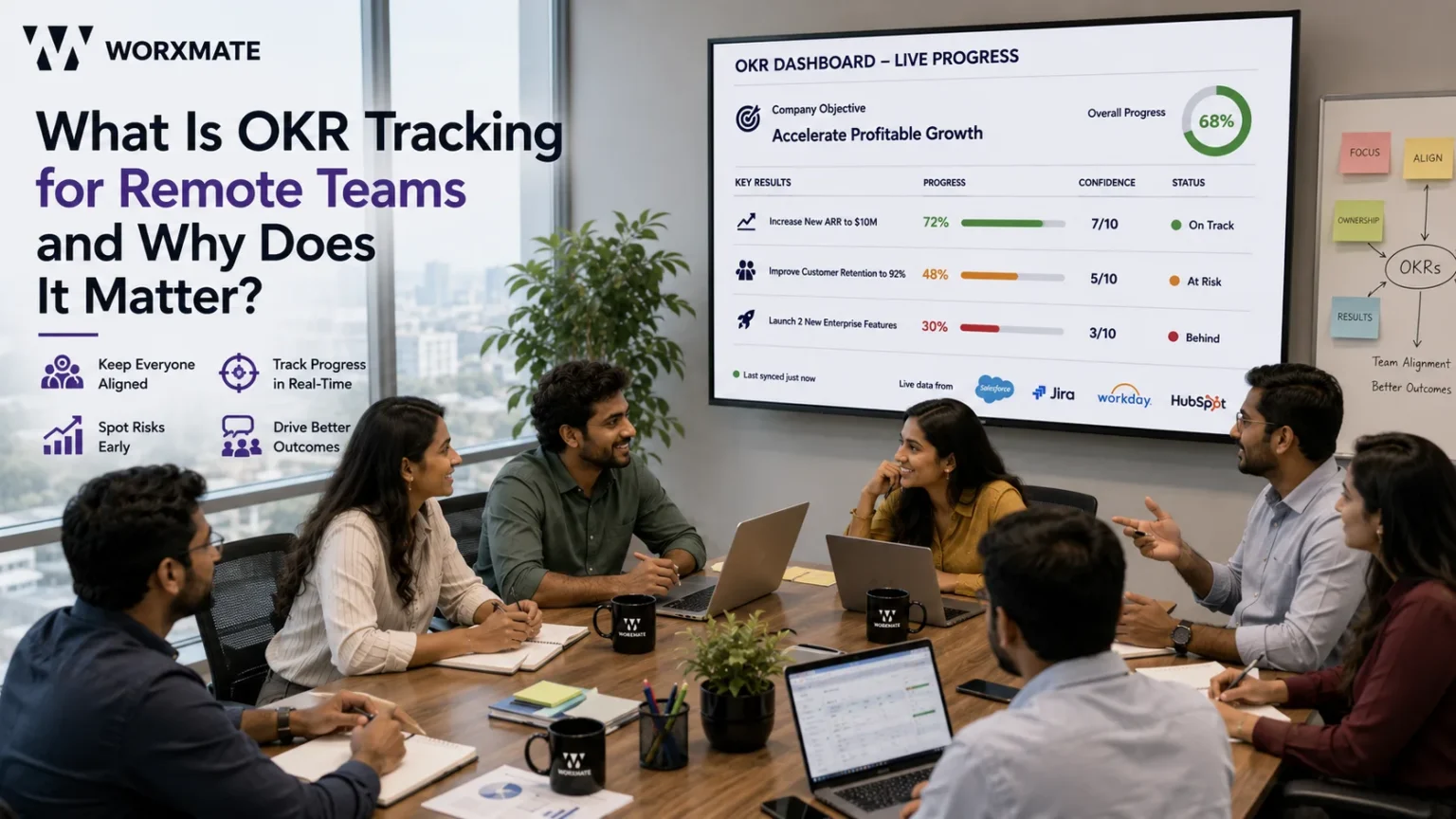
OKR tracking for remote teams means monitoring Objectives and Key Results through a shared, always-visible system instead of physical presence or hallway updates. It matters because distributed teams lose the informal signals that keep goals on track in an office — without a structured cadence, remote OKRs quietly drift from “written” to “forgotten” within a single quarter. Six things fix this: cap objectives at three per team, run weekly check-ins (sync or async), make every OKR visible company-wide, automate updates from the tools teams already use, separate tracking from micromanagement, and run review meetings that cover only what’s at risk.
Summary
This article looks at why OKR tracking specifically breaks down in distributed teams, and the structural fixes cadence, visibility, tooling and coaching that keep goals from sliding into a box-ticking exercise.
The difference between teams that sustain OKRs past the first quarter and teams that quietly abandon them by the second almost always comes down to how progress is tracked, not how the goals were written.
Why OKR Tracking for Remote Teams Is the Key to Distributed Success
OKR tracking for remote teams is the fundamental mechanism that bridges the gap between high-level strategy and daily execution in a decentralized workforce. In a remote environment, the absence of “water cooler” conversations and physical oversight creates a visibility vacuum that can lead to strategic drift. When teams are distributed, the traditional methods of assessing performance such as hours logged or physical presence—become obsolete. Instead, organizations must pivot toward a results-only work environment where success is defined by measurable outcomes.
According to research by McKinsey & Company, clarity of goals is one of the top three drivers of employee performance in remote settings. Without a centralized system for OKR tracking for remote teams, individual contributors often struggle to understand how their specific tasks contribute to the broader mission. This lack of context is a primary cause of disengagement. Implementing a robust tracking system ensures that every team member, regardless of their physical location, has a “north star” to follow. This alignment is not just about productivity; it is about providing the psychological safety that comes from knowing exactly what is expected and how progress is being measured.
Furthermore, OKR tracking for remote teams facilitates a shift from micromanagement to empowerment. When objectives and key results are clearly defined and visible to everyone, managers no longer feel the need to check in constantly on the status of minor tasks. The data speaks for itself. This transparency builds trust, as employees feel ownership over their results and managers can focus on removing blockers rather than policing activity. In the modern mid-market enterprise, where agility is a competitive advantage, this shift is essential for scaling operations without increasing administrative overhead. It’s also where organizational alignment stops being a slogan and starts being something you can actually observe in how teams behave week to week.
The Unique Challenges of OKR Tracking for Remote Teams
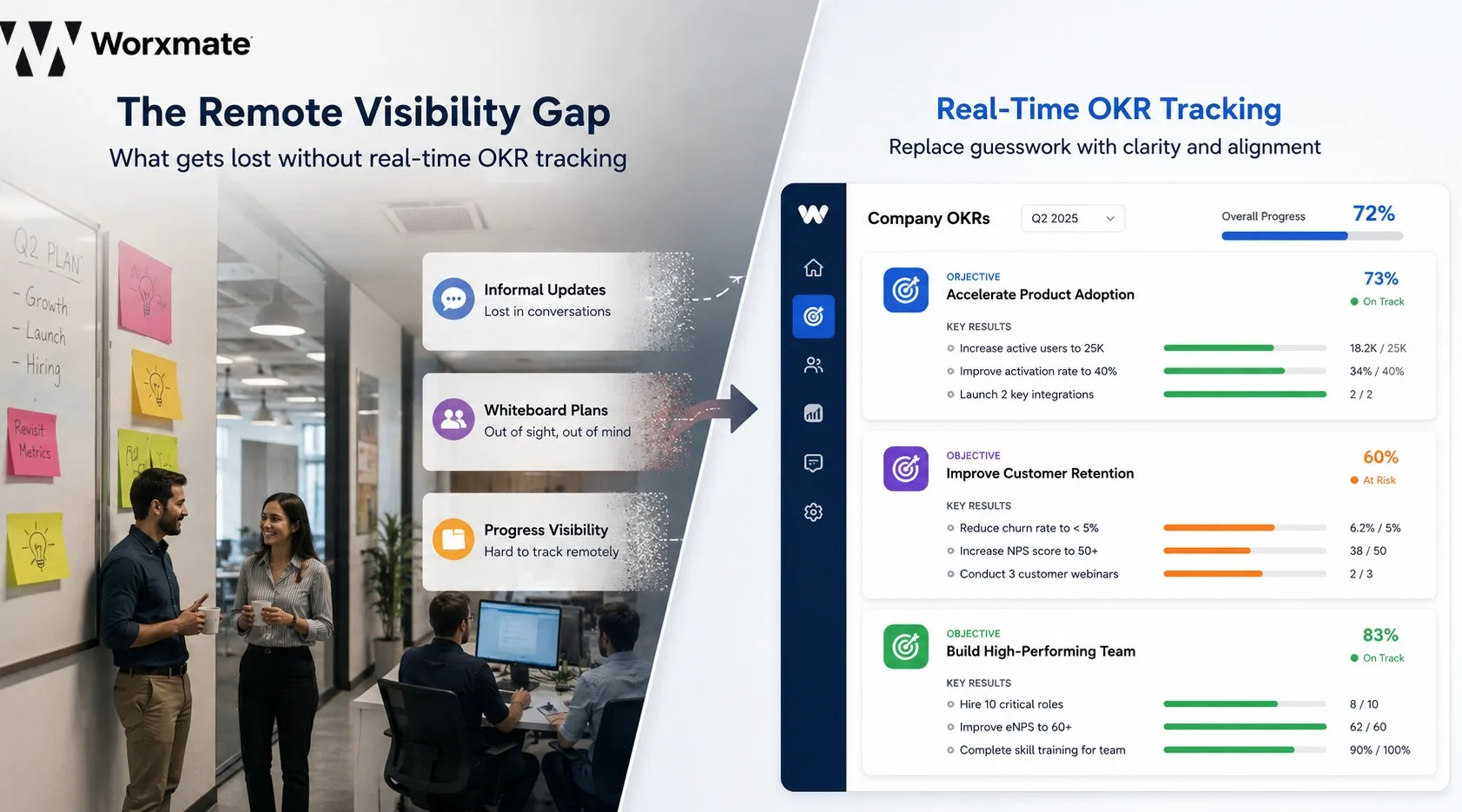
The primary hurdle in OKR tracking for remote teams is the “out of sight, out of mind” phenomenon, which can lead to significant misalignment over a standard 90-day OKR cycle. In a physical office, subtle cues and spontaneous updates keep projects on track. In a remote setup, these cues disappear, making it easy for teams to work on low-priority tasks that do not move the needle. This is why organizational alignment becomes significantly harder to maintain without a digital-first tracking strategy.
Another challenge is the risk of social loafing, where individuals may feel less accountable because their contributions are less visible to the group. Without consistent OKR tracking for remote teams, it becomes difficult to distinguish between high-performers and those who are merely “present” online. This can create resentment within high-performing cohorts and degrade the overall culture. To combat this, the tracking process must be frequent and data-driven, ensuring that every key result is updated in real-time or at least on a weekly cadence.
Data silos also present a major obstacle. Remote teams often use a fragmented stack of tools—Slack for communication, Jira for tasks, and spreadsheets for goals. When OKR tracking for remote teams is buried in a static spreadsheet that no one opens, the framework loses its efficacy. Gartner reports that 70% of employees feel overwhelmed by the number of applications they use, and if goal tracking is just “one more thing” to check, it will be ignored. The challenge lies in integrating OKR tracking for remote teams into the existing workflow so that it feels like a natural part of the day rather than a chore. In the mid-market organisations I’ve worked with, this fragmentation is rarely a tooling problem first it’s usually a sign that OKR tracking was bolted onto the existing workflow instead of being built into it from day one.
Best Practices for Setting and Monitoring OKR Tracking for Remote Teams
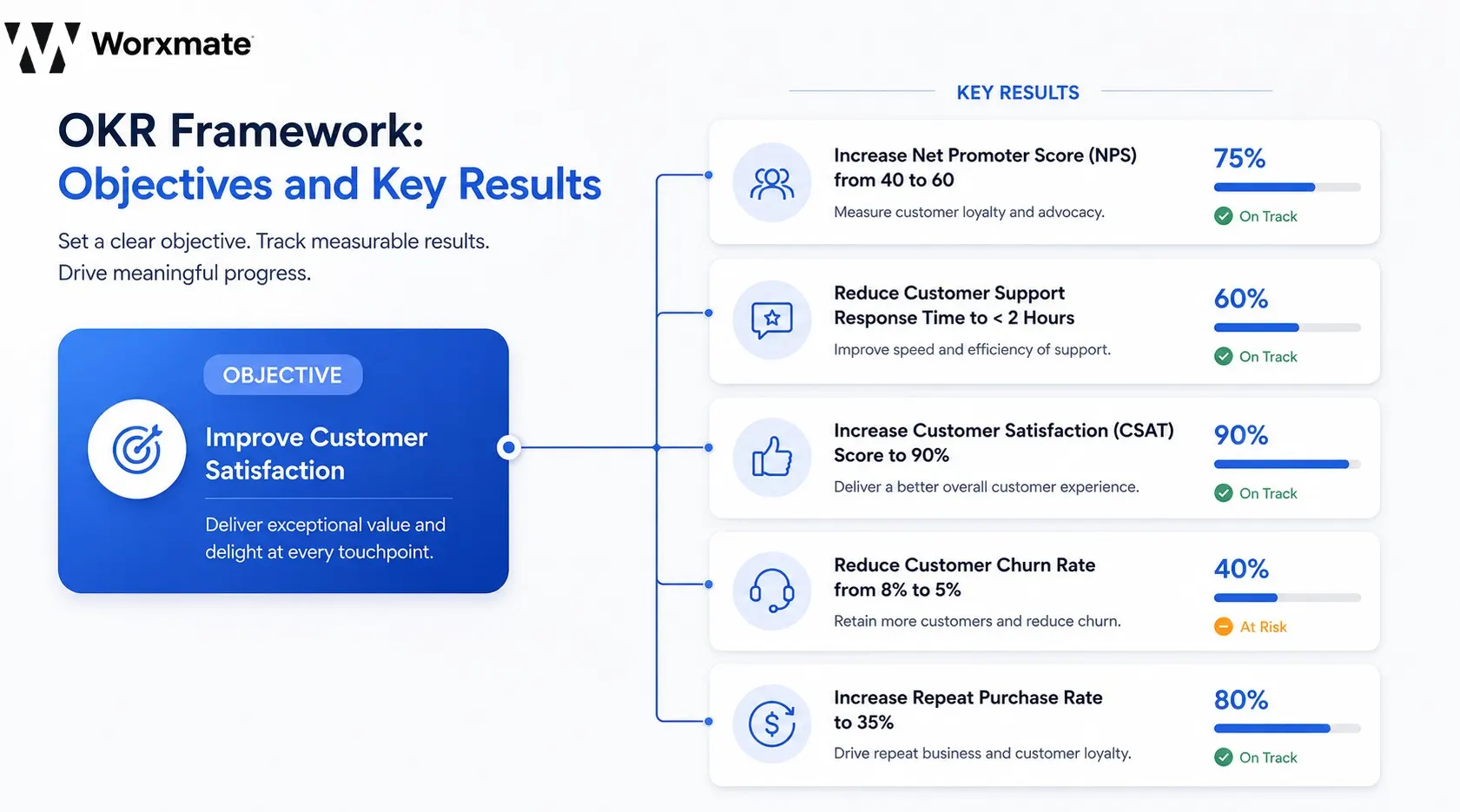
To maximize the impact of OKR tracking for remote teams, leadership must adopt a highly structured approach to both setting and monitoring goals. The process begins with the “less is more” principle. In a distributed environment, cognitive load is high; therefore, each team should have no more than three objectives, each supported by three to five key results. This focus ensures that even in the absence of direct supervision, employees know exactly where to direct their energy. Effective OKR tracking for remote teams depends on this initial clarity.
-
Establish a Consistent Rhythm
Remote work thrives on cadence. Monitoring should involve weekly OKR check-ins where progress is discussed openly. These are not status reports but strategic huddles to identify blockers and celebrate wins. By making OKR tracking for remote teams a recurring agenda item, you reinforce its importance. Teams spread across three or more time zones often assume this means a live weekly call it doesn’t have to. What matters is that the update happens on a fixed day, in a fixed place, whether or not everyone is online at the same time. See how weekly OKR check-ins should actually run for a cadence template you can copy directly.
-
Focus on Lead Indicators
Key results should be measurable and time-bound. Instead of tracking “improved customer satisfaction,” track “reduce median response time to under 2 hours by the end of Q3.” This level of detail makes OKR tracking for remote teams objective rather than subjective, which is vital when you cannot observe the work being done in person. This is also where output and outcome key results get confused. A key result like “ship the new dashboard” is an output it’s completed or it isn’t. A key result like “reduce median response time to under 2 hours” is an outcome it tells you whether the output actually changed anything. Both have a place in OKR tracking metrics, but only one of them tells you if the work mattered and knowing which is which is the difference between a team that hits 80% completion with nothing to show for it, and one that doesn’t.
-
Promote Vertical and Horizontal Visibility
Transparency is the antidote to remote silos. Every employee should be able to see the OKRs of the CEO, their manager, and their peers. This visibility fosters a sense of shared purpose and allows for better OKR advantages like cross-departmental collaboration. This is where organizational alignment either becomes real or stays a slide in a townhall deck. If a BU head can’t see what a peer department is working on, dependencies get discovered in week 10 of a 12-week cycle instead of week 2. Team OKR tracking that’s visible by default not shared on request is what surfaces those dependencies while there’s still time to act on them.
Monitoring progress is not a passive activity. It requires active participation from both managers and employees. By utilizing real-time OKR tracking tools, teams can see progress bars move as they complete tasks. This visual feedback loop is incredibly motivating for remote staff who might otherwise feel disconnected from the company’s success. When OKR tracking for remote teams is done correctly, it turns the abstract strategy into a tangible, rewarding game of progress. Our guide to OKR progress tracking breaks down exactly how to score that progress once it’s in the system.
The Role of Technology: Choosing the Right OKR Tracking for Remote Teams Software
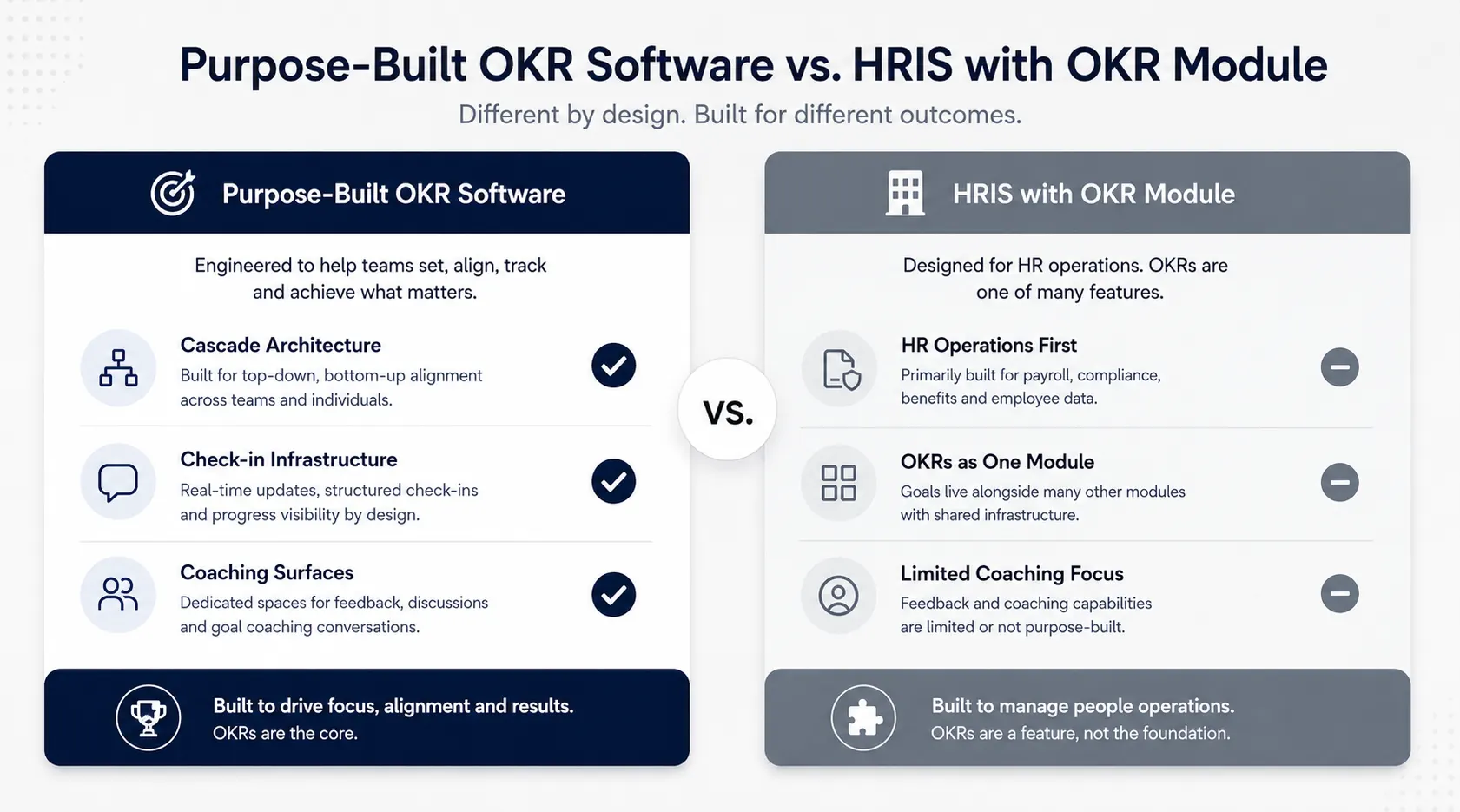
The success of OKR tracking for remote teams is heavily dependent on the technological infrastructure supporting it. Spreadsheets are often the starting point for many companies, but they quickly become a liability as the organization scales. A spreadsheet is a “dead” document—it doesn’t send notifications, it doesn’t integrate with other tools, and it requires manual updates that are easily forgotten. For effective OKR tracking for remote teams, a dedicated software solution is necessary to provide a “single source of truth.”
When evaluating software for OKR tracking for remote teams, several critical features should be prioritized. First, the platform must offer seamless integration with communication tools like Slack or Microsoft Teams. If an employee can update their key results directly from the chat interface they already use, the compliance rate for OKR tracking for remote teams will skyrocket. Second, the software should provide visual dashboards that aggregate data at the individual, team, and company levels. This allows leadership to spot trends and potential failures before they become critical issues. Teams that pair check-ins with real-time OKR dashboards typically catch at-risk key results two to three weeks earlier than teams relying on end-of-quarter reviews alone the same logic behind real-time OKR tracking generally. If you’re comparing platforms, our OKR tracking tools breakdown and our product comparison page cover which platforms handle this natively versus as a bolt-on.
Automation is another key factor. Modern continuous performance management software can pull data directly from project management tools like Jira or Salesforce to update key results automatically. This reduces the administrative burden on remote staff and ensures that the data used for OKR tracking for remote teams is always accurate and up-to-date. By removing the friction of manual reporting, technology allows teams to focus on the work itself rather than the reporting of the work. This is a crucial distinction for mid-market companies that need to remain lean and efficient. Pairing OKR tracking with task management that’s linked at the task level not just the goal level is what actually closes the loop between daily work and quarterly outcomes.
Automation is another key factor. Modern continuous performance management software can pull data directly from project management tools like Jira or Salesforce to update key results automatically. This reduces the administrative burden on remote staff and ensures that the data used for OKR tracking for remote teams is always accurate and up-to-date. By removing the friction of manual reporting, technology allows teams to focus on the work itself rather than the reporting of the work. This is a crucial distinction for mid-market companies that need to remain lean and efficient.
Finally, the chosen solution for OKR tracking for remote teams should support the entire performance management cycle. This includes not just goal tracking, but also feedback loops, recognition, and reviews. When all these elements are housed in one platform, it creates a cohesive experience for the remote employee. They see their goals, receive feedback on their progress, and are recognized for their achievements all in one place. This holistic approach to continuous performance management is what separates high-performing distributed organizations from those that struggle with the transition to remote work.
Fostering Accountability and Transparency Without Micromanagement
One of the most delicate balances to strike in OKR tracking for remote teams is the line between accountability and micromanagement. In the absence of physical presence, some managers overcompensate by demanding constant updates or monitoring keystrokes. This approach is counterproductive and destroys the trust necessary for remote work to function. Instead, OKR tracking for remote teams should be used as a framework for “radical transparency.” When everyone’s goals and progress are public, accountability becomes a peer-driven process rather than a top-down one.
“Alignment is agreement — not a configuration in a tool. A platform can display alignment once it exists between teams. It cannot create that agreement by turning on a dashboard.”
Transparency in OKR tracking for remote teams means that if a project is falling behind, it is visible to everyone involved. This shouldn’t be a source of shame, but an invitation for support. In a healthy remote culture, a red status on a key result triggers a conversation about what resources or help are needed to get back on track. This shift in perspective from “who is failing?” to “where do we need to help?” is only possible when you have a reliable system for OKR tracking for remote teams, and when there’s enough manager and employee trust already in place for a red status to be read as information, not blame.
To further reduce the need for micromanagement, leaders should emphasize the “why” behind every objective. When remote staff understand the strategic context, they are more likely to take initiative and solve problems independently. OKR tracking for remote teams then becomes a tool for self-correction. Employees can look at their OKR tracking metrics and realize for themselves if they are focusing on the right activities. This level of autonomy is highly valued by remote workers and leads to higher job satisfaction and retention rates. According to Gallup, employees who feel they have autonomy over their work are 43% more likely to be engaged which ties directly back to employee engagement as a whole, not just goal completion. This is also where most OKR coaching engagements quietly fail not because the framework is wrong, but because the coaching stops at the leadership layer and never reaches the managers running these conversations every week. Our breakdown of why OKR coaching fails after the workshop ends covers this pattern in more depth.
How to Run Effective Virtual OKR Review Meetings
Virtual review meetings are the heartbeat of OKR tracking for remote teams. These sessions provide the necessary human connection to the data and ensure that everyone is still aligned as the quarter progresses. However, remote meetings can easily become fatiguing or unproductive if not managed correctly. To make OKR tracking for remote teams successful, review meetings must be structured, time-boxed, and focused on high-impact discussion rather than mere status updates.
A successful virtual OKR review should follow a specific agenda. Start by reviewing the high-level objectives to remind everyone of the big picture. Then, move into a “by exception” review of key results. Instead of discussing every single metric, focus on those that are either significantly ahead of schedule or those that are at risk. This keeps the meeting efficient and ensures that time is spent on problem-solving. Effective OKR tracking for remote teams requires this level of focus to avoid “Zoom fatigue” and keep the team energized.
Incorporating one-on-one meetings alongside team reviews is also essential. These private sessions allow for deeper coaching and personal development discussions that might not be appropriate for a group setting. During these meetings, managers can use the data from OKR tracking for remote teams to provide specific, actionable feedback. This dual approach—team alignment and individual coaching—ensures that the OKR framework supports both organizational growth and individual career progression. When OKR tracking for remote teams is integrated into the rhythm of the company, it becomes a powerful driver of continuous improvement.
Async-First OKR Tracking: Making Check-Ins Work Across Time Zones
For teams spread across IST, GMT and EST, a single weekly meeting that works for everyone doesn’t exist someone is always joining at 7 a.m. or staying online past 9 p.m. Treating async updates as a fallback for when the live meeting doesn’t work is where OKR tracking for remote teams usually starts to fail. Async needs to be the default, with synchronous meetings reserved for the conversations that actually need a room.
An async-first system for OKR tracking for remote teams runs on three fixed elements: a status colour (on track, at risk, off track) updated against every key result, a short written note what changed, what’s blocking it, what help is needed and a fixed window in which that update has to happen, regardless of time zone. No live meeting is required for this to work. What is required is that skipping the update is visible to the same people who would notice a missed stand-up in a physical office.
This is where the discipline behind Worxmate’s Execute stage of the DEEP AI framework matters more than the tool itself: automated check-in reminders and at-risk detection exist specifically because async systems fail quietly. A key result with no update for two weeks doesn’t send up a flare on its own someone or something has to notice.
A cadence that works in practice: async updates due every Monday in the team’s tracking tool, a Wednesday leadership scan that looks only at key results flagged at risk (not a review of every OKR in the company), and a synchronous team huddle every two weeks, scheduled in whatever overlap window the team actually shares. This keeps the volume of live meeting time low while keeping the visibility of at-risk work high — which is the actual goal of OKR tracking for remote teams, not meeting attendance.
The failure mode to watch for: async without structure becomes silence, not tracking. A tool that lets people update key results “whenever” without a fixed cadence and a visible red/amber/green status will quietly return to the same “out of sight, out of mind” problem this article opened with. If you’re building this cadence from scratch, our guide on how to run OKR check-ins every week is a useful starting template, and OKR progress tracking covers how to score the update itself once it’s in the system.
Spreadsheet Tracking vs. Specialized OKR Software
| Feature | Spreadsheet Tracking | Specialized OKR Software |
|---|---|---|
| Data Accuracy | Manual, prone to errors | Automated, real-time syncing |
| Visibility | Limited, often siloed | Company-wide transparency |
| Engagement | Low, perceived as “admin work” | High, via notifications & UI |
| Collaboration | Static, no feedback loop | Integrated check-ins & comments |
Case Study: Buffer — Achieving 100% Transparency in Remote Goal Tracking
-
The Challenge
As a pioneer in the remote-first movement, Buffer faced the significant challenge of maintaining radical transparency and alignment across a globally distributed team. Without a central office, the risk of “information asymmetry” was high, where some team members had more context than others, leading to fragmented efforts and a lack of unified direction.
-
The Solution
Buffer implemented a fully transparent OKR framework where every objective and key result—from the CEO to the newest hire—was published internally for everyone to see. They coupled this with a rigorous cadence of monthly and quarterly reviews, ensuring that the tracking process was integrated into their digital workspace rather than existing as a separate administrative task.
-
Results and Impact
By prioritizing transparent goal tracking, Buffer maintained a high level of employee trust and engagement, contributing to their industry-leading retention rates. Their commitment to open goals allowed for 100% visibility into company progress, ensuring that all 80+ employees remained aligned with the company’s long-term vision despite working across dozens of different time zones. (Source: Buffer Open Blog)
Conclusion
The transition to a distributed workforce necessitates a fundamental rethinking of how we define and measure progress. OKR tracking for remote teams provides the necessary structure to ensure that autonomy does not lead to anarchy. By replacing manual, siloed reporting with transparent, real-time data, mid-market companies can achieve a level of strategic alignment that was previously only possible in a centralized office environment.
Implementing a successful strategy requires more than just picking a framework; it requires the right tools and culture to sustain it. You can explore how OKRs for remote teams overcome common hurdles, or dive deeper into the benefits of hybrid work environments. Utilizing a dedicated continuous performance management software ensures your data remains actionable and your team stays focused on the outcomes that truly matter.
For the complete picture of how OKR tracking connects to goal-setting, cadence and reporting across the full lifecycle, see our full guide to OKR tracking, or browse the rest of Worxmate’s OKR tracking articles for role- and team-specific breakdowns.
Ready to eliminate the visibility gap and drive your distributed team toward peak performance? Leverage OKR tracking metrics to gain deep insights into your operations, establish a consistent rhythm of OKR check-ins, and start your free trial with Worxmate today to transform your remote strategy into measurable success.
If the gap in your organisation is less about the software and more about whether teams know how to write and run genuine outcome-driven OKRs in the first place, that’s a coaching problem before it’s a tooling one — worth a conversation with Worxmate’s OKR consulting team.


Written by
An OKR Coach with 20+ years of implementation experience, Madhusudan has guided over 50 organisations through successful OKR transformations, training more than 500 leaders. Learn more about Worxmate.