 WORXMATE
Dealing with Negative Performance Reviews in 2026 – Turn Criticism into Growth
Actionable insights to align your OKRs with everyday performance management-from proven frameworks to the tools that power them.
Summary
Navigating the cognitive dissonance of receiving a poor performance rating while being assigned high-priority projects can be one of the most confusing experiences in a professional career. This article explores why managers send mixed signals and provides a strategic framework for decoding feedback and reclaiming your narrative. By leveraging objective frameworks like OKRs, professionals can bridge the communication gap and turn a negative review into a catalyst for long-term growth.
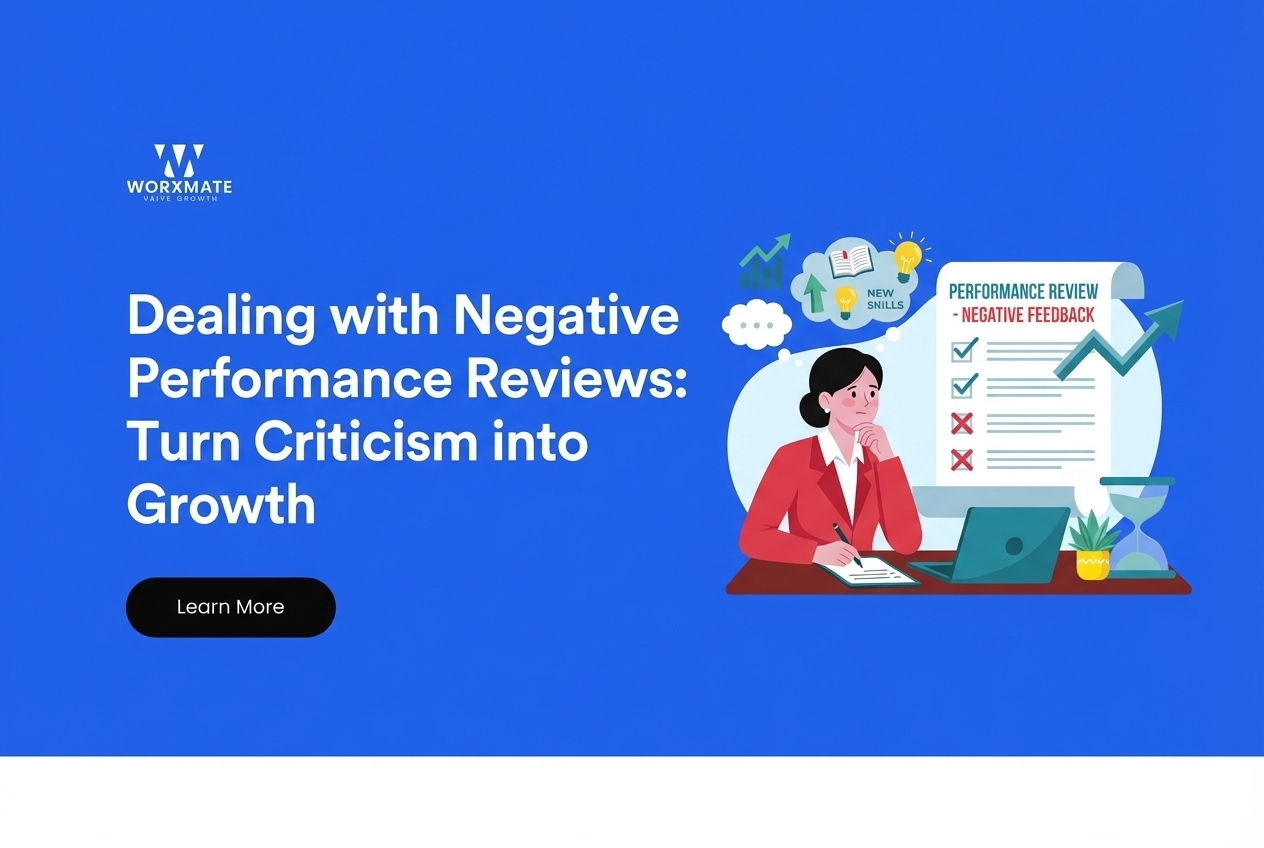
Few professional experiences are as jarring as sitting through a performance appraisal that yields a “needs improvement” rating, only to have that same manager ask you to lead a critical project the following Monday. This paradox creates a state of professional vertigo. You are left wondering: Am I actually failing, or is the review a formality? If my work is substandard, why am I still the go-to person for high-stakes tasks? Dealing with negative performance reviews in this context requires more than just resilience; it requires a consultant’s mindset to diagnose the underlying organizational dynamics.
In the rapidly evolving corporate landscape of 2026, the traditional annual review is being replaced by continuous feedback loops, yet the “mixed signal” phenomenon persists. Especially in high-growth markets like India, where the pressure to deliver is coupled with a talent crunch in specialized roles, managers often find themselves in a bind. They must document performance gaps per HR mandates while simultaneously relying on your institutional knowledge to meet aggressive quarterly targets. Understanding how to bridge this gap is essential for your performance management journey and long-term career stability.
This guide will walk you through the nuances of conflicting managerial signals, the role of strategic planning in individual success, and how to use modern tools to ensure your output is never again open to subjective misinterpretation.
Understanding the Paradox: Why Managers Give Poor Reviews While Retaining Talent
The first step in dealing with negative performance reviews is acknowledging that a “bad” review is not always a precursor to a termination. In many mid-market companies, particularly in the tech and services sectors in Bengaluru or Gurgaon, managers use reviews as a “calibration” tool. They might be under pressure from leadership to keep ratings within a certain bell curve, or they may be using a lower rating as a “wake-up call” to push a high-potential employee toward a specific area of organizational growth.
Another common reason for this paradox is the “Mission-Critical Dependency.” A manager might genuinely feel your documentation or soft skills are lacking (leading to a negative review), but they also recognize that your technical execution is the only thing keeping a specific project on track. This creates a situation where the manager is “hedging their bets”—identifying your weaknesses to satisfy HR requirements while keeping you close because your output is indispensable for their own KPIs.
By 2026, data-driven performance metrics have become the norm. However, human bias still creeps in. According to a Gartner study on the future of work, over 60% of managers struggle to provide actionable feedback that aligns with day-to-day tasks. This misalignment often results in the “Review-Reality Gap,” where the formal document reflects one version of your performance, while the manager’s daily requests reflect another. Recognizing this gap is the first step toward reclaiming your professional standing.
Achieve Your Goals Faster
See how Worxmate can help your team set clear goals and achieve faster results. Book your free demo today and experience the power of AI-driven OKRs in action.
Decoding the Feedback: Is it a Performance Issue or a Communication Gap?
When dealing with negative performance reviews, you must conduct a cold, clinical audit of the feedback received. Was the feedback “objective” (e.g., “Missed 20% of deadlines”) or “subjective” (e.g., “Lacks a proactive attitude”)? Subjective feedback is often a symptom of a communication gap rather than a lack of competence. In the Indian corporate context, cultural nuances often lead managers to give “soft” negative feedback that is difficult to translate into specific actions.
To decode the feedback, look at your goal setting history. If you met all your KPIs but still received a negative review, the issue is likely one of visibility or alignment. Your manager may not fully understand the complexity of your tasks, or perhaps the goals themselves were not properly calibrated at the start of the cycle. This is where task management transparency becomes vital. If your manager doesn’t see the “how,” they only judge the “what,” and if the “what” doesn’t perfectly match their shifting expectations, the review suffers.
Ask yourself these three questions:
- Did I have a clear, documented list of expectations before this review?
- Does my manager’s daily behavior (requesting collaboration) contradict the written feedback?
- Are the “areas for improvement” skills that I am actually using in the new projects I’ve been assigned?
If the answer to the last two is “Yes,” you are likely dealing with a manager who values your work but is failing to communicate your value within the formal performance system.
Practical Steps for Dealing with Negative Performance Reviews and Conflicting Signals
Once you’ve identified the mixed signals, you need a proactive strategy. Silence is often interpreted as agreement in the corporate world. If you disagree with the review but want to continue collaborating, you must initiate a “Clarification Session.” This is not a confrontation; it is a strategic alignment meeting aimed at understanding employee satisfaction from the manager’s perspective.
Start by documenting every instance where your manager has requested your help on critical tasks since the review. Use this data to highlight the contradiction. For example: “In my review, it was noted that I need to improve my leadership skills, yet I have been asked to lead the Alpha Project’s sprint planning. I want to ensure I am applying the leadership standards you expect during this project. Could we define what success looks like for this specific task?”
This approach does two things: it forces the manager to acknowledge the value you are currently providing and it links your “improvement areas” to real-world work. Dealing with negative performance reviews effectively means turning the review into a living document rather than a static annual event. Suggesting a move to a more agile framework, such as OKR examples you’ve researched, can show that you are committed to objective growth and measurable results.
Using OKRs to Clarify Expectations and Objective Success
One of the most effective ways to eliminate mixed signals is to move the conversation from “feelings” to “Objectives and Key Results” (OKRs). When dealing with negative performance reviews, OKRs serve as your shield and your roadmap. They replace vague descriptors like “hardworking” or “unreliable” with “Achieved 15% increase in lead conversion” or “Reduced system latency by 200ms.”
If your company doesn’t already use a dedicated OKR software, you should advocate for its adoption. For an individual contributor, setting your own “Bottom-Up” OKRs and getting manager buy-in can transform the next review cycle. You can say, “To address the feedback in my last review, I have set these three Objectives. If I hit these Key Results, will that constitute an ‘Exceeds Expectations’ rating in the next cycle?”
This level of long-term business goals with examples of your direct contribution makes it nearly impossible for a manager to give a subjective negative review later. In 2026, the best performers are those who own their data. By using a performance management system that tracks progress in real-time, you remove the “surprise” element of the annual review. You and your manager will always be looking at the same dashboard, ensuring that collaboration requests are always aligned with recognized performance.
Dealing with Negative Performance Reviews: When to Stay and When to Pivot
Not every mixed signal can be resolved through better communication. Sometimes, dealing with negative performance reviews reveals a fundamental “cultural mismatch” or a “toxic management” situation. If you have consistently met your OKRs, asked for clarification, and demonstrated growth, but the formal reviews remain negative while the workload increases, you may be in a “performance punishment” cycle.
Performance punishment occurs when a manager gives a high-performer a negative or mediocre review to prevent them from getting promoted (and thus leaving the manager’s team) or to avoid paying out a higher bonus, all while piling on more work because they know you will deliver. In the competitive Indian market, this is a common tactic used to retain “workhorses” without rewarding them as “stars.”
Assessing your long-term growth requires looking at the broader organizational chart. Are others on your team facing similar mixed signals? Is the company’s OKR consulting strategy transparent, or is it a black box? If the negative review feels like a ceiling rather than a stepping stone, it may be time to pivot. However, use the current projects you are being “requested” to collaborate on as fodder for your resume. Turn those high-priority tasks into quantifiable achievements for your next role.
Achieve Your Goals Faster
See how Worxmate can help your team set clear goals and achieve faster results. Book your free demo today and experience the power of AI-driven OKRs in action.
How to Rebuild Professional Trust After a Negative Review
If you decide to stay, rebuilding trust is a two-way street. Dealing with negative performance reviews requires you to demonstrate “active listening” and “iterative improvement.” Even if you feel the review was unfair, showing a willingness to address the manager’s stated concerns—while continuing to excel in the collaborative tasks they assign—builds a narrative of resilience and maturity.
Establish a cadence for “Micro-Reviews.” Instead of waiting six months, ask for a 15-minute check-in every two weeks specifically to discuss the feedback points. Use these sessions to show evidence of change. If the feedback was about “collaboration,” highlight a recent instance where you assisted a cross-functional team. If it was about “strategic thinking,” share a brief insight on how a current task fits into the company’s strategic planning goals.
Rebuilding trust also involves managing up. Help your manager look good by providing them with the data they need to defend your performance to their superiors. Often, a manager wants to give you a better review but lacks the documented evidence to “prove” it to the HR department or the leadership team. By consistently using performance management software to log your wins, you give them the ammunition they need to upgrade your status.
Case Study: Software Engineer — From ‘Needs Improvement’ to Lead Architect
-
The Challenge
Arjun, a Senior Software Engineer at a mid-sized fintech firm in Mumbai, received a “Needs Improvement” rating during the annual cycle. The feedback cited “lack of ownership” and “poor communication.” However, that same week, his manager asked him to lead the migration of the core payment gateway—a high-risk, high-visibility project.
-
The Solution
Confused by the mixed signals, Arjun didn’t retreat. He requested a meeting to align his new project responsibilities with his review feedback. He proposed using a structured OKR framework to track the migration. He set an Objective: “Seamlessly migrate payment gateway with zero downtime,” with Key Results focused on technical milestones and weekly stakeholder updates (addressing the ‘communication’ feedback).
-
Results and Impact
By using OKR software to make his progress visible, Arjun eliminated the subjectivity of his manager’s “feelings.” Six months later, the project was a success. His manager had a documented trail of Arjun’s “ownership” and “proactive communication.” This led to the negative review being overturned in the mid-year cycle, followed by a promotion to Lead Architect. According to McKinsey research, companies that implement frequent, objective performance discussions see a 24% increase in employee engagement and significantly higher retention of top talent.
Dealing with negative performance reviews is never easy, but in the modern workplace, it is a challenge that can be managed with the right data and the right mindset. By moving away from subjective “vibes” and toward objective OKRs, you can turn mixed signals into a clear path for advancement. Whether you are seeking to rebuild trust within your current team or preparing for your next big move, your ability to navigate these dynamics is a hallmark of professional maturity.
The future of work in 2026 and beyond belongs to those who can bridge the gap between formal evaluations and daily contributions. Don’t let a single document define your career—let your results, documented and aligned with organizational goals, speak for themselves.
Ready to accelerate your career resilience journey? Start your free trial with Worxmate today and discover how our Performance Management software can transform your strategy into measurable results.


Written by
An OKR Coach with 20+ years of implementation experience, Madhusudan has guided over 50 organisations through successful OKR transformations, training more than 500 leaders. Learn more about Worxmate.
Frequently Asked Questions
Look for the “Review-Reality Gap.” If your review cites subjective issues (e.g., “lacks proactive attitude”) but you are consistently assigned high-priority, mission-critical projects, the rating is likely a calibration tool to fit a bell curve or satisfy HR mandates. Genuine warnings usually come with concrete examples, a performance improvement plan (PIP), and a noticeable reduction in your responsibilities. If your workload increases despite a “needs improvement” rating, it’s likely a mixed-signal situation rather than a pre-termination warning.
Schedule a “Clarification Session” focused on alignment, not confrontation. Use data to bridge the gap. For example: “In my review, you noted I need to improve leadership skills. Yet you’ve asked me to lead the Alpha Project. To ensure I meet your expectations, could we define what successful leadership looks like for this specific project?” This approach forces the manager to acknowledge your value while giving you actionable, objective criteria to meet.
Performance punishment happens when a manager gives you a mediocre or negative review to prevent your promotion (so you don’t leave their team) or avoid paying a bonus, while still assigning you heavy workloads because you deliver results. Signs include: consistently meeting or exceeding OKRs, receiving critical project assignments, but getting low ratings; being denied growth opportunities; and noticing that peers with similar output receive better reviews. If this persists after you’ve requested clarification, it may be time to pivot to a new role.
It depends on the root cause. Stay if: the feedback was subjective but fixable, your manager agrees to use OKRs for clarity, and you see a genuine path to rebuilding trust through micro-reviews. Consider leaving if: you’ve documented objective success, requested alignment, and the negative reviews continue while your workload increases (a sign of a toxic “workhorse” culture). Use the high-priority projects you’re leading to build quantifiable achievements for your resume and external opportunities.