 WORXMATE
Summary
OKR software for hybrid teams provides a unified digital environment to synchronize organizational goals across distributed workforces. By centralizing objectives, this technology ensures that both remote and in-office employees remain focused on high-impact outcomes rather than mere activity.
This article explores how specialized software bridges the alignment gap and fosters transparency in hybrid settings. It provides strategic insights for HR leaders looking to drive accountability and engagement through modern goal-setting frameworks.
OKR software for hybrid teams is a strategic platform that enables organizations to align individual efforts with corporate objectives across varying locations and time zones. As the modern workplace shifts toward a permanent mix of remote and office-based work, the traditional methods of “management by walking around” have become obsolete. In their place, leaders require a structured digital framework that provides visibility into progress without infringing on employee autonomy. By implementing OKR software for hybrid teams, companies can create a single source of truth that defines what success looks like, how it is measured, and who is responsible for each key result. This technological foundation is no longer a luxury but a necessity for mid-market firms aiming to maintain distributed team productivity while scaling operations in a complex business environment.
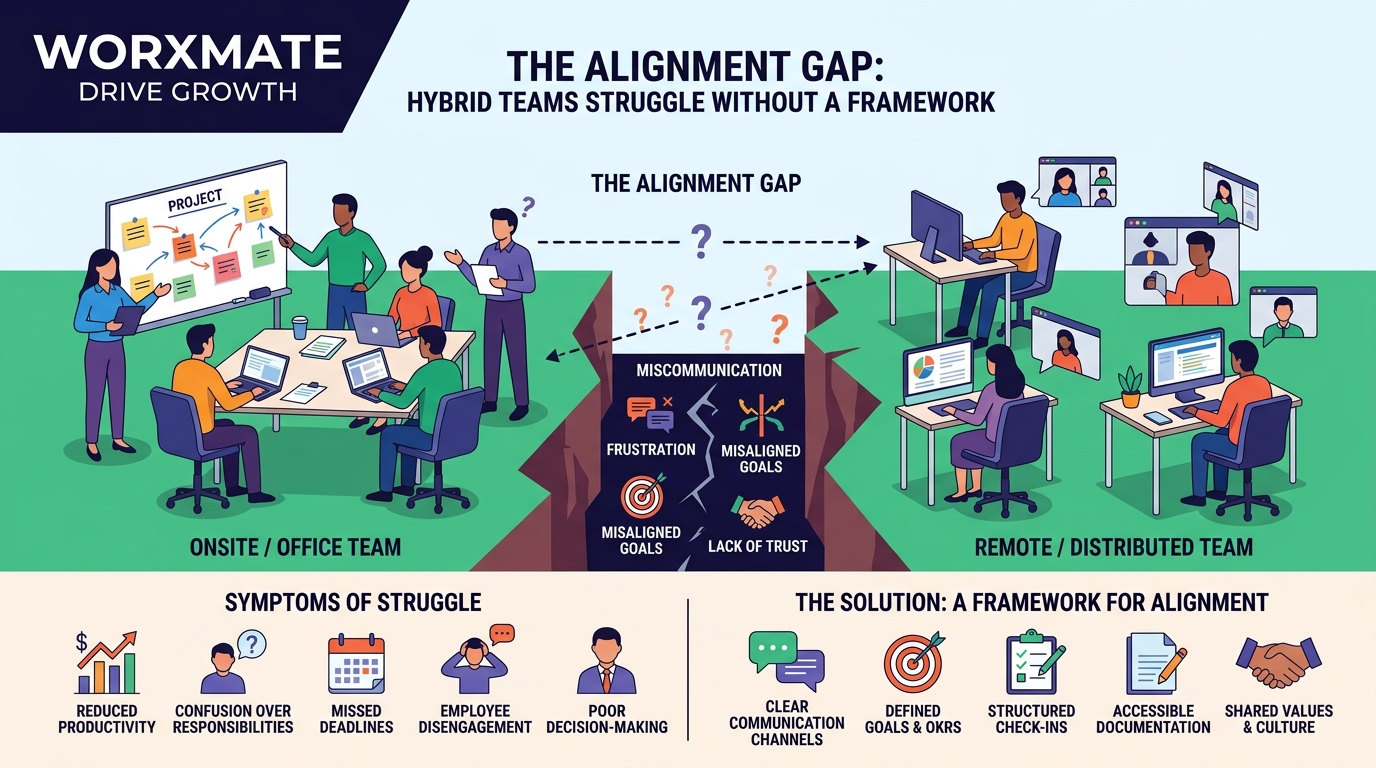
The Alignment Gap: Why Hybrid Teams Struggle Without a Framework
OKR software for hybrid teams addresses the fundamental “alignment gap” that occurs when employees are no longer physically present in the same room. Research by McKinsey indicates that a lack of clear communication regarding post-pandemic working models leads to increased employee anxiety and decreased productivity. This gap often manifests as a “proximity bias,” where in-office employees receive more clarity and recognition than their remote counterparts. Without a robust OKR software for hybrid teams, strategic priorities frequently get lost in the shuffle of daily emails and Slack messages.
The primary challenge in hybrid work management is ensuring that every team member, regardless of their desk location, understands how their daily tasks contribute to the company’s long-term vision. When organizations rely on fragmented tools, they often suffer from “strategic drift,” where teams move in different directions because they lack a common North Star. By utilizing OKR software for hybrid teams, leadership can cascade strategic goals down to the individual level, ensuring that everyone is rowing in the same direction. This software acts as the connective tissue for the organization, replacing the informal hallway conversations that used to keep teams aligned with a formal, transparent record of intent and progress.
Furthermore, the absence of a dedicated framework often leads to “shadow work”—tasks that feel productive but do not actually move the needle on core business objectives. OKR software for hybrid teams forces a discipline of prioritization. By requiring teams to define specific, time-bound key results, the software highlights which activities are essential and which are merely distractions. This level of goal alignment is critical for maintaining a competitive advantage in an era where agility and speed of execution are the primary differentiators between market leaders and also-rans.
Enhanced Transparency: Seeing Progress Across Time Zones
OKR software for hybrid teams solves the visibility crisis that often plagues distributed organizations. In a traditional office, progress is often signaled by physical presence and visible activity. In a hybrid world, these signals are gone. OKR software for hybrid teams replaces physical cues with digital transparency, allowing any employee to see the status of any objective at any time. This radical transparency is essential for building trust; when people can see what their colleagues are working on, the need for constant status update meetings diminishes significantly.
One of the most significant benefits of OKR software for hybrid teams is its ability to facilitate transparent communication across different time zones. A team lead in New York can log in and instantly see the progress made by a developer in Bangalore without needing to wait for a sync call. This asynchronous visibility is a cornerstone of distributed team productivity. According to the Harvard Business Review, transparency in goal setting is one of the highest predictors of team success in remote settings. By using OKR software for hybrid teams, companies can move away from “black box” departments and toward a culture of open contribution.
This transparency also aids in identifying bottlenecks before they become critical failures. When OKR software for hybrid teams is used effectively, it provides a real-time performance dashboard that flags key results that are “at risk” or “behind.” In a hybrid environment, these early warning signs are often missed in casual conversation. The software ensures that data-driven insights are available to everyone, fostering a proactive approach to problem-solving rather than a reactive one. This is a vital component of a modern strategic performance management system.
-
Eliminating Information Silos
By centralizing all objectives in OKR software for hybrid teams, departments can see how their work intersects with others, preventing the “silo effect” that often occurs in remote-heavy cultures.
-
Democratizing Data Access
Every employee, from the intern to the CEO, has access to the same progress metrics, ensuring that everyone is operating from the same set of facts.
-
Reducing Meeting Fatigue
When progress is visible in the software, teams can repurpose “status update” meetings for more valuable strategic discussions and creative collaboration.
Driving Accountability Without Micromanagement
OKR software for hybrid teams provides the perfect balance between oversight and autonomy. For many managers, the shift to hybrid work triggered an instinct to micromanage—tracking “green dots” on chat apps or requiring exhaustive daily logs. However, OKR software for hybrid teams shifts the focus from how people work to what they actually achieve. This “outcome-driven” approach is the hallmark of effective hybrid work management. By setting clear key results within the OKR software for hybrid teams, managers can step back and allow employees the flexibility to manage their own schedules, provided the results are met.
This shift is crucial for remote performance tracking. Instead of monitoring inputs (hours spent), leaders monitor outputs (milestones reached). OKR software for hybrid teams makes this transition seamless by providing a structured way to document commitments. When an employee owns a specific key result in the system, they feel a heightened sense of personal accountability. They are not just completing tasks; they are responsible for a measurable piece of the company’s success. This sense of ownership is a powerful motivator that thrives in a hybrid environment when supported by the right OKR software for hybrid teams.
Moreover, OKR software for hybrid teams facilitates regular OKR check-ins. These are not policing sessions, but rather supportive conversations focused on progress and obstacles. The software provides the data foundation for these talks, ensuring they are objective and focused on growth. This approach reduces the stress associated with traditional performance management cycles and replaces it with a continuous loop of feedback and improvement. By using OKR software for hybrid teams, organizations can build a high-trust culture where accountability is a shared value rather than a top-down mandate.
Centralizing Communication Around Strategic Goals
OKR software for hybrid teams acts as a central hub for all strategic conversations. In many hybrid organizations, communication is scattered across email, Slack, Jira, and various document editors. This fragmentation makes it nearly impossible to maintain a coherent narrative about the company’s direction. OKR software for hybrid teams provides a dedicated space where every discussion is linked directly to a specific objective. This ensures that transparent communication is always grounded in the context of what the company is trying to achieve.
When teams use OKR software for hybrid teams, they can attach comments, updates, and evidence of progress directly to the key results. This creates a historical record of why certain decisions were made and how goals evolved over time. For a hybrid workforce, this context is invaluable. A new hire joining a remote team can look at the OKR software for hybrid teams and immediately understand the history and current status of their team’s priorities. This accelerates the onboarding process and ensures that culture and strategy are integrated from day one.
Furthermore, OKR software for hybrid teams integrates with the tools your team already uses. Whether it is pulling data from a CRM or pushing updates to a chat channel, the software ensures that OKRs remain top-of-mind. This prevents the “set it and forget it” mentality that often dooms manual goal-setting efforts. By weaving OKR software for hybrid teams into the daily workflow, organizations ensure that organizational alignment is a lived experience rather than a static document on a shared drive.
| Feature | Manual Spreadsheets | OKR Software for Hybrid Teams |
|---|---|---|
| Data Accuracy | Prone to manual entry errors | Automated sync with source systems |
| Visibility | Hidden in private folders | Global search and real-time updates |
| Collaboration | Static, one-way reporting | Interactive comments and tagging |
| Historical Context | Difficult to track changes | Full audit trail of goal evolution |
| Scalability | Breaks as team size increases | Designed for thousands of users |
Real-Time Data: Moving Beyond Static Spreadsheets
OKR software for hybrid teams represents a quantum leap over the traditional “spreadsheet and slide deck” approach to goal tracking. In a fast-moving hybrid environment, a spreadsheet is out of date the moment it is saved. OKR software for hybrid teams provides a live view of the organization’s pulse. This real-time performance tracking allows leaders to make informed decisions based on today’s data, not last month’s report. For mid-market companies, this agility is a significant component of their business growth strategy.
The move to OKR software for hybrid teams also enables more sophisticated data visualization. Instead of staring at rows of numbers, stakeholders can view progress through intuitive dashboards, heatmaps, and alignment trees. This makes it easier to spot trends and outliers. For example, if the OKR software for hybrid teams shows that three different teams are all struggling with key results related to a single product launch, leadership can quickly identify a systemic issue rather than blaming individual performance. This is the essence of moving beyond spreadsheets.
Additionally, OKR software for hybrid teams supports the use of both leading indicators and lagging indicators. While spreadsheets often focus on the final result (lagging), software can track the activities and milestones (leading) that predict future success. This predictive capability is essential for hybrid work management, where managers need to know if a project is going off track before the deadline passes. By leveraging the data capabilities of OKR software for hybrid teams, organizations can move from a posture of hindsight to one of foresight.
Boosting Employee Engagement in a Distributed Environment
OKR software for hybrid teams is a powerful tool for enhancing employee engagement. According to Gallup, employees who feel their work is meaningful and aligned with their company’s mission are significantly more engaged and less likely to leave. In a hybrid setting, it is easy for employees to feel like a “cog in the machine.” OKR software for hybrid teams combats this by explicitly showing every individual how their work contributes to the bigger picture. This visual connection between “my task” and “our goal” is a fundamental driver of distributed team productivity.
When companies implement OKR software for hybrid teams, they often see a rise in “discretionary effort”—the willingness of employees to go above and beyond their basic job descriptions. This happens because the software provides a platform for recognition. When a key result is achieved in the OKR software for hybrid teams, it is a visible win that can be celebrated by the entire organization. This digital “high-five” is essential for maintaining morale in a hybrid culture where physical celebrations are rare. It reinforces a performance management culture based on achievement and merit.
Furthermore, OKR software for hybrid teams encourages a “bottom-up” approach to goal setting. While top-level objectives are set by leadership, the software allows teams to propose their own key results. This autonomy is a major factor in employee engagement. When people have a say in how they will be measured, they are much more committed to the outcome. By using OKR software for hybrid teams to facilitate this collaborative process, organizations can tap into the collective intelligence of their entire workforce, leading to more ambitious and creative OKR implementation.
-
Providing Clear Career Paths
By tracking long-term development goals alongside business OKRs in your OKR software for hybrid teams, you show employees that the company is invested in their personal growth.
-
Enhancing Psychological Safety
Transparent goals reduce the “fear of the unknown” that often leads to burnout in remote environments, as everyone knows exactly what is expected of them.
-
Fostering a Sense of Belonging
Seeing the collective progress of the organization in the OKR software for hybrid teams reminds remote workers that they are part of a larger, winning team.
Integrating OKR Software into Your Existing Hybrid Tech Stack
OKR software for hybrid teams should not be another isolated tool that employees have to remember to check. The most successful OKR implementation strategies involve integrating the software deeply into the existing tech stack. Whether your team lives in Microsoft Teams, Slack, Jira, or Salesforce, your OKR software for hybrid teams should meet them where they are. This integration ensures that goal tracking becomes a natural part of the workday, rather than a burdensome administrative task.
For example, a sales team can have their quarterly revenue targets from Salesforce automatically update their key results in the OKR software for hybrid teams. An engineering team can link their Jira epics to specific product objectives. This automation reduces the “friction of reporting” and ensures that the data in your OKR software for hybrid teams is always accurate and up-to-date. For HR directors and Operations managers, this level of integration is key to ensuring high adoption rates across the organization. It is a critical part of a modern hybrid work success strategy.
Finally, OKR software for hybrid teams provides the analytical layer that ties all these disparate tools together. While Jira tracks tasks and Salesforce tracks leads, the OKR software for hybrid teams tracks value. It answers the question: “We are doing all this work, but is it actually helping us achieve our strategy?” By providing this high-level perspective, the software helps leaders optimize their tech stack and ensure that their investments in technology are actually driving business outcomes. This holistic view is the ultimate benefit of adopting OKR software for hybrid teams in a modern, distributed enterprise.
Case Study: Adobe — Scaling Global Alignment with Check-ins
-
The Challenge
Adobe faced significant hurdles as it grew into a global powerhouse. Their traditional annual performance review process was cumbersome, backward-looking, and failed to keep their increasingly distributed workforce aligned with rapid market changes.
-
The Solution
The company abandoned annual reviews in favor of a “Check-in” framework. This model utilized a digital approach to set quarterly objectives and key results, fostering continuous dialogue between managers and employees regardless of their geographic location.
-
Results and Impact
Following the transition to a continuous, goal-aligned system, Adobe saw a 30% reduction in voluntary turnover and estimated that managers saved over 80,000 hours per year that were previously spent on administrative review tasks.
Ready to transform your hybrid work management from a hope into a measurable, company-wide achievement? Stop letting valuable opportunities slip through the cracks.
👉 Start your free trial of Worxmate today and align your team to build consistent, high-impact outcomes.


Written by
An OKR Coach with 20+ years of implementation experience, Madhusudan has guided over 50 organisations through successful OKR transformations, training more than 500 leaders. Learn more about Worxmate.