HR Business Partner OKR Examples for Healthcare Professionals (2026 Guide)
Actionable insights to align your OKRs with everyday performance management-from proven frameworks to the tools that power them.
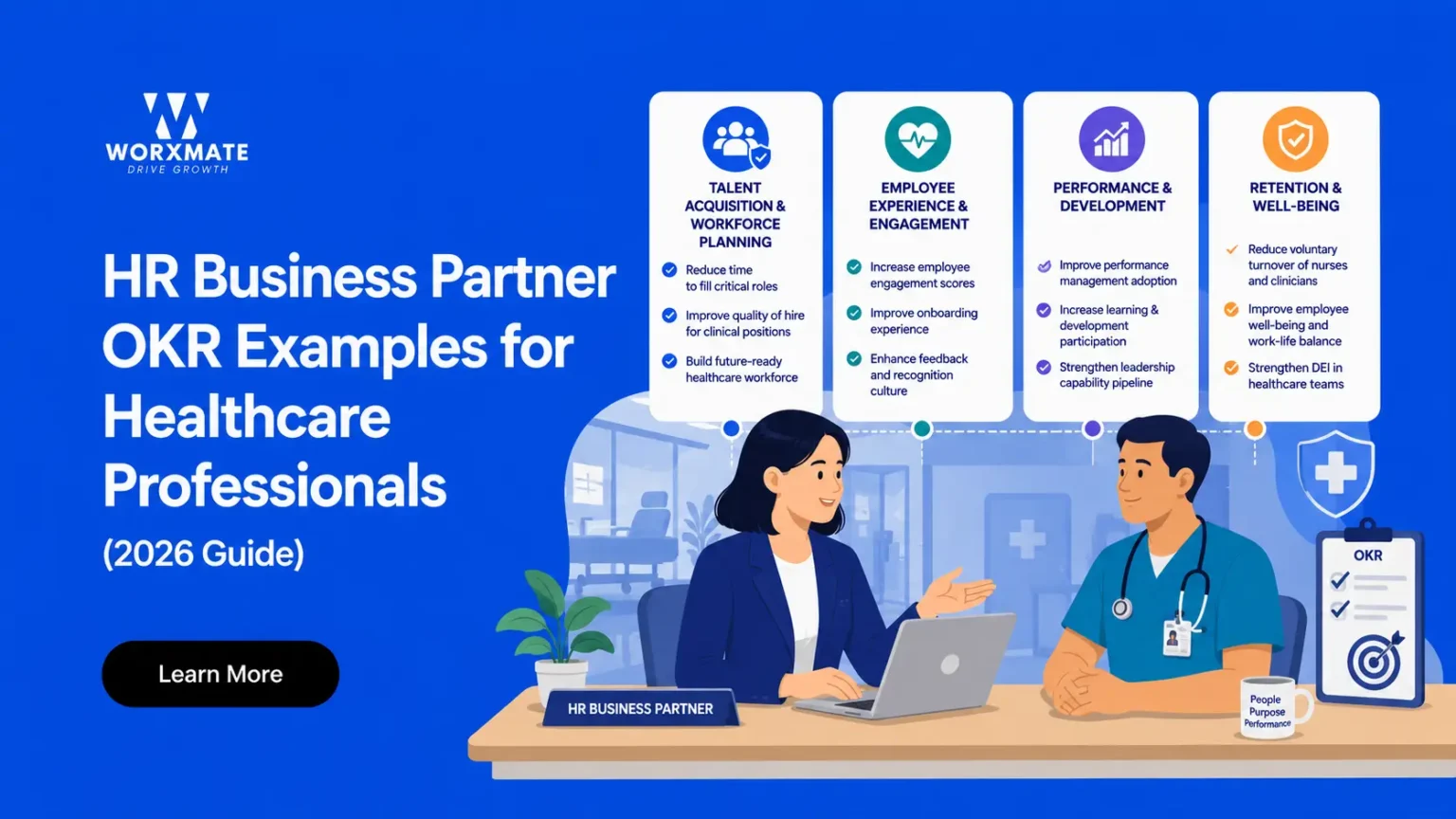
Look, if you’re an HRBP in healthcare right now, you don’t need another theory. You need stuff that works. Between the ongoing staffing shortages, AI popping up in admin tasks, and nurses running on fumes, setting goals for 2026 feels a little ridiculous sometimes. But here’s the truth: well-built OKRs cut through the chaos.
This guide provides 7 practical HR Business Partner OKR examples for healthcare professionals, plus a few blunt tips to stop wasting your team’s time and actually write goals that move the needle.
What Are OKRs for an HR Business Partner? (Simple Definition)
In one sentence: OKRs for an HR Business Partner are a goal-setting framework that pairs a bold Objective (what you want to achieve) with 3-5 measurable Key Results (how you’ll know you got there).
Unlike KPIs (Key Performance Indicators) like “turnover rate” or “time-to-hire,” which just tell you how things are going, OKRs actually drive change. For HRBPs in healthcare, this means shifting from “we’re understaffed” (a complaint) to “reduce PRN agency spend by 15% by Q3” (a Key Result).
What Makes a Good HRBP OKR in 2026?
The rules have changed. Here’s what actually works this year in healthcare:
-
Focus on retention, not just recruiting. The post-COVID churn is still real. An OKR that keeps your current BSNs happy is worth 10 that just chase new hires.
-
Make it AI-aware, not AI-obsessed. Don’t write “leverage AI.” Write “reduce manual schedule conflicts by 20% using automated shift-fill tools.” Be specific.
-
Keep it measurable by week two. If you don’t have a baseline number for “clinician well-being,” go find one first. A good KR is zeros and ones, not vibes.
HR Business Partner OKR Examples for Healthcare
Here are seven real-world examples. Steal these.
Example 1: Reducing Agency Dependency
-
Objective: Reduce our reliance on expensive travel nurses and agency staff to stabilize the core team.
-
Key Result 1: Increase internal float pool utilization from 30% to 55% of total shift coverage.
-
Key Result 2: Decrease spend on external agency staff by $200K this quarter.
-
Key Result 3: Train 25 current staff nurses to dual-certify in med-surg and telemetry.
-
Why this works: It directly attacks budget bleed while building internal capability.
Example 2: Improving Clinician Retention
-
Objective: Give our bedside nurses a real reason to stay for one more year.
-
Key Result 1: Implement a bi-monthly “career pathing” roundtable for 80% of early-career nurses.
-
Key Result 2: Reduce voluntary turnover in the ED from 28% to 22%.
-
Key Result 3: Increase completed tuition reimbursement applications by 40% (people don’t leave if you’re paying for their MSN).
-
Why this works: It addresses burnout with tangible career growth, not pizza parties.
Example 3: New Grad RN Onboarding (First 90 Days)
-
Objective: Get our 2026 new grad RNs from terrified to confident in under 90 days.
-
Key Result 1: Reduce first-year new grad attrition from 35% to 20%.
-
Key Result 2: Achieve 90% completion rate on a structured 12-week preceptor feedback loop.
-
Key Result 3: Increase new grad satisfaction scores (on their 90-day survey) from 3.2 to 4.5/5.
-
Why this works: Fixes the leaky pipeline. Gen Z nurses want transparency and mentorship.
Example 4: Manager Effectiveness (The Hidden Lever)
-
Objective: Turn our charge nurses and unit managers into better coaches (so you don’t have to micromanage everyone).
-
Key Result 1: All 40 unit managers complete a mandatory “difficult conversation” workshop by March 1.
-
Key Result 2: Increase internal promotion rate from charge nurse to manager from 15% to 30%.
-
Key Result 3: Reduce employee relations cases related to “unfair scheduling” by 50%.
-
Why this works: Bad managers cause 70% of preventable turnover. Fix them, fix retention.
Example 5: DEI in Clinical Advancement
-
Objective: Ensure our leadership pipeline actually looks like our patient population.
-
Key Result 1: Increase representation of underrepresented groups in nurse manager interviews by 25%.
-
Key Result 2: Launch a mentorship program pairing 20 BIPOC staff nurses with executive leadership.
-
Key Result 3: Standardize the charge nurse selection rubric to remove subjective bias (100% of units use the new rubric).
-
Why this works: It’s not fluff. It’s a measurable system change.
Example 6: Reducing Scheduling Burnout
-
Objective: Kill the biggest source of nurse frustration: last-minute mandatory shifts.
-
Key Result 1: Reduce unscheduled call-outs on weekends by 30% using a new self-swap app.
-
Key Result 2: Decrease use of “mandatory overtime” notices from 12x/month to 2x/month.
-
Key Result 3: Achieve 80% staff adoption of the new shift-trading board within 8 weeks.
-
Why this works: It solves a real, daily pain point. That builds trust.
Example 7: HR Process Automation (2026 Reality)
-
Objective: Stop drowning in paperwork so you can actually spend time on the floor.
-
Key Result 1: Automate 70% of license verification checks using the new state database API.
-
Key Result 2: Reduce average onboarding time for a travel nurse from 14 days to 5 days.
-
Key Result 3: Cut the HR response time for “leave of absence” requests from 48hrs to 4hrs.
-
Why this works: It frees you up to do strategic work, not data entry.
What Common OKR Mistakes Do HRBPs Make?
I’ve seen these fail in real hospitals. Don’t be that person.
-
Mistake 1: Activity-based KRs. “Conduct 5 satisfaction surveys.” Cool. But so what? The real KR is “increase survey score from 3 to 4.” Outcomes only.
-
Mistake 2: Too many objectives. You cannot fix retention, recruiting, DEI, compliance, and payroll in one quarter. Pick two. Do them well.
-
Mistake 3: Ignoring the unit reality. An OKR for “mandatory overtime reduction” fails immediately if the CNO doesn’t have sign-off. You must get clinical leadership bought in first.
-
Mistake 4: Setting and forgetting. The worst sin. If you don’t look at these OKRs every two weeks, they’re just wishful thinking on a slide deck. Half the reason teams forget is the tool makes checking in a chore — worth a look at our OKR software comparison if that’s your bottleneck.
How to Write Your Own HRBP OKRs (Step-by-Step)
Don’t start with a blank page. That’s how you get garbage. Do this instead.
-
Start with the problem. Ask yourself: What one thing makes 75% of my managers complain on Monday mornings? Staffing? Payroll errors? Toxic behavior?
-
Draft your Objective. Write one sentence that is inspiring but specific. “Fix the night shift” is bad. “Make night shift the safest, most-staffed shift in the hospital” is good.
-
Add 3 KRs. Each must have a number. Example: (1) Add 5 permanent night-shift RNs. (2) Decrease call-outs on nights by 25%. (3) Achieve 90% night shift satisfaction on safety.
-
Pressure-test them. Ask a unit manager: “If we fail at KR #3 but win at #1, did we succeed?” If the answer is no, you have a conflict. Fix it before you launch.
Conclusion: Stop Reading. Start Doing.
Look, you’ve got seven real examples, a handful of mistakes to avoid, and a step-by-step process. That’s more than enough to start.
Here’s the honest truth: No OKR framework survives first contact with reality. Your ED manager will quit. Your budget will get cut. Some new compliance rule will drop out of nowhere. That’s fine. The goal isn’t perfection—it’s progress.
So here’s your one thing for this week:
Pick one objective from this guide. Just one. Write it down. Share it with one person on Monday morning. Check in on Friday.
That’s it. That’s literally all it takes to be better than 90% of HR teams who just talk about OKRs but never actually do them.
And if you want to stop wrestling with spreadsheets and manually chasing updates? That’s where Worxmate comes in. See how these same OKRs come to life—auto-aligned to your performance reviews, tracked weekly, and actually painless.
Ready to see the demo? Let’s turn these examples into your reality. 🚀


Written by
An OKR Coach with 20+ years of implementation experience, Madhusudan has guided over 50 organisations through successful OKR transformations, training more than 500 leaders. Learn more about Worxmate.
Frequently Asked Questions
While HR KPIs track baseline operational metrics like turnover rates or time-to-fill, HRBP OKRs actively drive strategic change by pairing a bold objective with measurable key results. In healthcare, this means shifting from simply tracking understaffing to actively reducing PRN agency spend or improving float pool utilization.
Effective healthcare OKRs tackle burnout by focusing on tangible career growth, structured mentorship, and manageable workloads rather than superficial perks. For instance, setting key results around bi-monthly career pathing roundtables or tuition reimbursement applications directly impacts retention.
To measure qualitative goals effectively, establish a firm baseline during week two and tie your key results to concrete actions or scored surveys. A strong KR relies on hard numbers and tracked behaviors—like completion rates on feedback loops—rather than subjective feelings.
New grad OKRs should focus on accelerating confidence and support within the critical first 90 days of employment. Key results should target reduced first-year attrition, higher satisfaction survey scores, and completion rates on structured preceptor feedback loops.
HRBPs can target agency dependency by building internal capacity and cross-training current staff to handle multiple unit demands. Objectives should focus on increasing internal float pool utilization and decreasing external agency spend by a specific dollar amount each quarter.
Unit managers and charge nurses directly influence daily bedside morale, meaning better coaching prevents HR from having to constantly micromanage staff issues. OKRs focused on manager effectiveness typically mandate leadership workshops and difficult-conversation training to empower frontline leaders.
A common mistake is copying generic corporate templates that fail to address the unique operational realities of clinical environments, such as shift work and acute staffing shortages. HRBPs also frequently write vague key results that rely on subjective vibes rather than actionable metrics.
Worxmate provides an AI-powered platform built specifically to align strategy execution, goal cascading, and OKR management across complex enterprise structures. It helps HR and business leaders track progress seamlessly, ensuring that departmental HRBP goals tie directly into overarching organizational success.
Given the dynamic nature of healthcare operations, HRBPs should conduct bi-weekly check-ins to monitor KR progress and quarterly reviews to recalibrate objectives. This agility ensures that goals remain relevant when sudden staffing shortages or regulatory changes arise.