
Practical Legal OKRs: 2026 Blueprint for Legal Teams
Actionable insights to align your OKRs with everyday performance management-from proven frameworks to the tools that power them.
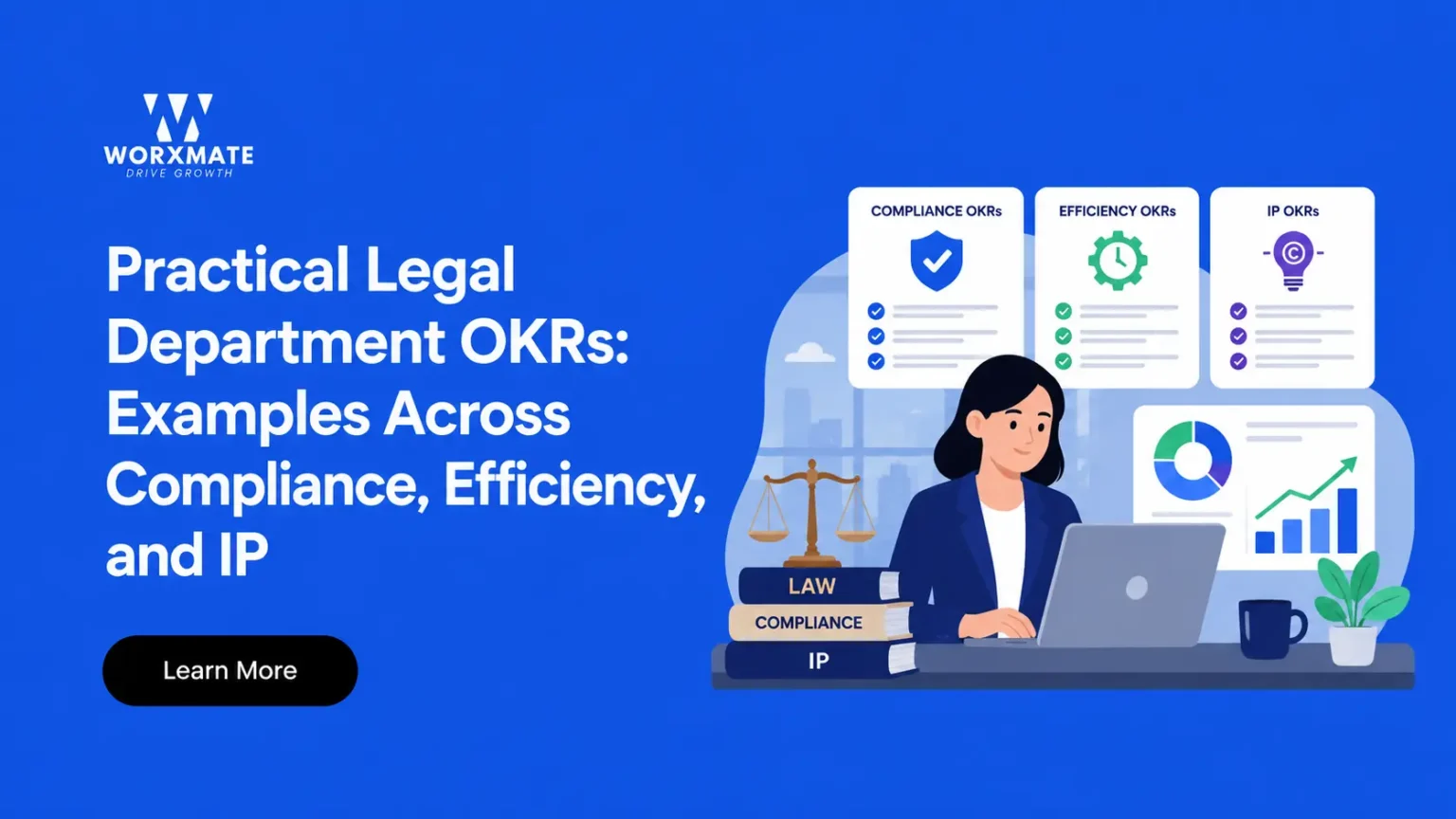
Legal department OKRs shift teams from reactive cost centers to strategic growth engines. By deploying a modern OKR Solution, General Counsel automate compliance, accelerate contract cycles, and align legal output with boardroom objectives. Move beyond static spreadsheets to real-time performance intelligence and predictive forecasting.
The most common failure point for General Counsel isn’t a lack of legal expertise—it’s the inability to translate that expertise into business velocity. When legal teams operate as a “black box,” they lose their seat at the table. The transition to a modern OKR framework is the only way to quantify your impact on the bottom line and prove your department is an engine for growth.
The transition to legal department OKRs matters because the role of the General Counsel has fundamentally changed. Today’s legal leaders are expected to contribute to business velocity, manage complex global risks, and oversee digital transformation. Using a strategic performance management system allows these leaders to quantify their successes, such as reducing contract turnaround times or increasing compliance training completion rates, in a way that aligns with the CEO’s vision.
In this guide, we will explore the evolution of legal performance management, identify why traditional KPIs often fall short, and provide practical examples for compliance, risk, and efficiency. We will also discuss how to achieve strategic alignment between legal and the wider business, ensuring your team remains a vital driver of organizational success.
The Evolution of Legal: From Cost Center to Strategic Partner
Historically, legal departments were evaluated based on their ability to stay within budget and avoid litigation. This “cost center” mentality often led to a reactive posture, where legal was seen as a hurdle to be cleared rather than a partner to be consulted. However, companies like Microsoft and Google have pioneered a different approach, integrating legal deeply into product development and market expansion strategies.
The shift toward outcome-driven performance management reflects a broader trend in corporate governance. According to Gartner, legal department spending on technology is expected to increase threefold by 2025 as teams seek to automate routine tasks and focus on higher-value strategic work. This evolution requires a new way of measuring success—one that prioritizes the impact of legal advice on business outcomes rather than just the volume of work produced.
Strategic legal teams now participate in strategic priorities such as ESG (Environmental, Social, and Governance) initiatives, cybersecurity readiness, and intellectual property monetization. By setting legal department OKRs that reflect these priorities, legal leaders can prove that their department is an engine for growth, not just a safety net.
Why Traditional KPIs Aren’t Enough for Modern Legal Teams
Enterprise Comparison: Static vs. AI-Driven OKRs
When evaluating an OKR Solution, the difference between a spreadsheet and a platform is the difference between tracking history and driving the future.
| Feature | Static Spreadsheets | Worxmate OKR Solution |
|---|---|---|
| Predictive Forecasting | None | AI-Driven |
| Security Compliance | Low (Drive/Email) | SOC2 Enterprise |
| Cross-Functional Nexus | Disconnected | Automated Alignment |
| Performance Visibility | Lagging | Real-time Intelligence |
| Goal Authoring | Manual | AI-Assisted |
| Operational Blocker Detection | None | Automated |
| Best For | Small Teams | Enterprise Scale |
| Feature | Static Spreadsheets | Worxmate OKR Solution |
|---|---|---|
| Goal Visibility | Siloed/Manual | Real-time Enterprise View |
| AI Automation | None | Predictive Forecasting |
| Security | Low (Email/Drive) | SOC2 Enterprise Grade |
| Cross-functional | Disconnected | Nexus AI Alignment |
| Performance Data | Lagging Indicators | Continuous Intelligence |
While Key Performance Indicators (KPIs) like “total legal spend” or “number of lawsuits filed” provide a snapshot of activity, they rarely tell the full story of departmental value. Traditional performance metrics in legal tend to be lagging indicators—they measure what has already happened rather than influencing future performance.
For example, a KPI tracking “matters closed” doesn’t account for the complexity or the strategic importance of those matters. In contrast, legal department okrs focus on the “why” and the “result.” Instead of just closing contracts, an Objective might be to “Enable faster sales cycles,” with a Key Result of “Reducing the average contract negotiation time by 15%.” This shifts the focus from the task to the business benefit.
| Feature | Traditional Legal KPIs | Legal Department OKRs |
|---|---|---|
| Primary Focus | Efficiency and activity volume | Strategic outcomes and value |
| Timeline | Static, often annual | Dynamic, typically quarterly |
| Alignment | Department-specific silos | Cross-functional alignment |
| Visibility | Private to leadership | Transparent across the organization |
As John Doerr notes in his seminal work on OKRs, the framework is designed to foster focus, alignment, and tracking. For legal teams, this means moving away from “busy work” and toward measurable goals that reflect the department’s true contribution to organizational health.
Key Focus Areas for Legal Department OKRs
When developing legal department okrs, it is helpful to categorize goals into specific pillars that reflect the department’s core responsibilities. This ensures a balanced approach that covers both defensive (risk-based) and offensive (growth-based) strategies.
Operational Excellence and Efficiency
Focus on streamlining processes to reduce friction for internal stakeholders. According to McKinsey, legal departments can achieve 20% to 30% efficiency gains by optimizing process management and adopting automation. This might involve implementing new contract management software or refining intake procedures.
Risk Mitigation and Compliance
Ensure the organization stays ahead of regulatory changes and internal policy requirements. These OKRs should focus on proactive education and the creation of robust frameworks that prevent issues before they arise, rather than just responding to breaches.
Strategic Business Partnership
Align legal support with the goals of other departments, such as Sales, HR, or Product. By embedding legal expertise into the early stages of business planning, the team can help navigate obstacles and accelerate time-to-market for new initiatives.
By using these focus areas as a guide, legal leaders can ensure their legal department okrs are comprehensive and touch every facet of the business where legal expertise is required.
Practical Legal Department OKRs Examples for Modern Teams
To implement this framework effectively, it helps to see concrete legal department okrs that address real-world challenges. Below are three examples across compliance, efficiency, and risk management.
Example 1: Enhancing Compliance Culture
Objective: Become a industry leader in proactive regulatory compliance and ethics.
KR 1: Achieve 100% completion of the annual ethics training by all employees within 30 days of launch.
KR 2: Conduct 4 internal audits of high-risk departments and implement all recommended corrective actions.
KR 3: Reduce the number of reported policy violations by 20% compared to the previous year.
Example 2: Improving Contract Lifecycle Efficiency
Objective: Streamline the contract process to support increased sales velocity.
KR 1: Implement an automated contract management system (CMS) across the Sales and Procurement teams.
KR 2: Reduce the median turnaround time for standard NDAs from 3 days to 24 hours.
KR 3: Update 100% of standard contract templates to reflect the latest 2025 regulatory requirements.
Example 3: Strategic Intellectual Property Management
Objective: Strengthen the company’s competitive advantage through robust IP protection.
KR 1: File 15 new patent applications for core product innovations identified by the R&D team.
KR 2: Complete a comprehensive IP audit of all third-party licenses to ensure 100% compliance.
KR 3: Conduct 2 workshops for the engineering team on identifying and documenting patentable inventions.
These business strategy OKR examples demonstrate how legal can set targets that are both ambitious and quantifiable, providing a clear roadmap for success.
Unlock Goal Clarity and Accelerate Employee Growth
Looking to drive goal clarity and employee growth? Discover how Worxmate’s AI-powered Performance Management Software can help.
How to Align Legal Department OKRs with Corporate Strategy
For legal department okrs to be truly effective, they must not exist in a vacuum. They need to be vertically aligned with the organization’s top-level mission and horizontally aligned with the goals of other business units. This process of organizational alignment ensures that everyone is pulling in the same direction.
According to research published in the Harvard Business Review, companies with highly aligned employees grow revenue 58% faster and are 72% more profitable than unaligned peers. For a General Counsel, this means sitting down with the CEO and other department heads to understand their biggest pain points. If the CEO’s primary goal is “International Expansion,” the legal department’s Objective should reflect the legal groundwork required to enter new markets safely and quickly.
Using performance management frameworks helps facilitate these conversations. When legal can show how their specific Key Results directly support a corporate Objective, it changes the narrative from “how much does legal cost?” to “how much value is legal adding to our expansion efforts?” This level of transparency is essential for maintaining the department’s influence and securing the necessary budget for future initiatives.
Overcoming Common Challenges in Legal Goal Setting
The Pattern: In a recent enterprise engagement with a European Fintech scaleup (~100 people) experiencing product demo conversion drops, we found that legal and sales were operating in silos. Legal was tracking ‘matters closed’ while Sales was failing to convert due to contract friction.
The Intervention: We pushed the team through rigorous ‘so what’ inquiry sequences and mandated cross-functional co-ownership of a single Key Result between the Product Lead and the Account Executive.
The Result: This eliminated blame culture, aligned commercial and product teams on demo-to-conversion rates, and accelerated annual growth delivery.
Implementing legal department okrs is not without its hurdles. Many legal professionals find it difficult to quantify work that is inherently qualitative, such as “providing sound legal advice.” There is also the challenge of the “dog that didn’t bark”—measuring the risks that were avoided because of legal’s proactive intervention.
One common mistake is setting too many Key Results, which leads to a lack of focus. A successful implementation of legal department okrs requires prioritizing the 3-5 most impactful goals for the quarter. Another challenge is the fear that strictly defined goals will limit the department’s ability to respond to urgent, unforeseen legal crises. To counter this, OKRs should be viewed as a flexible framework, not a rigid set of rules; they can be adjusted if the business environment shifts significantly.
Education is key to overcoming these barriers. Teams need to understand that legal department okrs are not a tool for micromanagement but a way to provide clarity and purpose. When legal staff see how their work contributes to the company’s success, engagement levels typically rise, as they feel more connected to the organization’s mission.
Tracking and Managing Legal Performance with Worxmate
To truly master legal department okrs, legal operations leaders need the right tools to track progress and visualize data. Relying on manual spreadsheets often leads to outdated information and a lack of real-time visibility. Worxmate provides a comprehensive platform designed to manage complex goal hierarchies and foster collaboration across teams.
With Worxmate, General Counsel can utilize performance analytics to monitor Key Results in real-time. This allows for more meaningful check-ins and the ability to pivot strategies quickly if a goal is at risk. By centralizing all legal department okrs in one place, the entire team stays aligned on what matters most, reducing administrative overhead and allowing lawyers to focus on high-level legal work.
Furthermore, Worxmate’s integration with other business systems ensures that legal performance data is always contextually relevant to the company’s broader performance. Whether you are aiming to improve compliance, drive efficiency, or support a major merger, Worxmate provides the transparency and structure needed to turn legal strategy into measurable business impact. Regular check-ins maintain momentum and keep strategic priorities front of mind. Tracking a real-time confidence score helps identify at-risk targets before quarter-end. Surfacing operational blockers early ensures leadership can clear obstacles quickly. Seamless cascading ensures department milestones stay synchronized with company strategy. Strong goal alignment eliminates siloed efforts and connects daily work to strategic outcomes.
Adopting legal department okrs is a transformative step for any in-house legal team. Start your free trial with Worxmate today and discover how our Performance Management software can transform your legal strategy into measurable results.


Written by
An OKR Coach with 20+ years of implementation experience, Madhusudan has guided over 50 organisations through successful OKR transformations, training more than 500 leaders. Learn more about Worxmate.
Frequently Asked Questions
An OKR Solution replaces manual tracking with real-time performance intelligence, allowing legal teams to automate contract cycles, identify operational blockers, and align legal output with corporate growth objectives.
Spreadsheets lack the predictive forecasting, SOC2 security, and cross-functional alignment necessary for modern enterprise legal teams. They treat OKRs as static lists rather than dynamic, AI-driven performance engines.
Yes, using OKR software is highly beneficial for legal departments as it provides real-time visibility into goal progress and automates tracking. According to Gartner, legal tech spending is rising because automation and structured data allow legal teams to prove their strategic value to the C-suite more effectively than manual spreadsheets.
Common mistakes include setting too many goals, focusing on activities (outputs) rather than outcomes, and failing to align legal goals with other departments. To succeed, legal leaders should prioritize a few critical Objectives and ensure they are developed in collaboration with stakeholders from Sales, Finance, and HR.
Compliance OKRs shift the focus from merely checking boxes to proactively building a strong compliance culture that supports business growth. By establishing measurable key results—such as increasing training completion rates or reducing regulatory audit findings—General Counsels can demonstrate tangible risk mitigation to the C-suite and board.
An effective efficiency OKR is to streamline contract execution to accelerate business velocity and sales cycles. A sample objective could be to optimize the contract review workflow, supported by key results like reducing average contract turnaround time from ten days to three and increasing automated NDA self-service adoption by 40%.
Legal teams can use IP-focused OKRs to align patent filings and portfolio management directly with core corporate product roadmaps and market expansion strategies. Key results might include auditing existing IP assets for commercial monetization or accelerating the patent application filing timeline for strategic new technologies.
Traditional output metrics only track the volume of work produced without measuring its actual impact on business outcomes or risk reduction. Modern legal OKRs bridge this gap by focusing on strategic value, ensuring that legal operations directly drive competitive advantage rather than just processing requests.
Worxmate provides a centralized AI-powered strategy execution platform that allows General Counsels to cascade high-level corporate and legal objectives down to individual in-house attorneys and compliance specialists. The platform ensures complete visibility, continuous progress tracking, and seamless alignment across departments like HR, Sales, and Finance.