

Summary
Setting OKR stretch goals involves creating ambitious targets that push an organization beyond its current operational limits, typically aiming for a 70% success rate to foster innovation. By distinguishing between moonshots and roofshots, leadership teams can drive a high-performance culture that prioritizes exponential growth over incremental gains.
While traditional goal-setting focuses on 100% completion, the OKR stretch goal framework encourages teams to embrace the risk of failure in exchange for breakthrough results. This guide outlines the strategic process for implementing these ambitious targets while maintaining employee engagement and psychological safety.
Implementing OKR stretch goals is the primary method used by high-growth companies to transition from steady progress to industry leadership. When an organization sets targets that are intentionally difficult to achieve, it forces teams to rethink existing processes and discover more efficient ways of working. This approach is not about working harder, but about working differently to achieve what previously seemed impossible. The challenge for most mid-market companies lies in the balance between ambition and achievability. According to Harvard Business Review, only 10% to 20% of companies successfully achieve their most ambitious targets, often because they lack a structured stretch goal framework. Without the right system, high-pressure targets can lead to burnout rather than innovation.
In the following sections, we will explore how to define these objectives, the psychology behind high ambition, and the specific steps required to integrate aspirational vs committed OKRs into your performance management strategy. By following this structured approach, you can build a resilient culture that thrives on challenge.
What are OKR Stretch Goals? Defining Moonshots vs. Roofshots
At the core of the Google OKR methodology is the distinction between two types of targets: moonshots and roofshots. Understanding the difference is critical for setting the right expectations across your departments. OKR stretch goals are specifically designed to be “moonshots”—targets that are so ambitious they require a fundamental shift in strategy to achieve.
| Feature | Moonshot Goals (Stretch) | Roofshot Goals (Committed) |
|---|---|---|
| Success Definition | 70% achievement is a win | 100% achievement is expected |
| Risk Level | High risk of “failure” | Low risk; focus on execution |
| Primary Focus | Innovation and breakthroughs | Consistency and reliability |
| Resource Need | May require new capabilities | Uses existing resources |
The Psychology of Ambition: Why Your Team Needs to Aim Higher
The drive to set OKR stretch goals is rooted in the “Goal Setting Theory” popularized by Edwin Locke and Gary Latham. They found that specific, difficult goals lead to higher performance than easy goals. When teams aim for the “roof,” they often hit it. When they aim for the “moon,” even a partial success results in significantly higher output than a safe target ever could.
According to Gallup, clear expectations combined with challenging goals can increase employee engagement by up to 30%. This psychological shift moves the team from a defensive mindset of “not failing” to a proactive mindset of “discovering what is possible.”
A Practical 5-Step Process for Implementation
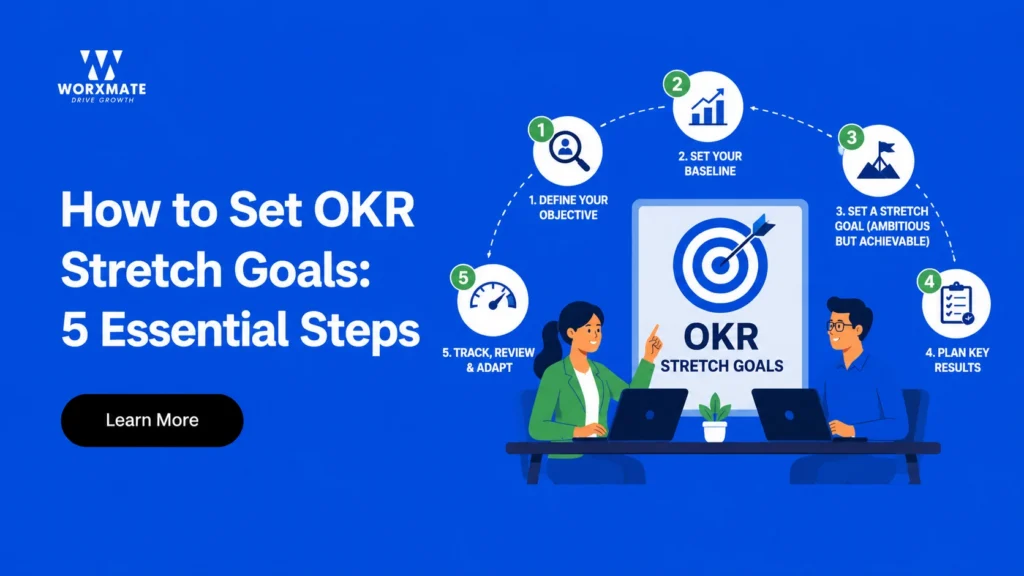
To effectively integrate these ambitious targets into your organization’s workflow, follow these five sequential steps.
Step 1: Define the baseline for OKR stretch goals
Analyze your historical performance data to establish what “business as usual” looks like before setting your targets. You cannot effectively set OKR stretch goals without knowing your current capacity, as an ambitious target must be mathematically distinct from a standard projection.
Pro Tip: Use your last four quarters of data to identify your average growth rate, then set your stretch target at 1.5x to 2x that baseline.
Step 2: Differentiate between moonshot and roofshot goals
Categorize every objective in your OKR setting process as either committed or aspirational. Clearly labeling OKR stretch goals ensures that employees understand that a 70% score on these specific items is considered a high-performance result, not a failure.
Why it matters: Mislabeling a committed goal as a stretch goal can lead to operational gaps, while mislabeling a stretch goal as committed can cause unnecessary stress.
Step 3: Align ambitious targets with strategic priorities
Ensure that every high-effort goal directly supports your organizational alignment and long-term vision. McKinsey reports that companies with high alignment are 2.3x more likely to be in the top quartile of business performance.
Example: If your strategy is market expansion, a stretch goal might be “Enter 5 new international markets” when the team currently has capacity for two.
Step 4: Cultivate psychological safety for OKR stretch goals
Build a culture where “failing” at a moonshot is celebrated as a learning opportunity rather than punished. Without psychological safety, employees will sandbag their targets, setting safe goals they know they can hit 100% of the time to avoid negative reviews.
Pro Tip: Decouple the achievement of stretch goals from direct financial bonuses to encourage true risk-taking.
Step 5: Track progress on OKR stretch goals regularly
Monitor your measurable goals through weekly or bi-weekly check-ins to identify where teams are getting stuck. Frequent tracking allows leadership to reallocate resources or provide coaching before a team becomes discouraged by the magnitude of the target.
The 70% Rule: How to Measure Success When You Miss the Target
In the Google OKR methodology, the “sweet spot” for a stretch goal is a score of 0.6 to 0.7 (or 60-70%). If a team consistently hits 1.0 (100%), the goals are not ambitious enough. If they consistently score below 0.3, they may be setting “impossible” rather than “stretching” goals. Successful outcomes vs outputs monitoring requires looking at the progress made, even if the final number wasn’t reached.
Common Pitfalls: Why Stretch Goals Fail and How to Avoid Them
The most frequent reason OKR stretch goals fail is “stretch goal fatigue.” When every single objective is a moonshot, teams feel overwhelmed and stop trying. Another common mistake is failing to provide the necessary resources; you cannot ask for a 50% increase in lead generation without providing additional tools or budget. Ensure your strategy development accounts for the “how” as much as the “what.”
Balancing Ambition and Burnout: Maintaining Psychological Safety
A high-performance culture is only sustainable if it is built on a foundation of trust. Leaders must emphasize that OKR stretch goals are meant to inspire, not to intimidate. If the pressure to hit 100% on a stretch goal becomes too high, the quality of work often suffers, and top talent may leave. Regularly solicit feedback to ensure the level of challenge remains motivating rather than paralyzing.
How to Track Stretch OKRs Using Performance Management Software
Managing complex OKR stretch goals across a mid-market enterprise is nearly impossible using static spreadsheets. Utilizing a dedicated performance management system allows for real-time visibility into progress and automated flagging of goals at risk. By integrating performance management with OKRs, executives can see exactly which teams are pushing boundaries and which need additional support to reach their ambitious targets.
Ready to accelerate your goal-setting journey? Start your free trial with Worxmate today and discover how our Performance Management software can transform your strategy into measurable results.