
Which B2B SaaS Sales OKR Examples Drive Growth? 8 Picks
Actionable insights to align your OKRs with everyday performance management-from proven frameworks to the tools that power them.
Summary
B2b saas sales OKR examples provide a strategic framework for sales organizations to align individual performance with high-level business objectives. Unlike traditional quotas that focus solely on output, these OKRs emphasize outcomes like pipeline health, deal quality, and market expansion to ensure long-term revenue sustainability.
In the high-velocity world of software, sales leaders face intense pressure to deliver predictable growth while managing complex buyer journeys. By utilizing structured b2b saas sales OKR examples, VPs of Sales and Founders can move beyond transactional management and foster a culture of accountability and strategic execution across SDR, AE, and Leadership roles.
The transition from a “growth at all costs” mentality to efficient, outcome-driven revenue generation is the primary challenge for modern SaaS companies. Sales teams often find themselves buried in activities—calls made, emails sent, meetings booked—without a clear link to the company’s long-term vision. This disconnect leads to bloated pipelines that don’t convert and high burn rates that threaten organizational stability.
Implementing a robust OKR framework allows sales teams to prioritize the right activities. According to Salesforce, 72% of sales professionals say their role has become more consultative, requiring a shift in how success is measured. By focusing on measurable goals that reflect this consultative nature, teams can improve both their win rates and their overall sales productivity.
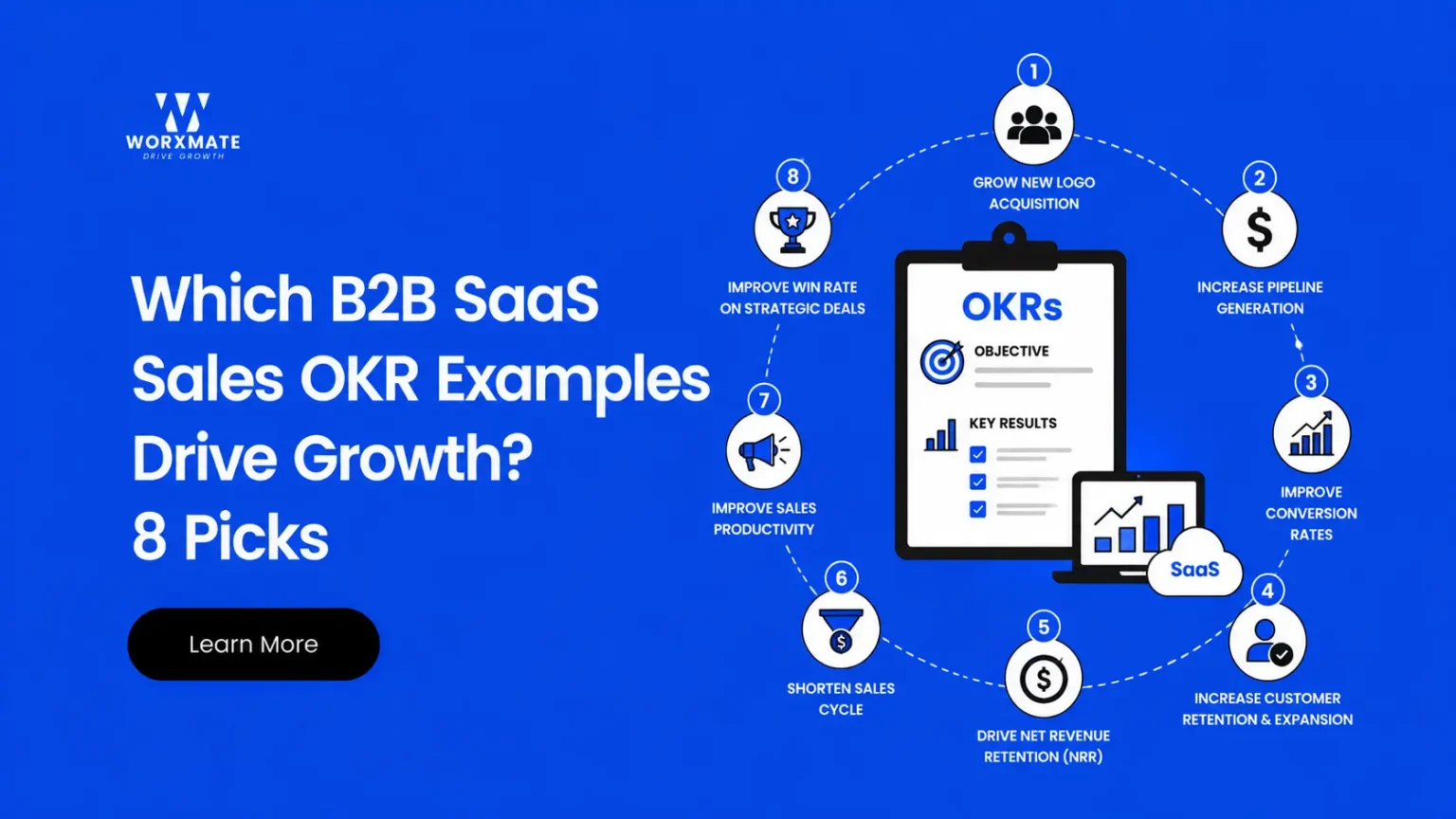
In this article, we have compiled 8 b2b saas sales okr examples designed to help you align your revenue engine. These examples cover various sales functions, from lead generation to leadership, providing a blueprint for sustainable growth.
The Difference Between Sales KPIs and OKRs in B2B SaaS
While often used interchangeably, KPIs and OKRs serve different purposes in a sales organization. KPIs (Key Performance Indicators) are health metrics that track the ongoing performance of a process. In contrast, OKRs (Objectives and Key Results) are used to drive change, improvement, or the achievement of a specific strategic goal. Gartner research suggests that sales teams utilizing an OKR framework see a 15% increase in pipeline velocity by focusing on the right levers rather than just the volume of work.
| Feature | Sales KPIs | Sales OKRs |
|---|---|---|
| Primary Focus | Status quo and business-as-usual | Growth, change, and strategic shifts |
| Timeframe | Ongoing/Continuous | Quarterly (Typically) |
| Example | Monthly Recurring Revenue (MRR) | Improve Win Rate in Enterprise Segment |
How to Set Sales OKRs That Actually Drive Performance
Setting effective Sales OKRs requires a balance between ambitious goals and realistic execution. Start by identifying the biggest bottleneck in your sales funnel. Is it lead quality, deal velocity, or churn? Once identified, create an Objective that is qualitative and inspiring, followed by 3 Key Results that are quantitative and time-bound. This ensures organizational alignment across the entire sales floor.
b2b saas sales okr examples 1
The goal is to improve the quality of leads generated by Sales Development Representatives (SDRs). This involves tightening the definition of a Sales Qualified Lead (SQL) and enhancing the initial discovery process. Key results will include higher conversion rates from SQL to Opportunity and a reduction in lead disqualification by Account Executives.
-
Objective:
Improve SDR Lead Quality for Enterprise Segments
-
Key Results:
- Key Result 1: Implement a new lead scoring framework by month one via collaboration with Marketing Operations.
- Key Result 2: Increase the SQL-to-Opportunity conversion rate by 20% through targeted discovery training sessions.
- Key Result 3: Achieve a 90% AE acceptance rate of SDR-generated leads using updated qualification criteria.
b2b saas sales okr examples 2
The goal is to maximize the win rates and average deal sizes for Account Executives. This involves implementing a more rigorous value-selling methodology and focusing on multi-threaded deal management. Key results will include an increase in the average contract value and a higher percentage of closed-won deals.
-
Objective:
Maximize AE Win Rates and Deal Size
-
Key Results:
- Key Result 1: Launch a value-selling certification program for all AEs by the end of the quarter.
- Key Result 2: Increase the average deal size by 15% through strategic upselling and packaging.
- Key Result 3: Improve the competitive win rate by 10% via updated battle cards and objection handling workshops.
b2b saas sales okr examples 3
The goal is to scale the revenue engine by improving leadership oversight and forecasting accuracy. This involves adopting better data hygiene practices and more frequent pipeline reviews. Key results will include a reduction in forecast variance and an increase in the total pipeline value.
-
Objective:
Scale the Revenue Engine Through Leadership
-
Key Results:
- Key Result 1: Deploy a real-time sales dashboard for leadership using integrated CRM data.
- Key Result 2: Achieve a forecast accuracy of +/- 5% through weekly manager-led pipeline audits.
- Key Result 3: Increase total qualified pipeline value by 25% by optimizing outbound sales sequences.
b2b saas sales okr examples 4
The goal is to increase the velocity of deals moving through the sales funnel. This involves identifying and removing friction points in the mid-funnel stages. Key results will include a shorter average sales cycle and a faster transition between the discovery and proposal stages.
-
Objective:
Accelerate Pipeline Velocity Across the Funnel
-
Key Results:
- Key Result 1: Implement an automated contract management tool to reduce legal review time by 30%.
- Key Result 2: Reduce the average sales cycle length from 90 to 75 days through improved demo-to-trial conversion.
- Key Result 3: Increase the velocity of MQL to SQL transition by 15% via a 2-hour response time SLA.
b2b saas sales okr examples 5
The goal is to drive expansion revenue from the existing customer base. This involves a closer partnership between Sales and Customer Success to identify upsell opportunities. Key results will include a higher net revenue retention and an increase in the number of multi-product customers.
-
Objective:
Drive Expansion Revenue From Existing Accounts
-
Key Results:
- Key Result 1: Establish a cross-functional “Expansion Task Force” with Customer Success by week two.
- Key Result 2: Increase expansion ARR by $500k through targeted account-based marketing campaigns.
- Key Result 3: Achieve a 115% Net Revenue Retention (NRR) by reducing down-sells and increasing seat expansion.
Unlock Goal Clarity and Accelerate Employee Growth
Looking to drive goal clarity and employee growth? Discover how Worxmate’s AI-powered Performance Management Software can help.
b2b saas sales okr examples 6
The goal is to enhance overall sales productivity by reducing administrative overhead and improving tool adoption. This involves streamlining the tech stack and providing better training on CRM usage. Key results will include more time spent on selling activities and higher data accuracy scores.
-
Objective:
Enhance Sales Productivity and Efficiency
-
Key Results:
- Key Result 1: Consolidate the sales tech stack to remove 2 redundant tools by the end of the quarter.
- Key Result 2: Increase average weekly “selling time” per rep by 5 hours through automated data entry.
- Key Result 3: Achieve a 95% CRM data completion rate for all active opportunities via mandatory field updates.
b2b saas sales okr examples 7
The goal is to optimize market penetration in a new geographic or vertical segment. This involves building a specialized sales motion and creating segment-specific collateral. Key results will include a set number of new logos in the target segment and a baseline for market share.
-
Objective:
Optimize Market Penetration in EMEA Region
-
Key Results:
- Key Result 1: Hire and onboard 3 local sales representatives in the EMEA region within 60 days.
- Key Result 2: Secure 10 new enterprise logos in the UK market through localized outreach.
- Key Result 3: Generate $1M in new pipeline specifically from the DACH region via regional webinars.
b2b saas sales okr examples 8
The goal is to strengthen the alignment between Sales and Marketing to ensure a unified revenue strategy. This involves shared goals and regular feedback loops. Key results will include a higher percentage of marketing-sourced pipeline and improved lead quality feedback scores.
-
Objective:
Strengthen Sales and Marketing Alignment
-
Key Results:
- Key Result 1: Establish a bi-weekly “Smarketing” meeting to review lead quality and conversion data.
- Key Result 2: Increase marketing-sourced pipeline contribution to 40% through optimized ad spend.
- Key Result 3: Achieve a 4/5 satisfaction score from Sales on the quality of marketing-provided sales enablement materials.
Cross-Functional Alignment: Connecting Sales OKRs with Marketing and Product
Sales cannot exist in a vacuum. To be truly effective, b2b saas sales okr examples must align with the objectives of Marketing and Product teams. For instance, if the Product team is launching a new feature, the Sales team should have an OKR focused on the adoption or revenue from that specific feature. Harvard Business Review (HBR) reports that companies with high alignment between sales and marketing grow 19% faster and are 15% more profitable.
Common Pitfalls to Avoid When Implementing Sales OKRs
Many SaaS companies fail with OKRs because they treat them as a “set and forget” activity. Another common mistake is creating too many OKRs, which dilutes focus. For a sales team, focus is everything. Stick to 2-3 high-impact objectives per quarter. Avoid making OKRs synonymous with individual commissions; while they are related to performance, OKRs should encourage ambitious, sometimes risky, strategic growth that commissions might otherwise discourage.
How Worxmate Simplifies Sales Performance Management
Managing complex b2b saas sales okr examples across multiple teams requires more than just a spreadsheet. Worxmate provides a centralized platform to track progress, facilitate OKR check-ins, and ensure that every rep understands how their work contributes to the bigger picture. By integrating with your existing CRM, Worxmate offers real-time visibility into the metrics that matter, allowing sales leaders to pivot quickly and keep the revenue engine running at peak efficiency.
Conclusion
Setting clear, actionable b2b saas sales okr examples empowers sales leaders to align their teams, measure success, and drive real business impact. Whether you’re aiming to improve lead quality, increase win rates, or accelerate pipeline velocity, the right OKR framework keeps your strategy focused and your teams accountable. By moving beyond simple quotas, your organization can achieve sustainable, predictable growth in an increasingly competitive market.
By implementing these b2b saas sales okr examples, you can strengthen OKR alignment across your revenue teams, maintain momentum through consistent OKR check-ins, and pursue ambitious goals with full visibility. It is time to transition from tracking activities to achieving strategic outcomes that truly move the needle for your SaaS business.
Ready to align your B2B SaaS Sales goals with real outcomes? Start your free trial with Worxmate today and discover how our AI-powered OKR and Performance Management software can transform your strategy into measurable, trackable results.


Written by
An OKR Coach with 20+ years of implementation experience, Madhusudan has guided over 50 organisations through successful OKR transformations, training more than 500 leaders. Learn more about Worxmate.
Frequently Asked Questions
The best examples focus on outcomes like pipeline velocity, win rates, and expansion revenue. According to Gartner, teams using OKRs see a 15% improvement in pipeline health by prioritizing strategic levers over raw activity volume.
Start by identifying your primary revenue bottleneck, such as lead quality or deal size. Create a qualitative objective and pair it with three quantitative key results that measure infrastructure, growth, and conversion.
Yes, because they provide much-needed focus in a resource-constrained environment. High alignment between sales and marketing, driven by shared OKRs, can lead to 19% faster growth according to HBR.
A major pitfall is linking OKRs directly to individual commissions, which can lead to sandbagging. OKRs should be used to drive ambitious strategic growth rather than just tracking base-level quotas.
SDR OKRs should focus on qualified stage progression rather than raw meeting volume, aligning directly with Account Executive acceptance criteria. When SDR Key Results measure SQL-to-opportunity conversion rates, it prevents pipeline bloating and ensures AEs focus on high-intent enterprise prospects.
While Sales OKRs are typically structured on a quarterly cycle, high-performing SaaS revenue teams monitor Key Result progress weekly or bi-weekly. This regular operational review enables sales leaders to identify funnel bottlenecks early and reallocate reps or resources before the quarter ends.
Alignment requires establishing shared cross-functional OKRs focused on end-to-end customer lifetime value, such as joint qualified pipeline velocity or net revenue retention metrics. Platforms like Worxmate facilitate automated goal cascading across departments to ensure Marketing lead gen, Sales acquisition, and CS expansion work in sync.
Leaders should keep activity metrics as baseline KPIs while setting OKRs that reward strategic capabilities, such as consultative discovery depth or target account win rates. Demonstrating how focusing on qualitative deal execution increases average deal size and rep payout accelerates buy-in across the floor.
Spreadsheets create isolated data silos and fail to reflect real-time operational shifts across multi-stage sales cycles. Dedicated platforms like Worxmate integrate revenue data, enable seamless goal cascading, and provide AI-driven strategy execution insights to keep distributed sales teams aligned.