
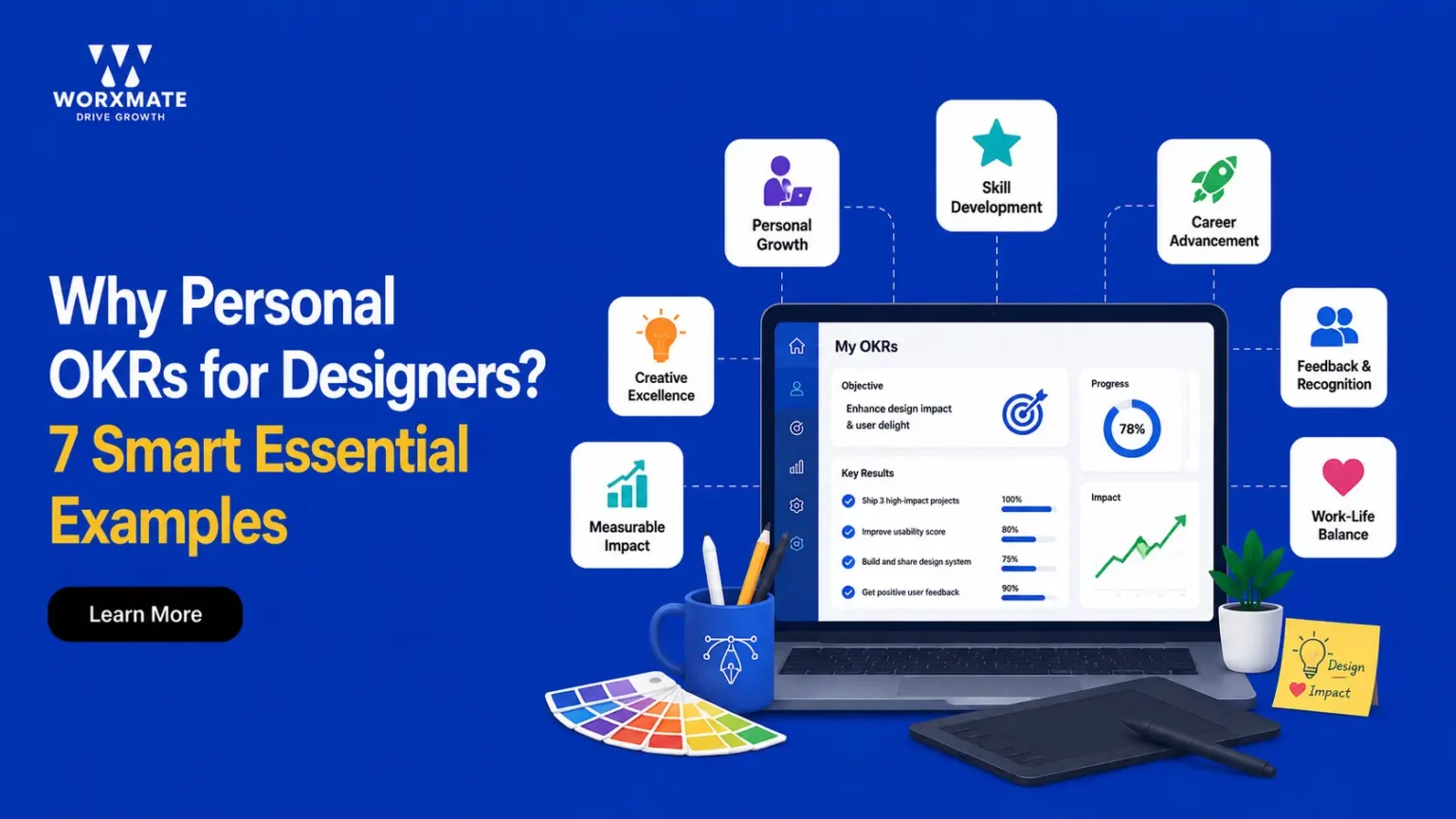
Why Personal OKRs for Designers? 7 Smart Essential Examples
Actionable insights to align your OKRs with everyday performance management-from proven frameworks to the tools that power them.
Summary
Personal OKRs for designers help creative professionals set measurable goals aligned with their career aspirations and the company’s strategic vision. They transform abstract design ambitions into concrete, trackable outcomes, ensuring continuous growth and impact.
In today’s fast-evolving design landscape, individual contributors often grapple with defining clear paths for professional development and demonstrating their value beyond project completion. Personal OKRs for designers offer a structured framework to articulate individual professional goals, foster skill mastery, and ensure their contributions directly support broader organizational objectives. This approach not only accelerates personal growth but also enhances team alignment and overall design maturity.
The world of design is dynamic, demanding continuous learning, skill refinement, and the ability to articulate impact beyond aesthetics. For designers, especially individual contributors, translating creative ambition into measurable career progression can be a significant challenge. Without a clear framework, professional development often feels reactive, project-driven, or simply overwhelming. This lack of structure can lead to stagnation, missed opportunities, and a disconnect between personal growth and organizational needs.
That’s where personal OKRs for designers become invaluable. They provide a powerful methodology to bridge the gap between aspirational career goals and daily execution. By setting clear Objectives and measurable Key Results, designers can proactively manage their growth, focus on high-impact areas, and visibly demonstrate their contributions to the business.
In this article, we’ve compiled 7 smart, essential personal OKRs for designers, offering practical examples across various design disciplines and skill sets. These examples are designed to inspire and guide you in setting impactful goals for your own career trajectory.
Why Designers Need Personal OKRs (and How They Differ from Team Goals)
Designers, like all professionals, thrive on purpose and progress. While team OKRs focus on collective outcomes and departmental success, personal OKRs for designers are tailored to individual growth trajectories, skill development, and career advancement. They empower designers to take ownership of their professional journey, ensuring that their learning and development efforts are intentional and measurable. This distinction is crucial: team OKRs drive shared business impact, whereas personal OKRs drive individual capability and contribution to that impact.
According to a McKinsey report, companies that prioritize design consistently outperform their competitors. For individual designers, this means a constant need to evolve and specialize. Personal OKRs provide a roadmap for this evolution, allowing them to align their aspirations with the strategic needs of the organization. They also foster accountability, moving beyond subjective performance reviews to quantifiable achievements.
The Anatomy of a Design-Focused OKR: Objectives vs. Key Results
Understanding the core components of an OKR is fundamental to setting effective personal OKRs for designers. An Objective is an ambitious, qualitative goal that describes *what* you want to achieve. It should be inspiring, memorable, and clearly articulated. Key Results, on the other hand, are measurable, quantitative metrics that define *how* you will achieve your Objective. They must be specific, time-bound, and verifiable. For designers, this often means translating creative outputs and processes into tangible metrics. For example, an Objective might be “Enhance my proficiency in motion design,” with Key Results focused on completing courses, applying new skills to projects, and receiving positive feedback.
Personal OKR Examples for UI/UX Designers
The goal is to elevate my expertise in user research and deliver more data-driven design solutions. This involves actively participating in research, mastering new methodologies, and integrating findings into my design process. Key results will include conducting interviews, analyzing data, and seeing a measurable improvement in design effectiveness, crucial for personal OKRs for designers.
-
Objective:
Elevate User Research Capabilities for Data-Driven Design
-
Key Results:
- Key Result 1: Conduct 5 user interviews and 2 usability tests for upcoming projects through direct participant engagement by end of quarter.
- Key Result 2: Analyze and present research findings in 3 design review sessions, increasing data integration into design decisions by 20% via stakeholder feedback.
- Key Result 3: Improve the success rate of new feature adoption by 15% through research-backed design iterations, as measured by product analytics.
Personal OKR Examples for Visual and Brand Designers
The goal is to enhance my skills in motion graphics to create more engaging brand experiences. This involves learning new software, experimenting with animation principles, and applying these skills to real-world projects. Key results will include completing a specialized course, producing animated assets, and receiving positive feedback on the impact of motion in brand communication. These are vital personal OKRs for designers focusing on visual impact.
-
Objective:
Master Motion Graphics for Dynamic Brand Storytelling
-
Key Results:
- Key Result 1: Complete an advanced After Effects course (e.g., School of Motion) by mid-quarter, earning a certificate of completion.
- Key Result 2: Produce 3 animated assets (e.g., social media ads, UI micro-interactions) for marketing campaigns, increasing engagement rates by 10% via A/B testing.
- Key Result 3: Receive a “Strong” or “Exceeds Expectations” rating in Q3 performance review for contributions to dynamic visual content, as evidenced by peer and manager feedback.
Personal OKR Examples for UI/UX Designers (Continued)
The goal is to improve the efficiency and consistency of my UI design workflow through better utilization of design systems. This involves actively contributing to the design system, advocating for its use, and measuring its impact on project delivery times. These personal OKRs for designers emphasize systematic improvement.
-
Objective:
Optimize UI Workflow with Enhanced Design System Adoption
-
Key Results:
- Key Result 1: Contribute 2 new components or 5 updated guidelines to the company’s design system documentation by end of quarter, reviewed by design lead.
- Key Result 2: Reduce average UI development time for new features by 15% by utilizing existing design system components, tracked through project management tools.
- Key Result 3: Increase positive feedback from engineering partners regarding design handoff clarity by 25% through consistent design system application, measured by post-project surveys.
Personal OKR Examples for Visual and Brand Designers (Continued)
The goal is to expand my technical skills in 3D rendering to create more immersive and innovative visual assets. This involves self-study, practical application, and showcasing new capabilities. For personal OKRs for designers pushing boundaries, this is a prime example.
-
Objective:
Integrate 3D Rendering into Visual Design Workflow
-
Key Results:
- Key Result 1: Complete 1 online course (e.g., Blender Guru) on 3D modeling and rendering fundamentals by end of month 2.
- Key Result 2: Create 2 distinct 3D rendered visuals for internal presentations or marketing mockups by end of quarter, showcasing new capabilities.
- Key Result 3: Receive positive feedback from at least 2 senior designers on the quality and potential application of 3D assets, through informal critique sessions.
Focusing on Soft Skills: OKRs for Design Leadership and Collaboration
The goal is to strengthen my cross-functional collaboration skills to foster more cohesive project outcomes. This involves proactive communication, active listening, and facilitating workshops. Key results will include leading discussions, gathering feedback, and seeing an improvement in project efficiency and team satisfaction. These are critical personal OKRs for designers aspiring to leadership.
-
Objective:
Enhance Cross-Functional Collaboration for Project Success
-
Key Results:
- Key Result 1: Initiate and lead 3 cross-functional design review sessions for key projects by end of quarter, ensuring diverse stakeholder input.
- Key Result 2: Increase positive feedback from product managers and engineers on my collaborative approach by 20%, as measured by informal check-ins and project retrospectives.
- Key Result 3: Reduce instances of design-to-development friction by 10% on my projects through improved communication and early alignment, tracked via project issue logs.
Unlock Goal Clarity and Accelerate Employee Growth
Looking to drive goal clarity and employee growth? Discover how Worxmate’s AI-powered Performance Management Software can help.
How to Track and Measure Creative Growth without Stifling Innovation
Tracking creative growth with personal OKRs for designers requires a delicate balance. The goal is not to micromanage creativity but to provide clear markers of progress and impact. For instance, instead of measuring “creativity,” focus on outcomes like “number of innovative solutions proposed” or “percentage increase in user engagement due to novel design elements.” Leveraging tools like Worxmate can help centralize these metrics, making it easier to log progress against Key Results without getting bogged down in administrative tasks. According to Harvard Business Review, measuring creativity involves focusing on novelty, usefulness, and implementation.
Regular OKR check-ins are essential for reviewing progress, identifying roadblocks, and adjusting Key Results as needed. This iterative process allows for flexibility, ensuring that the framework supports rather than hinders the fluid nature of design work. Instead of rigid adherence, the emphasis should be on learning and adaptation. This approach ensures that personal OKRs for designers remain a dynamic tool for growth.
Using Worxmate to Align Personal Design Goals with Company Vision
Worxmate provides a robust platform for managing personal OKRs for designers, enabling seamless alignment with broader company objectives. Its intuitive interface allows designers to easily set, track, and update their Objectives and Key Results, providing real-time visibility into their progress. This ensures that individual development efforts are not siloed but actively contribute to the organization’s strategic priorities.
With Worxmate, design leads can gain insights into their team’s collective skill development, identify areas for growth, and provide targeted support. The platform facilitates a culture of transparency and accountability, where designers can clearly see how their individual goals contribute to the larger picture, fostering a sense of purpose and shared success. This integration of personal and organizational goals is crucial for overall organizational alignment.
Personal OKR Examples for Designers: Mentorship and Skill Sharing
The goal is to cultivate a culture of knowledge sharing and mentorship within the design team, enhancing collective skill development. This involves actively mentoring junior designers, sharing best practices, and contributing to internal learning initiatives. Key results will include conducting mentorship sessions, presenting on design topics, and receiving positive feedback on my contributions to team growth. These personal OKRs for designers exemplify leadership.
-
Objective:
Foster a Culture of Design Mentorship and Knowledge Sharing
-
Key Results:
- Key Result 1: Conduct 3 one-on-one mentorship sessions with junior designers by end of quarter, providing actionable feedback on their projects.
- Key Result 2: Lead 2 internal “Lunch & Learn” sessions on advanced design techniques or tools, achieving an average attendee satisfaction score of 4.5/5.
- Key Result 3: See an increase of 10% in team-wide adoption of a new design tool or process that I introduced, as measured by team surveys or tool usage data.
Setting clear, actionable personal OKRs for designers empowers creative professionals to align their individual aspirations with measurable career outcomes and drive real business impact. Whether you’re aiming to master new tools, enhance research capabilities, or cultivate leadership skills, the right OKRs keep your personal development focused and your contributions accountable within the broader team context.
By implementing these personal OKRs for designers, individuals can strengthen OKR alignment with their career paths, maintain momentum through structured OKR check-ins, and pursue measurable goals with full visibility into their progress. This systematic approach transforms abstract design skill growth into strategic outcomes that directly enhance both individual portfolios and organizational success.
Ready to align your design career goals with real outcomes? Explore how OKR software brings structure to your goal setting, use OKR alignment to connect team efforts to company priorities, and sustain progress through a consistent OKR cycle. Start your free trial with Worxmate and turn your design objectives into results that actually move the needle.

Written by
An OKR Coach with 20+ years of implementation experience, Madhusudan has guided over 50 organisations through successful OKR transformations, training more than 500 leaders. Learn more about Worxmate.
Frequently Asked Questions
Personal OKRs for designers are a goal-setting framework that helps individual creative professionals define ambitious objectives and track measurable key results for their career development. They provide a clear roadmap for skill acquisition, project impact, and professional growth, making abstract design ambitions concrete and actionable.
UI/UX designers can use personal OKRs to focus on specific skill development, such as mastering user research, improving design system contributions, or enhancing prototyping skills. By setting objectives like “Elevate User Research Capabilities” with key results like “Conduct 5 user interviews,” they can systematically measure their progress and impact.
No, when implemented correctly, personal OKRs do not stifle creativity. Instead, they provide a framework to measure the *impact* and *application* of creativity, rather than creativity itself. By focusing on outcomes like “increased engagement due to novel design elements,” designers can channel their creativity towards measurable results without losing innovative spirit.
Common mistakes include making objectives too vague (e.g., “Be more creative”), setting key results that are not measurable (e.g., “Improve design quality”), or failing to regularly check in on progress. It’s also a mistake to set too many OKRs, which can dilute focus and lead to burnout.
For Visual and Brand designers, personal OKRs translate subjective aesthetic improvements into objective business metrics, such as brand consistency scores or asset production efficiency. This allows creative professionals to demonstrate how their craft directly influences brand perception and supports marketing’s strategic goals.
Designers should identify organizational KPIs—like user retention or conversion rates—and set personal objectives that support those goals through specific design interventions. By referencing design-driven growth models, designers can use OKRs to prove that their skill development directly contributes to the company’s bottom line.
Key Results should be quantitative ‘stretch’ targets that measure the outcome of design work, such as ‘Reduce design-to-development handoff time by 20%.’ They must be time-bound and verifiable, ensuring that the qualitative Objective is backed by hard data and clear milestones.
IC designers often face reactive, project-driven workloads that can lead to career stagnation without a structured growth plan. Personal OKRs provide a proactive framework to prioritize high-impact skill acquisition and professional development, ensuring their growth isn’t sidelined by daily task execution.
A dedicated platform provides visibility into how individual design goals cascade into broader company objectives, fostering a sense of purpose and alignment. It automates the tracking of Key Results and facilitates regular check-ins, making it easier for designers to visualize their career trajectory alongside their daily design tasks.