
Performance Management for BPO: 6 Critical Outcomes
Actionable insights to align your OKRs with everyday performance management-from proven frameworks to the tools that power them.
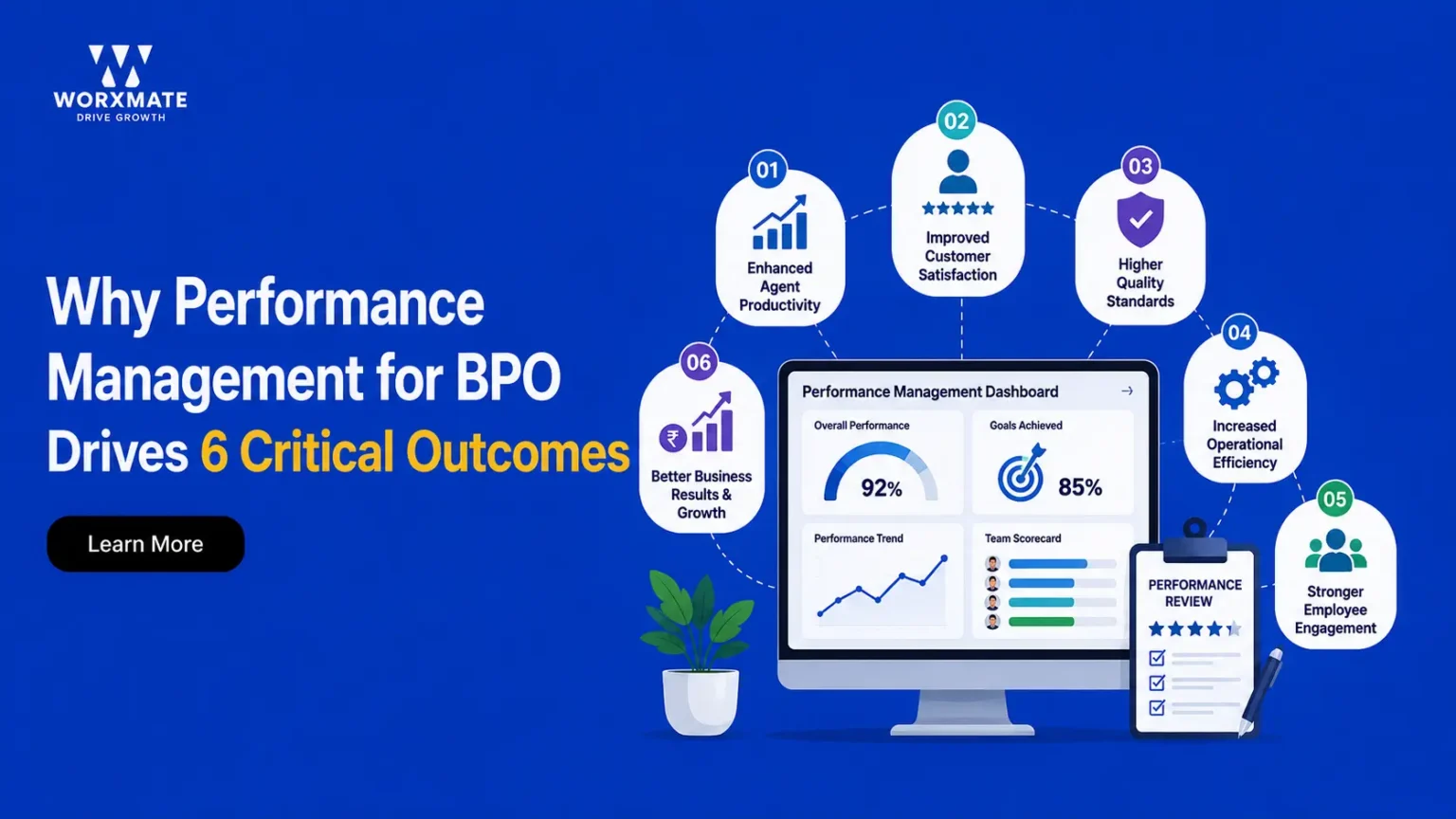
Performance Management for BPO: Modern performance management for BPO combines continuous employee feedback, real-time employee performance software, and strategic OKRs to reduce high agent attrition, eliminate data silos, and scale outsourcing efficiency.
Outsourcing leaders face relentless pressure to maintain service level agreements while curbing operational churn. Operating call centers and back-office processing hubs demands a shift from legacy annual appraisals toward agile, continuous tracking frameworks that align frontline staff with overarching client deliverables.
Why Performance Management for BPO Drives 6 Critical Business Outcomes
Performance management for BPO is the strategic integration of goal alignment, real-time feedback, and data-driven coaching designed to optimize the efficiency of outsourcing operations. In an industry where margins are thin and client expectations are exceptionally high, the ability to manage human capital effectively is the primary differentiator between market leaders and struggling firms. According to McKinsey, companies that implement sophisticated performance management systems can see a 20% increase in productivity across high-volume service environments.
The Business Process Outsourcing (BPO) sector operates on the backbone of human labor and technological efficiency. When performance management for BPO is treated as a continuous cycle rather than a quarterly administrative burden, it transforms the workforce from a cost center into a value-generating engine. This transformation is essential because the traditional “command and control” models of management are no longer sufficient to maintain competitiveness in a globalized market where talent mobility is at an all-time high.
Strategic performance management for BPO ensures that every agent, team lead, and operations manager understands how their daily tasks contribute to the broader client objectives. This clarity reduces role ambiguity, which is a leading cause of burnout in call centers and back-office processing units. By establishing a clear performance management cycle, BPO leaders can create a culture of accountability that survives the pressures of rapid scaling and seasonal volume spikes.
Furthermore, the shift toward outcome-driven performance management allows BPOs to move beyond simple output metrics. While counting the number of tickets resolved is important, measuring the quality and business impact of those resolutions provides the strategic insight needed to secure long-term client contracts. In this context, performance management for BPO becomes a tool for strategic partnership rather than just a mechanism for operational oversight.
Finally, a robust approach to performance management for BPO addresses the critical issue of employee morale. Gallup research indicates that highly engaged teams show 21% greater profitability. In the BPO world, where attrition often exceeds 30-40%, a system that recognizes performance and provides clear paths for growth is not just a “nice-to-have” but a fundamental requirement for business continuity.
Common Challenges in BPO Performance Tracking
Implementing effective performance management for BPO is often complicated by the sheer scale of operations. When managing thousands of agents across multiple geographies, maintaining consistency in performance standards becomes a significant hurdle. Many BPOs still rely on fragmented spreadsheets and legacy tools that do not communicate with each other, leading to data silos that obscure the true state of agent productivity.
One of the most persistent challenges in performance management for BPO is the “recency bias” in manual reviews. Team leads, often managing 15 to 20 agents, may only remember the most recent interactions when conducting monthly appraisals. This lack of historical context leads to unfair evaluations, which directly impacts employee engagement and trust. Without a centralized system to track progress over time, performance management for BPO remains subjective and prone to error.
Data Overload and Fragmentation
BPOs generate millions of data points daily, from call durations to customer satisfaction scores. The challenge lies in synthesizing this data into actionable insights that can be used for coaching. Without integrated performance management for BPO software, managers spend more time compiling reports than actually managing their teams.
High Attrition Rates
The constant churn of staff makes it difficult to maintain a consistent performance culture. New hires need to be onboarded and integrated into the performance management for BPO framework quickly to ensure they hit their targets within the first 30 days. High turnover often results in a “survival mode” mentality where long-term development is sacrificed for short-term output.
Misalignment of Client and Internal Goals
BPOs often struggle to balance the internal need for profitability with the client’s demand for high-quality service. If performance management for BPO only focuses on internal speed metrics, the quality of customer experience may suffer, leading to contract penalties or lost business.
Addressing these challenges requires a move toward transparency. When agents have visibility into their own metrics in real-time, the “black box” of performance management for BPO is eliminated. This transparency encourages self-correction and reduces the administrative burden on supervisors who would otherwise spend their day delivering routine status updates.
Moreover, the global nature of modern outsourcing means that performance management for BPO must account for cultural nuances and different labor laws. A “one-size-fits-all” approach rarely works when managing teams in the Philippines, India, and Eastern Europe simultaneously. A flexible, digital-first performance management for BPO strategy allows for localized adaptations while maintaining a unified corporate standard.
Key Performance Indicators (KPIs) Beyond Average Handle Time
While Average Handle Time (AHT) has historically been the gold standard for performance management for BPO, modern operations are realizing its limitations. Over-emphasizing AHT can lead agents to rush customers off the phone, which negatively impacts First Call Resolution (FCR) and Customer Satisfaction (CSAT). A sophisticated performance management for BPO strategy balances speed with quality.
To truly optimize an outsourcing workflow, managers must track a diversified set of OKR tracking metrics and KPIs. These indicators should provide a 360-degree view of both operational efficiency and employee health. In the context of performance management for BPO, the following table illustrates the shift from traditional to modern metrics:
| Metric Category | Traditional Focus (Output) | Modern Focus (Outcome) |
|---|---|---|
| Efficiency | Average Handle Time (AHT) | First Call Resolution (FCR) |
| Quality | QA Scorecard Compliance | Net Promoter Score (NPS) |
| Employee Health | Attendance/Shrinkage | Employee Net Promoter Score (eNPS) |
| Financial | Cost per Call | Customer Lifetime Value (CLV) Impact |
The integration of these modern metrics into performance management for BPO allows for more nuanced coaching. For instance, an agent with a high AHT but a perfect FCR rate is actually more valuable to a client than an agent who is fast but requires the customer to call back three times. Modern performance management for BPO identifies these high-value behaviors and incentivizes them.
Another critical KPI in performance management for BPO is “Occupancy Rate.” This measures the time agents spend on active tasks versus idle time. However, pushing occupancy too high (above 85-90%) is a proven recipe for burnout. A balanced performance management for BPO approach monitors occupancy to ensure efficiency without sacrificing the mental well-being of the workforce.
Furthermore, BPOs are increasingly incorporating “Quality of Work” metrics that assess the emotional intelligence and problem-solving capabilities of agents. As AI takes over simple transactional tasks, the remaining human-led interactions are more complex. Consequently, performance management for BPO must evolve to measure how well agents handle these high-stakes, “empathy-required” moments.
Implementing OKRs in a High-Volume Outsourcing Environment
Objectives and Key Results (OKRs) are often associated with tech startups, but they are increasingly being used in performance management for BPO to drive strategic alignment. Unlike traditional KPIs, which are often static and top-down, OKRs encourage teams to set ambitious, time-bound goals that push the boundaries of current performance. Implementing OKRs within performance management for BPO helps bridge the gap between daily operations and long-term client strategy.
For a BPO, an Objective might be “Achieve Industry-Leading Customer Loyalty for Client X.” The Key Results could include “Increase NPS from 40 to 60,” “Reduce churn by 15%,” and “Maintain 98% SLA compliance.” By framing goals this way, performance management for BPO moves away from micromanagement and toward empowerment. Agents and team leads can see the direct impact of their work on the “big picture.”
However, the high-volume nature of BPOs requires a specific approach to OKRs. Because the environment is so fast-paced, quarterly cycles might be too long. Many successful firms use monthly OKR cycles within their performance management for BPO framework to maintain agility. This allows teams to pivot quickly if a client changes their strategy or if a new product launch causes a surge in specific types of inquiries.
Understanding the nuance of OKRs vs KPIs is vital here. KPIs tell you if the business is “healthy” (e.g., is the system up? are we answering calls?), while OKRs tell you where the business is “going” (e.g., are we becoming more efficient? are we expanding our service lines?). A comprehensive performance management for BPO system uses both to provide a complete picture of performance.
To succeed with OKRs, BPO leadership must ensure that these goals are not tied directly to individual compensation in a way that discourages risk-taking. Performance management for BPO should use OKRs to foster a growth mindset, where “stretching” for a difficult goal is rewarded even if the target isn’t 100% met. This cultural shift is essential for driving innovation in an industry that is often criticized for being overly rigid.
The Role of Real-Time Feedback in Reducing Agent Attrition
In the BPO industry, silence from management is often interpreted as a sign that something is wrong. Traditional performance management for BPO, which relies on annual or semi-annual reviews, fails to provide the constant reinforcement that agents need to feel valued. Implementing real-time feedback systems is one of the most effective ways to combat high attrition rates.
When an agent receives immediate praise for handling a difficult customer or instant coaching on a technical error, the learning loop is closed while the event is still fresh. This immediacy is a cornerstone of modern performance management for BPO. According to a study by Harvard Business Review, employees who receive regular feedback are 3x more likely to be engaged than those who don’t. In a high-stress BPO environment, this engagement is the primary shield against “quiet quitting.”
Real-time feedback in performance management for BPO doesn’t always have to come from a human supervisor. AI-driven dashboards can provide agents with “nudges” throughout their shift, showing them how they are tracking against their daily goals. This gamification of performance management for BPO makes the work more engaging and gives agents a sense of autonomy over their daily output.
Continuous Coaching Over Annual Policing
Performance management for BPO should focus on development rather than discipline. Frequent, low-stakes check-ins allow managers to identify struggling agents early and provide support before performance dips lead to termination or resignation.
Peer-to-Peer Recognition
A truly effective performance management for BPO system includes a mechanism for agents to recognize each other. In a high-pressure environment, a “shout-out” from a colleague can be more meaningful than a formal email from a director.
Actionable Insights
Feedback is only useful if it is actionable. Performance management for BPO must ensure that feedback is specific, objective, and tied to clear steps for improvement. Vague comments like “work harder” are replaced with “reduce your wrap-up time by using these specific keyboard shortcuts.”
By prioritizing the human element through consistent communication, BPOs can significantly improve their employee retention techniques. When agents feel that their career growth is being actively managed through a structured performance management for BPO process, they are much more likely to stay with the company long-term, reducing the massive costs associated with recruiting and training new staff.
Leveraging Technology: How Worxmate Transforms BPO Workflows
When comparing enterprise HR solutions like Lattice to modern mid-market platforms, BPO executives frequently encounter prohibitive per-user licensing fees and rigid legacy review cycles that fail to scale with frontline agent shifts. Traditional platforms often bolt OKRs onto outdated annual workflows, driving up costs without solving remote operational oversight.
The Worxmate Advantage: Worxmate delivers unified OKRs, real-time performance management approaches, and continuous feedback at half the total investment of legacy platforms. Designed specifically for distributed teams across BPO, logistics, and healthcare, Worxmate eliminates platform bloat and enables rapid strategy execution across high-volume environments.
Technology is the catalyst that allows performance management for BPO to scale. Without the right digital infrastructure, even the best-designed performance framework will collapse under the weight of manual administration. Worxmate provides a unified platform that integrates goal setting, performance tracking, and employee engagement into a single, intuitive interface tailored for the mid-market BPO sector.
One of the primary benefits of using a dedicated system for performance management for BPO is the elimination of data silos. Worxmate connects with existing CRM and telephony systems to pull in real-time data, ensuring that performance reviews are based on objective facts rather than manager bias. This level of transparency is critical for building a culture of meritocracy, where high performers are clearly identified and rewarded.
Furthermore, Worxmate simplifies the implementation of complex frameworks like OKRs. In a high-volume environment, setting and tracking goals for thousands of employees can be a logistical nightmare. Worxmate’s automated workflows handle the heavy lifting, allowing managers to focus on what they do best: coaching and developing their people. This shift in focus is what ultimately drives the success of performance management for BPO.
The platform also supports the “High Touch” aspect of BPO management through features like automated check-in reminders and structured feedback templates. This ensures that no agent is left behind and that the performance management cycle remains consistent across all departments. By digitizing these interactions, BPOs can maintain a personal touch even as they grow to manage thousands of employees.
In conclusion, leveraging a platform like Worxmate for performance management for BPO allows companies to move from reactive firefighting to proactive strategy. With real-time visibility into agent performance and organizational health, BPO leaders can make data-driven decisions that improve client satisfaction and drive sustainable profitability.
Case Study: Teleperformance — Reducing Attrition via Digital Transformation
The Challenge
Teleperformance, a global leader in customer experience management, faced significant challenges with agent attrition and maintaining consistent service quality across its diverse global workforce. The traditional annual review process was insufficient for the fast-paced nature of their 300,000+ employee operation.
The Solution
The company implemented a “High Tech, High Touch” strategy, moving toward a continuous performance management framework. They deployed integrated digital platforms that provided agents with real-time access to their performance metrics and created structured channels for frequent supervisor feedback and peer recognition.
Results and Impact
By shifting to a more transparent and continuous model of performance management, Teleperformance reported a significant improvement in employee engagement scores and a stabilization of turnover rates. Their focus on digital performance tools contributed to a 15.5% year-over-year revenue growth, proving that investing in agent-centric performance systems directly impacts the bottom line. (Source: Teleperformance Annual Report / HBR Case Analysis)
The real cost of poor performance management for BPO isn’t just missed SLAs — it’s the systemic erosion of talent and client trust that occurs when agents feel like replaceable cogs in a machine. Teleperformance’s success proves that when global BPOs prioritize transparency and continuous feedback, they don’t just improve metrics; they build a resilient, high-performing culture that can thrive in any market condition.
By moving toward a structured system, your organization can achieve sustainable organizational growth, implement a more effective performance management cycle, and utilize outcome-driven performance management to stay ahead of the competition. These improvements lead to higher employee engagement and improved client retention. Regular check-ins maintain momentum and keep strategic priorities front of mind. Tracking a real-time confidence score helps identify at-risk targets before quarter-end. Surfacing operational blockers early ensures leadership can clear obstacles quickly. Seamless cascading ensures department milestones stay synchronized with company strategy.
Ready to transform your outsourcing operations from a volume-based shop to a value-driven powerhouse? Use OKR tracking metrics to align your teams, leverage real-time feedback to reduce turnover, and start your free trial with Worxmate today to see the difference data-driven performance can make.


Written by
An OKR Coach with 20+ years of implementation experience, Madhusudan has guided over 50 organisations through successful OKR transformations, training more than 500 leaders. Learn more about Worxmate.
Frequently Asked Questions
By replacing annual reviews with real-time feedback, regular 1:1 check-ins, and clear recognition mechanisms, BPOs can significantly boost engagement and reduce turnover rates that frequently exceed 30%.
OKRs bridge the gap between daily operational KPIs (like AHT) and high-level client objectives, ensuring that agents understand their contribution to customer satisfaction and strategic growth.
While Lattice caters to traditional enterprise tech companies with high per-user starting costs and bolted-on reviews, Worxmate provides cost-effective, agile OKRs and continuous tracking tailored specifically for distributed BPO and frontline workforces.
Modern BPOs track First Call Resolution (FCR), Net Promoter Score (NPS), employee Net Promoter Score (eNPS), and Customer Lifetime Value impact to balance speed with service quality.
Yes, dedicated platforms like Worxmate pull real-time data from existing CRMs and telephony environments to provide objective performance insights without manual spreadsheet compilation.
Given the fast-paced nature of BPO operations, monthly OKR cycles combined with weekly or bi-weekly check-ins ensure high agility and immediate correction of performance blockers.
Research shows highly engaged teams deliver up to 21% greater profitability, directly protecting profit margins in thin-margin outsourcing contracts.
Digital platforms maintain continuous audit trails of agent performance over the entire review cycle, preventing supervisors from relying solely on the most recent interactions during evaluations.
Yes, Worxmate supports localized adaptations across multiple regions (such as the Philippines, India, and Eastern Europe) while maintaining a unified corporate performance standard.
With streamlined onboarding and automated workflows, mid-market BPOs can deploy Worxmate and begin tracking continuous feedback and OKRs within weeks rather than months.
