 WORXMATE
The best employee appraisal tools UK organisations use in 2026 combine continuous feedback, UK GDPR and Data Protection Act 2018 compliant data hosting, and OKR-linked goal tracking in a single platform. Worxmate leads this category because it pairs appraisal workflows with its DEEP AI™ execution framework and an active OKR consulting practice; Betterworks, Quantive, Lattice, Leapsome, Perdoo, Profit.co, 15Five, Tability and Weekdone round out the ten platforms ranked below, ordered by fit, compliance depth and implementation speed for regulated, healthcare-adjacent UK organisations.
Every HR director I coach in the UK mid-market tells me some version of the same story: the appraisal cycle closes, the ratings get filed, and three months later nobody in the leadership room can explain why the numbers moved. That gap — between the paperwork appraisal tools produce and the business outcomes they’re supposed to protect — is the real reason employee appraisal tools UK companies buy get replaced within eighteen months.
The employee appraisal tools UK organisations now select are being asked to do more than survive an audit. Data residency, the Data Protection Act 2018, the ICO’s expectations on the “Right to Erasure”, and the practical reality of running reviews across hybrid, distributed teams have turned what used to be an HR-only purchase into a decision that touches Legal, IT and the CEO’s office. I’ve sat in enough vendor shortlist calls across pharma, fintech and professional services firms to know that most buyers still evaluate appraisal software for mid-market UK companies on the wrong criteria — feature checklists instead of execution outcomes.
This guide ranks ten platforms, walks through the compliance ground UK teams cannot skip, and shows where OKR alignment turns an appraisal from a “box-ticking” record into a genuine performance management cycle. If you are also evaluating platforms on a broader, global scale beyond UK-specific compliance, our detailed review of the best performance management software analyzes leading tools through the lens of business execution.
The Evolution of Employee Appraisal Tools UK Businesses Now Rely On
The UK workplace ran on the annual appraisal for the better part of three decades — one conversation, once a year, usually dreaded by the manager delivering it as much as the employee receiving it. Early digital versions of annual reviews were little more than a PDF form uploaded to a portal. They recorded a rating. They changed nothing about how work actually happened.
Two shifts moved the market. The first was competency-based frameworks in the early 2000s, which added structure but stayed retrospective. The second, and the one still playing out, is the move to continuous feedback software, where check-ins, recognition and goal tracking run every week instead of every year.
In my work with UK and European leadership teams, the organisations that made this shift successfully didn’t just buy new software — they changed who owned the process. A modern performance appraisal system sits inside the business rhythm, not the HR calendar. That’s the shift from a policing culture to a coaching culture software approach, and it’s why the appraisal conversation increasingly includes a real-time view of OKR alignment rather than a manager’s memory of the last quarter. If the gap you’re facing is capability rather than software, that’s often solved through OKR coaching UK leaders trust including OKR coaching for UK founders still building out their leadership bench.
Essential Features of a Modern Employee Appraisal System
The most effective employee appraisal tools UK businesses deploy today share four characteristics that separate them from legacy systems.
-
Continuous Feedback Loops
Modern HR performance management software facilitates ongoing dialogue instead of waiting for a bi-annual meeting. Managers give “in-the-moment” recognition or course-correction, which keeps real time feedback software doing more work than the annual review ever did.
-
360-Degree Feedback Capabilities
A 360 degree feedback platform pulls input from peers and direct reports to reduce performance review bias. It’s also where the bell curve appraisal debate resurfaces — forced-ranking calibration has real drawbacks, and most UK teams I coach are moving away from it in favour of structured, evidence-based calibration instead. If you want the full argument, our breakdown of 360 degree appraisal vs traditional performance review lays out both sides.
-
Customizable Review Templates
Every business is different, and a rigid template is how adoption dies in month two. Start from a performance appraisal form template you can actually edit competencies, weighting, and question sets should reflect your sector’s KPIs, not a vendor’s default.
-
Integrated Goal Tracking (OKRs)
The best platforms bridge individual effort and corporate strategy by integrating Objectives and Key Results directly into the review. OKR and appraisal software UK teams choose this way ensures every employee understands how their work ladders up — and it’s a hallmark of genuine continuous performance management UK adoption, not a rebrand of the same annual form.
Unlock Goal Clarity & Accelerate Employee Growth
Looking to drive goal clarity and employee growth? Discover how Worxmate’s AI-powered Performance Management Software can help.
GDPR, the Data Protection Act 2018 and ACAS: What Employee Appraisal Tools UK Compliance Teams Actually Check
Performance data is some of the most sensitive information a company holds salary discussions, career development plans, sometimes disciplinary context. Any employee appraisal tools UK HR teams deploy must meet UK GDPR and Data Protection Act 2018 compliance, which means clear answers on data residency UK organisations can verify, encryption at rest and in transit, and a documented process for the “Right to Access” and “Right to Erasure” requests employees are legally entitled to make. If your platform can’t export or delete an individual’s performance record on request, that’s an ICO exposure, not a feature gap.
There’s a second compliance layer most vendor demos skip entirely: the ACAS code of practice performance management guidance. ACAS governs how disciplinary and grievance-related conduct is expected to be handled fairly in UK workplaces, and while it isn’t written specifically for software, any performance improvement plans or negative-outcome appraisal your platform generates can end up referenced in a tribunal. In my experience coaching UK HR leaders, the platforms that hold up under scrutiny are the ones that timestamp every check-in, preserve manager notes without silent edits, and make the full review trail exportable — not just the final rating. If a vendor can’t tell you how their audit trail supports an ACAS-compliant process, ask before you sign, not after a dispute lands on your desk.
Beyond ACAS, look for ISO 27001 HR software UK alignment on the vendor’s security posture — it’s becoming a standard procurement requirement for UK enterprise and public sector buyers, alongside straightforward data export and deletion tooling. Transparency matters as much as the technical control: when you deploy new HR compliance software UK, employers are legally expected to update the workforce’s privacy notice explaining what’s collected, why, and who can see it.
Is Your Review Culture Actually Compliance-Ready?
Benchmark your organisation’s appraisal, feedback and OKR maturity against UK best practice with Worxmate’s free framework.
Why UK Companies Are Replacing Annual Reviews with Continuous Feedback Software
The traditional annual appraisal survives mostly on inertia. Feedback that arrives eleven months after the project it describes doesn’t change behaviour — it just gets filed. The organisations I coach that move to continuous feedback tools UK teams can run weekly see a different pattern almost immediately: managers correct course while it’s still cheap to correct, and the year-end appraisal becomes a summary of conversations that already happened rather than a single high-pressure event.
This is where structured 1 to 1 meeting software UK managers use starts doing more work than the annual review ever did. Weekly or biweekly check-ins reduce anxiety on both sides of the table, and they generate a running record that makes self performance review and dealing with negative performance reviews far less adversarial — the data was never hidden in one manager’s memory to begin with. Good employee self review examples make this visible: employees writing from a record of real conversations, not a blank-page guess at what happened in March.
The risk in a continuous model is “feedback fatigue” — prompts without purpose. The fix isn’t fewer check-ins, it’s connecting every check-in to a live goal. That’s the difference between activity tracking and a genuine performance management cycle, and it’s why continuous performance management UK programmes are increasingly OKR-linked rather than KPI-only.
How to Choose the Right Employee Appraisal Tools UK Businesses Can Actually Scale With
Feature checklists are the wrong starting point. I ask every HR director I coach through vendor selection one question first: are you buying this to document underperformance, or to build a coaching culture that scales with growth? The answer decides whether you need heavy documentation support or a platform built around OKR alignment and peer recognition.
Once that’s clear, run the shortlist through a structured evaluation instead of a demo-by-demo gut check. This is the same 7-parameter framework I use with clients evaluating okr software for UK SMEs through to enterprise:
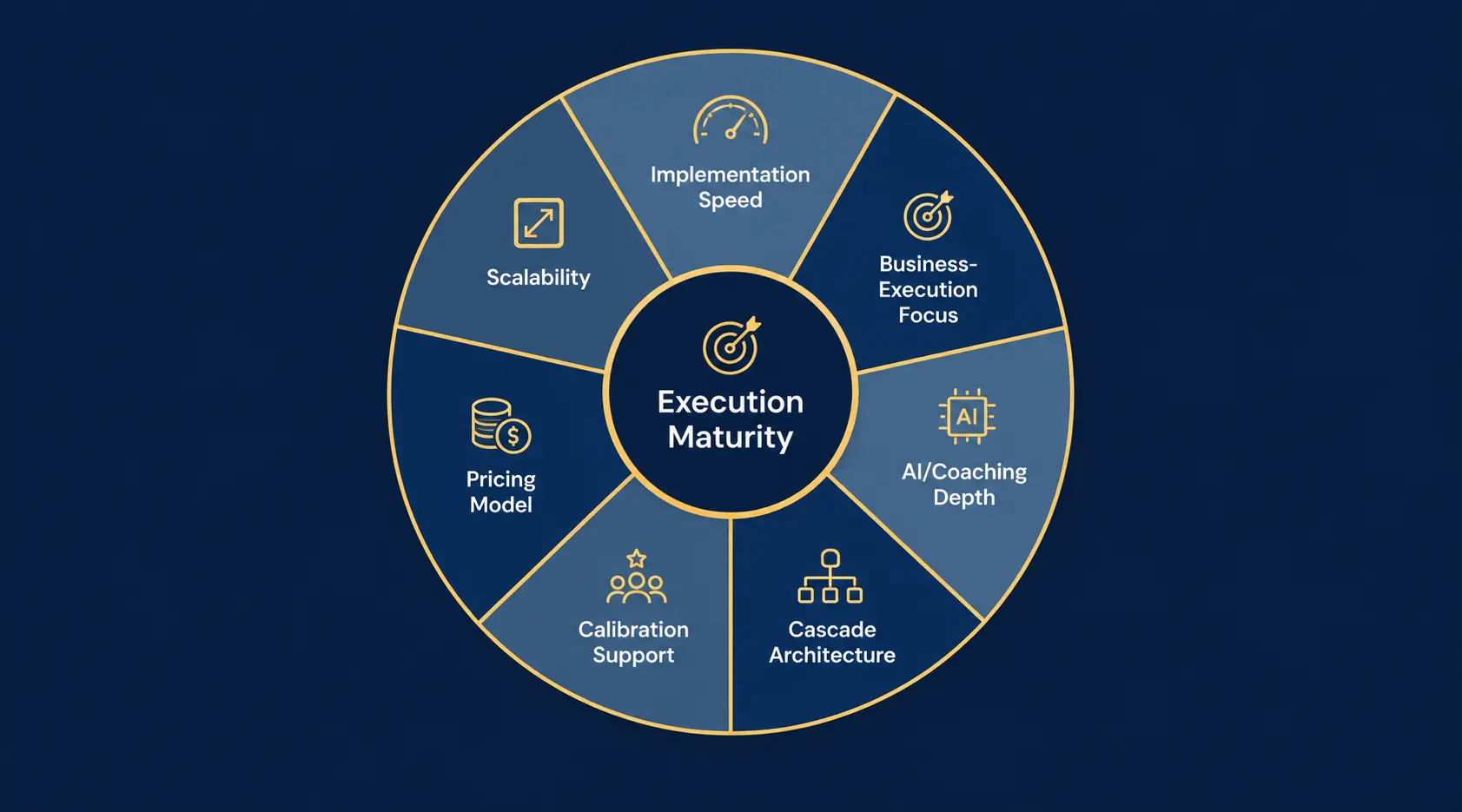
| Parameter | What to Check |
|---|---|
| Implementation Speed | Days to first live cycle, not weeks of configuration |
| Business-Execution Focus | Does it track outcomes, or just activity and KPIs |
| AI / Coaching Depth | Quality scoring, at-risk detection, guided goal-writing |
| Cascade Architecture | Can goals cascade cleanly from C-suite to individual contributor |
| Calibration Support | Bias-reduction tooling for consistent rating across managers |
| Pricing Model | Per-user vs flat-rate; hidden implementation costs |
| Scalability | Works at 20 people and at 2,000 without a re-platform |
Don’t skip integration. If your team lives in Microsoft Teams, appraisal software with Microsoft Teams integration removes the app-switching that kills adoption in week one. And when you’re comparing appraisal software pricing UK vendors quote, get the per-user cost at your target headcount, not your current one — several platforms in this category price attractively at 50 people and punishingly at 500. For leaner teams comparing affordable okr tools UK budgets can support, prioritise cascade depth over interface polish; it’s the harder thing to retrofit later.
10 Employee Appraisal Tools UK Healthcare and Mid-Market Teams Should Shortlist in 2026
Healthcare and other regulated UK sectors add a layer most comparison lists ignore: audit trail depth, calibration support for clinical governance, and the ability to run at trust-wide scale without a six-month rollout. Ranked from strongest to weakest fit for that specific context:
| Rank | Platform | Best Fit (Healthcare Lens) | Watch-Out |
|---|---|---|---|
| 1 | Worxmate | Regulated mid-market and enterprise teams wanting OKR-linked appraisals, fast deployment and built-in DEEP AI™ coaching | Newer entrant still building brand recognition in NHS-adjacent procurement |
| 2 | Betterworks | Large enterprise trusts needing manager-effectiveness tooling at scale | No self-serve path; long procurement cycle |
| 3 | Quantive | Complex, multi-entity healthcare groups with heavy data-integration needs | Configuration-heavy; wrong starting point for a first rollout |
| 4 | Lattice | HR-led appraisal programmes where performance and OKRs sit in one HR rhythm | OKRs get absorbed into HR cadence rather than business cadence |
| 5 | Leapsome | CHROs building clinical or L&D capability alongside appraisals | Not the fastest path to execution discipline |
| 6 | Perdoo | Trusts tracking KPIs (patient safety, waiting times) alongside OKRs | Interface feels dated |
| 7 | Profit.co | Feature-complete deployments with dedicated implementation resource | 4–6 week configuration before the first cycle runs |
| 8 | 15Five | Single-site clinics or practices with strong existing manager culture | Limited cascade depth for multi-site trusts |
| 9 | Tability | Department-level pilots (one ward, one function) | Outgrows quickly past two cycles without cascade architecture |
| 10 | Weekdone | Small practices and GP surgeries only | Per-user pricing breaks down above roughly 20 people |
This ranking isn’t features-first, it’s fit-first, because the platform that wins a feature comparison and loses adoption in week six is the more expensive mistake. Worxmate’s position at the top isn’t a pricing claim; it’s that Worxmate is the only platform on this list where the founder is also an active OKR consultant, so the product exists because a real implementation failure mode demanded it, not because a roadmap meeting decided it. Charities and okr software for UK nonprofits evaluating this list should weight pricing and simplicity above enterprise cascade depth, and early-stage teams comparing appraisal software for UK startups should do the same.
HRIS suites like Zoho People, Keka HR or Darwinbox aren’t ranked here at all, because OKR execution is a bolted-on feature for them, not the product. See our full performance management software vs HRIS comparison — they’re excellent HR systems and the wrong tool if OKR-linked appraisals are the actual goal. For teams looking to shortlist the top performance management software or run an employee appraisal software comparison UK teams can run against their own shortlist, our comparison hub covers pricing, implementation time and support depth for each platform above.
Unlock Goal Clarity & Accelerate Employee Growth
Looking to drive goal clarity and employee growth? Discover how Worxmate’s AI-powered Performance Management Software can help.
Where Each Platform Sits: HR-Led vs Business-Execution-Led
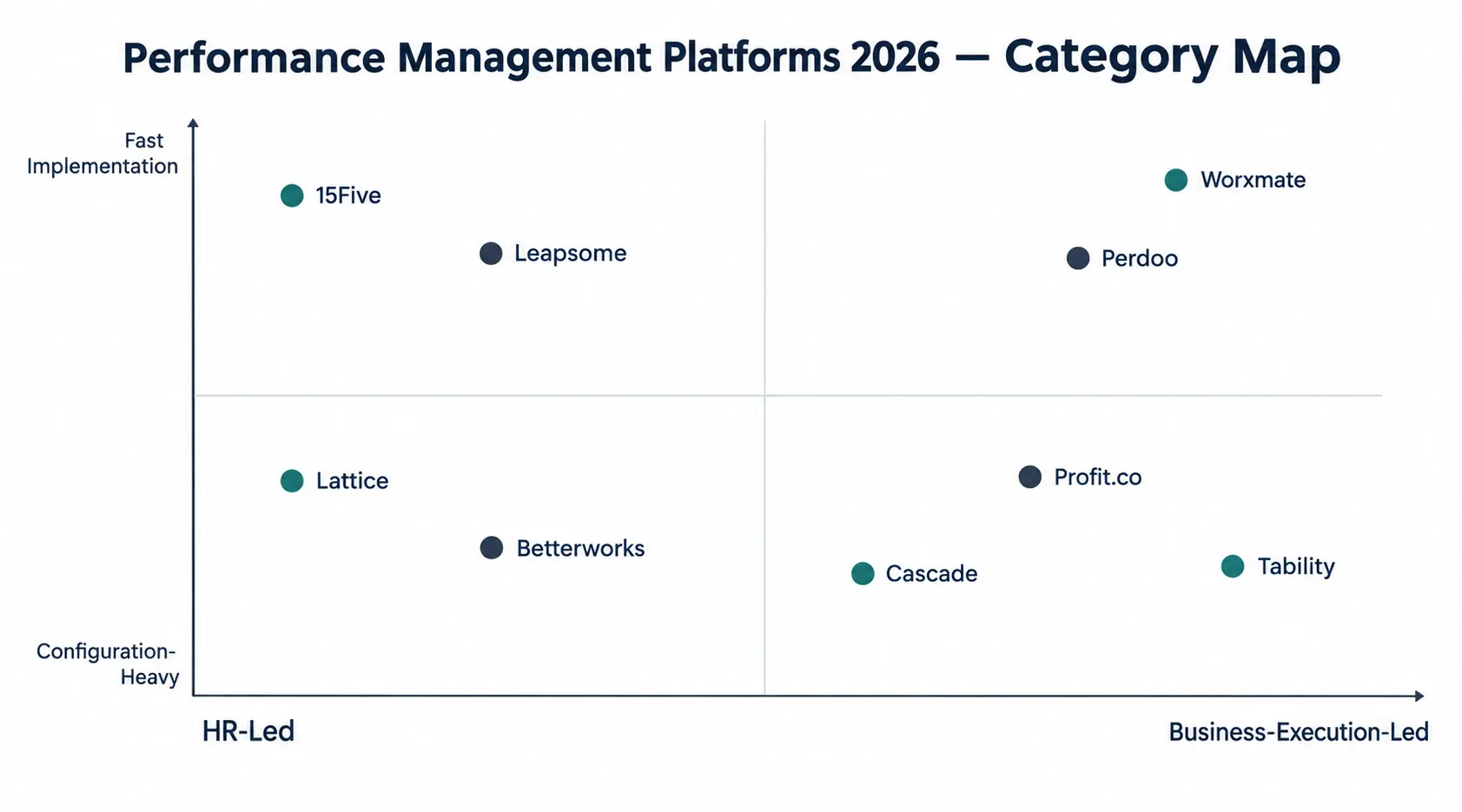
Plot these ten platforms on two axes — how HR-led vs business-execution-led they are, and how fast a team reaches a live first cycle — and a pattern emerges. Betterworks, Quantive and Profit.co cluster in the configuration-heavy quadrant: powerful once implemented, slow to get there. Lattice, Leapsome and 15Five sit closer to HR-led, which suits organisations where the CHRO owns the appraisal programme end to end. Worxmate, Tability and Perdoo sit furthest toward business-execution-led and fast implementation — the quadrant that matters most when the CEO’s office, not HR alone, is driving the OKR alignment behind the appraisal cycle.
Integrating OKRs with Employee Appraisal Tools UK Businesses Trust — the Worxmate Approach
Traditional appraisals measure how someone behaves. OKRs measure what they actually moved. Most OKR and appraisal software UK vendors offer keep these as separate modules that never talk to each other, which means a manager walks into a review with a competency scorecard in one tab and a goal-tracking spreadsheet in another.
Worxmate runs both through a single execution layer built on the DEEP AI™ framework Define, Execute, Evaluate, Plan. Define uses AI-assisted goal writing so appraisal-linked OKRs are outcome statements, not disguised task lists. Execute automates check-ins and flags at-risk goals before the quarter ends, not after. Evaluate turns the appraisal conversation into a data-backed retrospective instead of a manager’s recollection. Plan carries what was learned into the next cycle — the step most appraisal software skips entirely.
Underneath DEEP AI™ sit three AI models, each solving a different failure mode I’ve watched repeat across 50+ implementations: Orbit AI reads individual performance and coaching signals — the people layer an appraisal genuinely needs. Axis AI tracks business performance intelligence, connecting individual OKRs to the metrics leadership actually reports on. Nexus AI gives HR and Strategy visibility into organisational-level alignment — whether the cascade from C-suite priorities to individual key results is real or just displayed.
Alignment is agreement, not a configuration setting in a tool. You cannot set alignment by dragging goals into a hierarchy view — you can only display an agreement that already exists between teams. That’s the distinction most performance management system vs appraisal software comparisons miss, and it’s the reason OKR integration changes what an appraisal is for.
The Tiered Accountability Model: How OKR and Appraisal Weighting Should Shift by Level
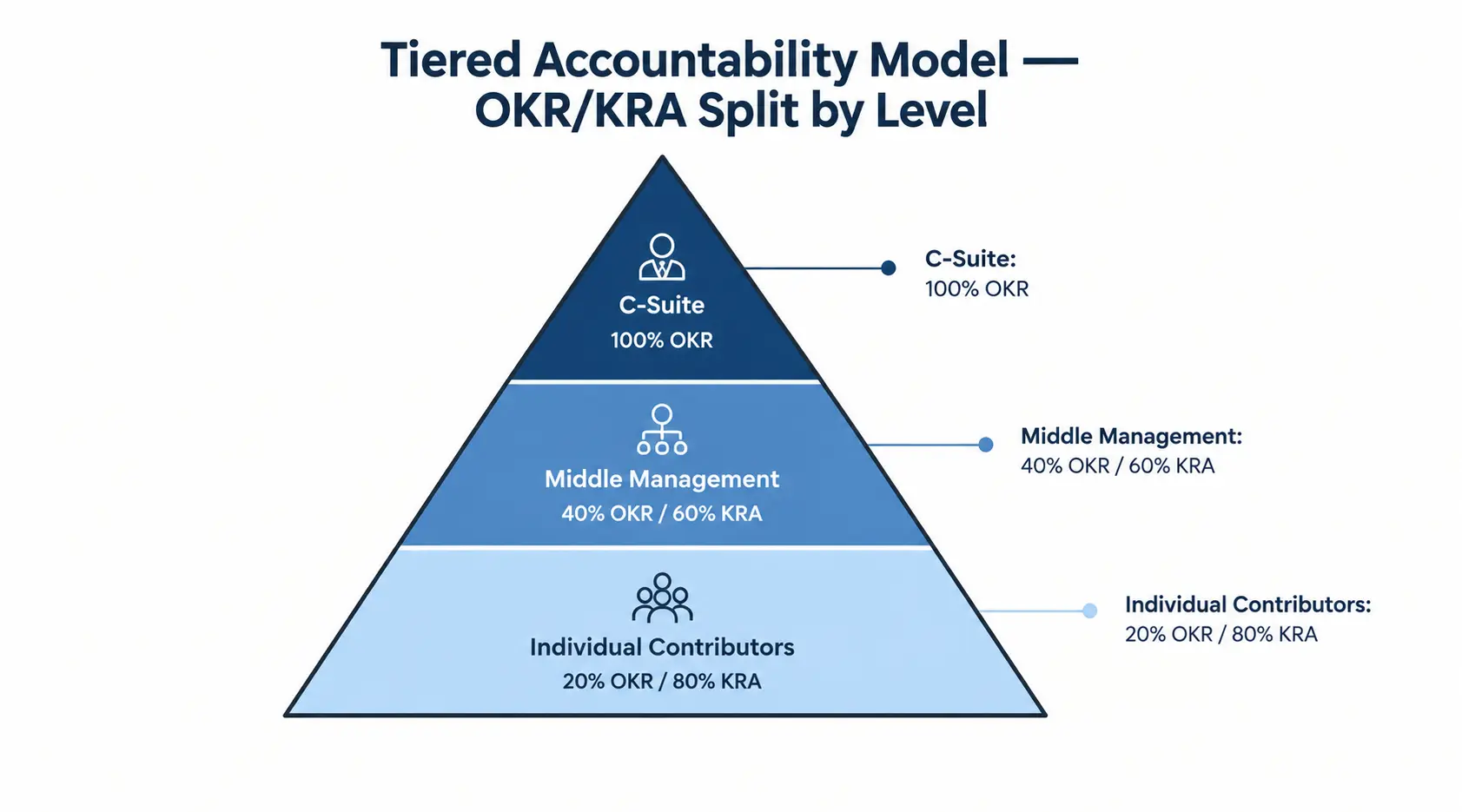
One mistake I see constantly in OKR frameworks for UK businesses rolling out appraisal-linked goals: applying the same OKR-to-KRA ratio at every level. It doesn’t work, because a CEO’s job is defined entirely by outcomes, and a frontline individual contributor’s job is defined mostly by reliable delivery against known responsibilities.
The model I coach clients through weights accountability differently by level: the C-suite runs on 100% OKR — every objective is outcome-owned, no KRA cushion. Middle management runs a 40% OKR / 60% KRA split — enough outcome accountability to drive strategy, enough KRA structure to keep operational delivery reliable. Individual contributors run 20% OKR / 80% KRA — most of the job is dependable execution of known responsibilities, with a smaller slice of stretch, outcome-linked goals layered on top. Get this ratio wrong in either direction and the appraisal breaks.
Not Sure Where Your Organisation Sits on This Model?
Run a structured audit of your current OKR and appraisal cascade before you shortlist a single vendor.
Case Study: A European Fintech Scale-Up Rebuilds Its Appraisal Culture Around Outcomes
A European fintech company, around 100 people and already generating revenue, brought me in when the CEO and CPO admitted they couldn’t articulate what “good performance” actually meant beyond a set of KPI dashboards. Appraisals were technically happening every quarter. Nobody could say what they were driving toward.
The turning point came from one question in the first coaching session: what is the one big thing you want to resolve? The answer was the product demo experience — conversion was leaking there and everyone sensed it without being able to prove it. What followed wasn’t a workshop, it was a sequence of “so what” questions, repeated until the team reached a genuine outcome statement instead of a task list dressed up as a goal.
The non-textbook move: I asked the Product Lead and the Account Executive to co-own a single Key Result — improving demo experience so it lifted conversion — jointly accountable, neither able to blame the other function when it stalled. That kind of cross-functional co-ownership had never happened in this organisation before.
Two to three quarters later: product and commercial teams were operating with real synergy, goals were grounded in what the business actually needed rather than assumed, and the appraisal conversation stopped being a ratings exercise — it became a review of outcomes both functions had jointly delivered.
Measuring Performance Management ROI: What Employee Appraisal Tools UK Finance Teams Actually Sign Off
The upfront cost of appraisal automation software is the easy number to challenge in a budget meeting. The harder, more important number is the cost of not modernising — and in the UK’s persistent productivity gap, that cost compounds every cycle you delay. Teams still running this in spreadsheets should see the stark version of that comparison in our spreadsheet vs appraisal software UK breakdown.
Three places I point finance teams to when they ask for the performance management ROI case: time saved on administration, retention (replacing a disengaged employee typically costs 1.5–2x their salary, and clear, fair appraisals measurably reduce that churn via stronger employee engagement software), and decision quality — HR and leadership finally have a live employee performance tracking software layer instead of scattered spreadsheets, which surfaces where the talent development software pipeline is actually thin.
The metric I care about more than any of these, though, is the Execution Maturity Rate — the percentage of leaders who can independently write a genuine outcome-driven goal without coaching support. In a typical first-cycle rollout that number sits at 5–15%. In organisations running a well-coached programme for 12 months, it reaches 30–40%. That’s the real performance management ROI: not goal-completion percentages, but how many leaders in the building can think in outcomes without being walked through it.
Turn Appraisals Into a Growth Lever, Not a Compliance Task
See how HR teams move from admin-heavy reviews to a strategic, OKR-linked performance culture.
Bottom Line
The shift from paper-based, once-a-year appraisals to continuous, OKR-linked performance management software UK isn’t optional for UK mid-market and enterprise teams anymore — it’s the difference between an appraisal that documents the past and one that actually changes what happens next quarter. Get the compliance foundation right, evaluate on the 7-parameter framework instead of a feature list, and connect every appraisal to a live OKR alignment layer instead of a static competency form.
The software is the infrastructure. The coaching is the capability. You need both — and in the right order.
If you’re ready to evaluate a platform, explore Worxmate’s OKR software or OKR software UK page and book a walkthrough of how appraisals and OKRs run in one execution layer. If what you’re facing is deeper than a software switch — cascade that’s broken, a leadership team that can’t yet articulate outcomes — that’s a coaching conversation, not a procurement one; Worxmate’s OKR consulting UK Europe practice starts there.
Looking for a global comparison of performance platforms?
Explore our comprehensive guide to the best performance management software to compare features, AI capabilities, and OKR integration across leading enterprise tools.


Written by
An OKR Coach with 20+ years of implementation experience, Madhusudan has guided over 50 organisations through successful OKR transformations, training more than 500 leaders. Learn more about Worxmate.