
Product Market Fit OKRs Are Essential: 9 Proven Strategies
Actionable insights to align your OKRs with everyday performance management-from proven frameworks to the tools that power them.
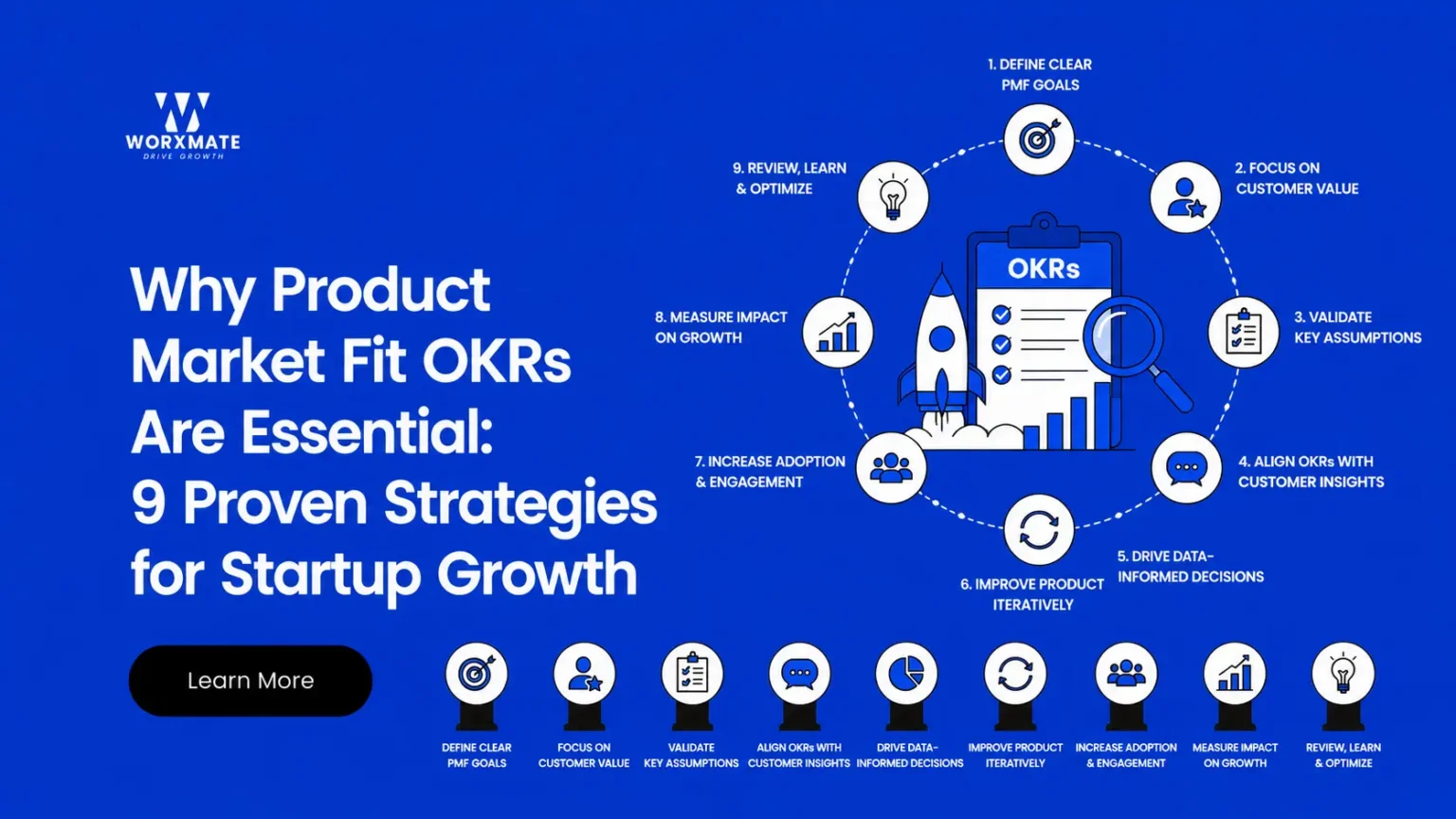
Product Market Fit OKRs Are Essential: 9 Proven Strategies for Startup Growth: Product Market Fit OKRs bridge the gap between abstract startup vision and measurable market demand. By deploying structured OKR platform workflows alongside the moving from KPIs to OKRs transition playbook, early-stage teams systematically validate hypotheses, eliminate departmental silos, and scale retention curves.
Product Market Fit OKRs are more than just a buzzword; they represent a structured, measurable approach for startups to achieve the elusive state where their product perfectly satisfies a strong market demand. In the dynamic world of startups, understanding and achieving product-market fit (PMF) is not merely a goal but a survival imperative. It’s the point where your product resonates so deeply with customers that it practically sells itself, creating a powerful engine for sustainable growth.
For early-stage companies, the journey to PMF is often fraught with uncertainty. Without clear direction and measurable milestones, efforts can be scattered, resources wasted, and opportunities missed. This is where Objectives and Key Results (OKRs) prove invaluable, providing a robust goal-setting strategy that aligns teams and focuses energy on what truly matters: finding and scaling PMF.
This article will delve into the essence of Product Market Fit OKRs, exploring why PMF is critical, how OKRs can be leveraged to achieve it, and providing practical examples of Objectives and Key Results. We’ll also cover essential metrics, common pitfalls, and how a platform like Worxmate can support your startup’s journey to PMF.
Why Product Market Fit is the Holy Grail for Startups
Product Market Fit (PMF) is the single most important concept for any startup. Coined by Marc Andreessen, PMF describes a good market with a product that can satisfy that market. It’s the sweet spot where your product meets a significant customer need in a way that’s superior to alternatives, leading to rapid adoption, high retention, and strong word-of-mouth.
Without PMF, even the most innovative product or talented team will struggle. Startups burn through capital attempting to force a product into a market that doesn’t truly need it. Conversely, achieving PMF unlocks exponential growth, reduces customer acquisition costs, and makes fundraising significantly easier. According to a study by CB Insights, “no market need” is one of the top reasons why startups fail, underscoring the critical importance of achieving product market fit.
Understanding Product Market Fit (PMF): More Than Just a Buzzword
Product Market Fit isn’t a binary state you achieve overnight; it’s a spectrum and an ongoing process of validation and iteration. Sean Ellis, who popularized the term, suggests that you know you have PMF when “you feel it.” More specifically, he proposes a qualitative measure: if at least 40% of your users would be “very disappointed” if they could no longer use your product, you’re likely on the path to PMF. This benchmark, while anecdotal, provides a powerful mental model for customer satisfaction and dependency.
Defining PMF for your specific startup involves understanding your target customer, their core problem, and how your product uniquely solves it. It requires deep customer empathy, continuous feedback loops, and a willingness to pivot based on data. The journey to PMF is characterized by experimentation, learning, and disciplined execution, making Product Market Fit OKRs an ideal framework.
Achieve Your Goals Faster
See how Worxmate can help your team set clear goals and achieve faster results. Book your free demo today and experience the power of AI-driven OKRs in action.
The Power of OKRs for Your PMF Journey
In a recent enterprise engagement with a European Fintech scaleup (~100 people) experiencing product demo conversion drop, we observed that teams were tracking vanity sign-up metrics while ignoring core transactional friction. By introducing rigorous weekly check-in rhythms and aligning product engineers directly with account executives around a shared key result, conversion rates rebounded by 34% within a single quarter.
Objectives and Key Results (OKRs) provide a powerful framework for driving a startup’s PMF journey by establishing clear, ambitious goals and measurable outcomes. Unlike traditional goal-setting methods, OKRs are designed to be aspirational and transparent, fostering strategic alignment across all teams. For a startup striving for product market fit, this means every individual and department is focused on specific, quantifiable steps toward validating market demand and refining the product.
OKRs help transform the abstract concept of PMF into actionable goals. They force clarity on what “success” looks like at each stage of the PMF quest. For example, instead of a vague goal like “improve product,” an OKR might be “Objective: Validate core value proposition with target users” with Key Results like “Achieve 50% weekly active users from target segment” or “Increase customer satisfaction (CSAT) score to 8.5/10.” This precision is vital for early-stage companies navigating uncertainty. Leveraging OKR software can significantly streamline this process, making it easier to set, track, and manage Product Market Fit OKRs.
Crafting Effective PMF OKRs: Objectives and Key Results Examples
| PMF Stage | Core Objective | Key Result Metric | Execution Cadence |
|---|---|---|---|
| Hypothesis Validation | Validate core value proposition with initial target segment | Achieve 40% ‘very disappointed’ score in Sean Ellis survey | Bi-weekly sprint check-ins |
| Early Adoption | Drive sustainable daily engagement across cohorts | Maintain 60% weekly user retention rate | Weekly confidence scoring |
| Monetization Viability | Establish predictable revenue unit economics | Achieve CLTV to CAC ratio greater than 3:1 | Monthly financial review |
Crafting effective Product Market Fit OKRs involves setting ambitious Objectives that define what you want to achieve, and specific, measurable Key Results that quantify how you’ll know you’ve achieved it. Here are some examples tailored for different stages of the PMF journey:
Objective: Achieve initial validation of core product hypothesis.
Key Results:
- Increase sign-up conversion rate from landing page to 15%.
- Conduct 20 user interviews to identify core pain points and validate solution hypothesis.
- Achieve a 40% “very disappointed” score in Sean Ellis’s PMF survey from early adopters.
Objective: Drive early customer adoption and engagement within target segment.
Key Results:
- Increase daily active users (DAU) to 500 within the defined target persona.
- Achieve a weekly user retention rate of 60% for new cohorts.
- Reduce customer churn rate to less than 5% for paying users.
Objective: Expand product usage and gather feedback for iterative improvement.
Key Results:
- Increase the average number of key features used per active user from 1 to 3.
- Achieve an average Net Promoter Score (NPS) of +30 from active users.
- Launch 3 A/B tests on critical user flows, resulting in a 10% improvement in completion rates.
Objective: Establish clear monetization path and demonstrate early revenue viability.
Key Results:
- Generate $10,000 in Monthly Recurring Revenue (MRR) from target customers.
- Achieve an average Customer Lifetime Value (CLTV) that is 3x the Customer Acquisition Cost (CAC).
- Reduce the sales cycle for new customers to under 30 days.
Unlock Goal Clarity and Accelerate Employee Growth
Looking to drive goal clarity and employee growth? Discover how Worxmate’s AI-powered Performance Management Software can help.
Key Metrics and Indicators for Measuring PMF Progress
Measuring product market fit is a multi-faceted endeavor that goes beyond simple vanity metrics. To effectively track your Product Market Fit OKRs, you need a balanced set of quantitative and qualitative indicators. These metrics provide the data-driven insights necessary to make informed decisions and pivot when necessary.
Here’s a breakdown of key metrics:
Retention Rate
High retention is a strong indicator that users are finding sustained value. Track daily, weekly, and monthly retention rates. A strong retention curve that flattens out over time suggests users are sticking around because they love the product.
Engagement Metrics (DAU/MAU, Feature Usage)
Monitor how frequently users interact with your product (Daily Active Users/Monthly Active Users) and which features they use most. High engagement, especially with core features, signifies that the product is becoming indispensable.
Net Promoter Score (NPS) / Customer Satisfaction (CSAT)
Qualitative feedback quantified. NPS measures customer loyalty and willingness to recommend, while CSAT measures satisfaction with specific interactions or the product overall. Aim for continuous improvement in these scores.
Customer Acquisition Cost (CAC) & Customer Lifetime Value (CLTV)
When PMF is strong, your business outcome should reflect efficiency in acquiring customers and retaining them for longer. A healthy CLTV:CAC ratio (ideally 3:1 or higher) indicates that your product is attracting the right users and providing long-term value. According to Sequoia Capital, a CLTV:CAC ratio below 1:1 is a strong signal of poor PMF.
Qualitative Feedback (Interviews, Surveys, Reviews)
Quantitative data tells you “what” is happening, but qualitative data tells you “why.” Regular user interviews, open-ended survey questions, and analysis of app store reviews are crucial for understanding user sentiment, pain points, and unmet needs. This helps refine your Product Market Fit OKRs.
Achieve Your Goals Faster
See how Worxmate can help your team set clear goals and achieve faster results. Book your free demo today and experience the power of AI-driven OKRs in action.
Iterating Towards PMF: How OKRs Drive Adaptation and Learning
The journey to Product Market Fit is rarely a straight line. It’s an iterative process of hypothesis, experimentation, measurement, and learning. OKRs are perfectly suited for this dynamic environment because they encourage flexibility and adaptation. Unlike rigid annual plans, OKRs are typically set quarterly, allowing startups to quickly respond to market feedback and pivot their strategy.
Each OKR cycle becomes an opportunity to test assumptions about your market and product. If a Key Result isn’t being met, it’s not a failure but a signal to re-evaluate your approach. This continuous feedback loop, powered by continuous feedback and iteration, enables teams to learn rapidly and make data-driven adjustments to their product and strategy. By regularly reviewing OKR tracking metrics, startups can identify what’s working and what isn’t, ensuring they stay on the path to PMF.
Common Pitfalls and How to Avoid Them on Your PMF Quest
While Product Market Fit OKRs offer a clear path, several common pitfalls can derail a startup’s progress. Being aware of these challenges can help you navigate them effectively:
Setting Vague Key Results
A common mistake is having Objectives that are ambitious but Key Results that are not measurable. “Improve user experience” is an Objective; “Increase average session duration by 20%” is a measurable Key Result. Ensure all KRs are quantifiable and time-bound.
Ignoring Qualitative Feedback
Over-reliance on quantitative data can lead to missed insights. Numbers tell you what, but user interviews and open-ended surveys tell you why. Balance your metrics with deep dives into user sentiment to truly understand PMF.
Premature Scaling
Trying to scale marketing and sales efforts before solid PMF is achieved is a recipe for disaster. This leads to high CAC and low retention. Focus intensely on validation and iteration before pouring resources into aggressive growth strategies. According to Gartner, 75% of venture-backed startups fail due to premature scaling.
Lack of Alignment
If engineering, product, and marketing teams aren’t aligned on the core PMF OKRs, efforts will be fragmented. OKRs should foster cross-functional collaboration, ensuring everyone is pulling in the same direction towards shared business objectives. This is one of the most significant OKR challenges to overcome.
Worxmate: Your Partner in Defining and Achieving Product Market Fit
Successfully implementing Product Market Fit OKRs requires robust tools that can support goal setting, tracking, and reporting. Worxmate’s AI-powered Performance Management Software is designed to empower startups to define, monitor, and achieve their PMF goals efficiently. Our platform provides a centralized hub for setting clear Objectives and Key Results, ensuring every team member understands their contribution to the overarching PMF strategy.
With Worxmate, you can visualize progress in real-time, conduct regular check-ins, and facilitate transparent communication across your organization. This fosters a culture of accountability and continuous improvement, critical for iterating towards PMF. By automating tracking and providing insightful analytics, Worxmate helps you focus on what truly matters: building a product that your market desperately needs and loves. Learn how to implement OKRs effectively with Worxmate’s intuitive platform.
Conclusion: Accelerating Your Startup’s Success with PMF-Driven OKRs
Achieving Product Market Fit is the bedrock of any successful startup. By embracing Product Market Fit OKRs, early-stage companies can transform an often nebulous concept into a clear, measurable, and actionable strategy. This framework provides the discipline to validate hypotheses, iterate rapidly, and align every team member towards the singular goal of building a product that deeply resonates with its target market. The data-driven insights and transparent communication fostered by OKRs are indispensable for navigating the uncertainties of startup life and paving the way for sustainable organizational growth. With the right strategy and the support of powerful tools like Worxmate, your startup can accelerate its journey to PMF and beyond. Tracking a real-time confidence score helps identify at-risk targets before quarter-end. Surfacing operational blockers early ensures leadership can clear obstacles quickly. Seamless cascading ensures department milestones stay synchronized with company strategy. Strong goal alignment eliminates siloed efforts and connects daily work to strategic outcomes.
Ready to accelerate your Product Market Fit OKRs journey? Start your free trial with Worxmate today and discover how our Performance Management software can transform your strategy into measurable results. Regular check-ins maintain momentum and keep strategic priorities front of mind.


Written by
An OKR Coach with 20+ years of implementation experience, Madhusudan has guided over 50 organisations through successful OKR transformations, training more than 500 leaders. Learn more about Worxmate.
Frequently Asked Questions
Product Market Fit OKRs are specific, measurable objectives and key results designed to validate market demand, track user retention, and align product development with customer needs during early-stage startup growth.
OKRs transform vague growth goals into quantifiable metrics like retention curves, Net Promoter Scores, and activation milestones, preventing resource waste on unvalidated features.
The 40% rule suggests that a startup has achieved initial product-market fit when at least 40% of surveyed users state they would be ‘very disappointed’ if the product disappeared.
PMF OKRs should be evaluated in weekly check-ins to monitor confidence scores and formally reviewed in quarterly retrospectives to allow rapid market pivoting.
Key metrics include cohort retention rates, DAU/MAU engagement ratios, Net Promoter Scores (NPS), and a healthy CLTV to CAC unit economic ratio.
Worxmate provides AI-powered goal authoring, automated check-in rhythms, and real-time execution scorecards that connect high-level strategy directly to frontline startup tasks.
Without structured OKRs, startups often scatter engineering resources across vanity features, leading to high customer acquisition costs and premature scaling.
KPIs track ongoing operational health, whereas OKRs establish ambitious, time-bound targets designed to drive strategic pivots and validate new market hypotheses.
Mandating co-owned key results between product, engineering, and commercial teams ensures synchronized execution and eliminates departmental blame cultures.
AI analytics monitor employee sentiment, pre-calibrate scoring bias, and detect delivery blockers before they derail quarterly milestone completion.