 WORXMATE

Quick Answer
Keep KPIs as your ongoing health metrics and introduce OKRs as quarterly, outcome-driven goals layered on top. Get executive alignment first, pilot with one or two teams, cascade top-down for the first two quarters, then shift to bottom-up with weekly check-ins. Organizations that coach this well typically raise their Execution Maturity Rate — the share of leaders who can write a genuine outcome-driven goal unassisted — from 5–15% to 30–40% within 12 months.
Moving from KPIs to OKRs is a strategic transition in performance management where organizations shift from tracking static business-as-usual metrics to defining aspirational, outcome-driven objectives. According to research by Gartner, companies that achieve high levels of strategic alignment through such frameworks grow their revenue 58% faster than those that remain siloed. This transition enables teams to foster greater agility, transparency, and cross-functional collaboration by connecting daily tasks to the overarching company vision.
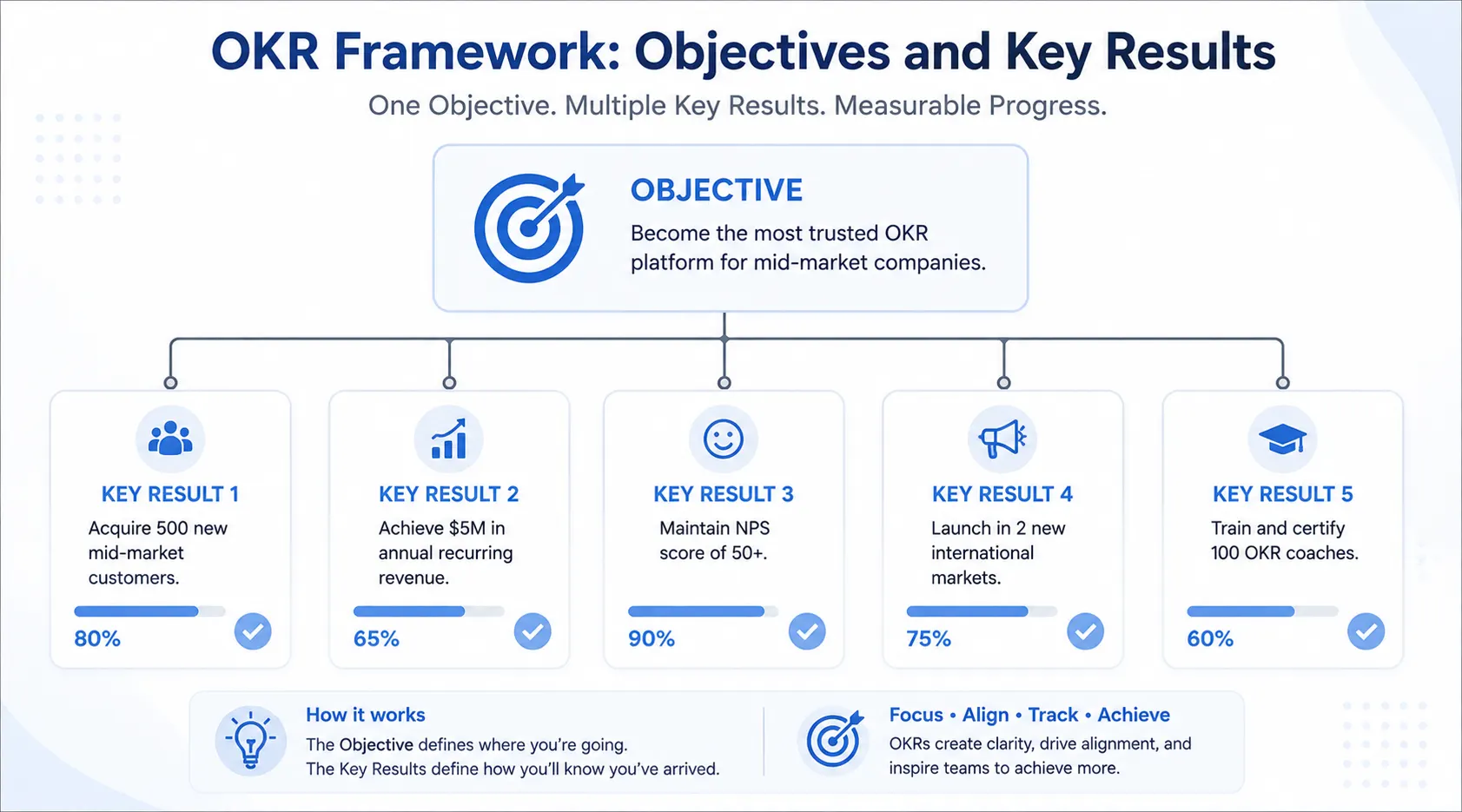
Moving from KPIs to OKRs involves shifting your organizational focus from monitoring health metrics and output to driving measurable growth and strategic outcomes. While KPIs (Key Performance Indicators) measure the efficiency of existing processes, OKRs (Objectives and Key Results) provide a framework for ambitious change, focusing on where the company needs to go and how it will get there. This evolution is essential for modern enterprises operating in volatile markets where static targets are no longer sufficient to maintain a competitive edge.
The core challenge for most mid-market companies is not a lack of data, but a lack of direction. Many leadership teams find themselves “hitting the numbers” on individual KPIs while failing to make progress on long-term strategic planning initiatives. That gap between hitting the numbers and building real organizational alignment is exactly where OKRs earn their place. By transitioning to an OKR model, you create a dynamic environment where teams are empowered to take risks and align their efforts toward shared goals. This guide explores the psychological, structural, and operational shifts required to make this transition successful. For a full side-by-side breakdown of both frameworks, see our complete OKR vs KPI comparison.
In the following sections, we will break down the fundamental differences between these two frameworks, examine why a KPI-only strategy often fails in fast-paced environments, and provide a step-by-step roadmap for moving from KPIs to OKRs. We will also discuss how to maintain a hybrid approach that leverages the strengths of both systems to ensure organizational stability while driving innovation.
The Evolution of Performance Management: Why Now?
The traditional model of performance management was built for the industrial age—an era defined by predictability, repetitive tasks, and top-down command. In that environment, KPIs were the gold standard because they allowed managers to monitor output and ensure that every “cog in the machine” was functioning at a baseline level of efficiency. However, as business shifted toward the knowledge economy, the limitations of this “monitoring-only” approach became apparent.
Today, companies like Google and Adobe have demonstrated that high-growth organizations require more than just efficiency; they require innovation and adaptability. The shift toward performance management systems that prioritize outcomes over outputs is a direct response to the increasing complexity of the global market. When you are moving from KPIs to OKRs, you are acknowledging that the “what” (metrics) is no longer enough without the “why” (objectives). This is not a rejection of measurement — it is a maturity curve. Organizations that get this right treat OKRs as the layer that gives KPIs direction, not a replacement for them. If your team still needs the fundamentals, our complete guide to what OKRs are breaks down the mechanics before you attempt the transition.
According to McKinsey, roughly 70% of organizational transformations fail due to a lack of employee engagement and management support. Traditional KPI systems often contribute to this failure by creating a “set it and forget it” mentality. In contrast, the OKR framework encourages continuous conversation and quarterly resets, ensuring that the organization remains aligned with current market realities rather than outdated annual plans.
Furthermore, the rise of remote and hybrid work has made organizational growth more dependent on transparency than ever before. Without a clear framework that connects individual work to the company’s “North Star,” employees often feel disconnected. Moving from KPIs to OKRs provides the visibility necessary to bridge this gap, allowing every team member to see how their specific key results contribute to the broader mission. This visibility problem compounds in distributed teams, where managers can no longer rely on hallway conversations to catch misalignment early. Building organizational performance that holds up across time zones and functions depends on structural transparency, not better reporting after the fact.
Understanding the Core Difference: KPIs vs. OKRs
To successfully navigate the process of moving from KPIs to OKRs, it is vital to understand that these are not mutually exclusive tools, but rather different lenses through which to view performance. A KPI is a “health metric”—it tells you if the engine is running. An OKR is a “GPS”—it tells you where the car is going and whether you are on track to arrive at your destination.
KPIs are typically operational and lagging. For example, a customer support team might have a KPI for “Average Response Time.” This is a critical metric to monitor, but hitting this target doesn’t necessarily mean the company is innovating or growing. It simply means the team is maintaining the status quo. When the organization begins moving from KPIs to OKRs, that same team might set an Objective to “Provide a World-Class Support Experience,” with a Key Result of “Increasing Net Promoter Score (NPS) from 60 to 80.”
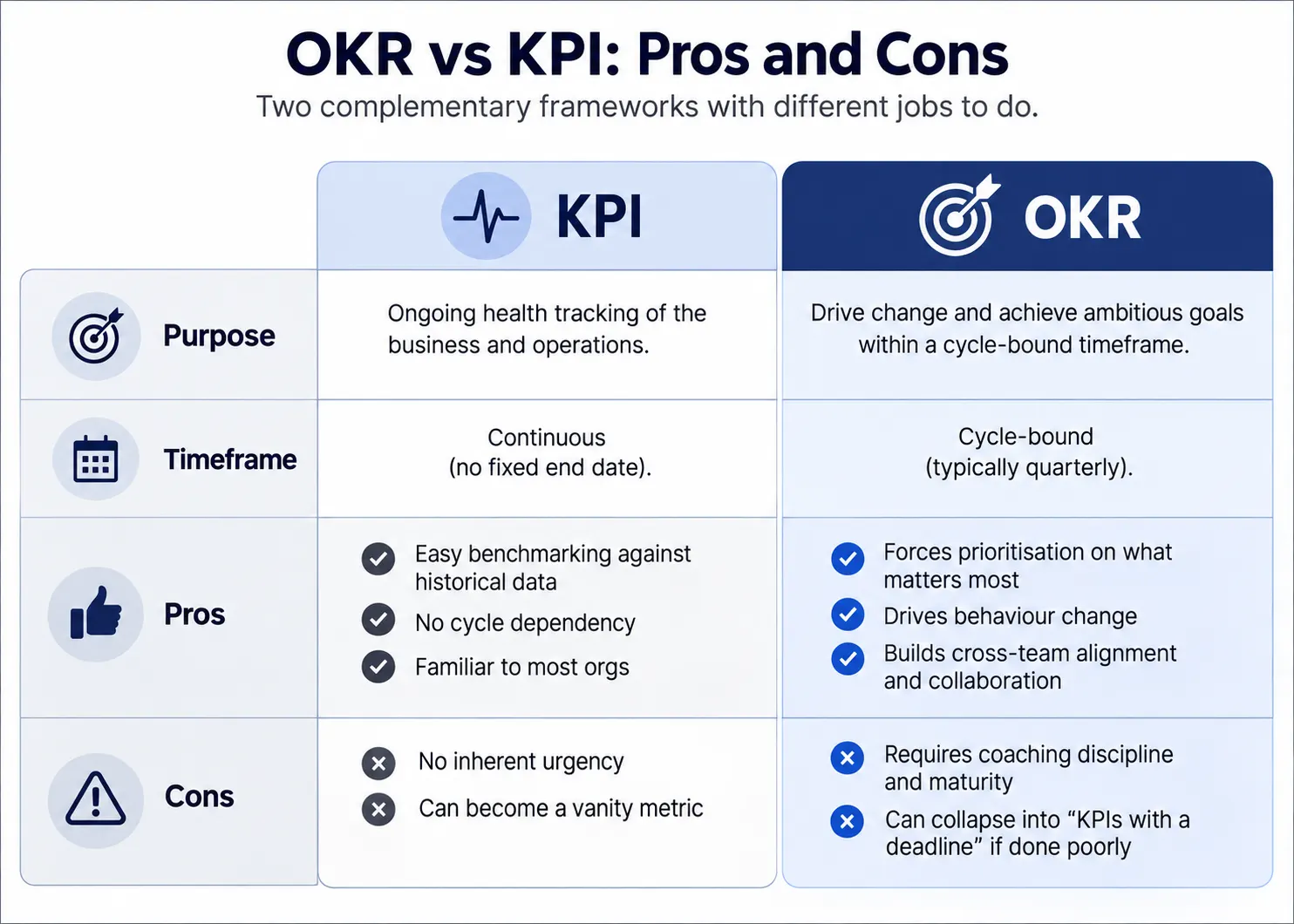
| Feature | Key Performance Indicators (KPIs) | Objectives and Key Results (OKRs) |
|---|---|---|
| Primary Focus | Monitoring steady-state performance and health. | Driving growth, change, and strategic innovation. |
| Timeframe | Ongoing, often reviewed annually or monthly. | Quarterly cycles with frequent check-ins. |
| Ambition | Attainable and realistic (100% completion expected). | Aspirational and “stretch” (70-80% is success). |
| Structure | Stand-alone metrics. | Hierarchical: Objectives linked to Key Results. |
| Outcome | Stability and efficiency. | Agility and strategic alignment. |
This is the shift our goal management framework is built around: moving teams from tracking activity to defining what “great” actually looks like. As the table illustrates, the transition is about moving from a culture of “maintenance” to a culture of “movement.” While KPIs keep the lights on, OKRs push the boundaries. This is why many leaders find that moving from KPIs to OKRs is the catalyst they need to break out of stagnation and enter a phase of rapid scaling.
The Limitations of a KPI-Only Strategy in a Fast-Paced Market
Relying solely on KPIs can lead to a phenomenon known as “metric fixation,” where employees optimize for the metric at the expense of the actual goal. HBR notes that when performance is tied strictly to narrow KPIs, 95% of employees often fail to understand their organization’s strategy. This lack of understanding creates silos, where the Marketing team hits their lead-gen KPIs, but the Sales team can’t close them because the leads are poor quality. This is the same dynamic that shows up as manager-employee friction when goals aren’t shared each side believes they hit their number, and neither trusts the other’s data.
In a KPI-only environment, there is often no incentive for cross-functional collaboration. Each department is focused on its own dashboard. When you are moving from KPIs to OKRs, you break these silos by creating shared Objectives that force functions to define success together (goal alignment), not separately. If the Objective is to “Successfully Launch Product X,” the Key Results will involve Marketing, Sales, and Product teams working in tandem, rather than chasing isolated metrics.
Another limitation is the “ceiling effect.” Because KPIs are usually tied to performance reviews and compensation, employees are incentivized to set conservative, “safe” targets that they know they can hit. This kills innovation. Moving from KPIs to OKRs introduces the concept of “stretch goals“—ambitious targets that encourage teams to think outside the box. In the OKR framework, failing to hit a 100% mark isn’t a sign of failure; it’s a sign that the team set a goal ambitious enough to drive real progress.
Finally, KPIs are often too slow to react to market shifts. A yearly KPI set in January may be completely irrelevant by June if a new competitor enters the market or technology changes. The quarterly rhythm of OKRs allows for the “pivot” that Eric Ries popularized in the Lean Startup methodology. Moving from KPIs to OKRs gives your leadership team the permission to re-evaluate and re-align strategy four times a year, ensuring you are always working on what matters most.
Why Moving from KPIs to OKRs Drives Better Strategic Alignment and Agility
Strategic alignment is the “holy grail” of modern management. It ensures that the CEO’s vision is translated into actionable tasks at the individual contributor level. Moving from KPIs to OKRs is the most effective way to achieve this because OKRs are designed to be transparent and bidirectional. Unlike KPIs, which are often handed down from on high, OKRs are frequently set through a mix of top-down and bottom-up planning.
When John Doerr introduced OKRs to the founders of Google, Larry Page and Sergey Brin, he emphasized that the power of the system lay in its ability to create a “shared language” for success. When everyone in the company can see the CEO’s OKRs, they can align their own team goals to support them. This transparency is a core benefit of modern OKR software, which replaces opaque spreadsheets with real-time dashboards accessible to all.
Agility is the second major benefit. In an agile leadership model, the ability to respond to change is more valuable than following a rigid plan. Moving from KPIs to OKRs facilitates this by decoupling “running the business” from “changing the business.” Your KPIs monitor the baseline, while your OKRs provide the flexibility to experiment with new initiatives. If a Key Result isn’t working halfway through the quarter, the team can analyze why and adjust their tactics without waiting for an annual review cycle.
This alignment also reduces “waste”—the time and resources spent on projects that don’t actually move the needle. By forcing teams to define “Key Results” that are measurable and outcome-based, the OKR framework ensures that effort is always tied to impact. This is a significant shift for companies moving from KPIs to OKRs, as it moves the conversation from “How busy were we?” to “What did we actually achieve?”
Unlock Goal Clarity and Accelerate Employee Growth
Looking to drive goal clarity and employee growth? Discover how Worxmate’s AI-powered Performance Management Software can help.
The Psychological Shift: Moving from KPIs to OKRs for Growth
The most difficult part of moving from KPIs to OKRs isn’t the software or the spreadsheets; it’s the mindset. For years, employees have been trained that “100% is an A.” In the OKR world, hitting 100% of your Key Results might actually mean you didn’t aim high enough. This requires a fundamental shift in how leadership treats “failure.”
To foster an outcome-based culture, leaders must decouple OKRs from base compensation. If an employee’s bonus is tied directly to hitting an OKR, they will never set a stretch goal. When moving from KPIs to OKRs, it is essential to communicate that OKRs are for growth and learning, while KPIs (and other performance metrics) are used for evaluating core job responsibilities. This psychological safety is what allows teams to innovate.
Furthermore, moving from KPIs to OKRs changes the role of the manager from a “supervisor” to a “coach.” Instead of checking a dashboard to see if a KPI is green or red, managers use OKR check-ins to ask: “What is blocking you?” and “How can I help you reach this Key Result?” This transition supports Gallup’s finding that employees whose managers provide regular feedback are 3.2 times more likely to be engaged at work. That kind of engagement doesn’t survive a training-day rollout. Most OKR programs don’t die at launch they die at what practitioners call the Coaching Cliff, the point where coaching stops at the leadership layer and managers are left to run check-ins with no support of their own. Our breakdown of why OKR coaching fails after the workshop ends covers exactly where this breaks and what to do differently.
This shift also empowers employees. In a KPI system, employees are often told exactly what to do. In an OKR system, they are given an Objective (the “What”) and are tasked with defining the Key Results (the “How”). This autonomy is a massive driver of motivation and retention, particularly among Gen Z and Millennial workers who value purpose and impact over mere task completion. Moving from KPIs to OKRs is, at its heart, an investment in your people’s potential.
Hybrid Approach: How to Integrate OKRs Without Scrapping Your KPIs
A common mistake companies make when moving from KPIs to OKRs is thinking they have to choose one or the other. In reality, the most successful organizations use a hybrid approach. You still need KPIs to monitor the health of your business. You don’t need an OKR for “Keeping the server uptime at 99.9%”—that is a KPI. You need an OKR for “Migrating to a new cloud architecture to support 10x user growth.”
Think of KPIs as the “vital signs” of your organization heart rate, blood pressure, temperature. As long as they are within a healthy range, you don’t need to spend much time on them. OKRs are your “fitness goals”—running a marathon or losing 10 pounds. You focus your energy and resources on the OKRs, while the KPIs run in the background. If a KPI suddenly drops into the “red zone,” it may trigger the creation of a new OKR to fix the underlying issue.
When moving from KPIs to OKRs, start by auditing your current metrics. Which ones are truly “Business as Usual” (BAU)? These remain KPIs. Which ones represent a change in direction or a major leap forward? These become the basis for your OKRs. For example, a SaaS company might keep “Churn Rate” as a KPI, but create an OKR around “Developing a New Onboarding Flow” to proactively address that churn. Whichever metrics you keep as KPIs, make sure the day-to-day work behind them is visible in the same place your OKRs live not in a separate task management tool nobody checks.
Using a continuous performance management system that can track both side-by-side is crucial. This allows leadership to see the “health” and the “growth” of the company in a single view. By maintaining this balance, you ensure that you aren’t so focused on the future that you let the present crumble, nor so focused on the present that you have no future.
8 Steps to Successfully Transition Your Team When Moving from KPIs to OKRs
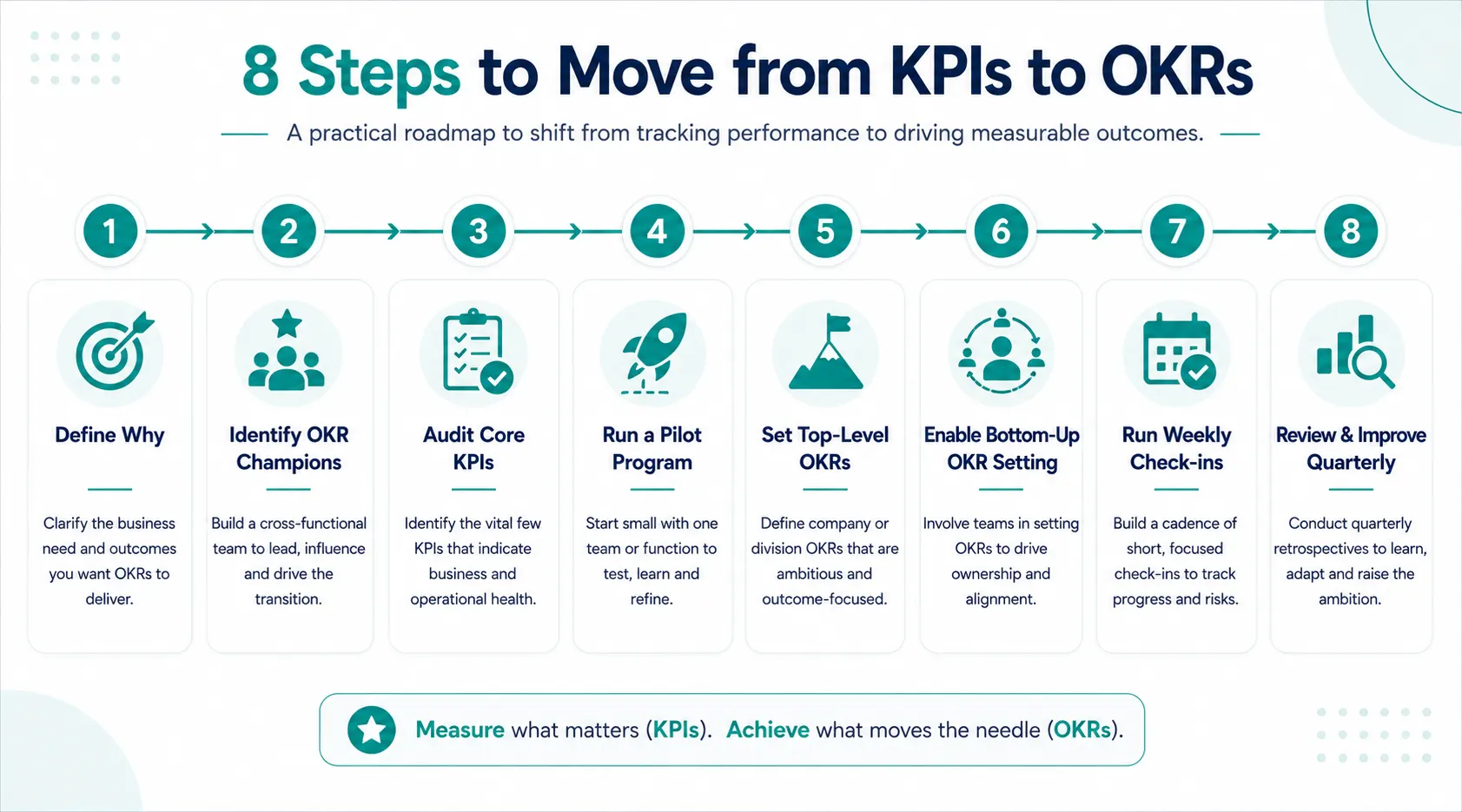
Transitioning an entire organization requires a structured approach. If you rush the process, you risk “OKR fatigue,” where teams see it as just another HR initiative. Follow these eight steps to ensure a smooth transition when moving from KPIs to OKRs.
-
1. Define the “Why” and Gain Executive Buy-in
Before introducing the framework to the staff, the leadership team must be aligned. Why are you moving from KPIs to OKRs? Is it for better alignment, faster growth, or more transparency? Without a clear “why,” the transition will lose momentum.
-
2. Identify Your “OKR Champions”
Select a group of early adopters within the company often department heads or project managers who can be trained deeply in the methodology. These champions will act as internal OKR consultants for their respective teams.
-
3. Establish Your Core KPIs
Clearly separate your health metrics from your growth goals. Document which metrics will remain as KPIs so that teams don’t feel they are losing sight of their daily responsibilities during the transition.
-
4. Start with a Pilot Program
Don’t roll out OKRs to 500 people at once. Start with one or two departments (like Product or Marketing) for one quarter. Learn from their challenges and successes before scaling to the rest of the organization. Choose a team with a visible, business-critical goal for the pilot not the easiest team to work with. A low-stakes pilot proves the framework works in theory; a real pilot proves it survives contact with actual pressure.
-
5. Set Top-Level Company OKRs
The CEO and executive team must set 3-5 high-level Objectives for the year and the quarter. These serve as the foundation for every other OKR in the company. See OKR examples for inspiration on how to phrase these.
-
6. Facilitate Bottom-Up Goal Setting
Once company OKRs are set, teams should propose their own OKRs that support those high-level goals. This creates buy-in and ensures that the people closest to the work are the ones defining the path forward. In the first two cycles, treat this as guided practice, not full autonomy teams new to outcome-thinking will often propose OKRs that are really KPIs with a deadline attached. Coaching matters more than the goals themselves at this stage. See goal alignment for how to keep bottom-up proposals tied to company strategic priorities.
-
7. Implement a Weekly Check-in Rhythm
OKRs fail when they are only discussed at the start and end of a quarter. Implement a 15-minute weekly ritual where teams discuss progress, identify blockers, and update their confidence scores for each Key Result. Keep this ritual separate from status-update meetings. The moment it becomes another place to report numbers instead of surface blockers, teams stop being honest in it.
-
8. Conduct a Quarterly Retrospective
At the end of the quarter, grade your OKRs. Be honest about why certain goals weren’t met. Use these insights to set better, more informed OKRs for the next cycle. This continuous learning is the engine of the OKR framework. This is the step most programs skip under deadline pressure and the one that determines whether cycle two is better than cycle one, or just a repeat of it. For a full breakdown of how each quarter should flow, see our guide to the OKR cycle.
Case Study: CloudScale — Increasing Cross-Functional Completion by 40%
-
The Challenge
CloudScale, a mid-sized SaaS firm with 200 employees, was struggling with extreme departmental silos. The Engineering team was hitting their “Sprint Velocity” KPIs, and Sales was hitting their “New Logo” KPIs, yet the company was failing to launch major integrated features on time. Internal surveys showed that 60% of employees felt their work had no direct impact on the company’s long-term business goals.
-
The Solution
The Chief People Officer initiated the process of moving from KPIs to OKRs. They kept operational metrics like “Server Uptime” as KPIs but introduced shared quarterly OKRs for product launches. They utilized a dedicated task management integration to link daily work directly to these new Key Results, ensuring every developer and salesperson saw how their tasks moved the needle.
-
Results and Impact
Within three quarters of moving from KPIs to OKRs, CloudScale saw a 40% increase in the completion rate of cross-functional projects. Employee engagement scores rose by 25%, as teams felt more connected to the mission. According to Deloitte, organizations that use collaborative goal-setting frameworks like OKRs are 2.3x more likely to be high-performing.
The journey of moving from KPIs to OKRs is not a destination but a continuous process of refinement. It requires patience, a willingness to embrace “ambitious failure,” and a commitment to radical transparency. However, for companies that want to thrive in the next decade, the shift from monitoring the past to driving the future is no longer optional.
Ready to accelerate your moving from KPIs to OKRs journey? Start your free trial with Worxmate today and discover how our Performance Management software can transform your strategy into measurable results.


Written by
An OKR Coach with 20+ years of implementation experience, Madhusudan has guided over 50 organisations through successful OKR transformations, training more than 500 leaders. Learn more about Worxmate.