How to Use an OKR Stretch Goal Calculator | 6 Steps
Actionable insights to align your OKRs with everyday performance management-from proven frameworks to the tools that power them.
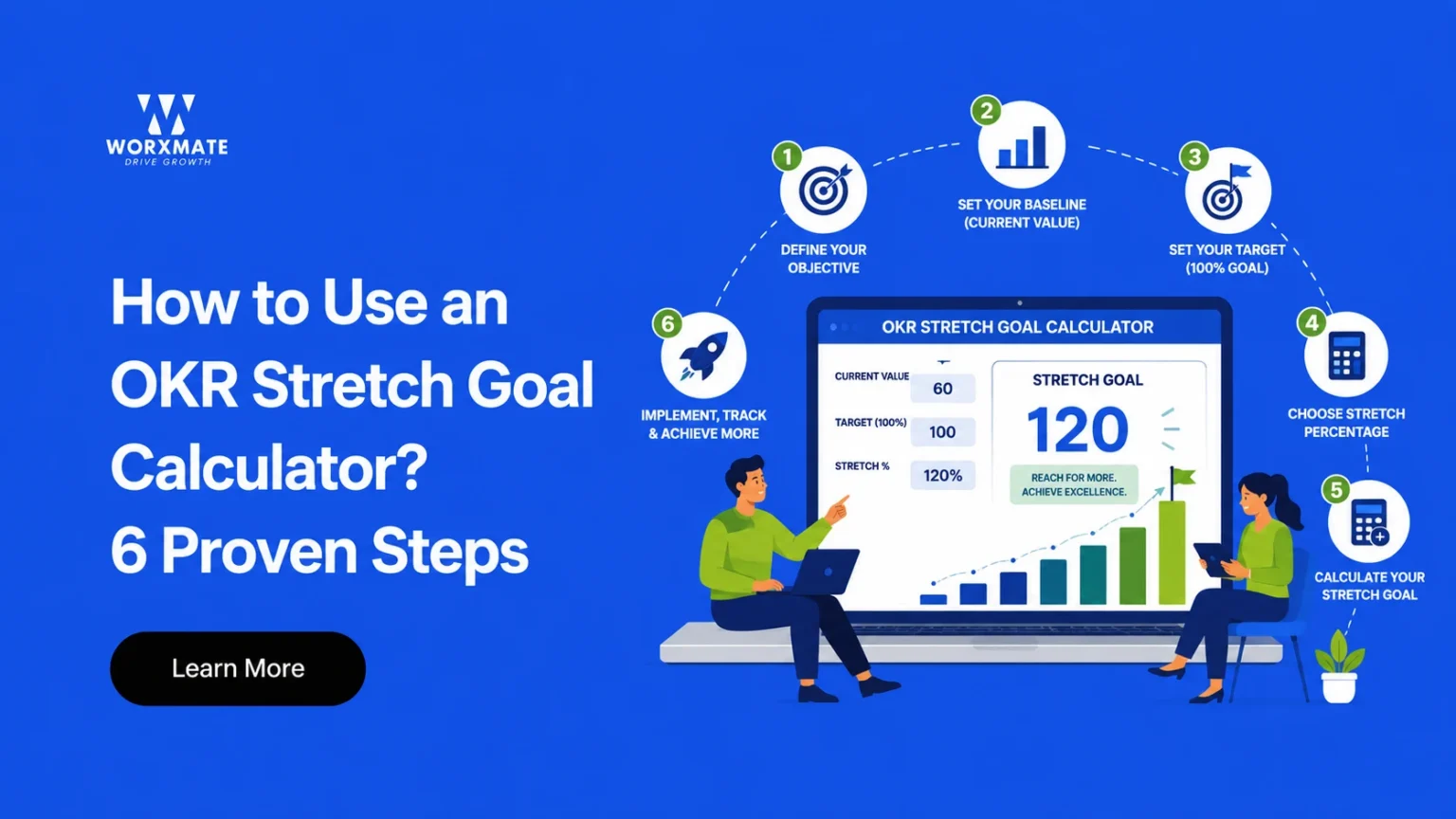
OKR Stretch Goal Calculator: An OKR stretch goal calculator measures the mathematical gap between baseline performance and visionary moonshot outcomes. Utilizing modern Best OKR software ensures mid-market enterprises establish data-driven aspirational targets, eliminate goal sandbagging, and maintain sustainable team engagement without risking core operational stability.
When scaling mid-market organizations attempt to push beyond incremental growth, leadership teams frequently struggle to quantify the exact delta between committed baseline operations and visionary moonshot aspirations. Relying on static spreadsheets often leads to inaccurate target sizing, resulting in either employee burnout or chronic sandbagging across departments.
By utilizing an OKR stretch goal calculator, mid-market companies can effectively manage risk and resource allocation. This structured approach helps teams move beyond safe, incremental improvements toward the exponential growth typically associated with high-performing cultures like those at Google and Adobe.
How do you know if your goals are ambitious enough to drive growth, but realistic enough to avoid burnout? An OKR stretch goal calculator provides the answer by offering a data-driven framework for setting “moonshot” objectives. In the world of Objectives and Key Results, a stretch goal is designed to be intentionally difficult, pushing a team to achieve what currently seems impossible through radical innovation rather than just working harder.
The problem many scaling companies face is “sandbagging”—the tendency to set targets that are easily reachable to ensure a 100% success rate. While this feels safe, it stifles organizational growth. According to Gartner, 80% of organizations are currently using or plan to implement OKRs to drive digital transformation, especially when moving from KPIs to OKRs, yet many struggle with the distinction between standard tasks and true stretch goals. Using an OKR stretch goal calculator helps eliminate this ambiguity by defining exactly what constitutes a “committed” versus a “stretch” target.
This article will explore the mechanics of ambitious goal setting, the essential differences between goal types, and how to use an OKR stretch goal calculator to balance your strategic portfolio. We will also dive into the “70% rule” popularized by John Doerr and explain how modern performance management systems automate the tracking of these high-stakes objectives.
What is an OKR Stretch Goal? Insights for your OKR Stretch Goal Calculator
An OKR stretch goal, often referred to as an “aspirational” or “moonshot” goal, is an objective where the path to completion is not fully known at the start of the quarter. Unlike committed goals, which are expected to be achieved 100%, a stretch goal is designed to challenge the status quo. When you input variables into an OKR stretch goal calculator, you are essentially measuring the “ambition gap”—the space between what you know you can do and what you wish you could do.
The concept was famously championed by Google, where leaders are encouraged to set goals that they have only a 60-70% chance of achieving. This philosophy suggests that if you are hitting 100% of your goals, you aren’t being ambitious enough. In an objectives and key results (OKRs) framework, these goals serve as a north star for the organization, driving teams to rethink their processes entirely.
Using an OKR stretch goal calculator ensures that these ambitious goals are not just random high numbers. Instead, they are calculated based on historical performance, market benchmarks, and resource availability. This prevents the “demotivation trap,” where employees stop trying because a goal feels completely disconnected from reality.
Committed vs. Stretch Goals: Knowing the Difference
Before you can effectively use an OKR stretch goal calculator, you must understand the two primary types of OKRs. Confusing the two is a leading cause of OKR failure in mid-market companies. Committed goals are the “must-haves”—they are tied to budgets, customer SLAs, and core business operations. Stretch goals are the “nice-to-haves” that represent significant breakthroughs.
| Feature | Committed Goals | Stretch (Aspirational) Goals |
|---|---|---|
| Expected Success Rate | 100% | 60% – 70% |
| Resource Allocation | Fully funded and prioritized | Resource-constrained; requires innovation |
| Failure Impact | Significant (missed revenue, lost clients) | Minimal (learning opportunity, high growth) |
| Focus | Operational excellence and reliability | Growth, innovation, and market disruption |
A high-functioning strategic performance management system treats these categories differently. While committed goals are non-negotiable, stretch goals require a culture that rewards effort and learning. Research from Harvard Business Review indicates that companies with high strategic alignment are 2.2 times more likely to be top performers, largely because they clearly distinguish between maintaining the business and growing the business. For more on this distinction, see our guide on aspirational vs committed OKRs.
How to Use an OKR Stretch Goal Calculator for Ambitious Goal Setting
To get the most out of an OKR stretch goal calculator, you need to follow a structured process. It isn’t enough to simply double your sales target and call it a “stretch.” Real ambitious goal setting requires an understanding of your “baseline” and your “potential.”
Step 1: Establish Your Baseline Performance
Look at your historical data from the last four quarters. If your average growth is 10%, that is your committed baseline. This is the starting point for any OKR stretch goal calculator logic.
Step 2: Define the “Committed” Target
Set a target that you are 100% confident you can hit with current resources. This ensures the business remains stable while you reach for higher peaks.
Step 3: Calculate the Stretch Delta
Using your OKR stretch goal calculator , add a “stretch multiplier.” Usually, this is 30% to 50% above the committed target. For example, if your committed goal is $1M in revenue, your stretch goal might be $1.4M.
Step 4: Assess Resource Gap
Identify what is missing to reach the stretch target. Do you need new technology, a different marketing strategy, or a new hire? This helps turn a “number” into an action plan.
When teams use an OKR stretch goal calculator, they often realize that reaching the moonshot requires moving away from outputs to outcomes. It forces a shift from “how much work can we do?” to “what impact can we create?”
Why Your OKR Stretch Goal Calculator Needs the 70% Rule
The “70% Rule” is the cornerstone of effective performance metrics in an OKR environment. If your OKR stretch goal calculator shows that a team hit 100% of their aspirational goals, it is a signal that the goals were too easy. In the OKR grading scale (0.0 to 1.0), a score of 0.6 to 0.7 is considered the “sweet spot” for success.
According to McKinsey, 70% of large-scale change programs fail due to employee resistance and lack of management support. One way to mitigate this is by removing the fear of failure. If an OKR stretch goal calculator is used correctly, a 70% achievement is celebrated as a massive win. This encourages employees to take risks without fearing for their performance reviews.
By integrating the 70% rule into your OKR stretch goal calculator, you create a psychological safety net. Teams understand that the goal is to “stretch” their capabilities. Even if they fall short of the 100% mark, the progress made is significantly greater than what would have been achieved with a safe, committed goal. This is a fundamental part of modern performance management with OKRs.
Calculating Risk and Resources for Moonshot OKRs
Setting moonshot goals without assessing risk is a recipe for disaster. An OKR stretch goal calculator must account for the “cost of pursuit.” Every hour spent chasing a moonshot is an hour taken away from core operations. Leaders must decide how much of their team’s capacity—usually 20% to 30%—should be dedicated to these high-risk, high-reward objectives.
A common mistake in ambitious goal setting is over-allocating resources to stretch goals at the expense of committed ones. If your OKR stretch goal calculator indicates that a project requires 100% of your top engineers’ time, you are no longer “stretching”—you are gambling with your core business. Microsoft and Spotify famously use “betting” frameworks to decide which stretch goals are worth the resource drain.
To balance this, your OKR stretch goal calculator should include a “Risk-to-Reward” ratio. If the potential reward of a stretch goal is 10x the committed goal, it justifies a higher risk profile. However, if the reward is only 1.2x, it may be better categorized as a committed goal with a slight increase in scope. This level of rigor is what separates successful mid-market companies from those that experience “OKR burnout.”
Unlock Goal Clarity and Accelerate Employee Growth
Looking to drive goal clarity and employee growth? Discover how Worxmate’s AI-powered Performance Management Software can help.
How to Automate Your OKR Stretch Goal Calculator and Tracking
While a manual OKR stretch goal calculator (like a spreadsheet) is a good start, scaling companies quickly outgrow it. Manually tracking the difference between committed and stretch targets across multiple departments becomes a bottleneck. Spreadsheets can’t easily flag when a “stretch” is consistently being treated as a “committed” goal, nor can they apply consistent grading logic at scale. This is where automation becomes essential for maintaining visibility, alignment, and psychological safety.
A purpose-built performance management system can function as an integrated OKR stretch goal calculator by doing three things that spreadsheets cannot.
First, it allows managers to tag objectives as either Committed or Aspirational at the point of creation. The system then automatically applies the 70% rule to grading—meaning a team that achieves 0.7 on a moonshot goal receives full recognition, while a committed goal that misses 100% triggers a flag for review. This removes the manual math and the fear of unfair evaluation.
Second, automation provides real-time dashboards that visualize the “ambition gap” across the entire organization. Instead of hunting through weekly updates, leaders can see at a glance which teams are safely hitting committed goals, which are healthily stretching, and which may have set targets that are either too easy or truly impossible. This saves HR directors and operations managers dozens of hours each quarter.
Third, an automated system links stretch goal performance to individual development plans over time. When the data shows a team consistently hitting 90%+ on aspirational goals, the system can suggest more challenging objectives for the next cycle. Conversely, if a team always lands below 40% on stretch goals, it prompts a conversation about resources, not a penalty. This turns the annual review process into a continuous cycle of learning and high-impact achievement. Regular check-ins maintain momentum and keep strategic priorities front of mind. Tracking a real-time confidence score helps identify at-risk targets before quarter-end. Surfacing operational blockers early ensures leadership can clear obstacles quickly. Seamless cascading ensures department milestones stay synchronized with company strategy. Strong goal alignment eliminates siloed efforts and connects daily work to strategic outcomes.
In conclusion, adopting an OKR stretch goal calculator is more than a mathematical exercise—it is a cultural shift. But that shift only sticks if the process is frictionless. Automating the distinction between committed and stretch goals signals to your team that innovation is valued, that failure in pursuit of greatness is acceptable, and that leadership is serious about removing administrative drag. By letting software handle the calculation and tracking, you free your workforce to do what matters most: reach for the stars while keeping their feet firmly on the ground.
Ready to accelerate your ambitious goal setting journey? Start your free trial with Worxmate today and discover how our Performance Management software can transform your strategy into measurable results.


Written by
An OKR Coach with 20+ years of implementation experience, Madhusudan has guided over 50 organisations through successful OKR transformations, training more than 500 leaders. Learn more about Worxmate.
Frequently Asked Questions
An OKR stretch goal calculator is a strategic analytical tool used by organizations to determine the mathematical gap between baseline operational performance and visionary moonshot objectives.
Stretch goals are typically calculated by taking your committed baseline performance and applying a 30% to 50% upward multiplier, aiming for a healthy 60% to 70% achievement rate.
The 70% rule states that achieving 60% to 70% of an aspirational stretch goal represents optimal success, proving the team set sufficiently ambitious targets without experiencing burnout.
Modern Best OKR software automates the tracking of committed versus aspirational goals, applies consistent grading logic, and provides real-time visibility into organizational ambition gaps.
Committed OKRs are mandatory operational targets expected to be achieved 100%, whereas stretch OKRs are high-risk aspirational goals focused on breakthrough innovation and market disruption.
Organizations prevent burnout by ensuring stretch goals are properly resourced, decoupling them from punitive performance reviews, and celebrating 70% achievement as a major strategic victory.
While spreadsheets work for early-stage teams, scaling companies quickly outgrow manual formulas due to siloed tracking, lack of automated grading rules, and administrative overhead.
The ambition gap is the quantifiable space between what a business knows it can safely achieve with current resources and what it could accomplish through radical innovation.
Stretch goals should be continuously monitored through weekly check-ins and formally graded at the end of each quarterly OKR cycle to capture lessons learned.
Worxmate combines OKR tracking, continuous performance management, and AI-powered insights to help mid-market companies align strategy, automate scoring, and drive high-impact growth.