 WORXMATE

Strategic Performance Management System: A comprehensive organizational framework that connects everyday execution, key results, and employee performance software tools to overarching company objectives. Unlike siloed annual appraisals, it leverages continuous feedback and strategic alignment to drive measurable business impact.
Modern organizations face unprecedented volatility, making the traditional separation between long-term planning and day-to-day execution obsolete. When leadership defines strategic priorities without establishing operational connectivity, workforce productivity stalls and strategic drift occurs. Forward-thinking enterprises are moving away from bloated legacy HR systems in favor of agile platforms that integrate OKRs with continuous performance management.
Have you ever thought about the magic behind successful companies? At the heart of it, they often weave “strategic planning” and “performance management” into their operations.
Think of it as a journey: strategic planning decides the destination and the path, while execution frameworks ensure we’re traveling in the right direction and at the desired speed. The blend of these concepts helps businesses achieve their goals.
Traditional performance management techniques frequently fail in a world where operational agility is the key to corporate success. What is the answer, then? The Strategic Performance Management System! What is an SPMS, though, and how is it different from the antiquated yearly performance assessments that many businesses still use?
SPMS helps teams and individuals coordinate their work with the organization’s overarching objectives. Consider it the link between routine tasks and strategic goals. But why is it now so important?
Dive with us on this journey to understand how strategic planning performance measurement and strategic performance management systems play pivotal roles in driving success.
What Is Strategic Performance Management System?
The process of improving performance assessment, monitoring, and execution in order to accomplish overall company goals is known as strategic performance management. Rather than operating as an isolated HR task, it unifies strategy execution across departments.
The balanced scorecard paradigm, which links employee performance to organizational capacity optimization, internal process efficiency, customer happiness, and financial success, is frequently used in strategic performance management.
Performance management comes in a variety of forms, including continuous performance management, agile performance management, and formal/annual performance management. One of the best-tested strategies that has been widely used by big businesses is strategic performance management, though mid-market and frontline organizations require leaner deployment models.
The Importance of Strategic Alignment
Making sure your business is spending time, money, and resources on projects that it has determined are strategically vital requires strategic alignment. Without rigorous strategic alignment, teams chase conflicting milestones.
The organization’s time and resources all result in work outputs that are intrinsically linked to the strategic objectives of the business. By establishing clear key results and weekly check-ins, leadership ensures transparency across all operational tiers.
Furthermore, strategic alignment improves the working environment for the organization’s employees. This alignment can inspire teams and raise morale in addition to producing better work that benefits the company.
People’s priorities and aspirations are less unclear. They are empowered to make choices and are aware of their place in the larger scheme of things. Because they are aware of how their work fits into the company’s strategy, they are able to make those choices.
According to a study by McKinsey, companies that align individual performance with strategy are 4.2 times more likely to outperform their competitors. This alignment ensures that resources, time, and effort are focused on initiatives that matter most to the organization’s success.
Unlock Goal Clarity & Accelerate Employee Growth
Looking to drive goal clarity and employee growth? Discover how Worxmate’s AI-powered Performance Management Software can help.
The Problem with Traditional Performance Management
The rewards you offer once the objectives have been reached make up the other essential part of the performance management balancing act. The majority of businesses still base the majority of their incentives on the yearly performance review.
An employee can leave the discussion with a performance improvement plan or a raise, so it’s both a positive and a negative incentive. Employers may view this combination of good and negative aspects as advantageous.
Traditional performance management approaches have the drawback of being mostly punitive. Even if they are aware that they have performed exceptionally well during the year, most employees dread their yearly performance reports.
Even after receiving financial incentives and praise on a regular basis, employees still experience anxiety when they attend annual review meetings.
Traditional performance management strategies simply do not function in today’s corporate workplace, which is culture-focused. As they work for your organization, provide your staff members a sense of purpose and appreciation for their contributions.
Core Pillars of a Modern Framework
Implementing a robust strategic performance management system requires transitioning away from static annual appraisals toward agile, continuous operational cadences. Organizations must adopt structured performance management approaches that bridge high-level strategy with daily frontline execution.
Successful deployment relies on transparent OKRs, regular 1:1 check-ins, and ongoing feedback loops. When managers replace annual reviews with weekly progress tracking, confidence scores and blockers are identified immediately rather than discovered months too late.
Benefits of a Strategic Performance Management System
So how can you accomplish organizational goals with the aid of a strategic performance management system? What are the organization’s and the workforce’s overall long- and short-term benefits? Let’s see.
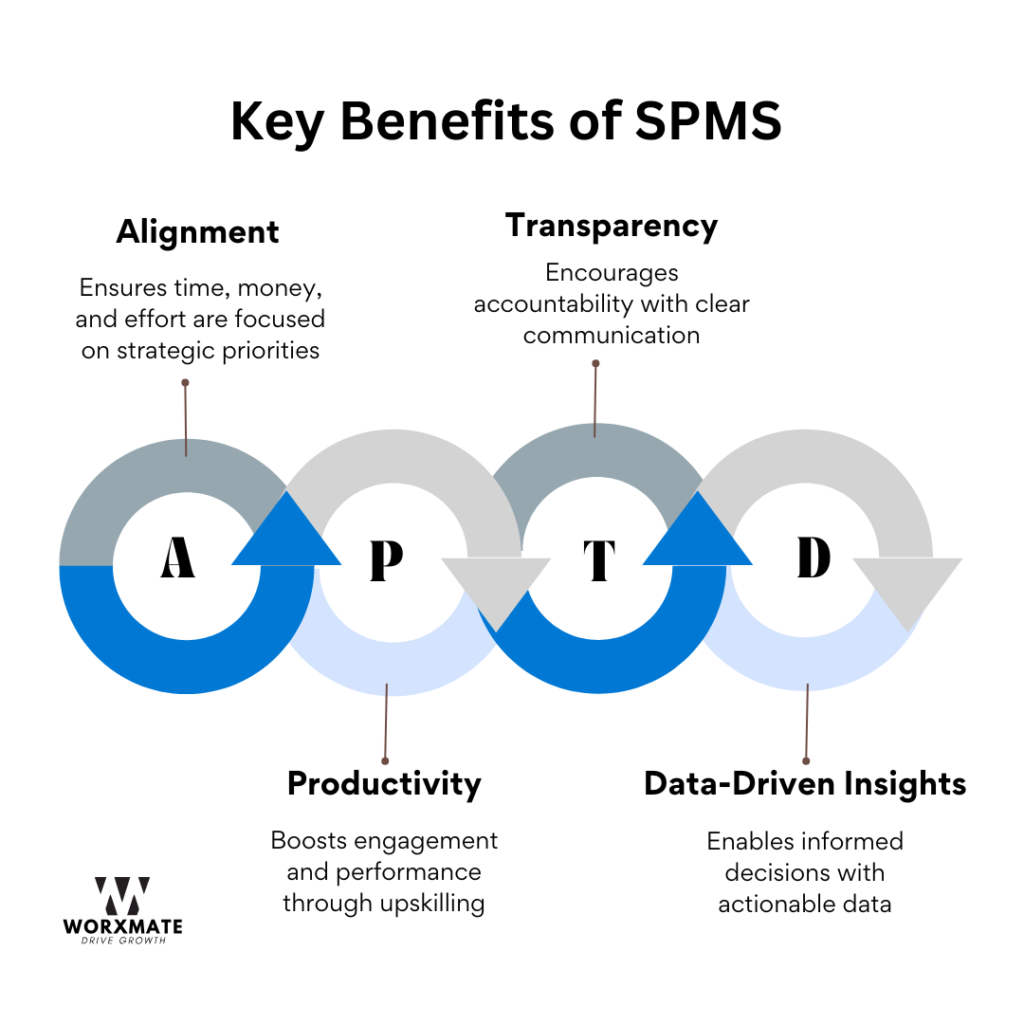
1. Better alignment of corporate objectives and goals
The technique of keeping your staff focused on the overall goals of your company is known as goal positioning or strategic coordination.
Managers make sure that staff members know what they are expected to do and why when they set company-wide goals. Administrators also make sure that the overall strategy is in line with their own objectives as well as those of the individuals under their supervision.
Also, for instance, companies leveraging performance data reported an improvement in project outcomes, according to a Deloitte survey.
2. Increased productivity and employee performance
Employee involvement in the management endeavor is bolstered by a strategic performance blueprint. It helps in uniting employees at all levels and emphasizing the role of each department.
Furthermore, obtaining the loyalty of the team may be assisted by designing a plan for skill development and professional advancement. There is also an increase in employee productivity as a result of frequent upskilling, which is a crucial component of strategic performance management.
For example, an organization that has high employee engagement saw an increase in employee productivity, as reported by Gallup.
3. Augmented transparency and accountability
Communication is an important element of the success of the performance management strategy. There must be proper communication between management and employees for the company to attain all its objectives.
This increases transparency among everyone in the company, from the CEO to the newest frontline worker. Hence, everyone takes ownership of their work and understands their part in the success of the organization.
4. Better decision-making with insights derived from data
Strategic performance management frequently makes reference to comprehensive business intelligence systems since it is an all-encompassing, organizational-wide endeavor.
They offer individual, team, business unit, financial, and customer-facing performance data. Managers and HR departments will gather, assess, and analyze performance-related data using analytics. This data-driven approach makes it easier to make informed decisions about how to improve the system, its strategies, and the company’s complete efficacy.
Forbes report states that companies that adopt data-driven performance management practices are 23% more likely to surpass their competitors.
Bottom Line
To achieve market profitability and operational resilience, businesses must implement a strategic performance management system. Organizations can successfully monitor and accomplish success by coordinating company goals and objectives, improving staff performance and productivity, raising accountability and transparency, and facilitating data-driven decision-making.
Frequent reviews and opportunities for skill development encourage employee loyalty and involvement, and openness and communication guarantee that each person is aware of their part in the operation of the company.
You can achieve long-term success and navigate the constantly shifting business landscape with confidence if you have a thorough framework in place. Therefore, adopt strategic performance management to realize your company’s full potential right now. Tracking a real-time confidence score helps identify at-risk targets before quarter-end. Seamless cascading ensures department milestones stay synchronized with company strategy. Strong goal alignment eliminates siloed efforts and connects daily work to strategic outcomes.
Managers and staff work together to create a successful performance management system. You may establish a system that empowers workers and propels corporate success by establishing open communication and mutual trust.
Ready to modernize your review cycles and align execution across your entire workforce? Explore Worxmate today to design a strategic performance management system tailored to your organization’s exact needs. Let’s achieve success, together!


Written by
An OKR Coach with 20+ years of implementation experience, Madhusudan has guided over 50 organisations through successful OKR transformations, training more than 500 leaders. Learn more about Worxmate.