 WORXMATE
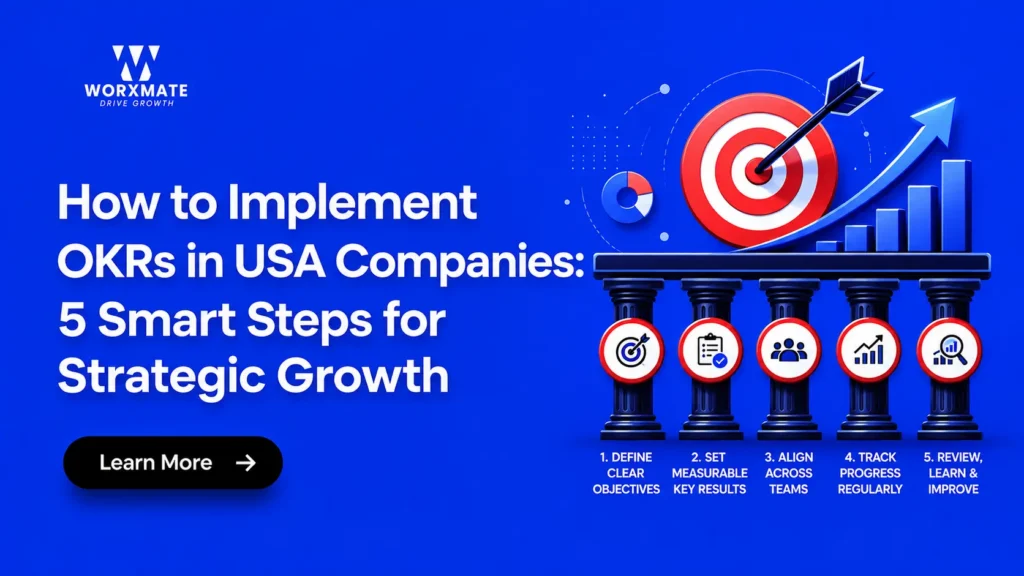
How to Implement OKRs in USA Companies: 5 Smart Steps for Strategic Growth
Actionable insights to align your OKRs with everyday performance management-from proven frameworks to the tools that power them.
Summary
The process of how to implement OKRs in USA companies effectively begins with establishing a clear OKR framework, followed by crafting ambitious yet measurable objectives and key results. Success hinges on fostering transparency and alignment across all levels, implementing robust tracking mechanisms, and committing to continuous refinement.
Most mid-market to enterprise-level US organizations seek to implement OKRs in USA companies to drive strategic focus and improve performance management. This guide provides a practical, step-by-step roadmap to navigate the nuances of American corporate culture and achieve measurable results.
Learning how to implement OKRs in USA companies is a strategic imperative for organizations aiming to enhance focus, alignment, and accountability. In a dynamic business environment, traditional goal-setting methods often fall short of providing the agility and measurable outcomes required for sustained growth. OKRs (Objectives and Key Results) offer a powerful framework to bridge the gap between strategy and execution, transforming abstract goals into concrete, trackable results.
For US-based teams, particularly those embracing hybrid or remote work models, OKRs provide a shared language for success, fostering a culture of ownership and continuous improvement. The unique aspects of American corporate culture, such as a strong emphasis on individual contribution, performance metrics, and transparent communication, make the OKR framework a natural fit when implemented thoughtfully. This guide provides a practical roadmap on how to implement OKRs in USA companies, ensuring they resonate with your organizational values and drive tangible business outcomes.
Step 1: Establish Your Foundational OKR Framework to Implement OKRs in USA Companies
Before you can successfully implement OKRs in USA companies, you must define the core components of your OKR framework. This includes setting the cadence (e.g., quarterly, annual), determining the levels of OKRs (company, team, individual), and establishing clear roles and responsibilities for OKR ownership.
This foundational step is critical because it ensures everyone understands the “rules of the game.” According to Harvard Business Review, a clear framework prevents confusion and fosters widespread adoption, which is often a significant hurdle in US organizations with diverse team structures.
Pro Tip: Start with a top-down approach for company-level OKRs, then allow teams to draft their OKRs in alignment. Consider an initial pilot program with one or two departments to refine your approach before a broader rollout.
Step 2: Craft Impactful Objectives and Key Results
Once your foundation is set, the next critical step to implement OKRs in USA companies is to write compelling Objectives and measurable Key Results. Objectives should be ambitious, qualitative, and inspiring, answering “what do we want to achieve?” Key Results are quantitative, specific, and time-bound, detailing “how will we measure progress?”
This phase is vital for US corporate culture, which often values clear, measurable goals and direct impact. John Doerr, who introduced OKRs to Google, emphasizes the importance of making Key Results “SMART” (Specific, Measurable, Achievable, Relevant, Time-bound).
Example: If the Objective is “Deliver an exceptional customer experience,” a Key Result could be “Increase Net Promoter Score (NPS) from 60 to 75 by end of Q3” or “Reduce average customer support resolution time from 48 hours to 24 hours.”
Step 3: Foster Alignment and Transparency Across Teams
To truly embed OKRs, you must cultivate a culture of strategic alignment and transparency. This means ensuring that team and individual OKRs directly contribute to the higher-level company objectives, and that everyone can see how their work impacts the broader organizational goals.
In the American corporate environment, transparency around goals and progress is often seen as a driver of employee engagement and trust. According to Gallup, highly engaged teams are 23% more profitable, and clear goal visibility is a key engagement factor.
Pro Tip: Utilize collaborative tools or OKR software to make all OKRs visible across the organization. Conduct regular all-hands meetings or town halls to communicate company-level OKRs and celebrate cross-functional contributions. This helps teams understand how to implement OKRs in USA companies effectively.
Unlock Goal Clarity and Accelerate Employee Growth
Looking to drive goal clarity and employee growth? Discover how Worxmate’s AI-powered Performance Management Software can help.
Step 4: Implement Robust Tracking and Feedback Mechanisms
A key differentiator for how to implement OKRs in USA companies successfully is the establishment of consistent OKR check-ins and feedback loops. Weekly or bi-weekly check-ins allow teams to discuss progress, identify roadblocks, and adjust tactics as needed, ensuring Key Results remain on track.
This continuous monitoring contrasts with traditional annual reviews and provides real-time insights into performance. Gartner research indicates that ongoing feedback significantly boosts employee performance and engagement compared to infrequent appraisals.
Pro Tip: Integrate OKR tracking with your existing performance management software or a dedicated OKR platform like Worxmate. Encourage open, constructive employee feedback during check-ins, focusing on learning and adaptation rather than blame. This is essential when you implement OKRs in USA companies.
Step 5: Iteratively Refine Your OKR Process
The journey to implement OKRs in USA companies is not a one-time event; it’s an iterative process of learning and refinement. At the end of each OKR cycle, conduct a thorough retrospective to evaluate what worked, what didn’t, and why.
This reflective practice, often called an OKR retrospective, is crucial for continuous improvement. It allows your organization to adapt the OKR framework to better suit its evolving needs and cultural nuances, ensuring long-term success and avoiding common OKR pitfalls.
Pro Tip: Document lessons learned and update your internal OKR guidelines. Seek input from all levels of employees, from individual contributors to leadership, to ensure the process remains relevant and effective. This continuous feedback loop will strengthen your ability to implement OKRs in USA companies successfully.
Conclusion
Knowing how to implement OKRs in USA companies gives HR Directors, COOs, and Founders a repeatable system to connect daily execution to strategic outcomes. Whether your priority is enhancing strategic alignment, boosting team accountability, or achieving measurable growth, this process builds the OKR discipline that keeps teams focused and performance management on track.
Teams that successfully implement OKRs in USA companies build stronger goal alignment across functions, maintain momentum through structured OKR check-ins, and power their performance management cycle with real data. The result is a team that moves from activity tracking to outcome ownership – exactly what a modern OKR and performance management system is built for.
Ready to put this process into action for how to implement OKRs in USA companies? Explore how OKR software removes the manual effort from goal tracking, use OKR alignment to connect every step to company priorities, and manage progress inside a structured OKR tracking system. Start your free trial with Worxmate and turn this process into measurable results your team can own.

Frequently Asked Questions
OKRs (Objectives and Key Results) are a goal-setting framework designed to define and track objectives and their outcomes. They are highly relevant for USA companies because they foster transparency, accountability, and strategic alignment, which are valued in American corporate culture, leading to improved performance and engagement.
Successful OKR adoption in a US company requires clear communication, comprehensive training, and leadership buy-in. Establishing a consistent OKR cadence, providing user-friendly OKR software, and celebrating small wins can significantly increase engagement and ensure the framework becomes part of the organizational DNA.
OKRs differ from traditional goal-setting by emphasizing ambitious, public objectives and measurable key results, typically on a quarterly cycle. Unlike annual performance reviews, OKRs encourage continuous feedback and agility, allowing US businesses to adapt quickly to market changes and drive outcome-focused results.
US companies can expect a strong ROI from implementing OKRs through enhanced strategic focus, improved employee engagement, and accelerated growth. Studies show that companies with clear, aligned goals experience higher productivity and profitability, as OKRs connect daily work directly to overarching business objectives.
Common pitfalls when implementing OKRs in US companies include setting too many OKRs, confusing outputs with outcomes, and failing to secure leadership commitment. Other mistakes involve treating OKRs as a to-do list, linking them directly to compensation, or neglecting regular check-ins and iterative refinement.