 WORXMATE
Quick Answer
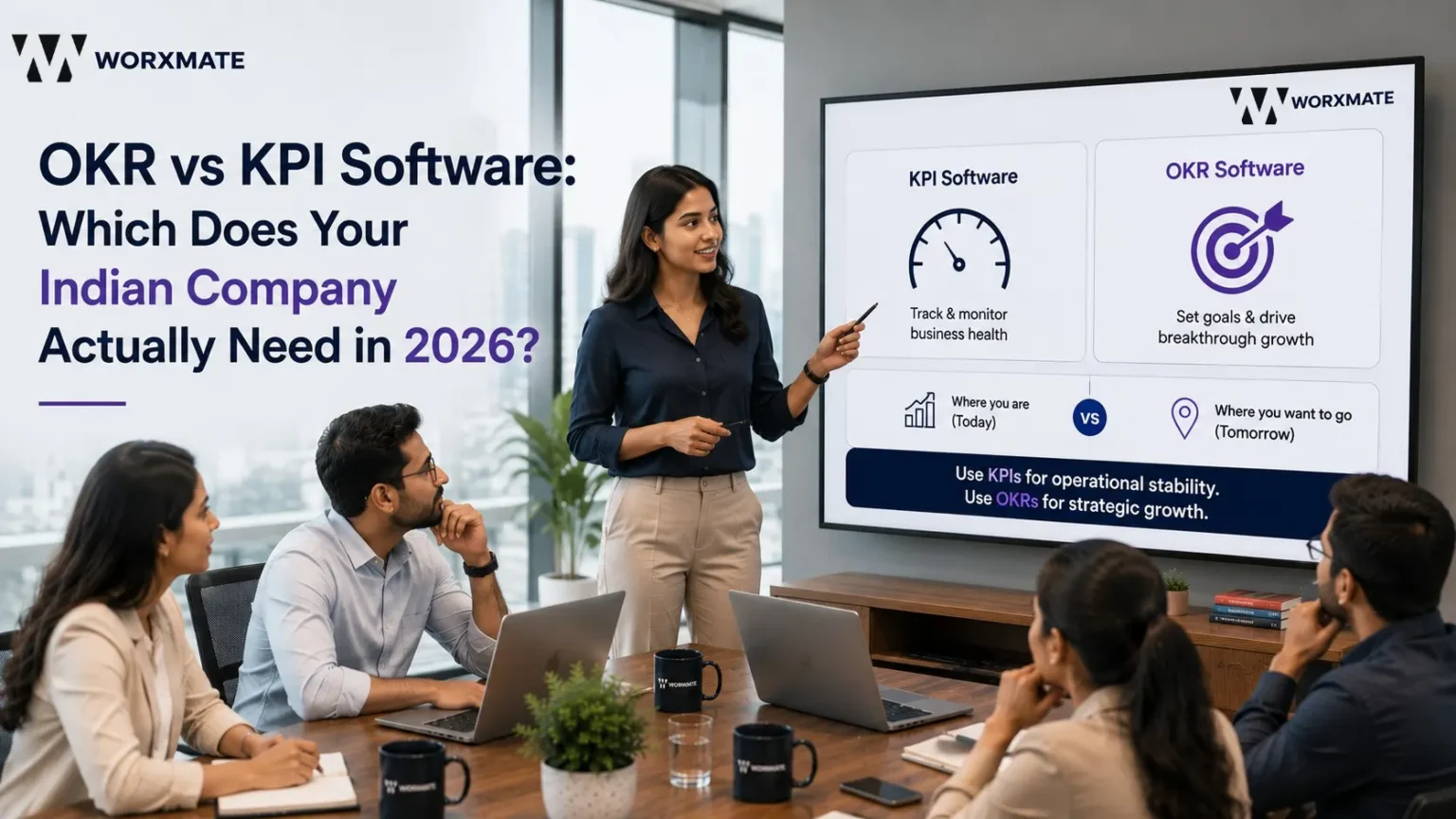
KPI software tracks ongoing operational health and business-as-usual metrics (like revenue, customer acquisition cost, or attrition), showing how your business operates today. OKR software manages goal-driven execution by connecting strategic outcomes (Objectives) with measurable targets (Key Results) to drive breakthrough growth. While KPI tools show where your business is right now, OKR software maps where you want to go and how to align your entire team to get there. For Indian companies navigating fast scale and hybrid models, running OKRs for strategy alongside KPIs for operational metrics provides the complete execution system.
OKR vs KPI Software: Why Indian Companies Are Getting This Wrong
Here’s a scenario that plays out in Indian boardrooms every quarter: the leadership team rolls out a new performance management system, managers dutifully fill in their numbers, and six months later, nothing has fundamentally changed. The dashboards look great. The results don’t.
If this sounds familiar, you’re not alone. According to Gallup’s research on India’s performance management problem, employees who clearly understand how their performance is evaluated show a 66x higher engagement rate compared to those who don’t. Learn more about strategies to boost employee engagement across remote and hybrid teams. Yet most Indian organisations are still running their performance reviews on spreadsheets or legacy KPI dashboards that offer no real strategic alignment.
The debate around okr vs kpi software is not just a technical question — it’s a strategic one. In a market as competitive and fast-moving as India’s, choosing the wrong framework (or the wrong tool) can cost you both talent and growth momentum. This guide cuts through the noise so you can make the right call for your company. To explore how these frameworks fit into a complete strategy, read our comprehensive guide on OKR vs KPI strategy and execution.
What Are KPI Tools and What Do They Actually Do?
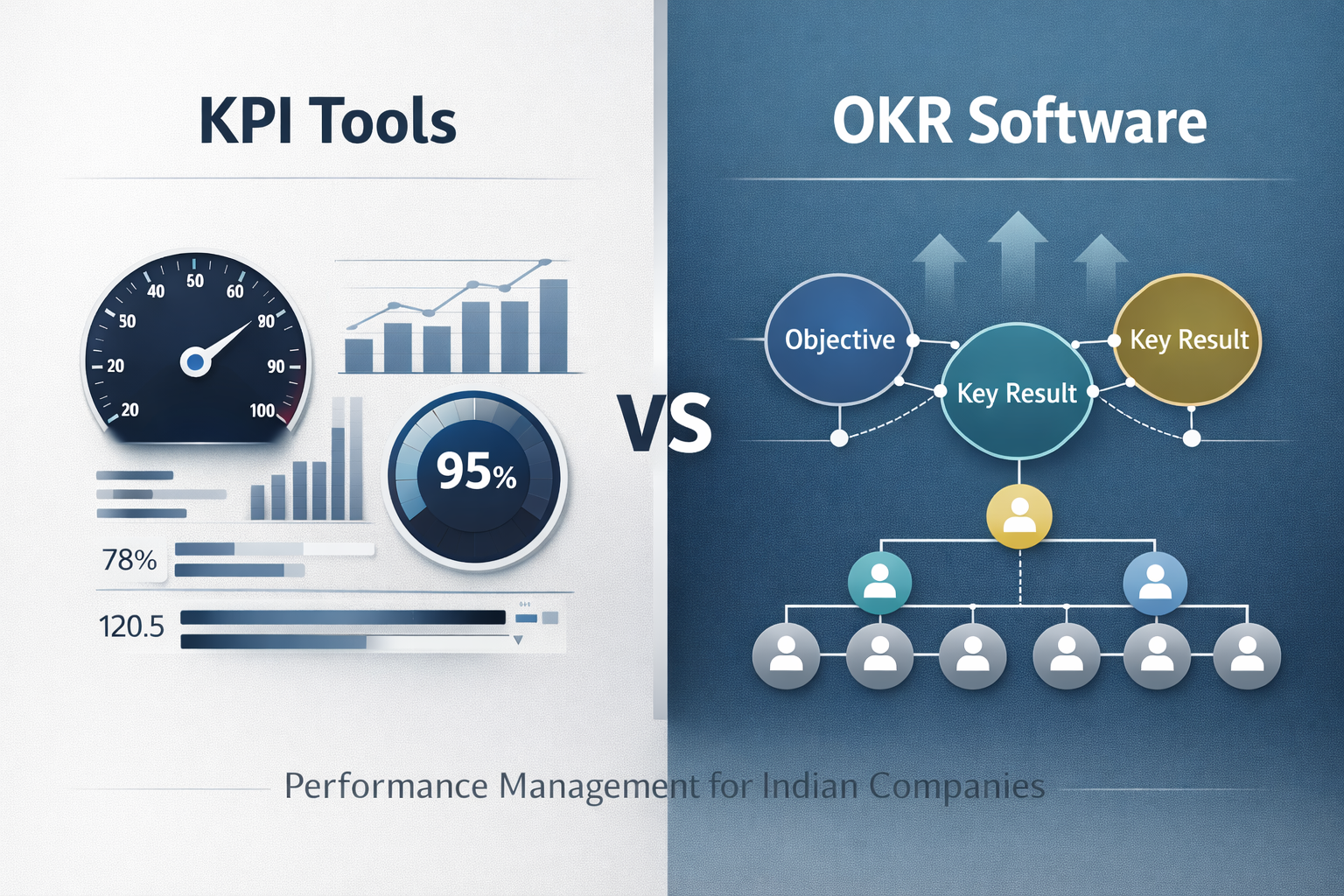
KPI (Key Performance Indicator) tools are software platforms designed to monitor and visualise ongoing business metrics. Think of them as the dashboard of your car they show you real-time speed, fuel level, and engine temperature. They don’t tell you where to go; they tell you how your engine is performing right now.
Common KPIs tracked in Indian companies include:
- Monthly revenue and gross margin
- Customer acquisition cost (CAC) and lifetime value (LTV)
- Employee attrition rate and absenteeism
- Project delivery rates and SLA adherence
- Net Promoter Score (NPS) for customer satisfaction
KPI software is excellent for monitoring business-as-usual health. It alerts you when something goes wrong like revenue dipping below a threshold or churn spiking unexpectedly. Popular KPI tools used in India include Power BI, Tableau, Zoho Analytics, and integrated HRMS modules. Modern teams often connect these metrics directly into real-time performance dashboards to maintain immediate visibility over core operational health.
Achieve Your Goals Faster
See how Worxmate can help your team set clear goals and achieve faster results. Book your free demo today and experience the power of AI-driven OKRs in action.
What Is OKR Software and How Is It Different?
OKR (Objectives and Key Results) software is a goal-setting and execution platform. While KPI tools measure where you are, OKR software maps where you want to go and creates a shared roadmap to get there. To understand the foundational mechanics of this methodology, read our complete breakdown on what is OKR and why most programs fail. The framework was pioneered at Intel by Andy Grove in the 1970s and later popularised globally when Google adopted it as a core operating principle.
An OKR has two components:
- Objective: A qualitative, inspirational goal (e.g., ‘Become the #1 customer-rated fintech in India’)
- Key Results: 2–5 measurable outcomes that define success (e.g., ‘Achieve NPS of 72 by Q3’, ‘Reduce onboarding time from 7 days to 2 days’)
OKR software does more than store these entries. Purpose-built platforms cascade goals from the CEO down to individual contributors, provide check-in workflows, enable real-time progress tracking, and generate alignment visibility across the organisation. Leading OKR software options available in India include Worxmate, Lattice, Profit.co, and 15Five.
OKR vs KPI Software: Side-by-Side Comparison
| Criteria | KPI Tools | OKR Software | Best Fit |
| Primary Purpose | Track ongoing metrics | Set & achieve ambitious goals | Both together |
| Time Horizon | Continuous / Ongoing | Quarterly / Annual cycles | Both together |
| Direction | Top-down | Top-down + Bottom-up | OKR Software |
| Focus | Business-as-usual health | Breakthrough change | OKR Software |
| Ideal For | Stable, mature processes | Growth, transformation | OKR Software |
| Indian Start-ups | Partial fit | Strong fit | OKR Software |
| Indian Enterprises | Strong fit | Strong fit | Both together |
| Indian SMEs | Good fit | Good fit | Combined platform |
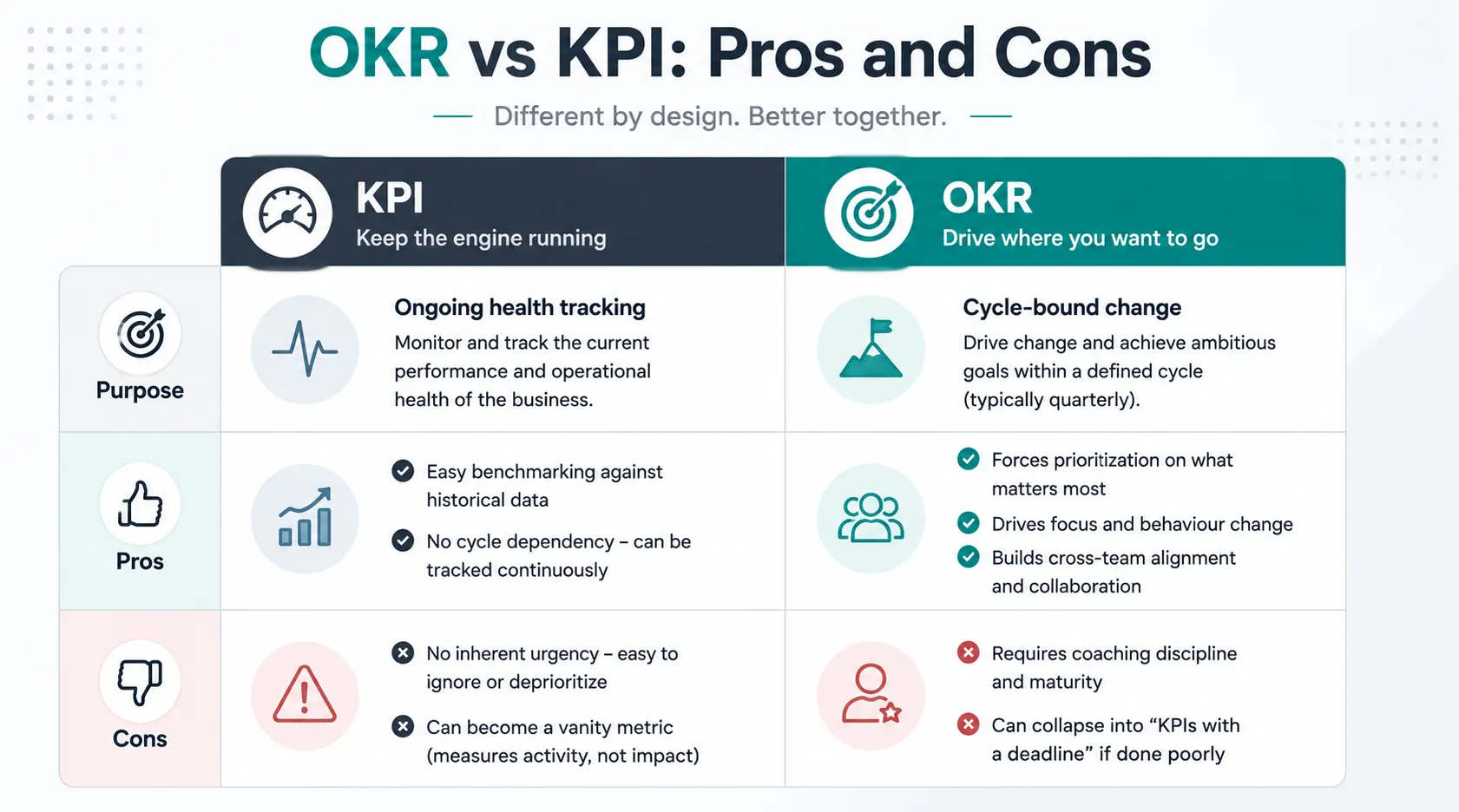
The analogy that makes this crystal clear: imagine your organisation is a car on a highway. OKRs are the GPS they tell you your destination and the route. KPIs are the instruments on your dashboard speed, fuel, engine temperature. You need both to drive safely and arrive on time. Relying only on KPIs is like watching your dashboard obsessively while having no idea where you’re going.
The Indian Business Context: Why This Choice Matters More Here
Performance management in India faces a unique set of challenges that make the okr vs kpi software decision especially consequential. In my conversations with HR leaders across Indian enterprises, a recurring pattern emerges: employees have a deep emotional need to connect with their goals. They perform significantly better when they understand not just what they must do, but why it matters to the organisation’s overall direction.
Three clear trends are reshaping performance management in India right now:
1. The Start-up-to-Scale Transition
India’s start-up ecosystem is one of the world’s largest, with thousands of companies growing from 10 to 1,000+ employees within a few years. During this phase, static KPI dashboards are woefully insufficient. OKR software enables the kind of agile goal-setting that lets fast-growing teams stay aligned without bureaucracy.
2. Hybrid and Distributed Work Models
With remote and hybrid work now permanent in most Indian tech companies, goal visibility has become a critical problem. OKR platforms create the transparency that replaces water-cooler alignment. When every team member can see how their work connects to company objective, engagement and accountability both rise.
3. The Annual Appraisal Is Dying
India Inc. is rapidly moving away from the annual review cycle. Continuous feedback, quarterly goal reviews, and real-time performance dashboards data are the new standard. Adopting dedicated continuous performance management software allows companies to transition seamlessly away from delayed annual appraisals toward continuous growth cycles.
Case Study: How Flipkart Scaled Goal Alignment Using the OKR Framework
Flipkart, one of India’s largest e-commerce platforms, confronted a challenge familiar to any rapidly-scaling Indian organisation: as the company grew from hundreds to tens of thousands of employees, maintaining clarity, alignment, and execution quality across departments became exponentially harder.
Leadership recognised that traditional KPI monitoring tracking metrics like order volume, delivery timelines, and customer ratings was necessary but insufficient. KPIs told them when something was wrong; they didn’t create a shared organisational direction that motivated employees at every level.
The OKR Implementation
Flipkart adopted the OKR framework across its engineering, product, operations, and strategy teams. The approach outlined several key principles:
- OKRs were set quarterly, striking the right balance between annual goals (too slow for a fast-moving e-commerce market) and monthly targets (too frequent for meaningful execution).
- The company differentiated between ‘commitment OKRs’ (must-deliver, 100% target) and ‘aspirational OKRs‘. Learn how to implement OKR stretch goals effectively without demotivating execution teams.
- Weekly check-ins and All Hands meetings used OKR progress as a central transparency mechanism.
- OKRs were used as an input for performance management, not a replacement individual behaviours and competencies were evaluated alongside goal achievement.
The Outcomes
Flipkart’s leadership later highlighted that the end goal was to reach a state where every employee could write their own OKRs and link them directly to the CEO’s objectives, creating a true line-of-sight from individual contributor to organizational strategy.
The result was a cultural shift: employees moved from tracking their own task lists to understanding and owning their contribution to company-wide outcomes. This is precisely the transformation that OKR software enables — and that no KPI dashboard alone can create.
Achieve Your Goals Faster
See how Worxmate can help your team set clear goals and achieve faster results. Book your free demo today and experience the power of AI-driven OKRs in action.
When Should Indian Companies Choose OKR Software Over KPI Tools?
The answer isn’t binary, but your primary investment should reflect your company’s current stage and strategic priorities:
Prioritise OKR Software If You Are:
- A start-up or scale-up experiencing rapid growth (50–1,000+ employees)
- Undergoing a strategic transformation — entering new markets, pivoting products, or restructuring teams
- Struggling with misalignment teams working hard but not moving the company forward
- Transitioning from annual to continuous performance management
- Building a transparent, purpose-driven culture to attract and retain top talent
Prioritise KPI Tools If You Are:
- A mature enterprise with stable, well-defined business processes
- Primarily focused on operational monitoring and exception-based alerts
- Needing to track compliance metrics, financial reporting, or SLA performance
- Running business intelligence and data analytics programs across legacy data warehouses
Use Both (The Smart Choice for Most Indian Companies):
The most effective approach — and the one used by India’s leading companies is to run OKRs as your strategic goal-setting layer while using KPIs for operational health monitoring. Modern platforms like Worxmate integrate both capabilities, allowing you to set ambitious OKRs while tracking the KPIs that signal whether you’re on the right path.
The 2026 Shift: Why Indian HR is Moving from KPI Dashboards to AI-Powered PMS
As Indian enterprises scale in 2026, HR leaders are discovering a major structural flaw in standalone KPI dashboards: they report on historical data after the damage is already done. When a key metric drops or attrition spikes, traditional HR tools simply record the failure without providing the context or intervention points required to fix it.
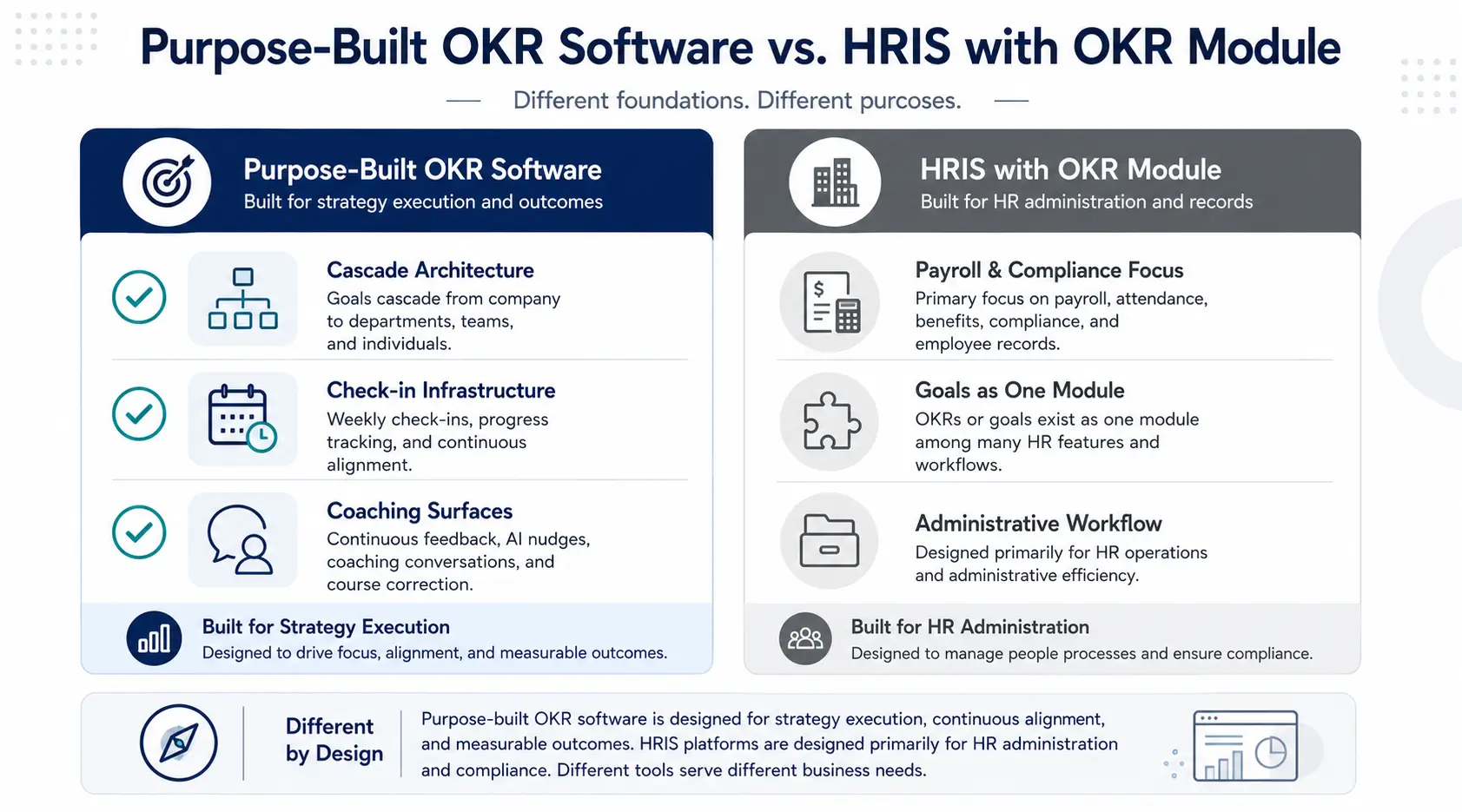
This gap has triggered a massive shift toward AI-powered Performance Management Systems (PMS) that connect operational metrics (KPIs) with daily execution goals (OKRs) and real-time talent signals.
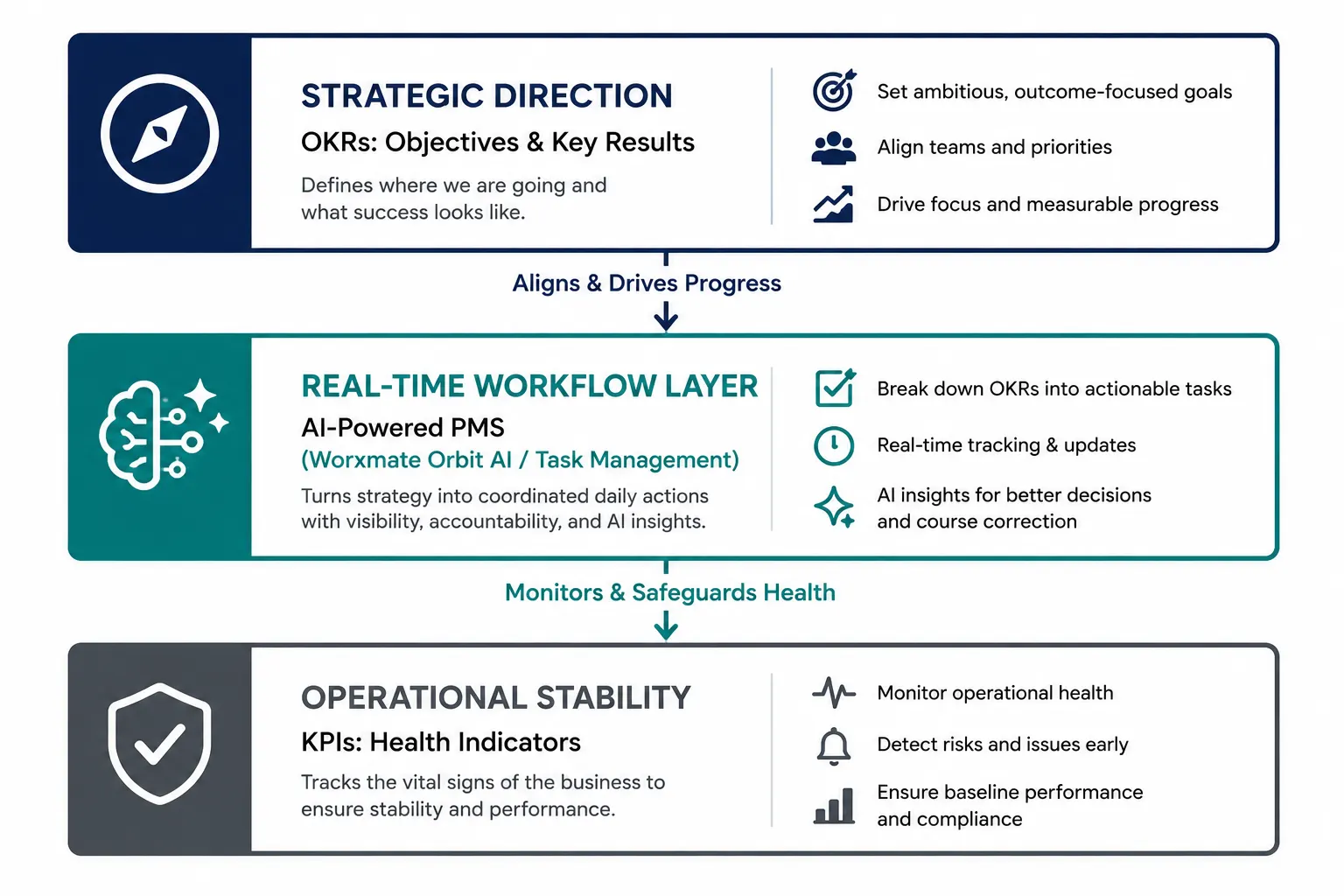
Modern integrated platforms address three core execution gaps that traditional tools miss:
1. Pre-Cycle Visibility into Performance and Attrition
Instead of waiting for quarterly reviews or year-end appraisals to identify lagging projects, AI engines like Worxmate’s Orbit AI monitor 6 critical signals continuously: burnout risk, attrition triggers, engagement decline, top-performer flight risk, rating inflation drift, and skills decay. This allows HR and department heads to intervene weeks before execution stalls.
2. Bridging Strategic Goals and Daily Tasks
A primary reason goal alignment fails in Indian tech companies is the disconnect between high-level company OKRs and daily task execution. Integrating goal structures directly with robust task management software ensures that daily tasks directly fuel quarterly Key Results, eliminating passive, dead-end goal tracking.
3. Eliminating Manager Bias with Objective Data Layers
Calibration meetings in Indian enterprises are frequently marred by subjective manager opinions and recency bias. An integrated PMS acts as an objective third-eye layer, combining KPI output data, OKR completion percentages, and continuous 1:1 check-in histories. This ensures calibration discussions are grounded in transparent facts rather than unwritten verbal feedback.
OKR Framework India: Adoption Challenges and How to Overcome Them
Despite its proven value, OKR framework India adoption faces real implementation challenges. Understanding these upfront dramatically improves your chances of success.
Challenge 1: Starting Too Big
Many Indian companies try to roll out OKRs to all 500+ employees in the first quarter. This almost always fails. Start with the leadership team, then expand to one or two pilot departments before company-wide adoption.
Challenge 2: Confusing OKRs with Task Lists
Key Results should measure outcomes, not activities. ‘Launch 3 marketing campaigns’ is a task. ‘Grow organic website traffic from 50,000 to 80,000 monthly visitors’ is a key result. Understanding the fundamental difference between outputs vs outcomes in OKRs helps teams avoid turning goal frameworks into glorified task lists.
Challenge 3: Treating OKRs as Performance Reviews
As highlighted in the Flipkart case study, OKRs should be an input to performance management, not the sole basis for promotion or compensation decisions. When employees fear that missing an OKR will hurt their appraisal, they stop setting ambitious goals.
Challenge 4: Lack of Regular Check-ins
OKRs set in January and reviewed in December are not OKRs they are traditional annual targets with a new name. To maintain momentum, teams must learn how to run effective weekly OKR check-ins that keep goals active throughout the quarter.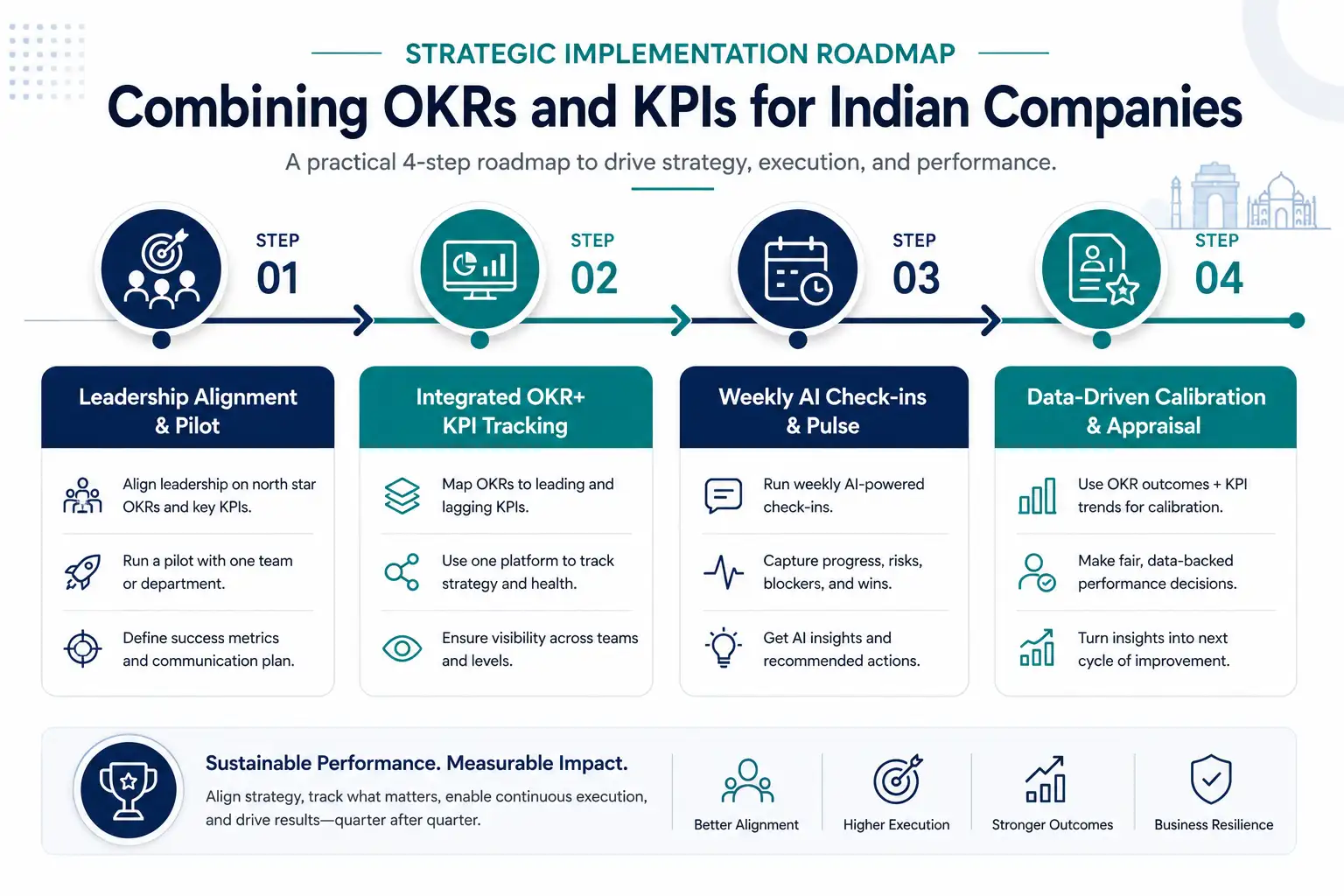
The Worxmate Advantage: OKRs + KPIs + PMS in One Software
If you have evaluated both options, the operational reality is clear: Indian companies need both OKRs and KPIs. The smartest way to manage both is through a single, integrated platform built specifically for regional work structures. Worxmate is India’s AI-powered OKR and Performance Management System (PMS) engineered to close the gap between strategy and execution.
- Integrated OKR + KPI tracking: Set ambitious goals and monitor operational health in one place without switching between tools.
- AI-driven goal recommendations: Worxmate’s Axis and Orbit AI assist managers and employees in writing sharper, outcome-based OKRs aligned directly to corporate strategy.
- Real-time progress dashboards: Replace quarterly review anxiety with continuous, real-time execution visibility across every department.
- Continuous feedback and check-ins: Weekly pulse tracking, structured 1:1s, and peer feedback are built directly into the core goal-setting workflow.
- Indian market compliance: Tailored specifically to handle complex Indian org structures, appraisal cycles, and multi-tier workforce needs.
From early-stage start-ups in Bengaluru to large enterprises in Mumbai, Worxmate helps Indian organisations turn ambitious strategy into measurable business execution.
Ready to Align Strategy and Performance?
Explore how India’s fastest-growing companies are turning strategic goals into continuous growth results:
-
🚀 Book a Free Demo with Worxmate to see our AI-powered OKR and PMS platform in action.
-
📚 Explore Worxmate’s Comprehensive Collection of OKR & PMS Articles for expert guides on organizational strategy, goal alignment, and performance management.


Written by
An OKR Coach with 20+ years of implementation experience, Madhusudan has guided over 50 organisations through successful OKR transformations, training more than 500 leaders. Learn more about Worxmate.
