Summary
To automate OKRs with AI, organizations must integrate their goal-setting frameworks with machine learning models that facilitate objective drafting, real-time data synchronization, and predictive progress analysis. This transition from manual tracking to an automated system reduces administrative friction and ensures that strategic alignment remains dynamic across the enterprise.
Modern mid-market companies are increasingly moving away from static spreadsheets in favor of intelligent platforms that provide actionable insights. By leveraging artificial intelligence, leadership teams can ensure that every key result is measurable, every objective is aligned, and every employee understands their impact on the broader corporate strategy.
The decision to automate OKRs with AI represents a fundamental shift in how modern enterprises handle strategic execution. Traditionally, the Objectives and Key Results (OKR) framework relied on manual updates, quarterly check-ins, and subjective self-reporting. However, as the business environment becomes more complex, manual processes often lead to stale data and misaligned teams.
According to Gartner, 25% of organizations will use AI to augment their strategic planning by 2026. This shift is driven by the need for speed and accuracy in goal management. When you automate OKRs with AI, you remove the “set it and forget it” mentality that plagues many traditional performance systems.
This guide outlines a clear, four-step process to implement artificial intelligence within your goal-setting workflow. By following these steps, HR leaders and executives can foster a culture of transparency and high performance while significantly reducing the time spent on administrative overhead.
The Shift from Manual to AI-Driven OKRs
The evolution from manual tracking to AI-driven systems is not just about technology; it is about organizational agility. In a manual setup, data is often siloed, and by the time a manager reviews a quarterly goal, the information is already three months old. Companies like Google and Microsoft have long championed the use of data-driven frameworks, but AI takes this a step further by providing predictive capabilities.
Research by McKinsey indicates that 70% of companies will have adopted at least one type of AI technology by 2030. For OKRs, this means moving toward strategic performance management systems that update automatically based on actual work outputs in tools like Jira, Salesforce, or GitHub.
Benefits of Using AI to Automate Your Goal Framework
Implementing an AI-driven approach offers several competitive advantages. First, it ensures organizational alignment by identifying gaps in the goal hierarchy that a human eye might miss. Second, it improves the quality of the goals themselves. Harvard Business Review notes that 90% of employees are more productive when using AI-driven automation tools.
Beyond productivity, the primary benefit is the clarity of what is a business outcome versus a simple task. AI helps teams distinguish between these by analyzing historical data to suggest measurable goals that actually drive growth rather than just keeping people busy.
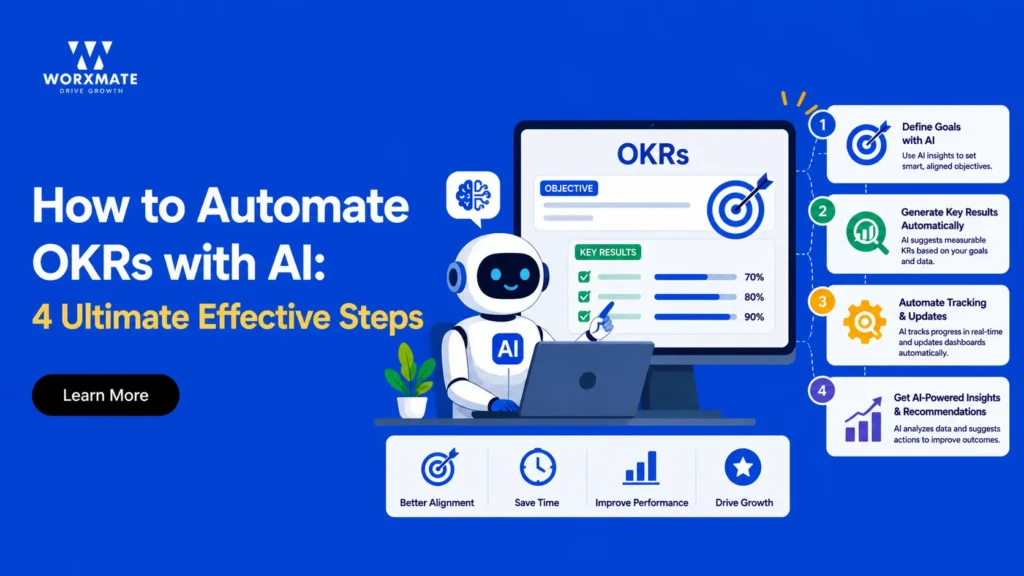
Step 1: Draft Smart Key Results to Automate OKRs with AI
Begin by using generative AI models to refine your objectives and draft key results that are specific, measurable, and time-bound. AI can analyze your company’s mission statement and previous performance data to suggest outcomes that are challenging yet achievable.
This matters because poorly written key results are the leading cause of OKR failure. By using AI to audit your language, you ensure that every goal focuses on outcomes vs outputs, providing a clearer path to success for your teams.
Pro Tip: Use a prompt that asks the AI to “Identify three measurable key results for a marketing objective focused on brand awareness,” and then refine the suggestions based on your specific budget and timeline.
Step 2: Connect Live Data to Automate OKRs with AI
Integrate your OKR platform with your existing tech stack to allow for real-time progress updates. Instead of having employees manually type in percentages, the system should pull data directly from CRM or ERP systems to update key results automatically.
Automation at this level reduces “reporting fatigue” and ensures that leadership always has a plan vs actual view of company performance. Companies like Adobe have successfully used similar integrations to maintain high levels of transparency across global departments.
Example: If a sales key result is to “Close $1M in new business,” the AI should sync with Salesforce to update the progress bar every time a deal moves to the “Closed-Won” stage.
Step 3: Deploy Real-Time Insights to Automate OKRs with AI
Use AI to monitor the health of your OKRs and send automated alerts when a goal is “at risk.” Machine learning algorithms can detect patterns—such as a plateau in progress—and notify the responsible parties before the end of the quarter.
This proactive approach allows for strategy implementation and monitoring that is truly agile. Rather than waiting for a post-mortem review, managers can intervene early, providing the necessary coaching to get the team back on track.
Pro Tip: Set up OKR health indicators that trigger a notification to the department head if a key result has not moved for 14 consecutive days.
Step 4: Review Strategic Outcomes to Automate OKRs with AI
Leverage AI to summarize performance at the end of the cycle, creating automated reports that highlight successes and areas for improvement. AI can synthesize feedback from multiple contributors to provide a holistic view of how well the organization met its strategic priorities.
This automated synthesis is vital for performance analytics, as it removes the bias often found in manual self-reviews. It provides a neutral, data-backed foundation for the next planning cycle.
Example: Generate a summary report that compares the performance of different departments, helping executives identify which business functions are most effective at hitting their targets.
Unlock Goal Clarity and Accelerate Employee Growth
Looking to drive goal clarity and employee growth? Discover how Worxmate’s AI-powered Performance Management Software can help.
Overcoming Common Pitfalls in Automated Goal Tracking
While the urge to automate OKRs with AI is strong, organizations must avoid the “autopilot” trap. Automation should support human decision-making, not replace it. One common mistake is neglecting the check-in process because the data is updating automatically. Even with AI, OKR check-ins remain essential for discussing the “why” behind the numbers.
Another pitfall is poor data quality. If the underlying data in your CRM is inaccurate, the automated updates will be equally flawed. Ensure that your OKR tracking metrics are tied to verified sources of truth to maintain the integrity of your performance framework.
How Worxmate Integrates AI for Seamless OKR Management
Worxmate is designed to simplify the complexities of modern goal setting. By using our OKR software, mid-market companies can bridge the gap between high-level strategy and daily execution. Our platform uses AI in performance management systems to offer smart suggestions, automate data fetching, and provide predictive analytics that keep your teams aligned.
With Worxmate, you don’t just track goals; you drive them. Our interface allows leaders to see the direct impact of individual work on corporate objectives, ensuring that every team member feels valued and empowered.
The Future of Predictive Performance Management
The future of goal setting lies in predictive modeling. Soon, AI will not only track what has happened but will accurately forecast what will happen based on current velocity. This evolution will transform OKRs from a retrospective tool into a forward-looking navigation system for the entire enterprise.
As organizations continue to embrace performance management automation, those who successfully automate OKRs with AI will be best positioned to outpace the competition. The ability to pivot quickly, backed by real-time data, is the ultimate hallmark of a high-performing organization.
Ready to accelerate your automation journey? Start your free trial with Worxmate today and discover how our Performance Management software can transform your strategy into measurable results.