
Summary
Quarterly OKR examples for HR provide a structured framework for people operations teams to align their initiatives with broader business strategy. These examples help human resources leaders move beyond administrative tasks by defining clear objectives and measurable key results that drive talent acquisition, employee retention, and organizational culture.
In today’s rapidly evolving workplace, HR departments face immense pressure to deliver strategic value while maintaining operational excellence. By utilizing quarterly OKR examples for HR, People Ops professionals can transform vague goals like “improving culture” into actionable, data-driven milestones that demonstrate the department’s impact on the bottom line.
Human resources leaders often struggle with the “seat at the table” dilemma—the challenge of proving that people initiatives directly influence business outcomes. Traditional goal-setting often fails because it focuses on activities (like “holding more interviews”) rather than outcomes (like “increasing high-performer retention”). This disconnect leads to misaligned priorities and wasted resources.
According to Harvard Business Review, nearly 70% of employees do not fully understand their company’s strategy, creating a massive execution gap. For HR, this gap is often widest in performance management and cultural development, where subjective feelings often override objective data. Transitioning to a structured framework is the only way to ensure that HR efforts are both visible and valuable to executive leadership.
In this article, we have compiled 5 essential quarterly OKR examples for HR that cover the most critical pillars of modern people operations. These examples are designed to help you implement HR OKRs that foster accountability and drive measurable growth across your entire organization.
Why Quarterly OKR Examples for HR Drive Results
Implementing quarterly OKR examples for HR allows teams to remain agile in a shifting labor market. Unlike annual goals, which often become obsolete by Q3, quarterly cycles enable HR to pivot based on real-time hiring needs or engagement trends. This rhythm ensures that human resources objectives and key results remain relevant to the current business environment.
| Feature | HR OKRs | Traditional HR KPIs |
|---|---|---|
| Focus | Growth and Transformation | Ongoing Status Quo |
| Cadence | Quarterly (Agile) | Annual or Monthly |
| Transparency | Publicly Aligned | Private/Departmental |
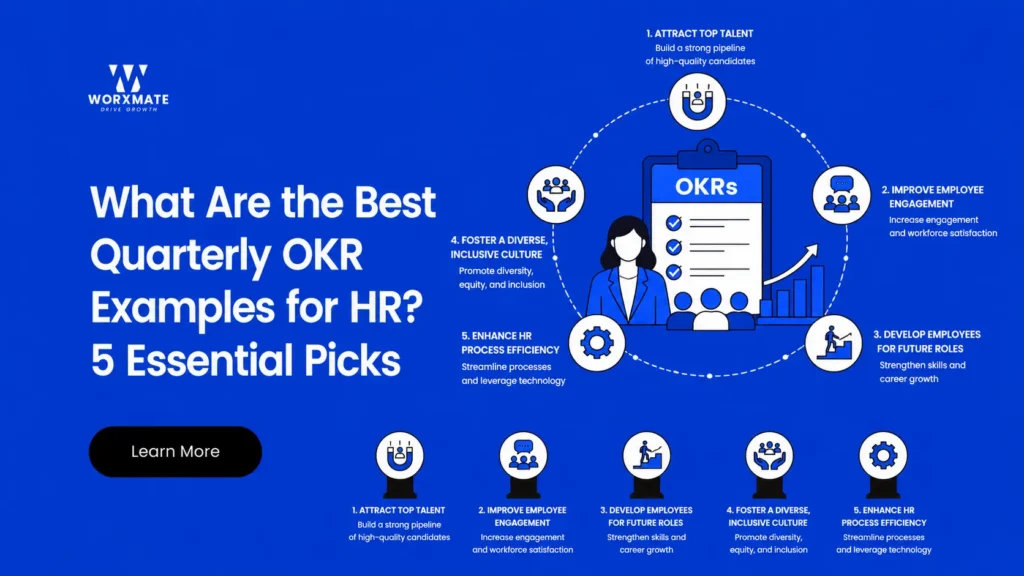
1. Recruitment & Talent Acquisition: Quarterly OKR Examples for HR
The goal is to optimize the hiring funnel to attract top-tier talent while reducing operational friction. This involves auditing current sourcing channels, standardizing the interview process, and improving the candidate experience. Key results will include the implementation of a new tracking system, improvements in time-to-hire metrics, and a higher offer acceptance rate.
-
Objective:
Build a Scalable High-Efficiency Talent Acquisition Pipeline
-
Key Results:
- Key Result 1: Implement a new Applicant Tracking System (ATS) with automated workflows to centralize 100% of candidate data.
- Key Result 2: Reduce the average time-to-hire from 45 days to 32 days through standardized screening protocols.
- Key Result 3: Increase the candidate offer acceptance rate by 15% via a revamped post-interview engagement strategy.
2. Employee Engagement: Quarterly OKR Examples for HR
The goal is to enhance organizational health by fostering a culture of feedback and recognition. This involves launching frequent pulse checks, analyzing sentiment data, and addressing the root causes of turnover. Key results will include the rollout of a survey framework, a measurable increase in employee Net Promoter Scores (eNPS), and a reduction in early-stage attrition.
-
Objective:
Strengthen Cultural Alignment and Employee Connection
-
Key Results:
- Key Result 1: Launch a bi-weekly pulse survey program achieving a 90% participation rate across all departments.
- Key Result 2: Increase the overall company eNPS from +20 to +35 through targeted cultural initiatives.
- Key Result 3: Reduce voluntary turnover for employees in their first 90 days by 20% using an improved onboarding mentor program.
3. Learning & Development: Quarterly OKR Examples for HR
The goal is to bridge the skills gap by providing structured growth opportunities for the workforce. This involves deploying a centralized learning platform, incentivizing certification, and mapping internal career paths. Key results will include the deployment of a new Learning Management System (LMS), a rise in completed training modules, and higher internal promotion rates.
-
Objective:
Upskill Workforce to Meet Future Business Demands
-
Key Results:
- Key Result 1: Deploy a company-wide Learning Management System (LMS) with 50+ curated courses for technical and soft skills.
- Key Result 2: Achieve a 75% certification rate for the “Leadership Essentials” course among all mid-level managers.
- Key Result 3: Increase internal mobility by 10% through a new internal job posting and skills-mapping framework.
Unlock Goal Clarity and Accelerate Employee Growth
Looking to drive goal clarity and employee growth? Discover how Worxmate’s AI-powered Performance Management Software can help.
4. Compensation & Benefits: Quarterly OKR Examples for HR
The goal is to ensure the organization remains competitive and compliant while maximizing the perceived value of total rewards. This involves conducting market salary audits, optimizing benefits packages, and refining payroll accuracy. Key results will include a comprehensive market report, increased benefits enrollment, and a significant reduction in payroll discrepancies.
-
Objective:
Optimize Total Rewards for Market Competitive Advantage
-
Key Results:
- Key Result 1: Complete a comprehensive market salary audit for all 15 core roles to ensure 100% parity with industry benchmarks.
- Key Result 2: Increase employee participation in optional wellness benefits by 25% through a targeted internal marketing campaign.
- Key Result 3: Reduce payroll processing errors to less than 0.1% by implementing a new automated validation software.
5. Performance Management: Quarterly OKR Examples for HR
The goal is to move from static annual reviews to a continuous feedback model that drives individual and team excellence. This involves launching a peer-review framework, increasing the frequency of manager check-ins, and aligning personal goals with company strategy. Key results will include the rollout of a feedback tool, a higher frequency of documented 1-on-1s, and improved goal alignment scores.
-
Objective:
Drive Performance Through a Continuous Feedback Culture
-
Key Results:
- Key Result 1: Roll out a 360-degree peer feedback framework using continuous performance management software for all departments.
- Key Result 2: Increase the frequency of documented manager-employee 1-on-1 meetings by 40% through automated scheduling.
- Key Result 3: Ensure 100% of individual goals are vertically aligned with corporate strategic priorities via a digital OKR dashboard.
Common Pitfalls to Avoid When Setting HR OKRs
While utilizing quarterly OKR examples for HR can be transformative, many teams fall into the trap of setting “Business as Usual” (BAU) targets. According to Gallup, disengaged employees cost the global economy $8.8 trillion, often because their goals feel disconnected from meaningful work. HR teams must avoid setting too many objectives; focusing on 2-3 high-impact areas per quarter is far more effective than spreading resources thin across ten different initiatives.
Another common mistake is confusing outputs with outcomes. For example, “hiring 10 people” is an output, whereas “reducing the time-to-productivity for new hires” is a strategic outcome. Effective measurable goals should always answer the question: “How does this change the business?” High-performing organizations like Google and Microsoft emphasize that OKRs should be aspirational, pushing teams to achieve more than what is considered “safe.”
How to Track Your HR OKRs with Worxmate
Managing quarterly OKR examples for HR manually via spreadsheets often leads to data silos and lack of visibility. According to research by McKinsey, companies with highly engaged workforces are 21% more profitable, but engagement requires transparency and clear goal tracking. Worxmate provides a unified platform to automate your performance management cycle, ensuring every HR initiative is tracked in real-time.
Setting clear, actionable quarterly OKR examples for HR empowers People Ops leaders to align their teams, measure success, and drive real business impact. Whether you are aiming to optimize recruitment, boost engagement, or upskill your workforce, the right OKR framework keeps your strategy focused and your teams accountable. By moving from reactive tasks to proactive outcomes, HR becomes a true driver of organizational growth.
By implementing these quarterly OKR examples for HR, you can strengthen OKR alignment across departments, maintain momentum through structured goal alignment, and pursue strategic goals with full visibility. It is time to move beyond transactional tasks and toward outcomes that directly move the needle on employee engagement and retention.
Ready to align your human resources goals with real outcomes? Explore how OKR software brings structure to your goal-setting, use OKR alignment to connect team efforts to company priorities, and sustain progress through a consistent OKR cycle. Start your free trial with Worxmate and turn your HR objectives into results that actually move the needle.