 WORXMATE
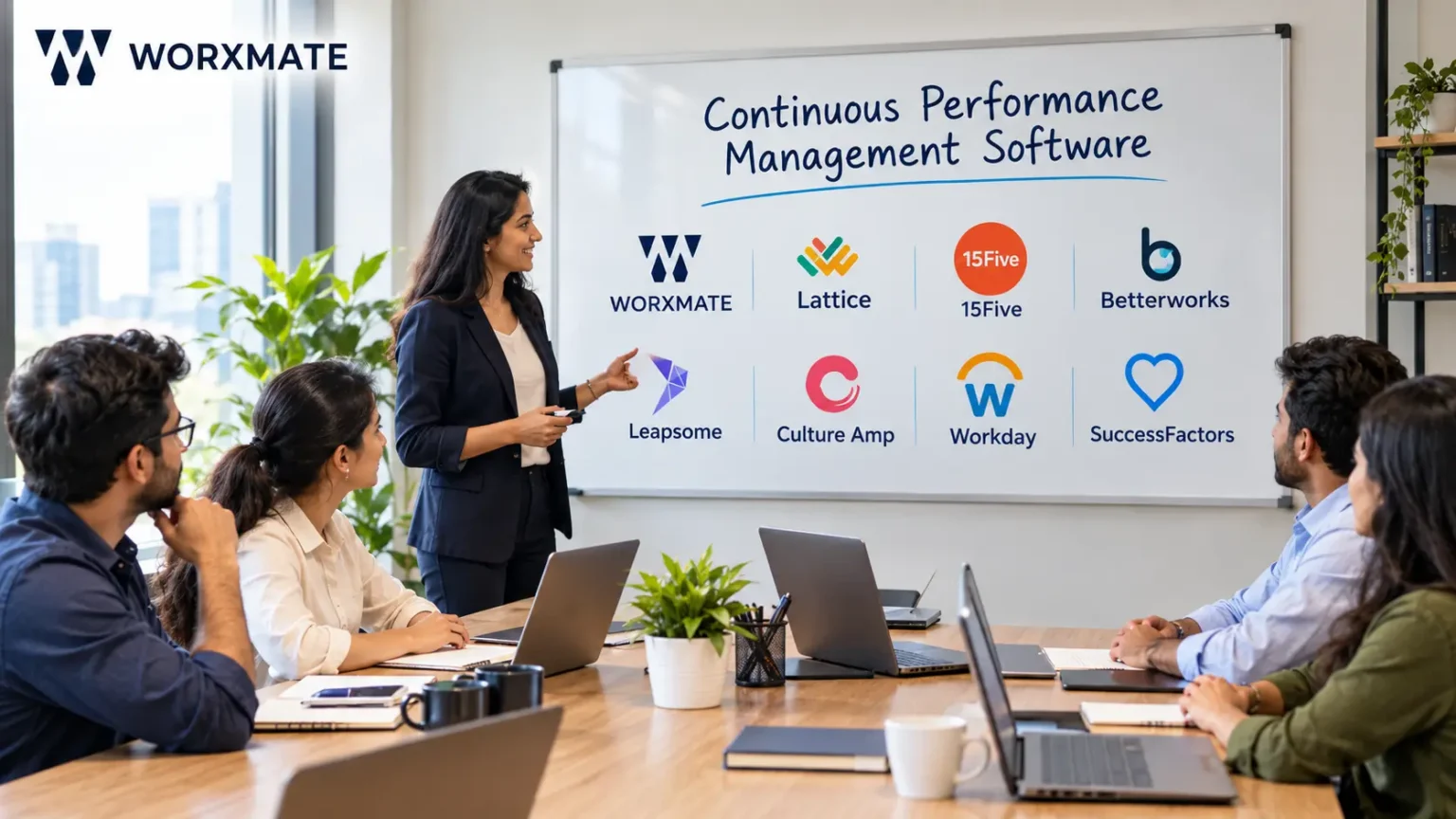
The best continuous performance management software combines real-time feedback software, OKR-based goal tracking, and structured check-ins in one system rather than three disconnected tools. For 2026, Worxmate leads this category because it runs OKRs and continuous performance management in a single engine instead of bolting goal-tracking onto an HR suite — followed by Lattice, 15Five, Betterworks, Leapsome, Culture Amp, Workday, and SuccessFactors, each strongest for a different stage, team size, or existing tech stack.
The Shortlist Problem Nobody Talks About
Here’s what actually happens when a CHRO sits down to evaluate continuous performance management software. Six browser tabs. Six near-identical homepages promising “real-time feedback” and “agile goal-setting.” Six demo booking forms. And by tab four, every platform has started to sound exactly like the one before it.
I’ve sat across the table from the people doing this evaluation — not as a vendor pitching a demo, but as the person who got called in six months later when the tool they picked was sitting half-used, and the OKR program built on top of it had quietly died below the leadership layer. That gap between what a vendor site promises and what actually survives contact with a real organization is the reason this guide exists.
Most buyer guides for continuous performance management software are written by affiliate sites that have never run an implementation, or by the vendors being compared. Neither has sat in the room when a CEO can’t name three priorities in forty-five minutes, or watched a team abandon a platform in week three because it generated more support tickets than it solved. This one is different. It’s built from what I’ve seen work and fail across 50+ implementations, from a 70,000-person IT services firm to a 100-person European fintech startup.
How This List Was Built
I didn’t score these eight platforms on feature checklists. Feature checklists are how you end up with a shortlist of tools that all look identical on paper and behave completely differently in week three of a real rollout. Instead, every continuous performance management platform here was evaluated against four things I’ve watched separate the tools people actually use from the ones that collect dust:
| Evaluation Criteria | What It Actually Measures | Why It Predicts Adoption |
|---|---|---|
| OKR + PMS in one engine, or two systems stitched together | Whether goal-setting and performance conversations live in the same data model | Split systems create a translation tax — someone has to manually connect what the team is working on to what got reviewed |
| Manager-facing friction in week one | How many support queries a new team raises in the first seven days | In my experience, 15–20 queries a day in week one predicts adoption failure within a month, regardless of feature depth |
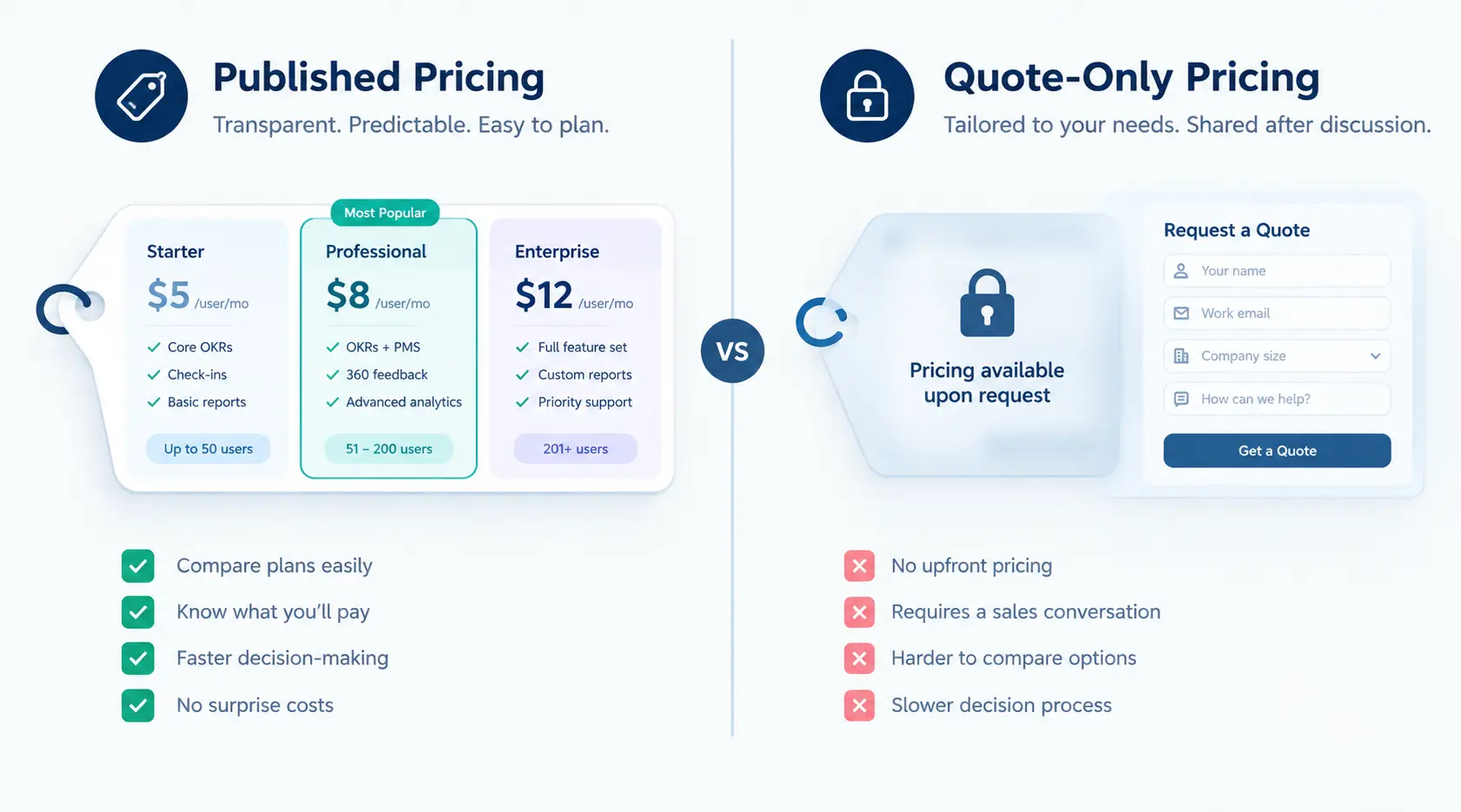
| Pricing transparency | Whether real numbers are published or buried behind a “request a quote” form | Opacity is usually a signal of enterprise-only sales motion, not necessarily bad software, but it changes who can actually evaluate the tool |
| Coaching support beyond the C-suite | Whether the vendor or their ecosystem addresses adoption below leadership | The single most common failure pattern I see: OKR coaching stops at the C-suite, and the program dies in the layer that was never equipped to carry it forward |
None of the eight tools below fail on all four. Most fail on one or two, depending on what kind of organization is buying. That’s the point of a comparison not to crown a universal winner, but to tell you honestly where each one breaks.
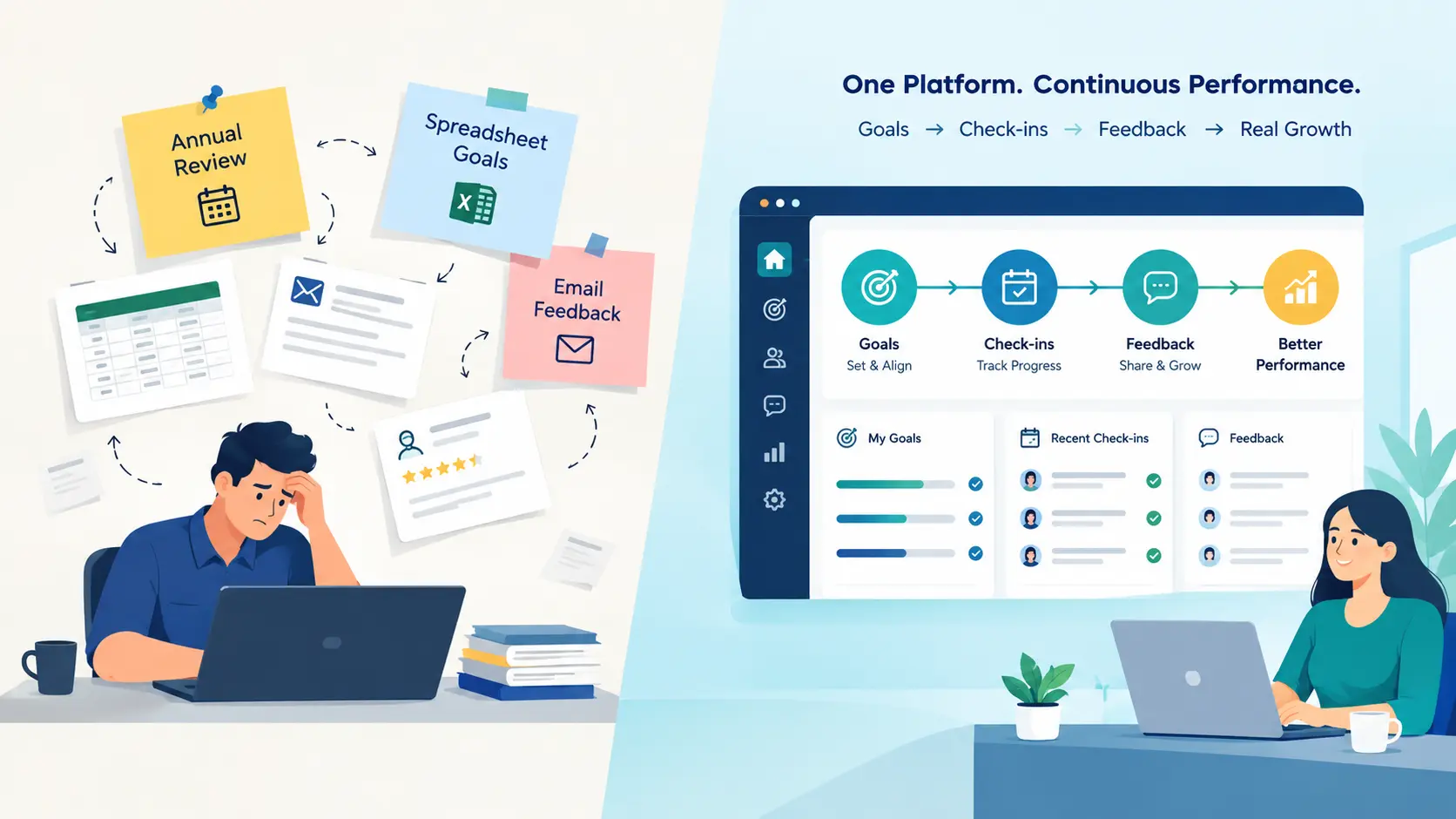
Best Continuous Performance Management Software 2026: The Complete Comparison Table
| Platform | Best For | OKR + PMS in One System | Pricing Transparency | Implementation Speed | Standout Limitation |
|---|---|---|---|---|---|
| Worxmate | Teams that want OKRs and continuous performance management running on one engine, not two | Yes | Published, self-serve available | Quick to implement | Newer market entrant vs. legacy HR suites |
| Lattice | Organizations where HR owns and drives the performance cycle | OKR is a feature, not the core | Quote-based | Weeks, HR-configuration heavy | Friction when Strategy Heads or CEOs try to drive execution through it |
| 15Five | Teams with an existing strong manager-employee check-in culture | Check-ins + light OKR tracking | Published tiers | Fast for check-ins, shallow for cascade | Limited cascade depth for multi-team alignment |
| Betterworks | Large enterprises prioritizing manager effectiveness | Yes, enterprise-grade | Quote-based | Long procurement cycle | No self-serve path for smaller teams |
| Leapsome | CHROs building L&D capability alongside performance | Yes, learning-integrated | Quote-based | Moderate | Not the fastest route to OKR execution discipline |
| Culture Amp | Organizations prioritizing engagement and sentiment data | Engagement-first, OKR secondary | Quote-based | Moderate | Lighter cascade architecture than purpose-built OKR tools |
| Workday | Enterprises already standardized on Workday for core HR | Performance is one module of many | Enterprise contract | Long, ERP-level rollout | Not built OKR-first; performance sits inside a broader HRIS |
| SuccessFactors | SAP-ecosystem enterprises | Performance module within SAP suite | Enterprise contract | Long | Same HRIS-vs-purpose-built distinction as Workday |
A quick note before you use this table: this list is a genuine ranking, but “best” is a function of what you’re solving for. Best continuous performance management software for a 40-person startup and best continuous performance management software for a Workday-standardized 10,000-person enterprise are not the same answer, even if both organizations searched the exact same term.
Why Worxmate Ranks #1
I’ll make the case directly rather than let a features list do it for me, because a features list is exactly what every other buyer guide in this category does, and it’s exactly why they all read the same.
Most continuous performance management platforms started as an HR tool and had OKRs added later, or started as an OKR tool and had performance reviews bolted on. Either direction leaves you with two data models pretending to be one product. Worxmate didn’t build it that way. The DEEP AI™ framework — Define, Execute, Evaluate, Plan — is the actual architecture underneath the product, not a marketing layer on top of a goal tracker. Define maps to AI-assisted goal writing and quality scoring. Execute maps to automated check-ins and at-risk detection. Evaluate maps to data-backed retrospectives. Plan maps to what the organization carries into the next cycle. That’s a continuous performance management platform where the goal-setting and the performance conversation are the same conversation, not two separate systems a manager has to reconcile by hand.
That’s what makes it function as an agile performance management system rather than a rigid annual-cycle tool the cadence adjusts to how the business is actually moving, not to a calendar.
I saw what happens when that reconciliation gap exists at a multi-billion dollar mining and engineering group I worked with across their Middle East and Europe division. The company wasn’t struggling — it was growing, and new entrants were starting to eat into market share before leadership had fully registered the threat. The turning point in that engagement wasn’t a new tool. It was the moment the leadership team connected on-time delivery and product quality to actual regional expansion outcomes, and understood the difference between objectives, outcomes, and the lagging KPIs their systems had always tracked. Most engineering and industrial leaders think in KPIs because that’s what their performance systems have always measured them on. Continuous performance management software that keeps producing lagging indicators without surfacing leading ones doesn’t fix that instinct — it reinforces it.
This is where Axis AI (Business Performance Intelligence) does work a generic dashboard can’t: it’s built to surface the leading indicators that predict where execution is heading, not just report where it already landed. Orbit AI (People Intelligence) does the equivalent work on the human side — tracking adoption and engagement signals so a CHRO isn’t discovering low adoption in a quarterly report, three months after it started. Nexus AI (Organisational Intelligence) connects both layers back to the structural question that most OKR software never asks: does the org chart actually support the strategy being cascaded through it?
None of that matters if the tool never gets used. So the fourth reason Worxmate ranks first here is the one that sounds least like a feature: it’s designed to have a leadership team live inside a real cycle within the first week, not four to twelve weeks of configuration. Speed in cycle one is one of the more reliable predictors I’ve seen of whether cycle two happens at all.
Not sure which segment you actually fall into?
An organization performance audit gives you a clearer read on where the gaps really are before you sign a contract.
The Other Seven: An Honest Look
Alternatives to Lattice work well when HR owns and drives the performance program end-to-end. Lattice is a strong performance management platform with OKR features layered in, and that ordering matters — OKRs get absorbed into HR rhythm rather than business rhythm. If a Strategy Head or CEO is trying to drive execution through it directly, that’s where the friction shows up. See the full alternatives to Lattice comparison for a parameter-by-parameter breakdown.
Alternatives to 15Five are worth exploring once cascade depth becomes the bottleneck. As continuous feedback software, 15Five’s weekly check-in and light OKR tracking genuinely shines in teams that already have a strong manager-employee conversation habit it’s solving a real problem well. Where it runs out of room is multi-team alignment; the cascade architecture isn’t built for it. Full comparison: alternatives to 15Five.
Alternatives to Betterworks matter most for organizations that need the manager-effectiveness strength Betterworks offers at enterprise scale, without the long procurement cycle or the absence of a self-serve path. It’s a genuinely strong platform for the segment it was built for large enterprise. See alternatives to Betterworks.
Alternatives to Leapsome are relevant for CHROs whose primary problem is capability development, not just goal-tracking — Leapsome’s L&D integration is a real strength. It’s not the fastest route to OKR execution discipline specifically, which is a different problem than the one it’s optimized to solve. See alternatives to Leapsome.
Alternatives to Culture Amp come into play when engagement and sentiment data need to sit at the center of the performance conversation rather than at the edge of it. Culture Amp is engagement-first by design, which means OKR cascade depth is lighter than a purpose-built OKR and continuous performance management platform. See alternatives to Culture Amp.
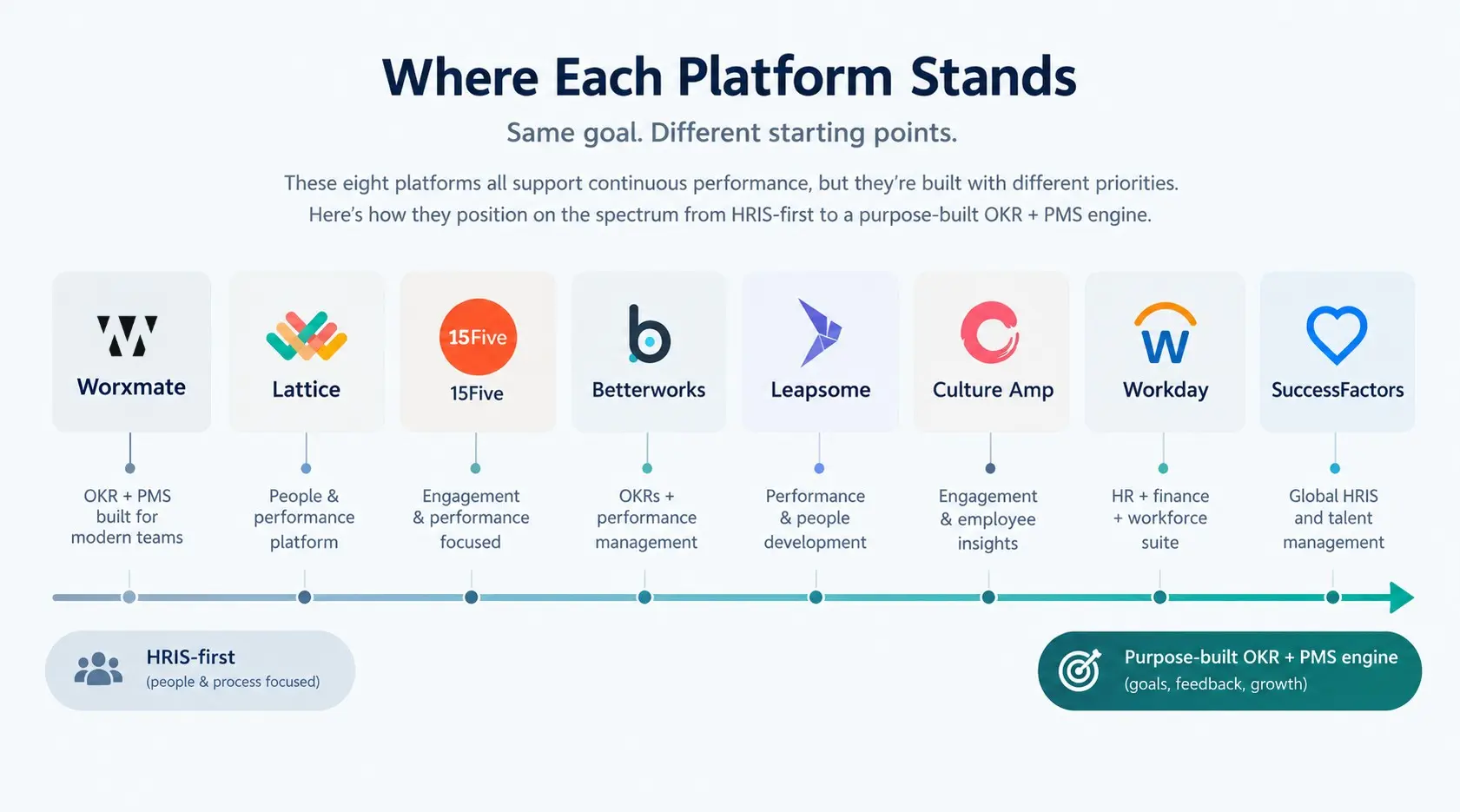
Alternatives to Workday and alternatives to SuccessFactors both sit in the same category conversation. Workday and SuccessFactors are excellent HRIS platforms they are not, and were never built to be, purpose-built continuous performance management software. For an HRIS suite, performance is one module among payroll, benefits, and core HR. For dedicated continuous performance management platforms, performance execution is the entire product. That’s not a criticism of either suite; it’s a category distinction worth understanding before you compare them on the same table. If your organization is already standardized on one for core HR, the honest question isn’t “which is the better performance module” — it’s “does performance execution deserve its own purpose-built layer.” See alternatives to Workday and alternatives to SuccessFactors. For the fuller version of this distinction, see performance management software vs. HRIS.
Which Continuous Performance Management Software Fits Your Team
Company stage and existing tech stack usually matter more than any single feature in this decision. Here’s how I’d narrow it by situation:
| Your Situation | What to Prioritize | Where to Read More |
|---|---|---|
| Startup, under 100 people, first real performance system | Fast setup, low support-query friction, self-serve pricing | Performance management software for startups |
| Enterprise, 2,000+ people, complex reporting lines | Cascade architecture, manager coaching support, procurement-ready security | Performance management software for enterprise |
| IT services or SaaS organization | Integration depth (Jira, Slack, Teams), engineering-team OKR support | Performance management software for IT |
| Regulated industry — pharma, financial services | Compliance-aware workflows, audit trails, calibration structure | Performance management software for pharma |
| BPO or high-headcount operations | Volume-friendly pricing, standardized review cycles at scale | Performance management software for BPO |
| Remote or distributed team | Async check-ins, timezone-aware cadence, transparent OKR dashboards | OKRs for remote teams (a dedicated remote-team continuous performance management software guide is in progress — this is the closest live resource today) |
| Budget-constrained or piloting the category | Free tier or trial depth before committing | Free performance management tools |
| Want the AI-native angle specifically | Predictive signals, not just dashboards after the fact | AI-driven performance management software |
If you’re further back in the research process and still deciding whether continuous performance management is the right model before you evaluate specific continuous performance management tools, our breakdown of continuous performance management vs. annual review is a useful starting point a dedicated head-to-head comparison on that exact phrase is coming soon.
Unlock Goal Clarity & Accelerate Employee Growth
Looking to drive goal clarity and employee growth? Discover how Worxmate’s AI-powered Performance Management Software can help.
Pricing: The Question Everyone Asks and Nobody Answers Publicly
Most of the platforms on this list — Lattice, Betterworks, Leapsome, Culture Amp, Workday, SuccessFactors — sit behind a “request a quote” form. That’s not automatically a red flag; enterprise software often prices around seat count, modules, and implementation scope in ways that don’t fit a static pricing page. But it does mean you can’t actually shortlist on price until you’ve already spent a sales call doing it, which is exactly the kind of friction that makes buyers default to whichever vendor answered fastest rather than whichever tool fits best.
Worxmate and 15Five both publish tiered pricing you can evaluate before a call. For a deeper breakdown of how continuous performance management software pricing actually gets structured across the category per-seat, per-module, or flat enterprise contract — see our guide on SaaS performance management pricing. A dedicated continuous performance management software pricing comparison, mapped specifically to the eight tools above, is one of the next pieces in this content series.
What Actually Predicts Whether the Software Gets Used
I want to close the comparison itself with the part every features table leaves out, because it’s the part that actually determines whether any of this was worth the evaluation time.
In the first week of a new platform rollout, I watch for three things, and they predict success more reliably than any feature comparison: whether the team chose this shift or had it announced to them with a go-live date, how many support queries the team raises in week one, and whether coaching support reaches below the C-suite into the management layer where these programs actually live or die. I’ve watched technically excellent continuous performance management software fail in organizations that skipped all three, and I’ve watched a genuinely mediocre tool outperform because the organization got those three things right first.
That’s also the honest caveat to this entire guide: no ranking, including this one, replaces that groundwork. If your organization hasn’t answered “what’s in it for the team” before the login credentials go out, the best continuous performance management software on this list will still struggle. The tool is the infrastructure. What happens in the first week is the capability. You need both, and you need them in the right order.
Building the case for continuous performance management internally?
This playbook covers how to get leadership buy-in and avoid the adoption traps that kill programs in the first quarter.
The Bottom Line
If you need one sentence: Worxmate is the best continuous performance management software for organizations that want OKRs and continuous performance conversations running on one engine instead of two, built by a team that has run these programs in the field, not just shipped features for them. If you’re specifically evaluating OKR software on its own, start with our best OKR software guide; if performance management is the primary lens and OKRs are secondary, our best performance management software guide is the more direct fit. This page exists for the buyer standing at the intersection of both.
Ready to see it in practice?
The Platform Path: If you’re ready to evaluate continuous performance management software directly, book a Worxmate demo or see current pricing.
The Consulting Path: If the platform isn’t your first problem — if goal quality, leadership alignment, or adoption below the C-suite is — our OKR consulting work addresses that directly. The software is the infrastructure. The coaching is the capability. Most organizations that get real value from continuous performance management software eventually need both.


Written by
An OKR Coach with 20+ years of implementation experience, Madhusudan has guided over 50 organisations through successful OKR transformations, training more than 500 leaders. Learn more about Worxmate.