 WORXMATE
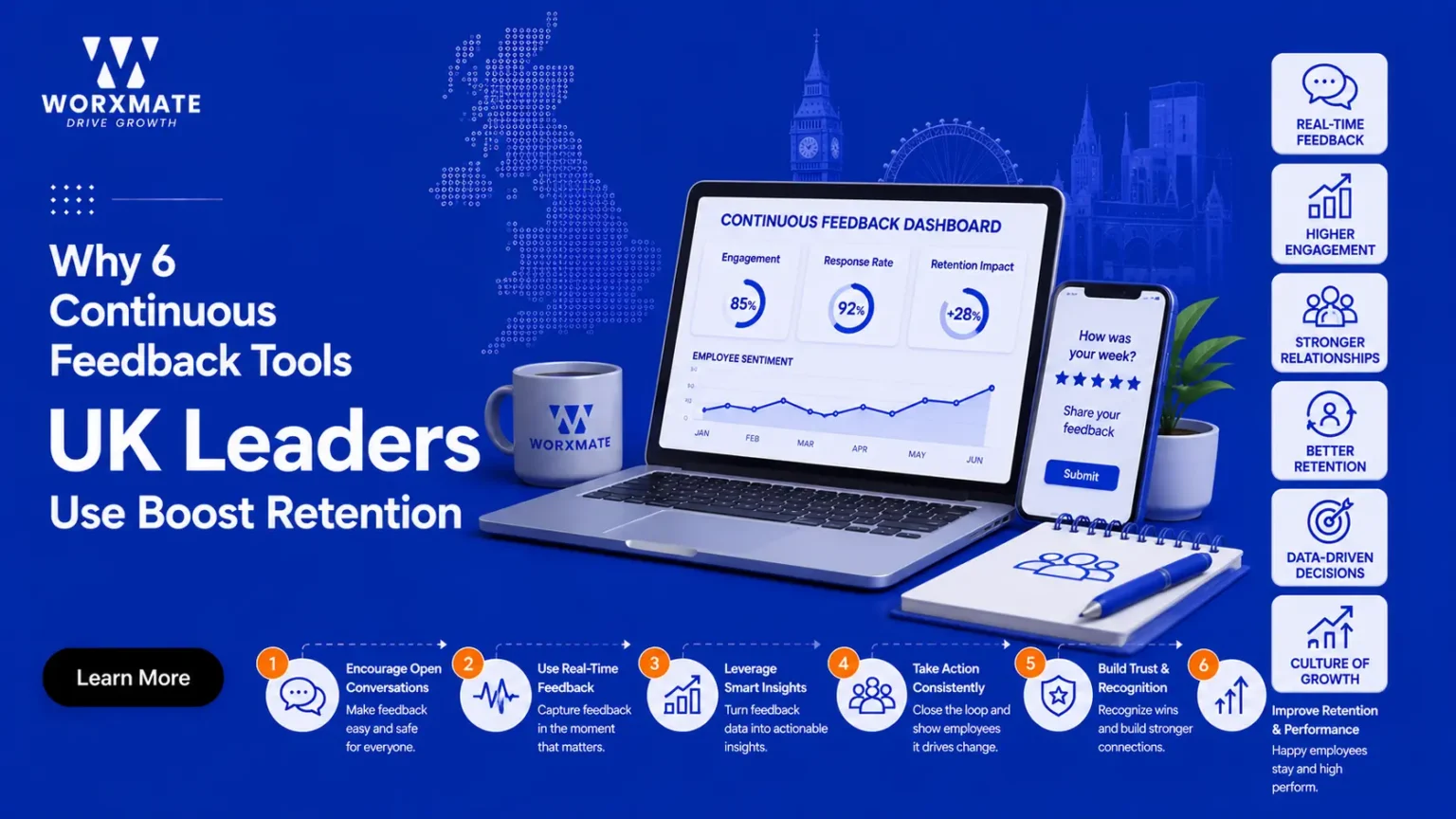
Why 6 Continuous Feedback Tools UK Leaders Use Boost Retention
Actionable insights to align your OKRs with everyday performance management-from proven frameworks to the tools that power them.
Summary
Continuous feedback tools UK organisations implement are digital platforms designed to facilitate frequent, real-time communication between managers and employees. These systems replace traditional annual reviews with ongoing dialogue to drive performance.
This article explores how adopting continuous feedback tools UK wide helps scaling businesses improve retention, align team goals, and foster a high-performance culture in a competitive labour market.
Why Continuous Feedback Tools UK Businesses Select Are Replacing Traditional Appraisals
Continuous feedback tools UK companies are adopting reflect a fundamental shift in how human capital is managed in the modern economy. For decades, the annual appraisal was the cornerstone of HR strategy, yet research from Gartner indicates that 81% of HR leaders are now making significant changes to their performance management systems. The primary driver is the recognition that a once-yearly conversation is insufficient for the fast-paced, digital-first environment that UK businesses operate in today.
The traditional model often resulted in “recency bias,” where managers only remembered the last three weeks of an employee’s work. By contrast, continuous feedback tools UK teams use allow for a chronological, data-rich record of achievement throughout the entire year. This shift is not just about frequency; it is about the quality of the interaction. According to Gallup, only 14% of employees strongly agree that their performance reviews inspire them to improve. By moving toward real-time feedback, organisations can address issues as they arise, rather than letting them fester for months.
In the context of the UK market, where “The Great Resignation” and subsequent talent shortages have pressured HR departments, the ability to engage employees consistently is a competitive necessity. Continuous feedback tools UK HR directors prioritise are those that integrate into the daily flow of work. When feedback is instantaneous, it becomes a coaching tool rather than a disciplinary one. This transition from “judge” to “coach” is central to modern performance management. By leveraging continuous feedback tools UK managers can provide the steering corrections necessary to keep projects on track without the administrative burden of traditional paperwork.
Furthermore, the UK’s productivity gap remains a persistent challenge for C-level executives. McKinsey has noted that agile organisations—those that prioritise frequent communication and rapid iteration—are 1.5 times more likely to outperform their peers. Continuous feedback tools UK enterprises deploy are the technological backbone of this agility. They ensure that every individual contributor understands how their daily tasks contribute to the broader corporate strategy, reducing the “strategic drift” often seen in larger organisations.
Unlock Goal Clarity & Accelerate Employee Growth
Looking to drive goal clarity and employee growth? Discover how Worxmate’s AI-powered Performance Management Software can help.
Why UK Businesses Are Prioritising Real-Time Employee Insights
Continuous feedback tools UK leaders invest in are increasingly focused on the power of real-time insights. In a volatile economic climate, waiting until the end of a quarter or year to understand employee sentiment or performance trends is a risk most companies cannot afford. Real-time insights allow for proactive interventions. For instance, if a specific department shows a sudden dip in engagement scores, continuous feedback tools UK HR teams monitor can flag this immediately, allowing for a targeted “stay interview” or resource reallocation.
The demand for ongoing feedback is particularly high among the younger workforce. Deloitte’s Gen Z and Millennial Survey highlights that these cohorts value professional development and transparency above almost all other workplace factors. Continuous feedback tools UK firms implement cater to this need by providing a platform for “always-on” recognition and constructive critique. This demographic shift has made the adoption of continuous feedback tools UK wide a matter of employer branding as much as operational efficiency.
Data from HBR suggests that companies that provide regular feedback have turnover rates that are 14.9% lower than those that do not. In high-growth sectors like London’s fintech or Manchester’s tech hub, retaining top-tier talent is the difference between scaling successfully and stagnation. Continuous feedback tools UK companies use often include pulse surveys and mood tracking, giving leadership a “thermometer” for the organisation’s health. This data is invaluable during periods of change, such as mergers, acquisitions, or shifts to hybrid work models.
Moreover, real-time insights help eliminate the “feedback vacuum” that often occurs in remote or hybrid settings. Continuous feedback tools UK organisations deploy bridge the physical gap between managers and their direct reports. By facilitating digital check-ins and peer-to-peer recognition, these tools ensure that remote workers feel visible and valued. The psychological safety created by a consistent feedback loop is a key driver of employee engagement, which Gallup links directly to a 21% increase in profitability.
Key Features To Look For In A UK-Compliant Feedback Tool
When evaluating continuous feedback tools UK organisations must consider several critical features that ensure both effectiveness and legal compliance. The UK regulatory environment, particularly regarding UK GDPR and data privacy, requires that any continuous performance management software handles sensitive employee data with the highest level of security. Data residency—knowing exactly where your employee data is stored—is a primary concern for UK-based legal and IT departments.
Beyond compliance, the best continuous feedback tools UK managers can use should offer the following features:
-
Seamless Integration with Communication Stacks
For feedback to be truly “continuous,” it must happen where the work happens. Top-tier continuous feedback tools UK teams prefer are those that integrate directly with Slack, Microsoft Teams, or Google Workspace. This allows a manager to send a “well done” or a constructive note without leaving their primary workflow, increasing adoption rates significantly.
-
Multi-Directional Feedback Capabilities
Modern performance management is no longer a one-way street. Effective continuous feedback tools UK firms select support 360 degree feedback, enabling peer-to-peer recognition and upward feedback. This democratisation of feedback helps uncover hidden leaders and identifies management blind spots that traditional top-down reviews miss.
-
Actionable Analytics and Sentiment Analysis
Raw data is useless without context. The most advanced continuous feedback tools UK HR directors use leverage AI to perform sentiment analysis on open-ended feedback. This can identify trends—such as rising frustration in a specific office or high levels of enthusiasm for a new project—allowing leadership to act on qualitative data with quantitative precision.
-
Customisable Feedback Templates
Not all feedback is created equal. Continuous feedback tools UK businesses implement should allow for custom templates tailored to different roles or project phases. Whether it’s a post-sprint retrospective or a monthly 1-on-1, having structured prompts ensures the feedback is constructive and aligned with the performance management cycle.
Choosing continuous feedback tools UK companies can rely on also means looking for providers that offer robust UK-based support. Having a partner who understands the nuances of the UK labour market and employment law can be a significant advantage during the implementation phase. Furthermore, the ability to export data for payroll or legal documentation ensures that the tool serves the broader needs of the HR function.
How Continuous Feedback Tools UK Integrate With OKR Frameworks
Continuous feedback tools UK organisations use are most effective when they are paired with a robust goal-setting framework like Objectives and Key Results (OKRs). The synergy between OKRs and CFRs (Conversations, Feedback, and Recognition) is well-documented. While OKRs provide the “what” and the “how” of performance, continuous feedback tools UK teams deploy provide the “why” and the “who.”
In an OKR-driven environment, goals are often ambitious and quarterly. Without frequent check-ins, these goals can easily be forgotten or become irrelevant as market conditions change. Continuous feedback tools UK managers utilise ensure that there is a constant dialogue regarding progress toward these key results. If a team member is struggling with a specific objective, the feedback loop allows for immediate support or a pivot in strategy. This prevents the “set and forget” mentality that plagues many strategic initiatives.
Furthermore, continuous feedback tools UK firms adopt help to humanise the OKR process. While OKRs are data-driven and objective, the feedback layer allows for recognition of the effort and soft skills required to achieve them. For example, a continuous feedback tools UK platform might allow a peer to recognise a colleague’s “collaboration” or “problem-solving” during a difficult project, even if the final OKR metric hasn’t been fully reached yet. This holistic view of performance is crucial for maintaining morale in high-pressure environments.
The integration of continuous feedback tools UK wide also facilitates better alignment. When feedback is linked directly to specific OKRs, it becomes clear how individual contributions move the needle for the company. This transparency is a hallmark of high-performing cultures. According to PwC, 73% of employees who understand their contribution to their company’s strategy are more engaged. By using continuous feedback tools UK businesses can create a direct line of sight from the CEO’s vision to the intern’s daily tasks.
Comparing The Best Continuous Feedback Tools For UK SMEs And Enterprises
When comparing continuous feedback tools UK organisations have a wide variety of options, ranging from lightweight survey apps to comprehensive performance suites. The choice often depends on the size of the organisation and the complexity of its performance culture. For SMEs, the focus is often on ease of use and rapid deployment, while enterprises require deep customisation and advanced security features.
| Feature | SME Focus | Enterprise Focus |
|---|---|---|
| Implementation | Plug-and-play, self-service | Dedicated account management, custom API integrations |
| Feedback Type | Peer recognition, simple pulse surveys | 360 reviews, complex matrix reporting, AI sentiment |
| Goal Alignment | Basic goal tracking | Full OKR cascading, multi-departmental visibility |
| Compliance | Standard UK GDPR compliance | Advanced data residency, SSO, audit logs |
Continuous feedback tools UK SMEs often choose are those that offer a high “time-to-value.” These platforms typically feature intuitive interfaces that require minimal training. The goal is to get managers and employees talking immediately. On the other hand, continuous feedback tools UK enterprises invest in are often part of a larger digital transformation strategy. These tools must talk to existing HRIS systems like Workday or HiBob and provide the granular data reporting required by global leadership teams.
Another factor in the comparison of continuous feedback tools UK wide is the “culture fit.” Some tools are designed to be “fun” and social, with emojis and public “shout-out” walls. Others are more professional and structured, focusing on developmental goals and competency frameworks. Selecting the right continuous feedback tools UK businesses need involves an honest assessment of the current company culture and where leadership wants to take it. A tool that feels too informal may be ignored in a traditional legal firm, while one that is too rigid might stifle creativity in a design agency.
Ultimately, the best continuous feedback tools UK organisations can implement are those that strike a balance between structure and flexibility. They should provide enough guidance to ensure feedback is high-quality, but enough freedom to allow for spontaneous appreciation. By carefully comparing continuous feedback tools UK HR leaders can find a solution that scales with their business, moving from simple check-ins to a sophisticated, data-driven performance engine.
Unlock Goal Clarity & Accelerate Employee Growth
Looking to drive goal clarity and employee growth? Discover how Worxmate’s AI-powered Performance Management Software can help.
Implementing A Feedback Culture: Best Practices For UK HR Leaders
Simply purchasing continuous feedback tools UK wide does not guarantee a feedback culture. Implementation is a change management process that requires buy-in from the top down. HR leaders must position the move toward continuous feedback as a benefit for the employee, not just another tracking mechanism for the company. When continuous feedback tools UK managers use are seen as a way to support career growth and remove blockers, adoption rates soar.
One best practice for implementing continuous feedback tools UK organisations find successful is to start with a pilot program. By selecting a forward-thinking department—such as Engineering or Marketing—to test the software, HR can gather internal testimonials and “success stories.” These stories are far more persuasive than a software manual. When other teams see that the pilot group is more aligned and less stressed, they will be more eager to adopt the continuous feedback tools UK wide.
Training is also essential. Many managers are uncomfortable giving or receiving feedback, especially if it is constructive. Continuous feedback tools UK HR teams deploy should be accompanied by workshops on “how to give feedback.” This includes using frameworks like the SBI model (Situation, Behaviour, Impact) to ensure comments are objective and helpful. Without this training, continuous feedback tools UK businesses use can inadvertently become platforms for vague praise or, worse, unhelpful criticism.
Finally, leadership must lead by example. If the C-suite is not using the continuous feedback tools UK teams are expected to use, the initiative will likely fail. Executives should be visible on the platform, giving recognition and asking for feedback themselves. This vulnerability builds trust and signals that the organisation is serious about its commitment to transparency. Over time, the use of continuous feedback tools UK wide becomes second nature, transforming the way the organisation learns, grows, and competes.
Case Study: Monzo — Driving Agile Performance With Continuous Feedback
-
The Challenge
As a rapidly scaling fintech based in London, Monzo faced the challenge of maintaining its agile, high-performance culture while growing its headcount into the thousands. Traditional annual reviews were too slow for their two-week sprint cycles, and there was a growing disconnect between individual effort and the company’s ambitious growth OKRs.
-
The Solution
The company moved away from rigid annual appraisals in favour of a continuous feedback loop. They implemented a system that encouraged real-time peer-to-peer recognition and weekly manager check-ins, all integrated into their existing digital communication channels. This approach prioritised “CFRs”—conversations, feedback, and recognition—over static documentation.
-
Results and Impact
By shifting to a continuous model, Monzo was able to maintain high levels of transparency and alignment during periods of hyper-growth. This agile approach to performance contributed to their industry-leading employee engagement scores and helped them scale to over 7 million customers while maintaining a highly motivated, mission-driven workforce. (Source: Monzo Annual Reports / Public Culture Documentation)
Conclusion
The real cost of outdated performance systems isn’t just administrative overhead—it is the erosion of trust and the loss of top talent to more agile competitors. Monzo’s experience proves that when high-growth organisations treat feedback as a continuous conversation rather than a yearly event, they unlock higher levels of transparency and retention. Continuous feedback tools UK businesses adopt are no longer optional; they are the essential infrastructure for any company serious about building a high-performance culture in a volatile market.
By moving beyond the limitations of the annual appraisal, your organisation can foster deeper employee engagement and build a more resilient performance management cycle. Leveraging 360-degree feedback and ongoing feedback ensures that every team member feels heard and aligned with the company’s strategic vision.
Ready to transform your feedback culture from a static process into a strategic advantage? Explore how to integrate OKRs and CFRs to drive measurable results, implement real-time feedback to keep your teams agile, and start your free trial with Worxmate today to see the impact of a truly continuous approach.


Written by
An OKR Coach with 20+ years of implementation experience, Madhusudan has guided over 50 organisations through successful OKR transformations, training more than 500 leaders. Learn more about Worxmate.
Frequently Asked Questions
These are digital platforms that facilitate ongoing, real-time communication between employees and managers, replacing the traditional annual review process with frequent check-ins and peer-to-peer recognition.
Annual appraisals often suffer from recency bias and fail to provide the timely guidance needed in agile environments. Continuous feedback improves engagement, reduces turnover, and aligns individual work with company OKRs.
By providing regular recognition and addressing concerns in real-time, these tools increase employee visibility and psychological safety, which are key drivers in reducing churn and improving the employee value proposition.
Most modern continuous feedback tools offer deep integrations with communication stacks like Slack and Microsoft Teams, allowing feedback to happen naturally within the existing daily workflow of the team.
Platforms like Worxmate bridge the gap between daily feedback and strategic goals by linking micro-check-ins directly to key results and objectives. This ensures that ongoing performance conversations reinforce team alignment and track real-time progress toward company-wide OKRs.
UK HR leaders should prioritise platforms featuring multi-directional feedback capabilities, actionable sentiment analysis, and customisable templates that reflect company culture. Seamless communication stack integrations and robust performance analytics are also vital for driving high user adoption rates.
Actionable sentiment analysis automatically detects dips in team morale or employee engagement before they escalate into turnover risks. This allows HR directors and managers to proactively intervene with targeted support and stay interviews.
Successful implementation relies on training managers to transition from traditional evaluators to supportive coaches who provide consistent steering corrections. Encouraging peer-to-peer recognition and embedding check-ins into the daily workflow will also drive long-term engagement.
By providing a continuous data-rich record of achievement rather than relying on annual recollections, these tools keep every individual contributor aligned with broader business goals. This transparency prevents strategic drift, ensuring agile UK teams remain focused on core execution priorities.