WORXMATE
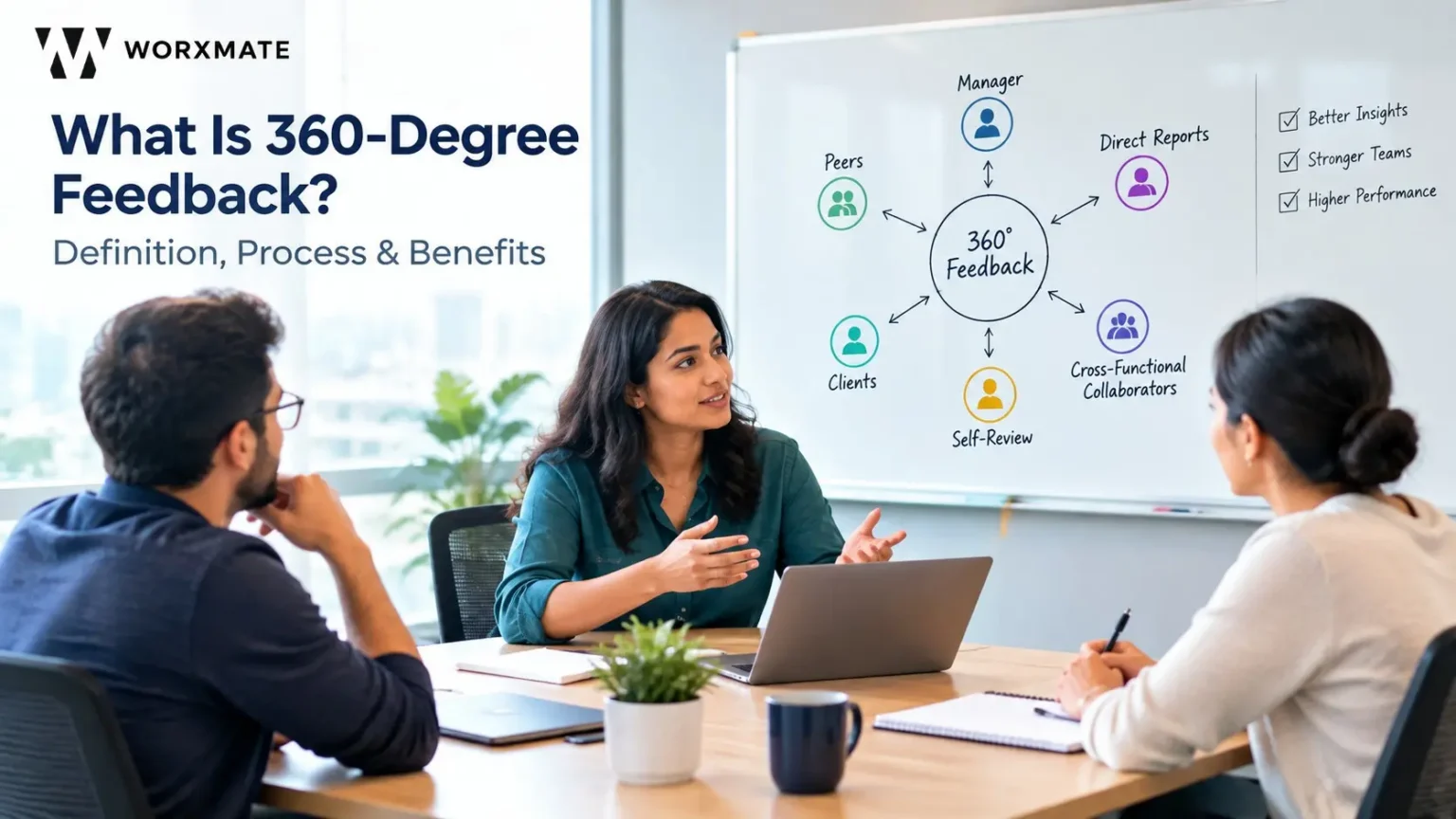
360-degree feedback is a performance evaluation method that collects confidential input on an employee from every direction around them, manager, peers, direct reports, and sometimes clients, instead of relying on a single manager’s opinion. It reduces individual bias, surfaces blind spots the employee cannot see in themselves, and builds a fuller picture of how someone actually shows up at work. Most organisations run it once or twice a year, tied to development planning rather than compensation decisions. Done well, it strengthens self-awareness, team dynamics, and leadership capability. Done badly, it produces a report nobody reads twice.
What Is 360-Degree Feedback? Definition, Process & Benefits
I have sat in enough calibration rooms to watch the same mistake happen twice: a manager forms an opinion of someone in the first two weeks of working together, and that opinion never updates again, no matter how much the person actually grows. That is the exact blind spot 360-degree feedback was built to fix, and it is why I push almost every organisation I coach to introduce it before their second OKR Cycle, not their fifth.
As CEOs, CHROs, and managers, you face the challenge of evaluating not just what your employees achieve, but how they collaborate, lead, and grow within the team. Traditional performance reviews provide only a fraction of this insight. They are like viewing a masterpiece through a keyhole, you miss the full picture.
The result? 79% of your employees quit their jobs citing lack of appreciation and feeling devalued as a key reason for leaving.
The feedback you don’t hear is often the most critical. As workplaces become more dynamic and collaborative, employees need more than just one person’s perspective to truly understand their impact. Traditional performance reviews often fall short of providing meaningful, actionable feedback.
That’s why you need 360-degree feedback, a powerful evaluation method that provides a well-rounded and comprehensive evaluation. Let’s dive in and explore this game-changing approach to performance management, and if you already understand the concept and want to compare which tools actually run it well, our separate guide on 360 feedback software covers that ground instead of this one.
Understanding 360-Degree Feedback
Imagine having a crystal ball that could show you not just how an employee performs, but how they’re perceived across the entire organization. That’s the essence of 360-degree feedback. 360-degree feedback is a process where employees receive confidential, anonymous feedback from their peers, subordinates, supervisors, and sometimes, even clients.
Unlike traditional top-down reviews, it evaluates an employee’s performance from all angles, offering a more holistic view. It not only measures job-specific skills but also assesses interpersonal skills, leadership qualities, and areas for development.
Who Actually Gives 360-Degree Feedback
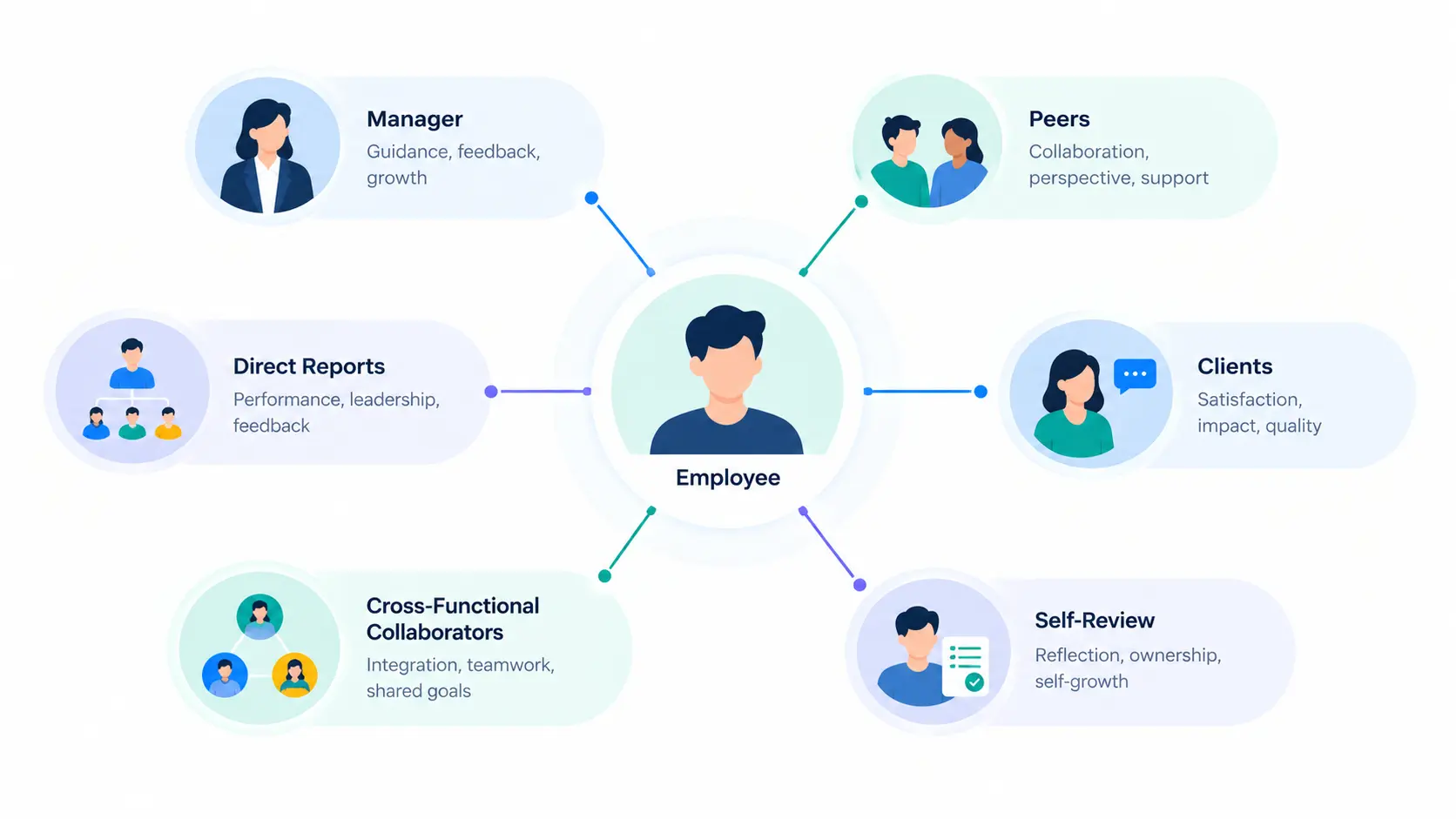
One of the most common questions I get from HR leaders setting this up for the first time is who should actually be in the rater group. The table below is the starting point I use in every implementation:
| Rater | What They See | Why It Matters |
|---|---|---|
| Direct Manager | Day-to-day output, priority alignment | Anchors feedback to business goals and goal alignment |
| Peers | Collaboration, reliability, communication style | Surfaces behaviour a manager rarely observes directly |
| Direct Reports | Leadership style, delegation, coaching quality | Critical for leadership development, often the most revealing input |
| Cross-Functional Collaborators | Dependency reliability, cross-team communication | Reveals patterns invisible within a single department |
| Clients (optional) | External-facing quality, responsiveness | Relevant for client-facing and sales roles |
| Self-Assessment | Employee’s own perception of their performance | The gap between self-view and others’ view is the real insight |
I ran this exact exercise with a leadership team at a 70,000-person IT services organisation, and the first thing that broke was everyone’s assumption about who they actually were as a manager. One leader was convinced his team saw him as highly collaborative. His direct reports rated him lowest on that exact competency, and the peer comments explained why: he made decisions in one-on-ones and communicated them as done deals in group settings. Nobody had ever told him that pattern was visible, because nobody had ever been asked in a structured, anonymous way. That is the gap 360-degree feedback exists to close, not performance in the abstract, but the distance between how someone believes they show up and how the room actually experiences them.
Here’s why its ability to capture diverse viewpoints matters:
-
Reduced Bias
By incorporating feedback from various sources, the process minimizes the impact of individual biases.
-
Improved Accuracy
It offers a more balanced and accurate assessment, ensuring that no critical feedback is left unheard.
-
Enhanced Self-Awareness
Employees gain insights into how others perceive their work, leading to more targeted self-improvement efforts. This is the gap I mentioned above, and in my experience across 50+ implementations, the size of that gap between self-perception and peer perception is a far better predictor of coaching readiness than the actual competency score itself.
Why 360-Degree Feedback is Vital for Organizations?
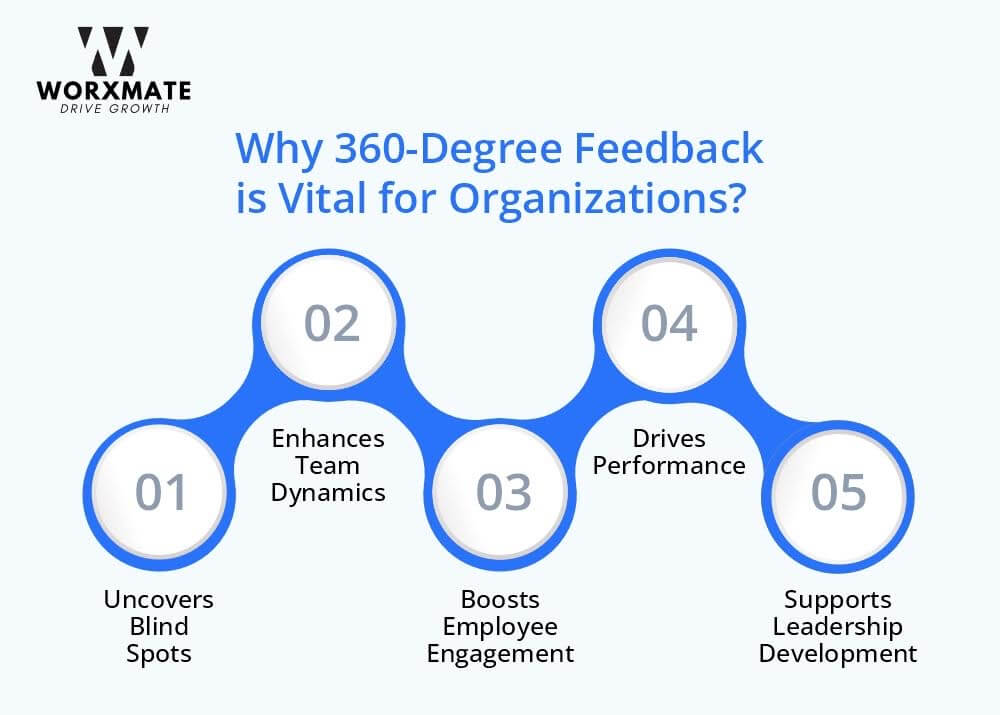
For decision-makers such as CHROs, CEOs, and managers, the 360-degree feedback process has become indispensable. It provides numerous benefits to organizations looking to refine their employee evaluation approach:
Across the 135+ HR leader conversations I have had on this exact topic, the organisations that get real value from 360-degree feedback share one trait: someone senior treats the output as a coaching input, not a scoring exercise. The moment a 360 report becomes ammunition for a compensation conversation, honesty in the next cycle drops sharply, because raters recalibrate what they are willing to say once they realise the stakes. Keep the two processes separate, even if they run in the same quarter, and the feedback stays useful far longer.
-
Uncovers Blind Spots
We all have them, areas where our self-perception doesn’t align with how others see us. 360-degree feedback illuminates these blind spots, fostering self-awareness and growth.
-
Enhances Team Dynamics
By involving peers in the feedback process, it naturally improves communication and collaboration within teams, strengthening cross-functional teams that otherwise operate in silos.
-
Boosts Employee Engagement
When employees feel their voices are heard and valued, employee engagement soars. A Gallup study found that employees who receive regular feedback are 3.6 times more likely to be motivated to do outstanding work.
-
Drives Performance
With a clear understanding of their impact and areas for improvement, employees can focus their efforts more effectively, leading to enhanced employee performance.
-
Supports Leadership Development
For managers and executives, 360-degree feedback is invaluable in honing leadership skills and adapting management styles.
360-Degree Feedback Benefits at a Glance
| Benefit | What Changes | Timeframe to See Impact |
|---|---|---|
| Reduced rating bias | Multi-source input replaces single-manager opinion | First cycle |
| Higher self-awareness | Gap between self-view and peer-view becomes visible | First cycle |
| Stronger team collaboration | Peers become active participants, not bystanders | 2–3 cycles |
| Better leadership capability | Managers adjust style based on direct-report input | 2–3 cycles |
| Higher engagement | Employees feel heard through structured, regular input | 2–3 cycles |
Implementing 360-Degree Feedback Effectively
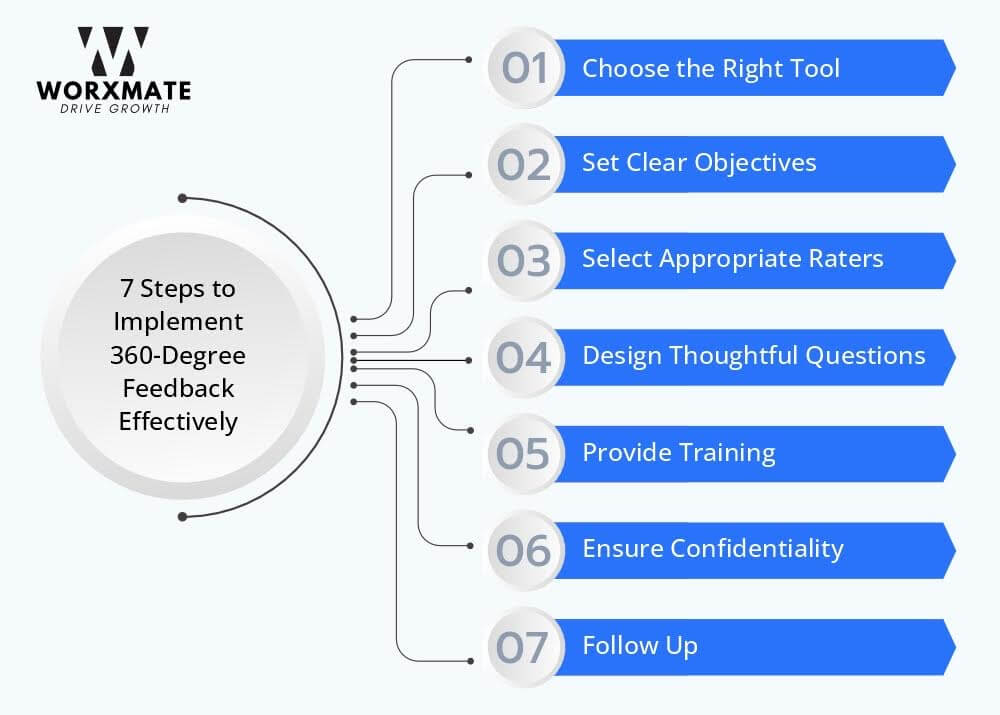
While the benefits are clear, the implementation of a 360-degree feedback system requires careful planning and execution. Here’s how to make it work:
1. Choose the Right Tool
Invest in robust 360 degree feedback software. The right technology can streamline the process, ensure anonymity, and provide actionable insights. Evaluating the best performance management software ensures your organization deploys technology that can streamline multi-rater workflows, guarantee anonymity,
-
While 360-degree feedback is powerful on its own, its impact is magnified when integrated into a comprehensive Performance Management System (PMS). A well-designed PMS creates a framework for ongoing feedback, goal-setting, and development planning.
and deliver actionable insights.
2. Set Clear Objectives
Define what you want to achieve with the feedback process. Is it for development purposes, performance evaluation, or both? This decision should connect back to your broader performance management frameworks, not sit as an isolated HR initiative.
3. Select Appropriate Raters
Ensure a diverse group of raters who have significant interaction with the employee being evaluated.
4. Design Thoughtful Questions
Focus on behaviors and competencies that align with your organization’s values and goals. Well-designed constructive feedback examples give raters a model for what useful, specific input actually sounds like, versus vague praise or vague criticism that nobody can act on.
5. Provide Training
Both raters and recipients should understand the process, its purpose, and how to give/receive constructive feedback.
6. Ensure Confidentiality
Keeping feedback anonymous fosters honesty and prevents any potential biases from interfering with the process.
7. Follow Up
The feedback process doesn’t end with the report. Create action plans and provide support for development. In my experience, this is the single most skipped step, and it is the one that determines whether the entire exercise was worth running at all. I ask every HR leader I coach the same question before their first cycle even launches: who is booking the follow-up conversation, and by when? If nobody can answer that question in the planning meeting, the cycle is not ready to run yet, no matter how polished the survey questions are.
Integrating with Performance Management System
While 360-degree feedback is powerful on its own, its impact is magnified when integrated into the best performance management software. A modern performance management system creates a unified framework for continuous feedback, strategic, goal-setting, and development planning.
By combining 360-degree feedback with regular one on one meetings, performance reviews, and employee development plans, organizations can create a culture of continuous improvement and open communication. This is also where feedback data should start informing OKR alignment, so a pattern flagged in a 360 cycle connects to an actual goal the person is accountable for, not a report that lives in a separate folder from their objectives.
I have seen this connection made and broken in the same organisation, three quarters apart. When the CHRO owned the 360 process independently of the business’s goal-setting cadence, the report generated conversation for about two weeks and then quietly stopped mattering. When the same organisation later tied 360 themes directly into each leader’s next-cycle OKRs, specifically writing a development-focused Key Result off the back of a recurring feedback pattern, the behaviour actually changed within a single quarter. The difference was not the quality of the feedback. It was whether the feedback had anywhere to go.
Unlock Goal Clarity & Accelerate Employee Growth
Looking to drive goal clarity and employee growth? Discover how Worxmate’s AI-powered Performance Management Software can help.
Challenges and Solutions
While 360-degree feedback offers numerous benefits, it’s not without challenges. Here are some common issues and how to address them:
| Challenge | Why It Happens | The Fix |
|---|---|---|
| Feedback Overload | Too many questions, too many raters, fatigue sets in | Focus on key competencies and limit the number of questions per cycle |
| Lack of Follow-Through | Reports get filed, never discussed | Integrate results into ongoing employee development plans and regular check-ins |
| Cultural Resistance | Employees fear feedback will be used punitively | Gradually introduce the concept, be transparent about purpose, gain buy-in from every level |
| Rater Fatigue Over Time | Same raters asked repeatedly, quality of input drops | Rotate rater pools where possible, keep cycles infrequent enough to stay meaningful |
| Vague or Generic Comments | Raters unsure what “useful” feedback looks like | Provide effective feedback techniques training before the cycle opens |
The Future of 360-Degree Feedback
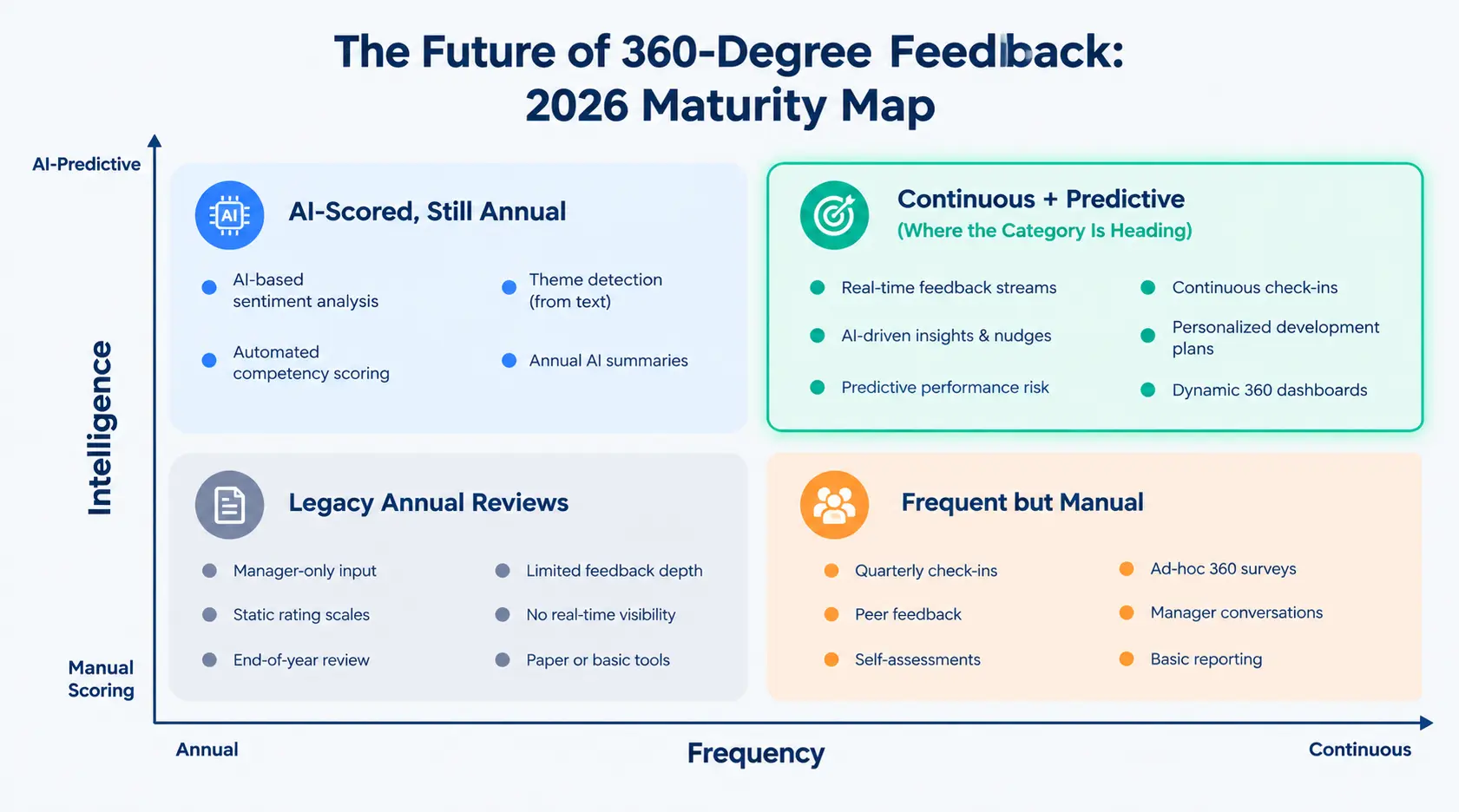
As we look ahead, the role of 360-degree feedback in shaping high-performing organizations is only set to grow. With advancements in AI and data analytics, the underlying process is becoming more sophisticated, offering deeper insights and predictive capabilities. This is where the category is genuinely shifting: from a once-a-year report to a continuous signal. Our piece on continuous feedback vs performance reviews goes deeper into that shift if you want to see where the category is headed.
Imagine being able to identify future leaders, predict team dynamics, or tailor development plans based on comprehensive feedback data. The possibilities are within reach today, not years away.
What I would caution against is treating AI-assisted analysis as a replacement for the human conversation that has to follow. A well-summarised theme still needs a manager willing to sit across from someone and say, out loud, “here is the pattern three of your peers independently noticed.” Technology can compress forty comments into five themes in seconds. It cannot have that conversation for you, and organisations that assume it can are the ones where the 360 process eventually collapses back into a report nobody reads.
Conclusion
360-degree feedback is more than just a trend; it’s a powerful tool for fostering growth, improving communication, and driving organizational success. By providing a comprehensive view of employee performance, it enables companies to make data-driven decisions about talent development and succession planning.
One completed 360 cycle, genuinely discussed and acted on, is worth more than five that got filed and forgotten. That principle applies here exactly the way it applies to OKRs.
Ready to take your performance management to the next level? Recognized among the best performance management software platforms on the market, Worxmate’s Worxmate’s performance management software with 360 feedback offers seamless multi-rater evaluations, with Orbit AI reading sentiment patterns across cycles to flag disengagement before it shows up in a formal review. If you are ready to compare tools specifically, our breakdown of the best 360 feedback software on the market walks through ten platforms side by side. Don’t let your organization fall behind, embrace 360-degree feedback today and watch your team grow.
Book a Demo to see how 360-degree feedback fits into a connected performance and OKR system.
💡 Comparing top PMS platforms for your organization?
Explore our expert analysis of the best performance management software to evaluate features, pricing, and 360-degree feedback capabilities across leading tools.


Written by
An OKR Coach with 20+ years of implementation experience, Madhusudan has guided over 50 organisations through successful OKR transformations, training more than 500 leaders. Learn more about Worxmate.