 WORXMATE
Summary
OKRs can transform the way organizations set and achieve goals, but many fail due to common OKR mistakes. These include setting overly ambitious or vague objectives, forgetting to review goals regularly, defining too many OKRs, or neglecting measurable key results. Lack of team alignment, poor progress tracking, and skipping data analysis also reduce effectiveness. To succeed, companies must provide training, encourage collaboration, and commit to continuous improvement. By avoiding these mistakes, OKRs become a powerful tool for focus, alignment, and long-term growth.
The crucial issues that organizations often face is to maintain focus, align their efforts across teams and to measure their progress effectively. According to the research made by Havard’s Business Review 26% of the employees are aligned with their company’s strategies.
Many companies are putting out effort without seeing significant progress, wasting their important resources, and falling short of their goals by not having a systematic and well-defined goal setting.
OKR is a framework that helps companies to bring in clarity on their priorities, promote alignment between responsibilities, and track progress.
However, when you implement OKRs you need to avoid some common mistakes and adopt the best practices that is required for your organization. In this blog we will understand the ten common OKR mistakes that usually occurs while implementing OKRs.
10 Common OKR Mistakes to Avoid While Implementing OKRs
1. Setting Ambitious Goals
Companies often forget the fact that setting ambitious goals can be motivating but they must be realistic. This instead brings in a frustration and pressure on the employees when they are not achieved. Instead, it is better to focus on setting challenging goals yet achievable.
2. Not Setting Specific Objectives
It is difficult to monitor development and measure achievement when the goals that has been set are not clear. It is crucial to maintain focus, clarity and be very specific on the goals that you have set. Setting clear objectives helps you to stay focused and you can also avoid mishandled management system which eventually helps you to grow faster.
3. Setting And Forgetting Goals
Simply setting OKRs at the start of a quarter or year and then forgetting about them until the very end. This is one of the most common mistakes everyone makes, to fully utilize the OKR methodology regularly reviewing and reassessing your OKRs to ensure they remain relevant and aligned with your priorities.
4. Neglecting Key Results
Key Results are essential for measuring progress towards objectives. Neglecting to define meaningful and measurable Key Results can result in aimless activity and a lack of accountability.
5. Setting Too Many OKRs Per Quarter
Defining too many objectives at once can distribute your efforts too widely and lose focus. Instead, prioritize a few key objectives each quarter to ensure maximum impact and effectiveness. Ideally there should be 3 to 5 objectives who are utilizing OKRs for the first time and then they can stretch according to their ability.
6. Failing To Create Alignment in Teams
One of the most important aspects for OKR success is alignment. It makes sure that all the individuals understand how objectives contribute to the overall company’s organization to encourage cooperation and alignment.
7. Not Tracking Progress
Failing to track progress against OKRs makes it difficult to course-correct and adjust strategies as needed. Implement systems for regular progress tracking and review to stay on track towards your objectives. The right OKR software makes this far easier than spreadsheets. Recorded data will give more information to take data driven decisions and better decisions means getting near to your objectives.
8. Not Learning from Data
Data provides valuable insights into what’s working and what’s not. Don’t overlook the importance of analysing data to identify trends, patterns, and areas for improvement.
9. Don’t Expect results quickly.
OKRs are a long-term tool for driving progress and improvement. Don’t expect immediate results; instead, focus on consistent effort and incremental progress over time.
10. Lack Of Training and Education
Proper training and education are essential for successful OKR implementation. Ensure that all employees understand the principles of OKRs and how to effectively set and manage them.
How to avoid OKR mistake
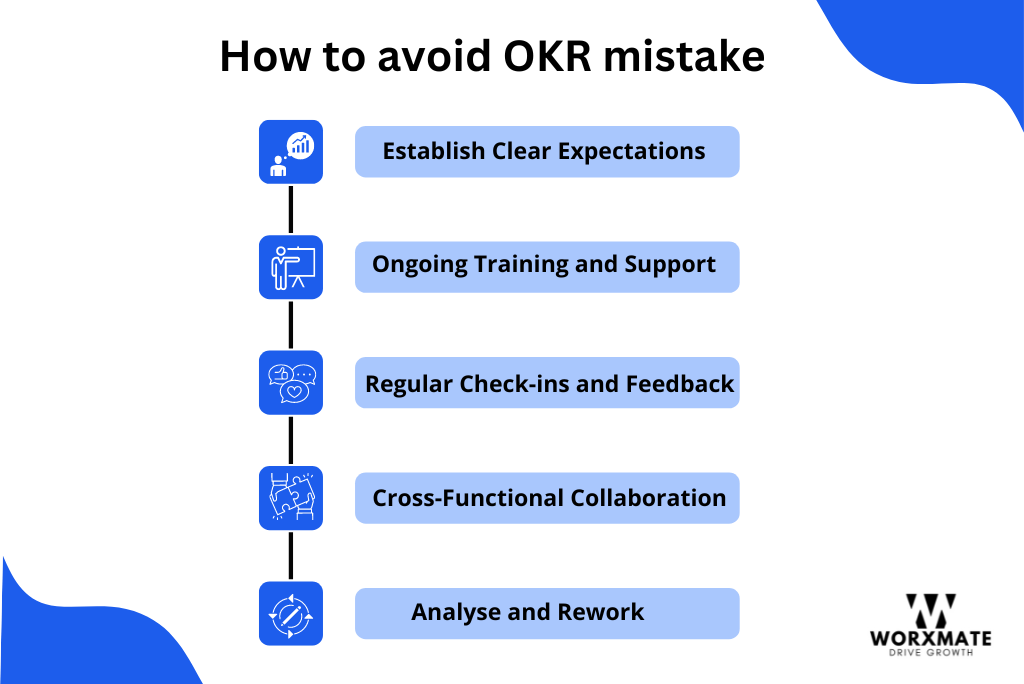 Establish Clear Expectations: Make sure all employees are aware of the goals and expectations of OKRs and how they fit into the organization’s larger plans and goals.
- Provide Ongoing Training and Support: Provide employees with training sessions and tools to teach them about OKR concepts, best practices, and how to define and accomplish goals and important outcomes.
- Encourage Regular Check-ins and Feedback: Encourage a culture of frequent check-ins and feedback meetings to monitor advancement, talk about difficulties, and help in achieving OKRs. This encourages responsibility and makes timely corrections possible when required.
- Promote Cross-Functional Collaboration: To make sure that OKRs are related and serve the organization’s overall goals, promote cooperation and alignment between teams and departments. This encourages a comprehensive strategy for achieving goals and helps prevent silos.
- Analyse and Rework: Evaluate the success of OKR implementation on a regular basis, get employee input, and don’t hesitate to make changes to improve the procedure and results. Optimizing OKRs’ impact requires constant improvement.
Conclusion:
Implementing the OKR framework can be a powerful way to drive focus, alignment, and accountability within your organization. However, avoiding common mistakes is crucial for maximizing its effectiveness.
By setting realistic yet ambitious goals, ensuring objectives are specific and measurable, regularly reviewing progress, promoting alignment across teams, and learning from data, you can overcome many of the challenges associated with OKRs.
Additionally, providing proper training, encouraging cross-functional collaboration, and fostering a culture of continuous improvement will further increase the chances of OKR success.
Remember, adopting OKRs is an ongoing journey, and consistent effort, adaptation, and a willingness to learn from mistakes are essential.
By being mindful of these common mistakes and implementing the recommended strategies, your organization can unlock the full potential of the OKR methodology, driving sustained progress, innovation, and growth.
Successfully implementing OKRs requires the right strategy, alignment, and continuous improvement. If you want to avoid these common mistakes and maximize the impact of OKRs in your organization, Worxmate is here to help.
Get expert guidance with our OKR consultant and ensure your goals drive real business results. Plus, explore our OKR software to streamline tracking, alignment, and execution.
Ready to accelerate your business growth strategy? Book a Demo with Worxmate.ai today to discover how our best OKR software can support your growth objectives and drive measurable results.”


Written by
An OKR Coach with 20+ years of implementation experience, Madhusudan has guided over 50 organisations through successful OKR transformations, training more than 500 leaders. Learn more about Worxmate.