 WORXMATE

Enterprise OKR Mistakes: Avoiding common goal-setting pitfalls requires deploying a robust OKR management system. By eliminating static spreadsheets, setting precise key results, and maintaining disciplined weekly check-ins, leadership teams can ensure their framework drives measurable continuous performance management and growth.
Top OKR Mistakes: Implementing Objectives and Key Results requires precise execution across a modern OKR management system. Avoid common pitfalls like setting too many goals, static spreadsheets, and ignoring weekly check-ins to ensure your OKR frameworks drive measurable enterprise growth.
Implementing Objectives and Key Results (OKRs) can significantly enhance focus, alignment, and performance across an organization—but only if done right. Many teams fall into common top mistakes to avoid when setting OKRs effectively, such as setting too many goals, lacking clarity, or treating OKRs as rigid checklists. These top mistakes to avoid when setting OKRs can lead to confusion, disengagement, and missed opportunities. Avoiding these top mistakes ensures your OKR efforts are impactful, aligned with strategy, and truly drive results.
Embarking on the journey of implementing Objectives and Key Results (OKR) marks a pivotal moment for any organization, laden with both anticipation and challenges.
Implementing OKRs, while popular and perceived as effective, guarantees success only when executed correctly and implemented with precision. Numerous pitfalls can hinder their efficacy, leading to frustration, disengagement, and ultimately, failure to achieve desired outcomes.
In this comprehensive guide, we delve into the top mistakes to avoid when setting OKRs, offering insights and strategies to navigate these challenges successfully.
Whether you’re a seasoned leader or just dipping your toes into the world of OKRs, understanding and sidestepping these common missteps will be instrumental in harnessing the full potential of this goal-setting framework.
At a Glance: The Key Differences
Evaluating enterprise goal management tools requires understanding how modern automated platforms compare against legacy static trackers.
| Evaluation Metric | Legacy Static Trackers | Worxmate Intelligent Platform |
|---|---|---|
| Primary Philosophy | Static spreadsheet check-ins | Continuous performance management |
| AI Capabilities | None / Manual text generation | Predictive forecasting & automated insights |
| Performance Management | Isolated annual reviews | Integrated 1:1s and continuous feedback |
| Goal-to-Task Link | Disconnected project boards | Seamless real-time line of sight |
| Ease of Use | Complex multi-step configurations | Intuitive user onboarding & adoption |
| Pricing Model | Rigid seat minimums & add-ons | Transparent value-based tiering |
| Best For | Basic milestone checklist logging | Dynamic enterprise growth & alignment |
Mistakes to Avoid When Implementing OKRs
Let’s explore the intricacies of OKR implementation, shedding light on prevalent mistakes organizations should steer clear of to fully capitalize on the potential of their OKR endeavors.
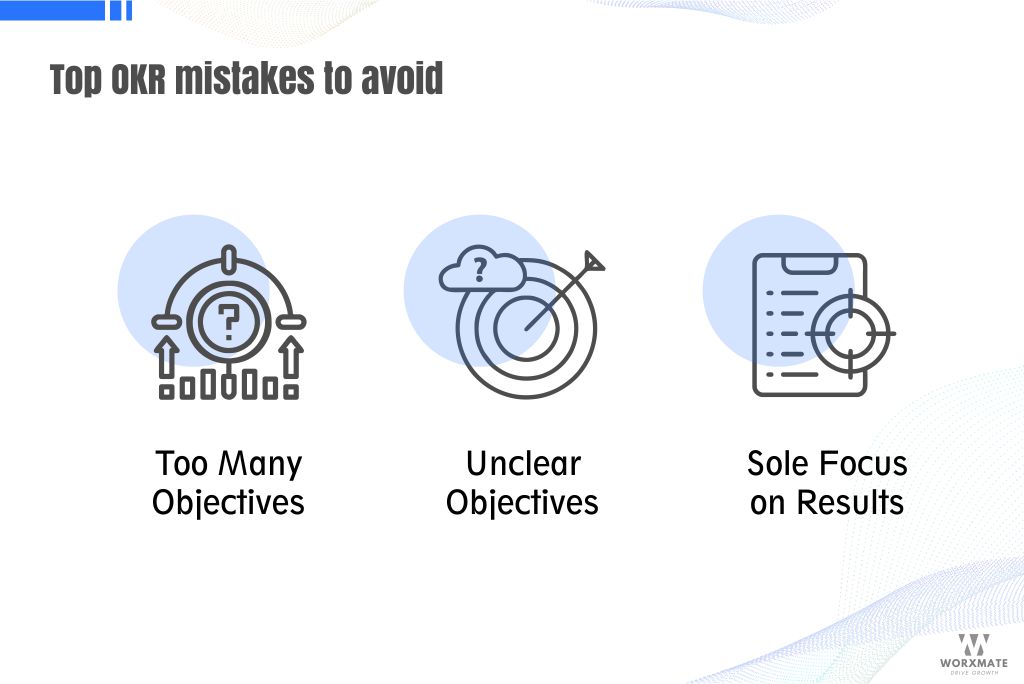
Setting Too Many Objectives
A common pitfall organizations encounter when implementing OKRs is the temptation to set too many objectives. While it may seem enticing to tackle numerous initiatives simultaneously, spreading focus too thinly can dilute effectiveness and hinder progress.
Instead, prioritize a select few objectives that align closely with your overarching goals and strategic priorities. By concentrating efforts on a manageable number of key objectives, you can ensure that resources are allocated efficiently and teams remain focused on what truly matters.
The ideal number of OKR objectives that a company should set typically ranges between 2 to 3 Objectives, each with 3 to 5 corresponding key results.
This recommendation is based on the principle that less is more when it comes to OKRs. This allows for clear focus and alignment, ensuring that efforts are directed towards achieving meaningful outcomes.
Lack of Clarity in Objectives
One of the most common OKR mistakes organizations make when implementing OKRs is setting vague or overly broad objectives. Without clear and specific objectives, it becomes challenging for teams to align their efforts and track progress effectively.
To avoid this pitfall, ensure that each objective is specific, measurable, achievable, relevant, and time-bound (SMART). Clearly define the desired outcomes and key results that will indicate success, providing teams with a clear roadmap to follow.
Focusing Solely on Results
While the OKRs stands for results, it’s essential not to overlook the importance of objectives themselves. Some organizations make the mistake of prioritizing results at the expense of setting meaningful objectives.
Remember that objectives provide context and direction for your key results, guiding teams toward achieving the desired outcomes. Strike a balance between setting ambitious but achievable objectives and defining measurable key results that will drive progress to achieve those objectives.
Failure to Cascade OKRs Effectively
OKRs are most effective when they cascade seamlessly from top-level organizational goals down to individual team and employee objectives. However, many organizations struggle with cascading OKRs effectively across different levels of the organization.
To avoid this mistake, ensure alignment between organizational, departmental, team, and individual OKRs. Establish clear linkages between higher-level objectives and lower-level objectives, fostering alignment and accountability throughout the organization.
Achieve Your Goals Faster
See how Worxmate can help your team set clear goals and achieve faster results. Book your free demo today and experience the power of AI-driven OKRs in action.
Neglecting Regular Review and Iteration
OKRs are dynamic and necessitate consistent evaluation and refinement to maintain their relevance and efficacy. Regrettably, certain organizations fall into the trap of adopting a “set it and forget it” approach, delaying OKR reviews until the end of a quarter or year.
To optimize OKRs‘ effectiveness, establish a rhythm for frequent OKR check-ins and progress assessments. Foster open dialogue and transparency, enabling teams to gauge their advancement, recognize challenges, and adapt strategies as necessary to ensure steady progress toward goal attainment. For teams operating across distributed environments, implementing structured OKR tracking for remote teams is essential to maintain visibility.
Overemphasizing Individual Performance
While OKRs are a valuable tool for driving individual performance, they are most effective when viewed through a lens of collective achievement and collaboration. Avoid the mistake of overemphasizing individual performance at the expense of team cohesion and collaboration.
Encourage a culture of shared accountability where teams work together towards common goals, supporting one another, and celebrating collective successes. Recognize that achieving objectives often requires cross-functional collaboration and alignment across teams.
Overlooking the Importance of Transparency and Accountability
Research from Harvard Business Review highlights that employees in high-trust workplaces exhibit 76% higher engagement and 29% greater life satisfaction. Therefore, transparency and accountability emerge as foundational principles for successful OKR implementation.
Overlooking these aspects can undermine the effectiveness of the entire process. Leaders must cultivate a culture of openness and transparency where OKRs are openly shared across teams and progress is visible to all stakeholders.
Furthermore, accountability should be woven into the organizational fabric, with clear expectations regarding individual and team responsibilities for achieving OKRs.
Treating OKRs as Static Targets Rather Than Dynamic Guides
Finally, a common mistake is treating OKRs as static targets set in stone at the beginning of a planning period. In reality, OKRs should be viewed as dynamic guides that evolve in response to changing circumstances and priorities.
Embrace a mindset of flexibility and adaptability, allowing for adjustments to OKRs based on new insights, market conditions, or organizational shifts. By remaining agile and responsive, you can ensure that OKRs remain relevant and impactful throughout the planning cycle.
The Integration Nightmare
Implementing goal frameworks often breaks down when platforms require complex middleware or manual data entry across fragmented productivity stacks.
The Point: Tool sprawl introduces administrative friction that kills user adoption and stalls quarterly progress tracking.
Many legacy options force teams to build brittle custom scripts or rely on external connectors just to sync weekly check-ins with core communication tools.
The Worxmate Advantage: Worxmate provides native integrations that sync seamlessly with your existing enterprise stack without requiring Zapier or complex IT provisioning.
- Native bi-directional syncing with enterprise collaboration suites.
- Automated update reminders delivered directly inside active workflows.
- Zero-maintenance maintenance pipelines for continuous metric collection.
Real-Time Visibility vs Historical Data
Waiting until the end of a reporting cycle to evaluate performance leaves leaders blind to emerging operational blockers and team burnout.
The Point: Delayed timesheets and retroactive status reports prevent proactive intervention when key results begin to drift off track.
Traditional tools store data in static silos, making it difficult to spot confidence score dips or assign targeted support when momentum slows down.
The Worxmate Advantage: Worxmate surfaces real-time progress dashboards and predictive confidence analytics that highlight potential risks weeks before failure occurs.
- Live confidence scoring during every check-in cycle.
- Instant visual indicator alerts for stalled key results.
- Predictive forecasting models powered by historical milestone data.
Strategic Alignment vs Task Tracking
Confusing daily task completion with true strategic outcome generation is a primary driver of organizational stagnation.
The Point: Teams can be 100% busy completing checklist items while moving zero needles on high-level corporate objectives.
Basic task managers treat every completed ticket with equal weight, stripping away the contextual line of sight needed to prioritize high-impact initiatives.
The Worxmate Advantage: Worxmate directly connects daily operational tasks to high-level strategic pillars, ensuring total organizational alignment.
- Clear multi-tier cascading from company vision down to individual contributor goals.
- Transparent mapping between departmental key results and daily deliverables.
- Contextual accountability that highlights strategic impact over mere output volume.
Pricing Transparency & Total Cost of Ownership
Hidden implementation fees, mandatory seat minimums, and expensive AI credit add-ons inflate the true cost of enterprise software procurement.
The Point: Unpredictable vendor pricing models penalize growing organizations and complicate accurate departmental budget forecasting.
Legacy vendors frequently lock core automation features behind expensive enterprise tiers, forcing smaller teams to compromise on security and functionality.
The Worxmate Advantage: Worxmate offers transparent, predictable pricing with zero hidden seat floors or punitive AI feature add-on fees.
- Clear, scalable pricing tiers designed for growing teams and enterprises alike.
- All core automation and analytics included without artificial gating.
- Rapid time-to-value with minimal professional services overhead.
Scenario Decision Trees
Choosing the right goal-setting platform depends heavily on your organization’s operational maturity, team distribution, and automation requirements.
When to Choose Legacy Tools: If your organization operates entirely within static spreadsheets, relies exclusively on annual milestone reviews, and requires zero automated workflow integrations, basic legacy trackers may suffice for simple checklist logging.
When to Choose Worxmate: If your enterprise demands real-time visibility, continuous performance management, seamless remote team tracking, and predictive AI forecasting without administrative friction, Worxmate is the definitive choice for modern leadership teams.

In summary, the implementation of Objectives and Key Results (OKRs) offers organizations a transformative journey toward enhanced focus, alignment, and performance.
By steering clear of the common mistakes outlined in this guide and wholeheartedly embracing best practices, organizations can unlock the potential of OKRs to drive strategic success.
Effectively aligning OKRs with overarching organizational goals, maintaining transparency and accountability, and fostering a culture of adaptability and continuous improvement are key tenets of successful implementation.
By doing so, organizations can not only maximize the effectiveness of their OKR initiatives but also pave the way for sustainable growth and success in the long term. Strong goal alignment eliminates siloed efforts and connects daily work to strategic outcomes.
So, as you embark on your OKR journey, remember to heed these insights, remain vigilant against potential pitfalls, and approach each step with confidence and clarity, knowing that you’re charting a course toward a brighter and more prosperous future.
Ready to move off legacy tools? Try Worxmate to align goals, track progress, and drive results—book a free demo today!


Written by
An OKR Coach with 20+ years of implementation experience, Madhusudan has guided over 50 organisations through successful OKR transformations, training more than 500 leaders. Learn more about Worxmate.