 WORXMATE
Quick Answer
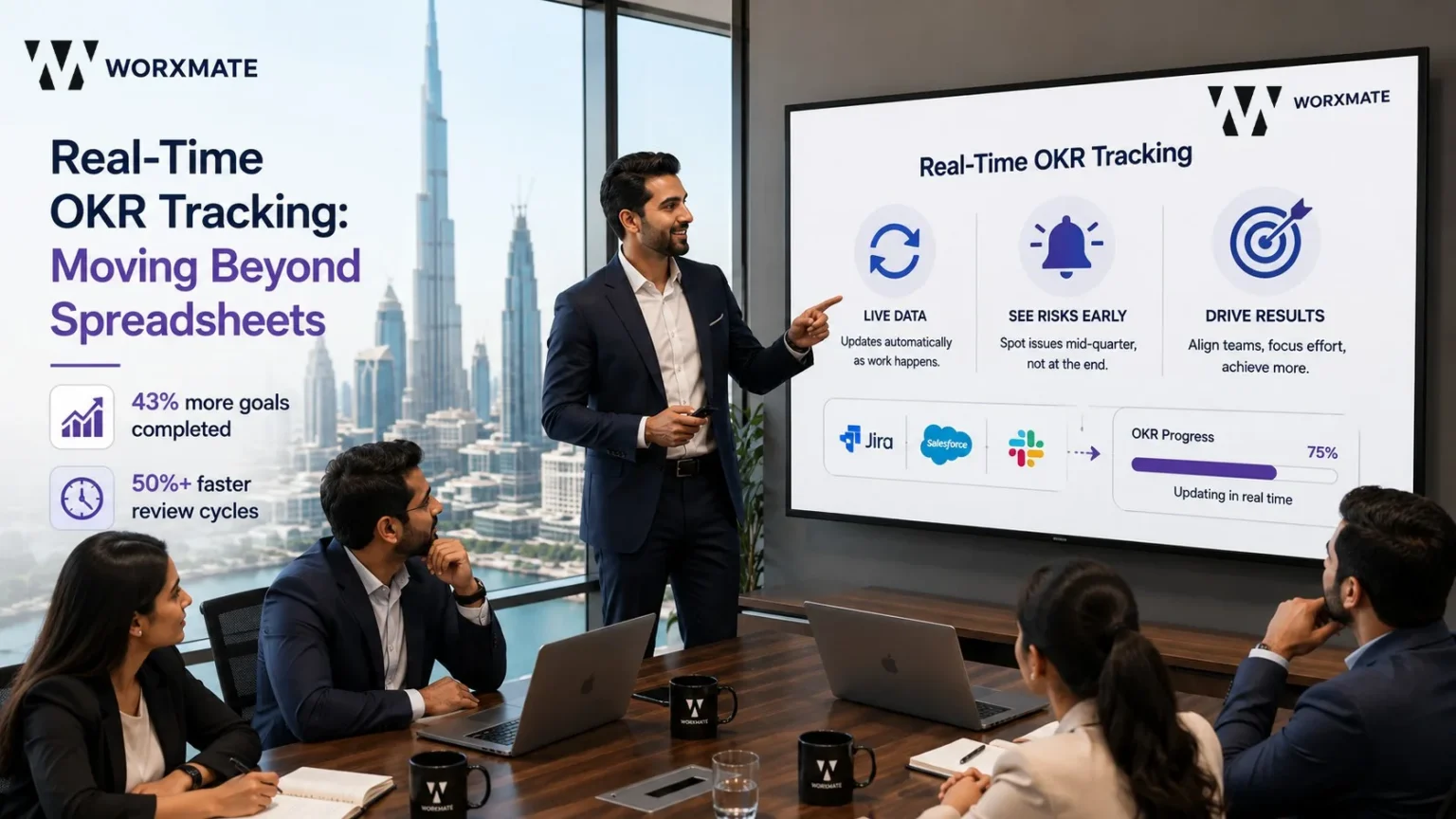
Real-time OKR tracking replaces manual spreadsheet updates with automated data pulled directly from tools like Jira, Salesforce, and Slack, so Key Results update as work happens instead of once a quarter. Teams using it complete 43% more goals and cut review-cycle time by more than half.
Moving beyond manual spreadsheets is essential for organizations that want to bridge the gap between strategy and execution. By leveraging automated data and AI-driven insights, companies can transform static goal documents into dynamic systems that drive measurable organizational growth. Real-time OKR tracking is the cornerstone of modern execution, yet 58% of organizations still rely on static spreadsheets to manage their performance. While spreadsheets are familiar and low-cost, they create a significant disconnect between planning and reality. Research indicates that 65% of startups fail to link their OKRs to company goals when using manual tracking methods. By the time a leader realizes a goal is off track in a shared file, the window for correction has often closed. The gap between strategy and execution in 2026 isn’t a failure of vision it’s a tracking problem that requires a transition to dynamic, data-driven systems.
Why Spreadsheets Fail for Real-time OKR Tracking
Spreadsheets are often the first tool companies reach for when beginning their goal-setting journey. They are accessible and flexible, but they are notoriously difficult to scale. As an organization grows, the “version control hell” of shared documents begins to undermine the very methodology OKRs are meant to support. When goals are hidden in hundreds of folders, they lose their status as a “North Star” and become a chore that employees only visit once a quarter.
For a full breakdown of every tracking method manual, hybrid, and automated see our complete guide to OKR tracking.
The lack of real-time visibility is perhaps the most damaging aspect of manual tracking. According to McKinsey, companies with robust performance management systems are 42% more likely to outperform their competitors. Spreadsheets, however, do not provide a “system” they provide a document. This distinction is critical because only 26% of employees currently have a clear understanding of how their individual work contributes to company goals. When tracking is manual, that transparency plummets further.
Consider the common pitfalls of spreadsheet-based management
-
Lack of Searchability
OKR documents frequently get lost in a sea of shared files, making it impossible for teams to reference them during daily decision-making.
-
Loss of Context
Spreadsheets rarely maintain historical data. When a cell is overwritten, the narrative of why a goal changed or why it stalled is lost forever.
-
The “OKR Nag” Syndrome
Without automation, managers must manually chase team members for updates, turning a strategic framework into a source of friction. In practice, this typically costs a manager three to four hours a week chasing status across teams time that should go toward coaching, not data collection.
-
Delayed Intervention
Because spreadsheets are updated sporadically, leaders often discover missed targets only during end-of-quarter reviews, when it is too late to pivot. This is the exact failure pattern inside a 70,000-person IT services organization: leadership teams sat through strategic reviews and MBRs with no real visibility into what was actually blocking execution, only realizing the problem once the quarter was already lost.
For leaders focused on strategic planning, the inability to see progress in real-time makes it nearly impossible to manage consistent measurement or maintain alignment across departments. This is precisely the gap that pushes most teams to begin a spreadsheet to OKR software migration in the first place.
What Real-time OKR Tracking Actually Means in 2026
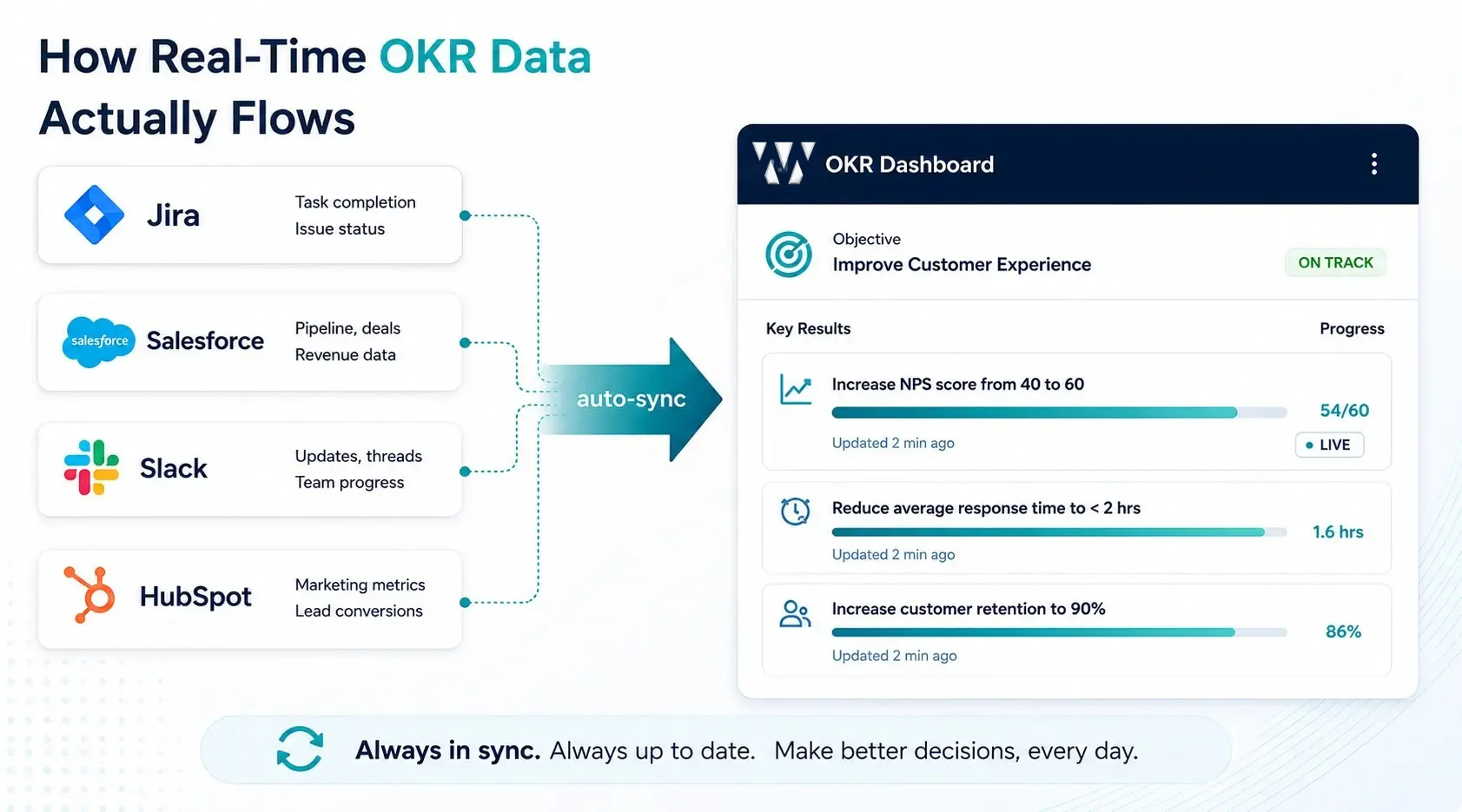
In the current business landscape, real-time OKR tracking is no longer just about having a dashboard that updates. It is about the deep integration of goals into the flow of work, visible through real-time performance dashboards rather than static exports. It means that when a developer closes a ticket in Jira or a salesperson closes a deal in Salesforce, the corresponding Key Result updates automatically. This creates a “living system” where the data is always fresh and actionable.
The transition from the “Old Way” to the “Real-Time Way” changes the fundamental rhythm of the organization:
| Old Way (Spreadsheets) | Real-Time OKR Tracking |
|---|---|
| Update spreadsheets weekly/monthly | Data pulls automatically from tools |
| Wait for quarter-end reviews | Spot risks mid-quarter via alerts |
| Hunt for status updates | Visibility by default for all users |
| Manual reporting for QBRs | One-click presentation generation |
| Disconnected tasks | Tasks linked directly to OKRs |
Picture a mid-size product team using automated OKR tracking: a Key Result reads “Reduce checkout errors from 4% to 1%.” Each time an engineer closes a related Jira ticket, the platform pulls that data and recalculates progress instantly. No one updates a cell. No one sends a Slack reminder asking for a percentage. The number simply reflects reality, and the number changes as reality changes. Under Worxmate’s DEEP AI framework, this is the Execute stage doing its job: automated check-ins and at-risk detection running quietly in the background so the team’s attention stays on the work, not the reporting.
 Organizations that embrace this shift see immediate behavioral changes. Teams that hold weekly check-ins—facilitated by real-time data—complete 43% more goals. Furthermore, end-of-cycle reviews improve success rates by 30-45% because the reviews are based on accurate, continuous data rather than end-of-quarter guesswork. For companies pursuing organizational growth, this level of visibility is the foundation of a high-performance culture.
The Core Capabilities of Real-time OKR Tracking Platforms
To move beyond the limitations of manual files, organizations are adopting dedicated OKR tracking tools. These platforms are designed to handle the complexity of cascading goals while keeping the user experience simple. Here are the five core capabilities that define a modern tracking environment:
-
Automated Progress Tracking
Instead of manual updates, modern platforms integrate with tools like Jira, Salesforce, HubSpot, and Slack. This ensures that progress velocity is calculated based on actual work completed, surfacing misalignment on the OKR dashboard before it compounds into missed targets.
-
Visualization of Trajectory
While a spreadsheet shows a static number, real-time OKR tracking shows trajectory. Seeing a goal at 80% is helpful, but seeing that it was 95% last week and is trending down allows a manager to intervene before the goal fails.
One completed OKR is worth more than five written ones.
This is why trajectory, not the raw completion percentage, is the number worth watching.
-
Automated Reminders and Check-ins
Modern platforms remove the “nagging” element by sending automated, contextual reminders. This fosters a healthy weekly OKR ritual where accountability is built into the software’s workflow.
-
Connected Tasks and Initiatives
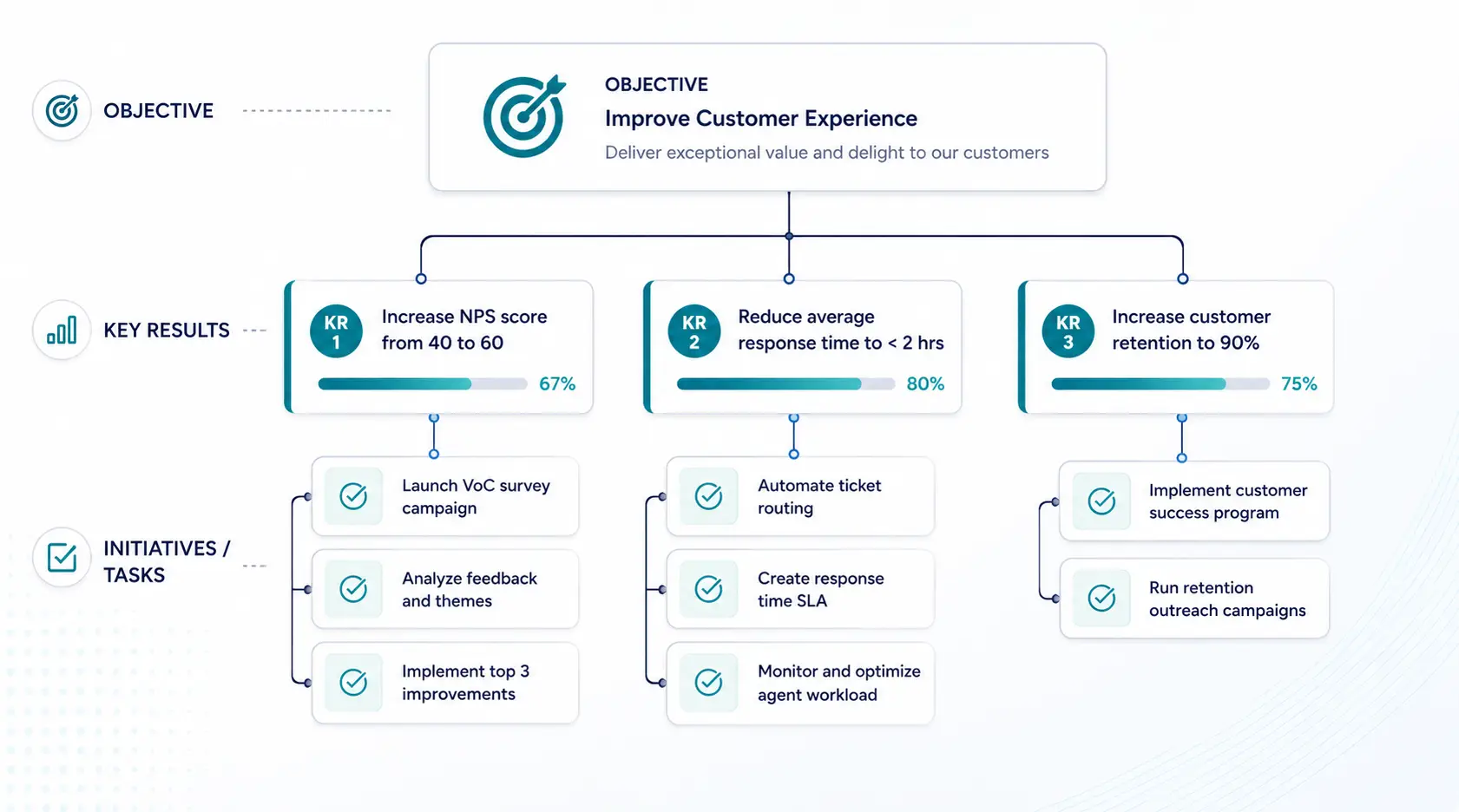
By using task management features within the OKR platform, teams can see exactly which daily activities are moving the needle. If progress lags, action items can be created immediately within the same context. This is also where the PMS-OKR Bridge matters: when tasks connect cleanly to Key Results, performance conversations later in the cycle are grounded in what actually moved the goal, not a manager’s memory of who seemed busy.
-
One-Click Reporting
Preparing for a quarterly business review (QBR) used to take days of manual data aggregation. Real-time systems generate presentation-ready reports instantly, providing leaders with accurate data and hours of reclaimed time.
Case Study: A Listed Financial Services Company Ends the “Blame the Data” Culture
A listed financial services company targeting aggressive multi-year revenue growth ran into a problem that had nothing to do with strategy and everything to do with visibility. Across more than 35 leaders, the pattern was the same: goals were missed, and the reason given, almost every time, was the IT team. Leaders described a lack of real-time data and analytics as the reason execution kept stalling treating IT as accountable for business outcomes it could only ever support, never own.
The Challenge:
The real issue wasn’t the data team. It was that nobody could see, in real time, which goals were actually pointed in the right direction. Leaders were operating on assumption, not visibility, and that gap had quietly hardened into a blame culture. Without a shared, current view of what was on track and what wasn’t, IT became the default explanation for every miss.
The Solution:
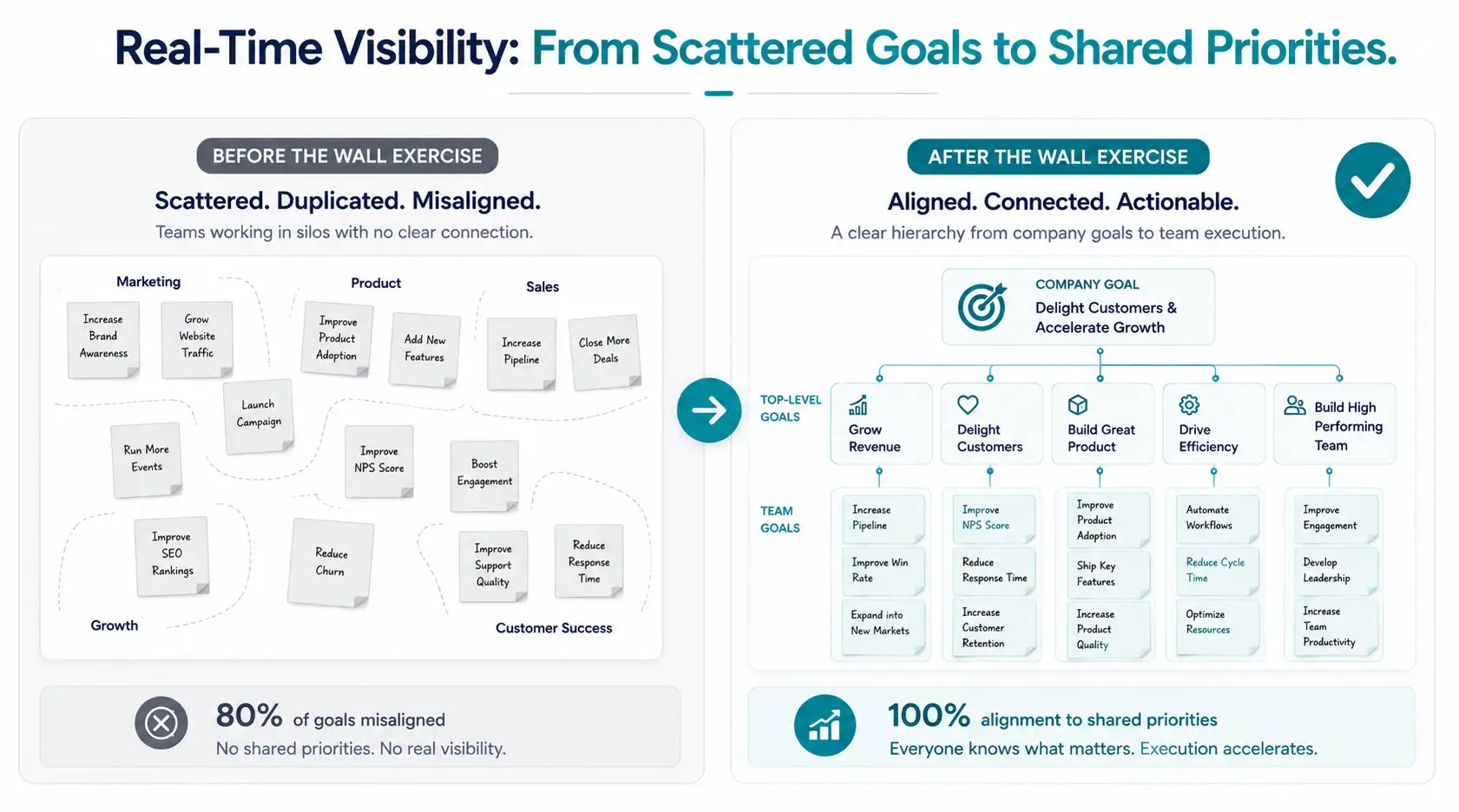
The turning point came from making the misalignment visible, all at once, in front of the room. Every leader wrote their current goals, their intended impact, and their challenges on sticky notes on a wall and the organization’s top leadership walked through every single one. The result was stark: roughly 80% of the goals on that wall weren’t designed in the right direction at all. Seeing that gap laid out in real time, rather than buried across dozens of separate documents, shifted leadership from surprise to conviction that a structured tracking system wasn’t optional it was necessary. From there, leadership groups were asked to agree on only 3–5 shared goals collectively, rather than cascading targets down from the top, which surfaced cross-functional dependencies organically instead of discovering them mid-quarter.
The Results:
- The IT blame culture disappeared entirely once ownership and visibility sat with the business, not the data team.
- Field sales teams identified the specific investment and marketing changes needed to drive 3X results.
- New territory entry was properly pre-planned with product positioning and marketing support in place before launch, not after.
- The organization moved from reactive firefighting to proactive execution at a level it hadn’t operated at before.
The lesson underneath this one is the same lesson spreadsheets teach the hard way: when nobody can see the real state of a goal, the blame lands on whoever’s easiest to point at. Real-time visibility doesn’t just catch a goal before it fails — it removes the argument about whose fault it was in the first place.
7 Reports Every Leader Needs in Real-Time
To effectively manage a modern workforce, leaders must move from intuition-based management to evidence-based leadership. According to research from Sprout and Gartner, there are seven critical reports that a real-time OKR tracking system should provide automatically:
- Real-Time Goal Alignment and OKR Progress Report: Measures the cascading alignment between strategic priorities and individual goals. Since only 12% of HR leaders conduct long-term strategic workforce planning, this visibility prevents misalignment from compounding.
- Continuous Feedback Frequency and Quality Report: Tracks the volume and sentiment of feedback. Given that 70% of team engagement variance is attributed to managers, regular feedback leads to 9% higher engagement.
- Performance Calibration and Ratings Distribution: Detects bias and inconsistency in reviews. With 41% of companies detecting manager bias, real-time calibration ensures high performers are recognized fairly.
- Predictive Attrition and Flight Risk Report: Uses behavioral signals to identify employees likely to exit within 6-12 months. Companies using these analytics see 15-25% lower voluntary turnover.
- Skills Gap and Workforce Capability Report: Maps current competencies against future needs. With 50% of today’s skills expected to be obsolete by 2027, this report is vital for long-term business goals.
- Manager Effectiveness and Team Performance Report: Analyzes how managers influence retention and performance. Investing in this development produces up to 28% improvement in performance metrics.
- DEI Performance Report: Monitors promotion rates and pay equity. Real-time data ensures that diversity and equity goals are met with the same rigor as financial targets.
These reports work best when they’re not static exports either. Worxmate’s Orbit AI, for instance, watches for six specific signals in this same real-time layer Burnout Risk, Attrition Trigger, Engagement Decline, Top Performer Flight Risk, Rating Inflation Drift, and Skills Decay so leaders see the pattern forming before it shows up in a quarterly report.
By leveraging these reports, leaders can ensure they understand employee satisfaction and performance trends before they impact the bottom line.
The Financial Case for Real-time OKR Tracking
The return on investment for moving beyond spreadsheets is supported by overwhelming data. When organizations implement a structured performance management system, the efficiency gains are felt across every department. For example, a 90-person startup that transitioned to a dedicated platform reported cutting their review cycle time by more than 50% while pushing goal completion rates above 90%.
The following table summarizes the typical improvements seen in core OKR tracking metrics when moving to real-time tracking:
| Metric | Improvement with Real-Time Tracking |
|---|---|
| Goal completion with weekly check-ins | +43% |
| Success rates with end-of-cycle reviews | +30-45% |
| Productivity vs. spreadsheet users | +25% |
| Likelihood to outperform competitors | +42% |
| Voluntary turnover reduction | -15-25% |
| Review cycle time savings | -50%+ |
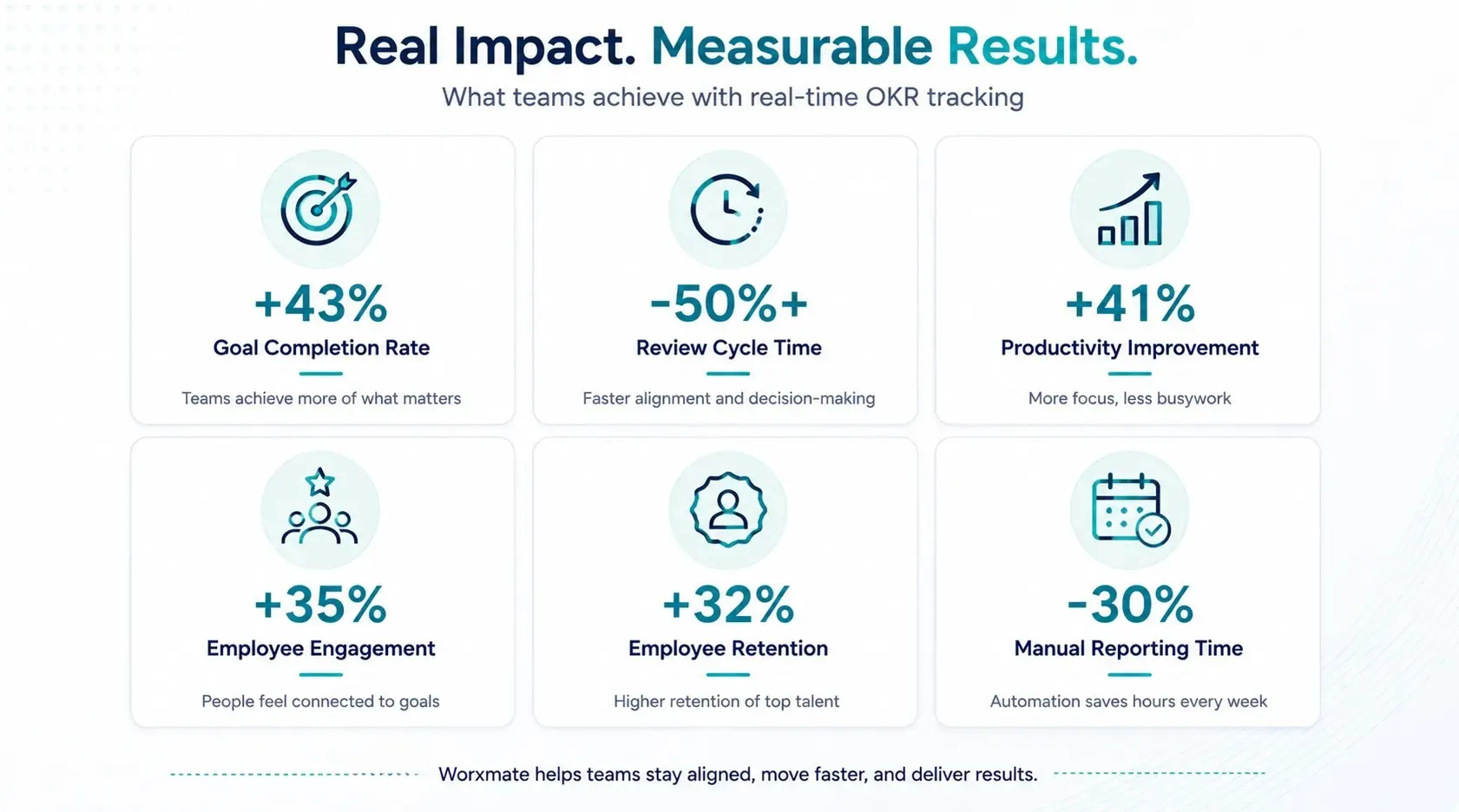
These figures demonstrate that real-time OKR tracking is not just an administrative upgrade it is a competitive advantage that directly impacts productivity and retention.
Common Transition Mistakes to Avoid
Despite the clear benefits, 7 out of 10 OKR implementations fail. The primary reason is the “set and forget” mentality, which real-time tracking is designed to solve but only if the transition is handled correctly. When moving away from spreadsheets, organizations often fall into the trap of over-complicating the new system or failing to integrate it into daily habits.
To ensure success, avoid these common mistakes:
-
Moving Everything at Once
Attempting to migrate every department simultaneously can overwhelm the organization. It is more effective to pilot the system with one team, prove the value, and then scale.
-
Ignoring Integration Needs
If the new platform doesn’t connect to the tools your team already uses, goals will remain disconnected from work. Real-time OKR tracking relies on seamless data flow from Jira, Slack, or CRMs.
-
Over-Customization
Many leaders try to replicate their complex spreadsheet formulas in the new platform. It is better to start simple, use the platform’s native logic, and iterate as adoption grows.
-
Neglecting Training
Adoption stalls when teams don’t understand the “why” behind the new tool. This is the exact moment coaching most often collapses see why OKR coaching fails after the workshop ends for the pattern. Invest in change management and OKR consulting to build the necessary habits.
By focusing on ease of use and consistent rituals, you can ensure that your transition to real-time OKR tracking leads to long-term success rather than platform fatigue.
How to Choose Your OKR Platform
The best tool is the one your team will actually use. A beautiful platform with 20% adoption is worthless, whereas a simple tool with 90% adoption drives transformative results. When evaluating options to replace existing tools or spreadsheets, use the following checklist:
If you’re still deciding between tracking approaches broadly, our OKR tracking guide covers the full decision framework—this section assumes you’re already leaning toward a real-time system.
- Integration: Does it connect to our existing stack (Slack, Jira, Salesforce)?
- Automation: Does it send reminders and update progress without manual entry?
- Visualization: Can we see trends and velocity, not just static status?
- Reporting: Can we generate QBR presentations with one click?
- Scalability: Will it work for 50 people as well as 500 or 5,000?
- Pricing: is it transparent and predictable for a growing company?
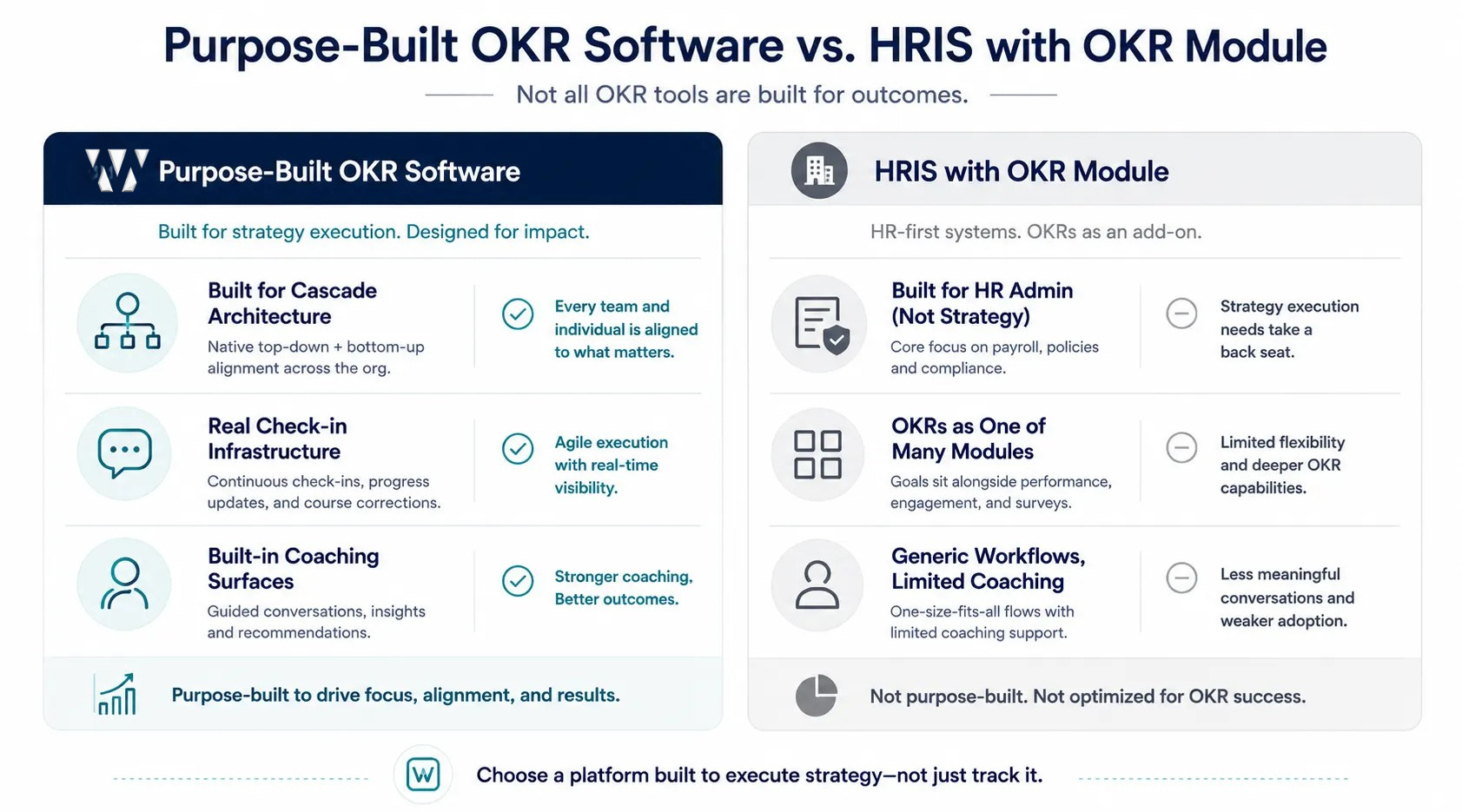
One category distinction is worth naming directly: an HRIS with an OKR module and a purpose-built OKR platform are not competing for the same job. HRIS systems are built around payroll, compliance, and core HR workflows OKRs are one feature among many. In a dedicated OKR platform, every part of the product exists to answer one question: is this making OKR execution better? That’s not a criticism of HRIS tools; it’s a category difference worth knowing before you buy.
 Reviewing OKR examples and success stories from similar industries can also help you determine which features are most critical for your specific organizational structure.
For more on the broader tracking landscape, explore Worxmate’s full collection of OKR articles.
The software here is the infrastructure it gives you the visibility this article has been describing. But visibility alone doesn’t fix a team that doesn’t know how to write an outcome-driven goal in the first place. If that’s the gap you’re looking at, that’s a coaching problem, not a software one, and worth a conversation with
OKR consulting before or alongside the platform switch.
Ready to accelerate your real-time OKR tracking journey? Book your Worxmate demo today and discover how our Performance Management software can transform your strategy into measurable results.


Written by
An OKR Coach with 20+ years of implementation experience, Madhusudan has guided over 50 organisations through successful OKR transformations, training more than 500 leaders. Learn more about Worxmate.