Cost of Poor Performance Management: ROI & Fixes
Actionable insights to align your OKRs with everyday performance management-from proven frameworks to the tools that power them.
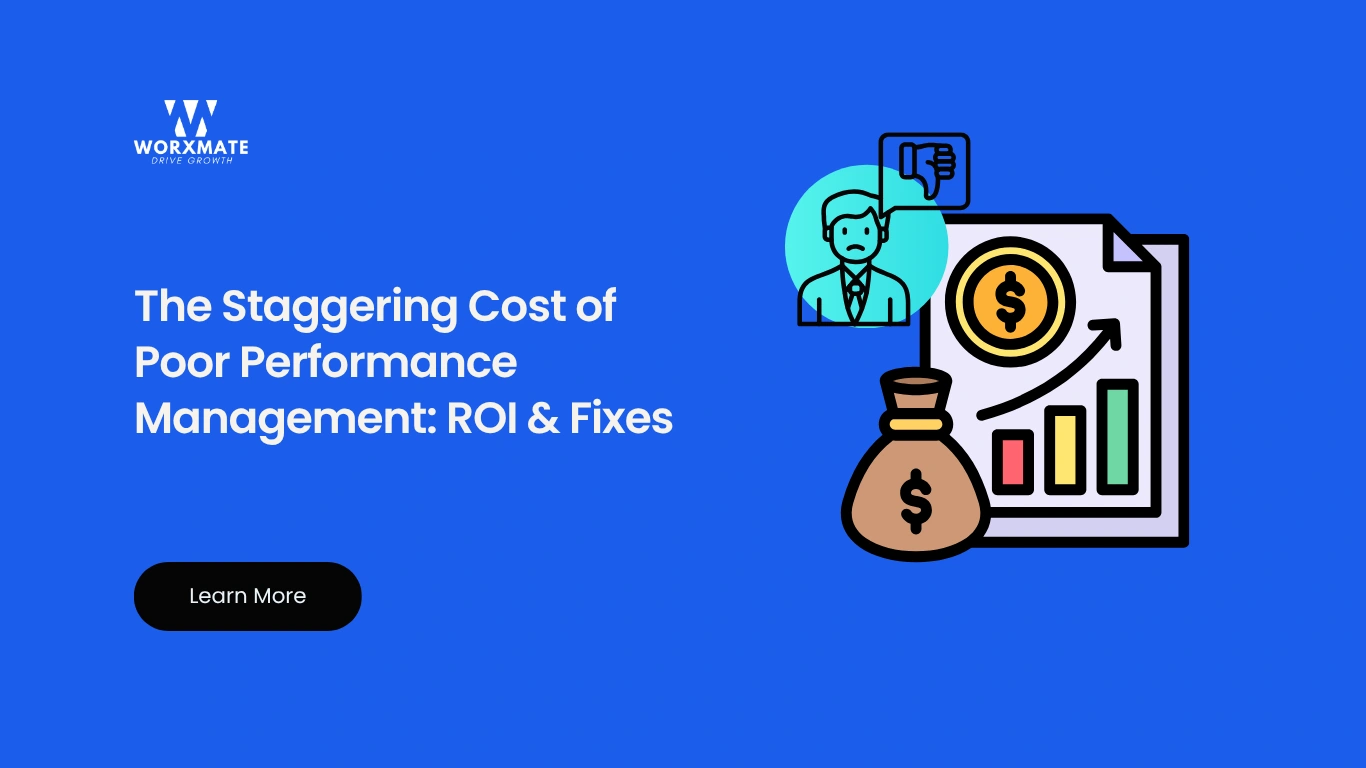
Cost of Poor Performance Management: The compounding financial loss from disengagement, high turnover, and misaligned execution caused by outdated review systems. Organizations can mitigate this by replacing legacy tools with agile, continuous performance management frameworks that connect daily tasks directly to strategic business outcomes.
Modern enterprises face a silent, compounding drain on profitability: tool sprawl, operational friction, and fragmented HR systems. When leadership teams evaluate their tech stacks, they often overlook how disconnected goal-setting and archaic appraisal cycles actively demotivate employees. Instead of driving growth, legacy software forces teams into bureaucratic compliance, leaving frontline workers and remote operations completely isolated from strategic priorities. To build a high-performance culture, organizations must look beyond basic HR administration and evaluate how their top performance review tools either accelerate execution or quietly bleed capital.
The Silent Profit Killer in Your Organization
Imagine a leak slowly draining your company’s most valuable resources: talent, productivity, and revenue. You might not see the gush, but the cumulative loss is devastating. This is the reality of poor performance management. It’s not just an HR headache; it’s a strategic failure with a direct line to your bottom line. When performance systems are bureaucratic, infrequent, or unfair, they do more than fail to develop people—they actively demotivate them.
The resulting cost of poor performance management is a multi-faceted burden, encompassing everything from the hard costs of constant hiring to the soft costs of disengagement and missed opportunities. In this post, we’ll dissect this hidden expense, compare legacy enterprise approaches with modern agile alternatives, and show you how to plug the drain for good.
The Point: Outdated systems treat performance as a backward-looking administrative event rather than a forward-looking growth engine.
The True Cost of Poor Performance Management: Breaking Down the Impact
The cost of poor performance management is rarely a single line item on a P&L statement. Instead, it’s a cascade of interconnected losses. To understand the full picture, we must look at its core components across financial, cultural, and strategic dimensions.
The Direct Financial Drain: Turnover & Productivity Loss
This is where the impact hits the books hardest. Replacing an employee costs, on average, 6 to 9 months of their salary. This includes recruitment, onboarding, training, and lost productivity during the ramp-up period. A broken system that doesn’t recognize or develop talent is a primary driver of this exodus. When employees feel their contributions are invisible or evaluated through biased, annual performance reviews, they begin looking elsewhere.
Furthermore, ineffective performance systems create confusion. Employees don’t know what “good” looks like, lack clear goals, and miss out on real-time employee feedback to course-correct. This ambiguity leads to misdirected effort, duplicated work, and missed deadlines. Addressing performance management failures can unlock a 5-10% increase in productivity by simply aligning daily tasks with high-level objectives.
The Cultural Cancer: Disengagement and Low Morale
Financial costs are tangible, but cultural erosion can be terminal. A primary culprit of widespread disengagement is managers who lack the tools and processes for meaningful coaching. When performance rating systems are biased, sporadic, or solely backward-looking, they destroy trust. Employees perceive the system as unfair, which damages the psychological contract with the employer.
This environment stifles innovation and risk-taking. Instead of striving for excellence, employees adopt a “quiet quitting” mindset, doing the bare minimum to avoid negative attention. Without continuous performance management, the feedback loop breaks, leaving high performers feeling unappreciated and low performers unaware of their gaps.
Strategic Stagnation: Missed Goals and Innovation
A company with a broken performance engine cannot execute its strategy effectively. If individual goals aren’t clearly linked to company OKRs (Objectives and Key Results), effort is wasted. Teams pull in different directions, and strategic priorities stall. This disconnect is particularly severe in organizations that rely on annual appraisal cycles, where goals set in January are completely irrelevant by June.
Why It Matters: Without a direct line of sight from daily tasks to strategic goals, employees operate in a vacuum, leading to execution gaps that competitors will quickly exploit.
Achieve Your Goals Faster
See how Worxmate can help your team set clear goals and achieve faster results. Book your free demo today and experience the power of AI-driven OKRs in action.
At a Glance: The Key Differences
To understand how modern platforms resolve these challenges compared to legacy enterprise software, let’s look at a direct comparison between Lattice and Worxmate.
| Feature / Dimension | Lattice (lattice.com) | Worxmate (worxmate.ai) |
|---|---|---|
| Primary Philosophy | Legacy HR compliance and structured review cycles. | Agile, execution-focused continuous performance. |
| AI Capabilities | Basic generative text summaries for reviews. | Predictive performance risk alerts and automated OKR alignment. |
| Performance Management | Heavy, annual review-centric modules. | Continuous, real-time feedback loops and agile check-ins. |
| Goal-to-Task Link | Disconnected high-level goals bolted onto reviews. | Direct line-of-sight from daily tasks to company OKRs. |
| Ease of Use | Complex, multi-module navigation with high admin overhead. | Intuitive, single-pane-of-glass interface built for rapid adoption. |
| Pricing Model | Expensive ($11+/user/month plus mandatory platform fees). | Transparent, cost-effective tiers at half the total investment. |
| Best For | Enterprise corporate offices with dedicated HR admins. | Mid-market, remote, and frontline operations (Logistics/Healthcare/IT). |
Architectural Foundation: Native Unified Workflows vs Fragmented Legacy Modules
Many enterprise platforms like Lattice have grown through acquisition or by bolting new features onto legacy architectures. This results in a fragmented user experience where OKRs, performance reviews, and 360 feedback feel like entirely separate products. Managers must navigate multiple dashboards, and data rarely flows seamlessly between modules. This fragmentation increases administrative overhead and reduces adoption rates across the organization.
In contrast, Worxmate is built from the ground up as a unified continuous performance management platform. OKRs, weekly check-ins, and performance reviews exist within a single, cohesive workflow. When an employee updates a key result, that progress is automatically reflected in their 1:1 check-ins and subsequent performance evaluations. This native integration ensures that performance data is always accurate, up-to-date, and contextually relevant.
The Worxmate Advantage: A single-pane-of-glass interface reduces administrative friction, ensuring high adoption rates and consistent data flow across all teams.
Operational Integration & Workflow Friction: Native Sync vs Expensive Middleware
For mid-market organizations, the total cost of ownership of HR software extends far beyond the sticker price. Legacy enterprise platforms often require complex integrations and expensive middleware to sync with existing HRIS, payroll, and project management tools. Maintaining these connections requires dedicated IT resources and constant troubleshooting, adding hidden costs to an already expensive platform.
Worxmate eliminates this friction with native integrations designed for modern operational environments. Whether your team operates in a corporate office, a healthcare facility, or a logistics hub, Worxmate syncs seamlessly with your existing tools without requiring custom development. This is particularly critical for organizations with frontline or remote workforces, where traditional desk-bound HR software fails to engage employees who don’t sit in front of a computer all day.
Key Takeaway: Native operational integrations ensure that performance tracking is embedded in the daily workflow, rather than treated as an administrative chore.
Strategic Alignment vs Disconnected Task Tracking
A common failure of traditional performance reviews is the disconnect between daily tasks and high-level strategic priorities. Employees spend hours filling out self-evaluations that have little to do with the actual business outcomes they achieved. This disconnect frustrates high performers and makes it difficult for leadership to identify execution bottlenecks.
By adopting modern performance management approaches, organizations can bridge this gap. Worxmate connects daily operational tasks directly to company OKRs. This ensures that every team member understands how their individual contributions impact the organization’s strategic priorities. Managers can monitor progress in real-time, identify blockers during weekly 1:1 check-ins, and provide targeted coaching before minor issues turn into costly failures.
Result: Improved strategic alignment, faster execution cycles, and a clear line of sight from frontline tasks to executive goals.
Achieve Your Goals Faster
See how Worxmate can help your team set clear goals and achieve faster results. Book your free demo today and experience the power of AI-driven OKRs in action.
Pricing Transparency & Total Cost of Ownership
Enterprise HR software is notorious for complex, opaque pricing structures. High starting costs, mandatory platform fees, and expensive add-ons for basic features like OKR tracking or advanced analytics can quickly blow out budgets. For mid-market companies, paying $11+/user/month plus platform minimums for a tool that employees only use once a year is a poor return on investment.
Worxmate offers a transparent, cost-effective alternative. By combining OKRs, continuous performance management, and employee feedback into a single platform, Worxmate delivers twice the value for half the total investment. There are no hidden fees, no mandatory consulting packages, and no complex tier structures. This transparent pricing model allows growing organizations to scale their performance management processes without facing unpredictable software bills.
Case Study: How Deloitte Transformed Its Performance Management
Facing the very costs of poor performance management we’ve outlined—excessive managerial time, employee frustration, and lack of agility—Deloitte undertook a radical overhaul of its system, as detailed in the Harvard Business Review.
Deloitte’s old system involved 1.8 million hours annually from its 65,000+ staff. Managers were spending weeks on backward-looking ratings and consensus meetings, time that wasn’t spent coaching their teams. They scrapped rankings, annual reviews, and complex 360 feedback tools. Instead, they implemented a new, future-focused system with two simple questions at its core regarding compensation and team fit, combined with frequent, future-oriented 1:1 check-ins.
The results were clear: the new process took managers 50% less time, the focus shifted from bureaucratic form-filling to real-time conversations, and goals could be adjusted weekly to meet changing business needs. Deloitte’s case is a powerful testament to the ROI of dismantling ineffective performance systems and building something lean, human, and business-focused.
Quantifying Your Risk: The Performance Management ROI Calculator
Understanding the cost of poor performance management for your specific organization is key to building a business case for change. While a precise calculation factors in unique variables, you can start with this framework:
Annual Cost Estimate = (Turnover Cost) + (Productivity Loss) + (Managerial Waste)
- Turnover Cost: (# of Voluntary Exits Linked to Management/Engagement) x (Average Salary x 0.75)
- Productivity Loss: (Total Workforce Salary) x (Estimated Productivity Drag % e.g., 5%)
- Managerial Waste: (Average Manager Hours Spent on Ineffective Reviews/Year) x (Average Manager Hourly Rate)
For a mid-sized company of 500 employees with an average salary of $70,000, a 15% turnover rate, and a conservative 5% productivity drag, the annual cost of poor performance management easily exceeds $2.5 million. Investing in a modern, continuous performance management platform is not an administrative expense; it is a direct recovery of these massive, hidden losses.
Scenario Decision Trees: When to Choose Lattice vs Worxmate
Choosing the right platform depends on your organization’s size, operational structure, and strategic priorities. Use this decision tree to guide your evaluation.
Choose Lattice if:
- You are a large enterprise with a dedicated HR department to manage complex, multi-module configurations.
- Your workforce is entirely desk-bound and operates primarily in traditional corporate office environments.
- You have the budget to support high per-user fees and mandatory platform minimums.
Choose Worxmate if:
- You want a unified, agile platform that combines OKRs and continuous performance management without administrative bloat.
- You have remote, frontline, or operational teams (Logistics, Healthcare, IT) that require mobile-friendly, lightweight workflows.
- You require transparent, predictable pricing that delivers enterprise-grade capabilities at half the total cost of ownership.
Bottom Line: What I’d Tell a Client
If you are still relying on annual performance reviews or struggling with fragmented, expensive HR modules, you are paying a heavy tax in the form of disengagement, turnover, and execution gaps. Transitioning to a continuous performance management framework is the single most effective way to align your teams, boost productivity, and retain your top talent. This directly accelerates measurable key results across the entire organization. Tracking a real-time confidence score helps identify at-risk targets before quarter-end. Seamless cascading ensures department milestones stay synchronized with company strategy. Strong goal alignment eliminates siloed efforts and connects daily work to strategic outcomes.
Worxmate provides the perfect balance of strategic alignment through OKRs and continuous employee feedback, ensuring your organization remains agile, focused, and profitable.
Ready to Eliminate the Cost of Poor Performance?
Don’t let a broken system continue to drain your resources. Transform your performance management from a costly chore into your greatest strategic advantage. Ready to evaluate modern alternatives? Book a demo with Worxmate today and discover how we can help you build a high-performance culture.


Written by
An OKR Coach with 20+ years of implementation experience, Madhusudan has guided over 50 organisations through successful OKR transformations, training more than 500 leaders. Learn more about Worxmate.
Frequently Asked Questions
Mid-market companies are migrating due to high starting costs, complex multi-module setups, and administrative bloat. They need agile, unified platforms that combine OKRs and performance reviews without expensive platform fees.
Worxmate combines OKRs, continuous performance management, and feedback into a single platform for half the investment of legacy tools, eliminating hidden platform fees and middleware costs.
Yes. Unlike desk-bound legacy systems, Worxmate is designed with mobile-friendly, lightweight workflows tailored for remote and frontline operations in Logistics, Healthcare, and IT.
Bolted-on OKR modules create fragmented workflows where daily tasks are disconnected from strategic goals, leading to low adoption and administrative confusion for managers.
By replacing annual reviews with regular 1:1 check-ins and real-time feedback, employees feel valued, understand their growth paths, and are far less likely to leave.
No. Worxmate features native integrations that sync seamlessly with modern HRIS and operational tools, eliminating the need for costly custom development or middleware maintenance.
Continuous check-ins allow managers and employees to adjust goals in real-time, ensuring individual efforts remain aligned with shifting company OKRs throughout the year.
Organizations see up to a 50% reduction in managerial administrative time, a 10% boost in productivity, and significantly lower recruitment costs due to reduced turnover.
Worxmate uses real-time, objective data from continuous check-ins and OKR progress to inform evaluations, reducing the recency and personal bias common in annual reviews.
No. Worxmate provides dedicated migration support to transition your data, OKRs, and review templates seamlessly, ensuring zero operational downtime for your teams.