25 Best Performance Management Software 2026, reviewed through the lens of business performance.
Not a feature checklist. Twenty-one platforms evaluated against the failures I watch repeat across every industry- from performer visibility to whether the software can tell you if your people are actually moving the business.

25 platforms, evaluated by what breaks in every HR conversation- not by the feature comparison.
Most performance management software gets evaluated by the wrong question
Does it run a smooth review cycle?" That's the wrong bar. I've sat across the table with 135+ HR leaders- across IT, fintech, pharma, retail, manufacturing, energy and SaaS- and the smooth-cycle question is almost never what's actually broken. This pattern shows up hardest in fast-scaling sectors: see how performance management for IT companies breaks down at scale.
The cycle runs fine. Self-assessments get submitted, managers complete their reviews, ratings get calibrated. What's broken is what those ratings mean. 80–90% of employees rate themselves 4 or higher out of 5. Managers give vague verbal feedback that never gets written down, then act surprised when conflict surfaces at calibration. HR ends up playing referee between manager and employee instead of running a system that produces real signal.
I come at this as an OKR Coach, 10+ years building strategy-execution systems, not performance-review systems. And that lens changes the entire evaluation criteria. A PMS that runs reviews well but can't tell you whether performance is actually moving the business is solving the wrong problem. The question isn't "can this software manage a review cycle." It's "can this software tell HR, in real time, who's driving the business forward, which skills are decaying, and where the next leadership gap is going to open up- without waiting for an annual cycle to surface it."
That's the bar I'm reviewing against.
Madhusudan Nayak - “Maddy”
Co-Founder & CEO, Worxmate · 20+ yrs Strategy Execution · 10+ yrs OKR implementation · 50+ organisations
Maddy brings 20+ years of Strategy Execution and 10+ years implementing OKR systems across 50+ organisations in IT, fintech, pharma, retail, manufacturing, energy and SaaS. This review is drawn from direct conversations with 135+ HR leaders throughout that experience- not from vendor briefings..
7 questions to evaluate any performance management platform
Forget feature checklists. If you're evaluating performance management software in 2026, evaluate it against the failures I see repeat, conversation after conversation, regardless of industry. Here's the framework I'd use. For the underlying numbers behind these questions, see this breakdown of performance management metrics.
Does it give HR performer visibility without depending on the manager?
Most platforms make HR wait for a manager's input to know who's excelling and who's at risk. That dependency is the single biggest reason HR reacts to performance problems instead of getting ahead of them. The tool should surface this signal independently.
Does it force feedback into a written, structured format- or tolerate vague and verbal?
The same pattern plays out across IT, gaming, fintech, manufacturing: managers give feedback verbally, it's never documented, and it resurfaces as a dispute at calibration that HR has to mediate. A platform that doesn't structure feedback in real time is just digitising the same conflict.
Does it connect skills data to L&D and IDP decisions- or are those still manager-suggested?
L&D budgets get spent on what a manager thinks needs attention, not what the data shows is actually declining or driving outcomes. If the platform can't show HR which skills move the needle, L&D stays a guessing game.
Does it treat PIPs as a development tool or a termination formality?
Most systems don't distinguish. The right platform should support PIPs as genuine improvement plans with tracked progress- not just a documented off-ramp.
Does it make 1:1s a tracked, structural part of the cycle- or an optional nice-to-have?
Orgs with no 1:1 culture are the ones where calibration produces the most surprises and the most conflict. If the platform treats 1:1s as optional, it's not solving the root problem.
Does it connect individual KRAs to business goals explicitly- or leave that to the employee?
This is the single biggest driver of disengagement and top-performer attrition I see across every industry. If KRAs sit disconnected from company objectives, performance management becomes a compliance exercise instead of a business lever.
Does it reduce rating bias structurally- or rely on calibration meetings to catch it after the fact?
By the time bias surfaces in a calibration meeting, the damage to trust is already done. The better question is whether the system catches drift in real time, before the conversation happens.
Run any tool on this list against these seven questions before you run it against a feature comparison. The feature comparison will look similar across most platforms. The answers to these questions won't.
Achieve Your Goals Faster
See how Worxmate can help your team set clear goals and achieve faster results. Book your free demo today and experience the power of AI-driven OKRs in action.
The best performance management software for 2026
Each evaluated against the same seven questions — through the lens of business performance, not review administration. If you're specifically shortlisting for the Indian market, see our focused ranking of the best performance management software in India. Comparing regionally? We also cover the top performance management software for USA teams and the continuous feedback tools UK buyers shortlist most often.
| Rank | Tools | Best For | Starting Price | Rating | Company Size |
|---|---|---|---|---|---|
| 01 | Worxmate ★ Editor's Choice | Mid-enterprises treating PMS as business execution | Custom (demo-based) | 4.8/5 | Mid-to-Enterprise |
| 02 | Workday Performance & Talent | Large enterprises on Workday HCM | Custom/quote | 4.2/5 | Enterprise |
| 03 | SAP SuccessFactors | Global enterprises, complex compliance, SAP ecosystem | ₹339/mo | 4.1/5 | Enterprise |
| 04 | Oracle Fusion Cloud HCM | Multinationals on Oracle ERP | $4–$9/employee/mo | 4.1/5 | Enterprise |
| 05 | PeopleFluent (with Reflektive) | Global enterprises wanting full talent suite + continuous feedback | Custom/quote | 4.2/5 | Enterprise |
| 06 | Betterworks | Enterprise/high-growth continuous performance enablement | Custom | 4.3/5 | Enterprise |
| 07 | Lattice | Mid-market performance + career development | $10/seat/mo | 4.7/5 | Mid-market |
| 08 | Leapsome | Scaling mid-market, all-in-one people platform | $7/user/mo | 4.8/5 | Mid-market |
| 09 | Culture Amp | Engagement-first, performance as secondary layer | Custom | 4.5/5 | Mid-to-Enterprise |
| 10 | Learn Amp | Scaling mid-market wanting learning + performance connected | From $46/user/yr | 4.6/5 | Mid-to-Enterprise/td> |
| 11 | 15Five | Manager-led weekly check-in culture | ~$11–16/user/mo | 4.6/5 | Small business |
| 12 | Engagedly | Broad feature set at accessible price | From $5/user/mo | 4.6/5 | Mid-market |
| 13 | PerformYard | Flexible, easy-to-use review workflows | $5–10/user/mo | 4.6/5 | Mid-market |
| 14 | Workleap | AI Manager Agent, engagement + performance | $4,999/yr | 4.2/5 | Small to Mid-market |
| 15 | Eletive | Behavioural-science engagement (Europe-focused) | Custom | 4.5/5 | Mid-to-Enterprise |
| 16 | Microsoft Viva Glint | Enterprise engagement listening on M365 | $6–12/user/mo | 4.6/5 | Enterprise |
| 17 | Qualtrics EmployeeXM | Research-grade people analytics | Custom | 4.4/5 | Enterprise |
| 18 | Bonusly | Peer recognition (not full PMS) | From $5/user/mo | 4.7/5 | Small to Mid-market |
| 19 | BambooHR | All-in-one HRIS with performance module | $10–25/employee/mo | 4.4/5 | Small to Mid-market |
| 20 | ThriveSparrow | All-in-one SMB performance + engagement | $5/user/mo | 4.4/5 | Small to Mid-market |
| 21 | Effy AI | Fast, low-overhead reviews, no HR function needed | $3/seat/mo | 4.8/5 | Small to Mid-market |
| 22 | PeopleGoal | SMBs wanting configurable, budget-friendly PMS | $4/user/mo | 4.5/5 | Small to Mid-market |
| 23 | Keka | Indian/APAC HRMS with performance + payroll | ₹9,999/mo (100 emp.) | 4.4/5 | Mid-market |
| 24 | Darwinbox | Indian/APAC enterprise HCM suite | Custom/quote | 4.4/5 | Enterprise |
| 25 | Actus | UK small-to-enterprise, appraisal replacement + local support | £3/user/mo | 4.7/5 | Small to Enterprise (UK) |
Ratings reflect a synthesis of public review platforms and direct HR-leader feedback as of July 2026. Pricing is publicly listed where available; many enterprise tiers are quote-based.
Worxmate
Best for: Mid-to-large enterprises ready to treat performance management as a business execution system, not a compliance exercise.
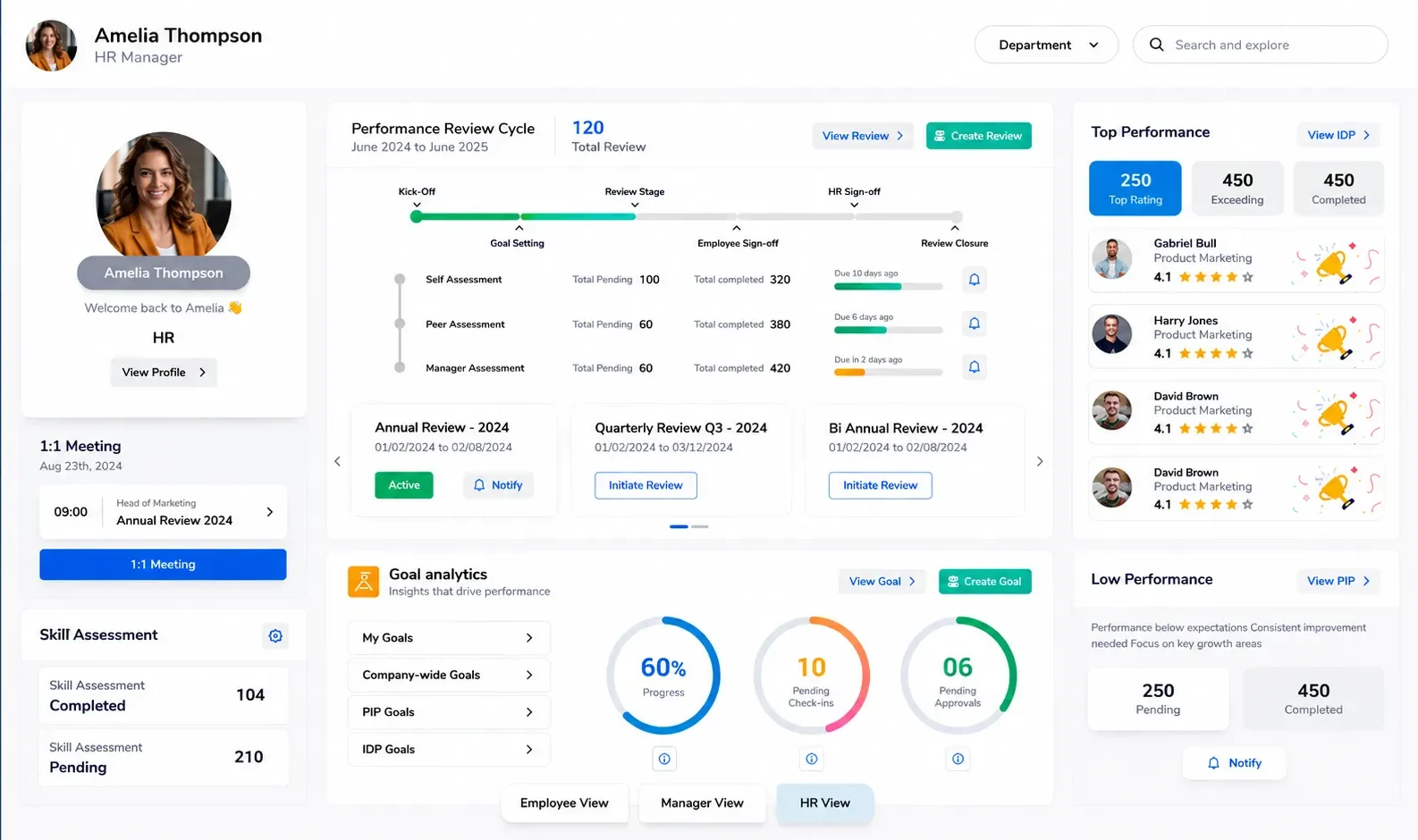
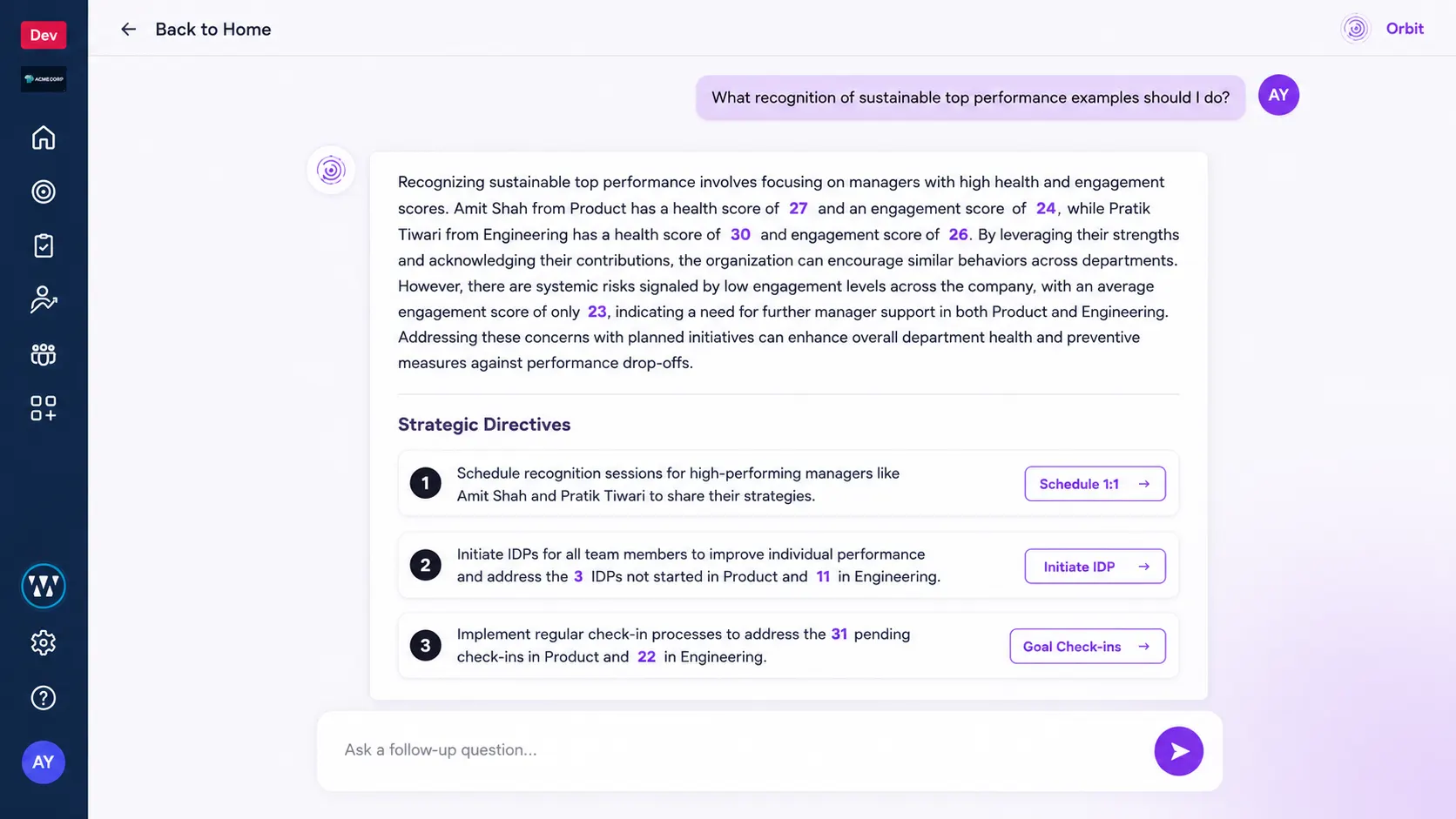
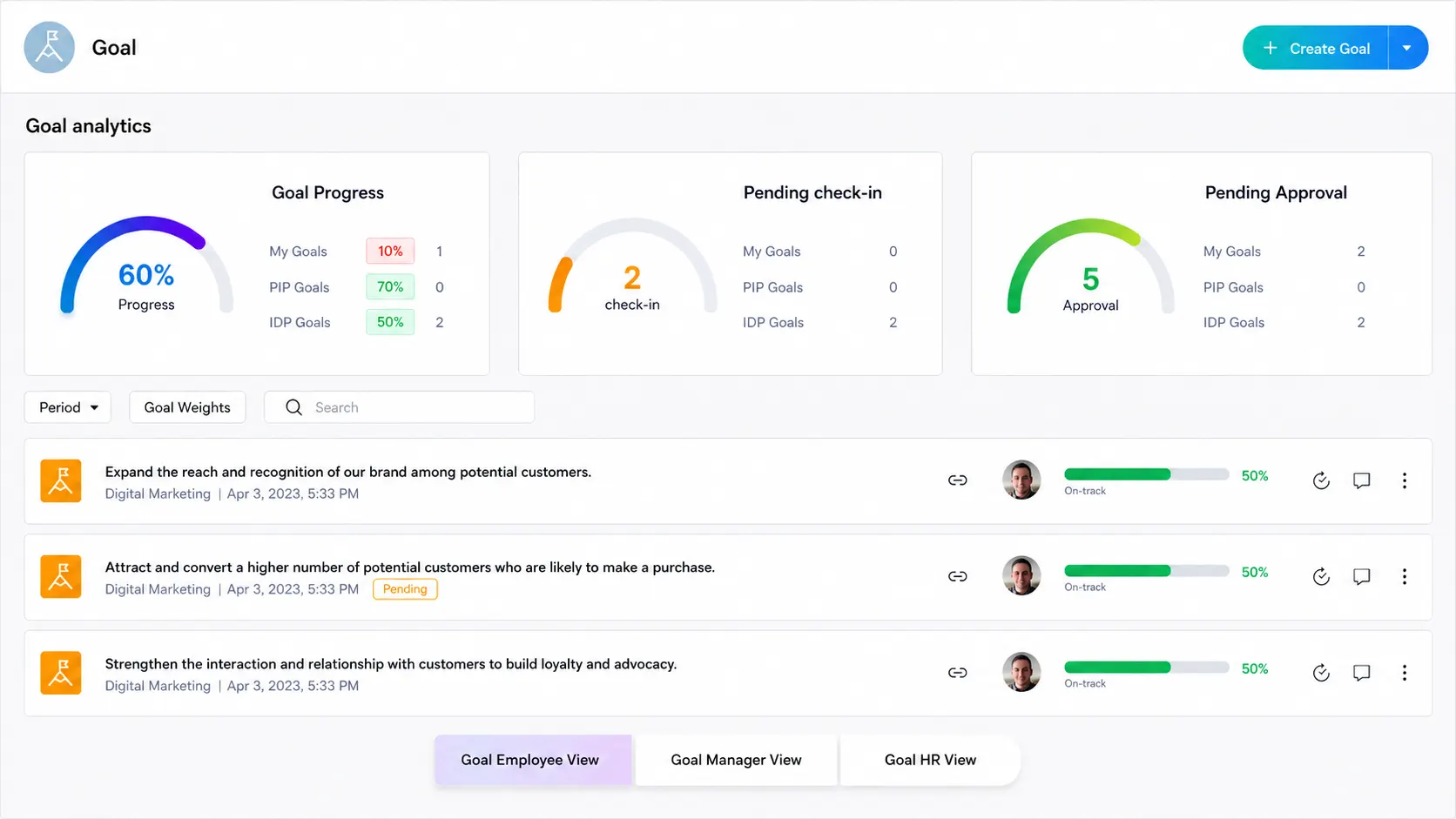
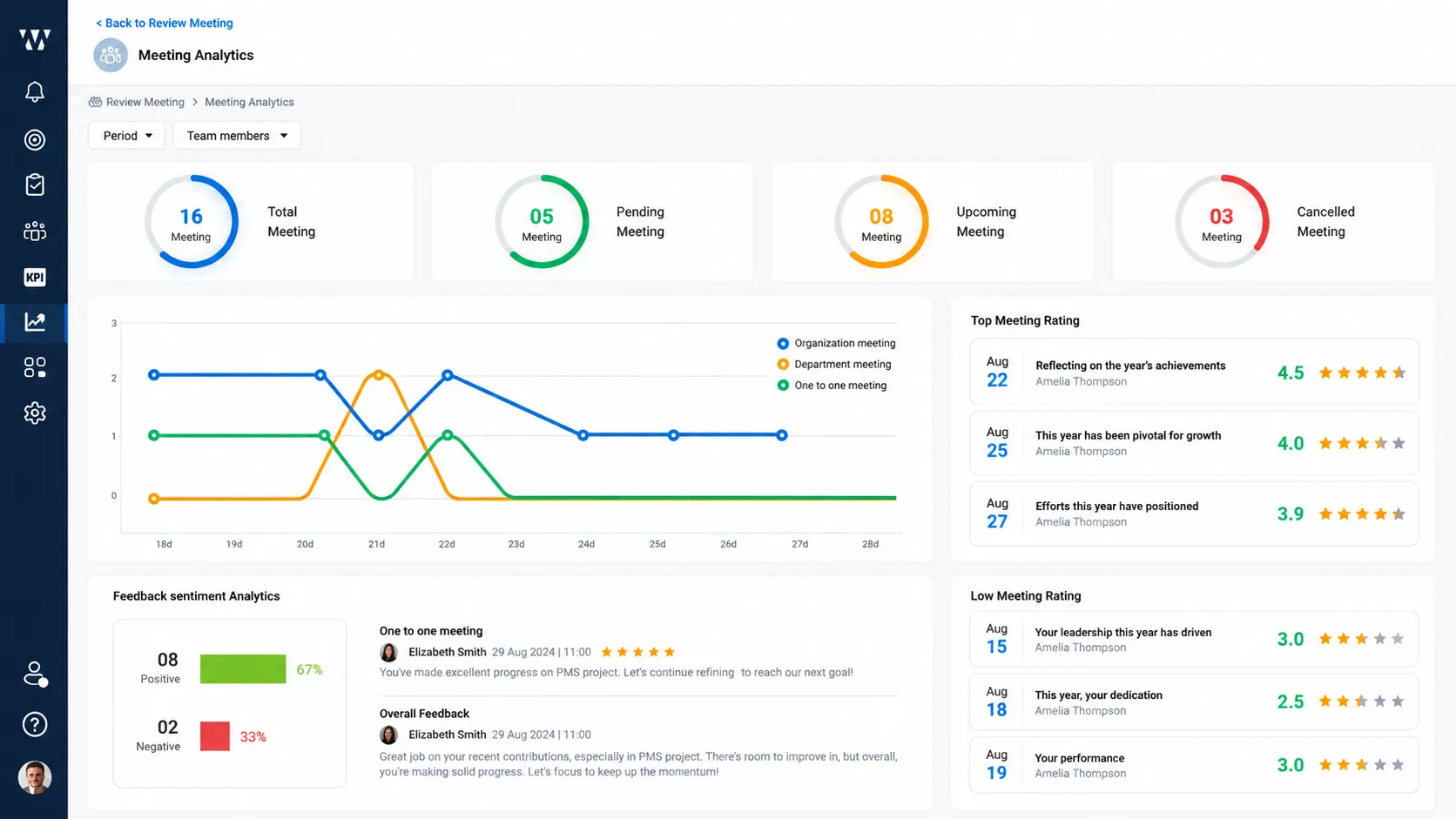
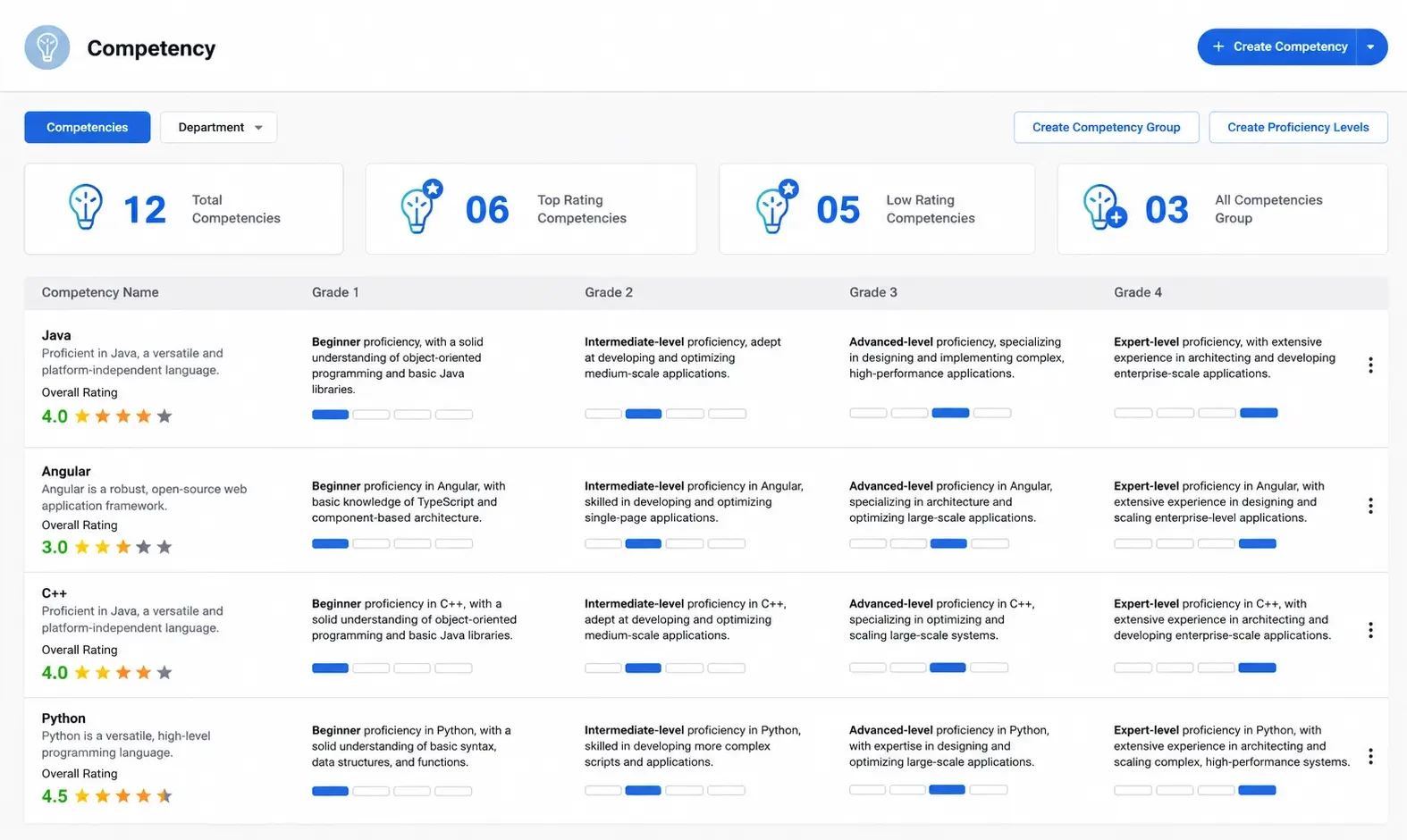
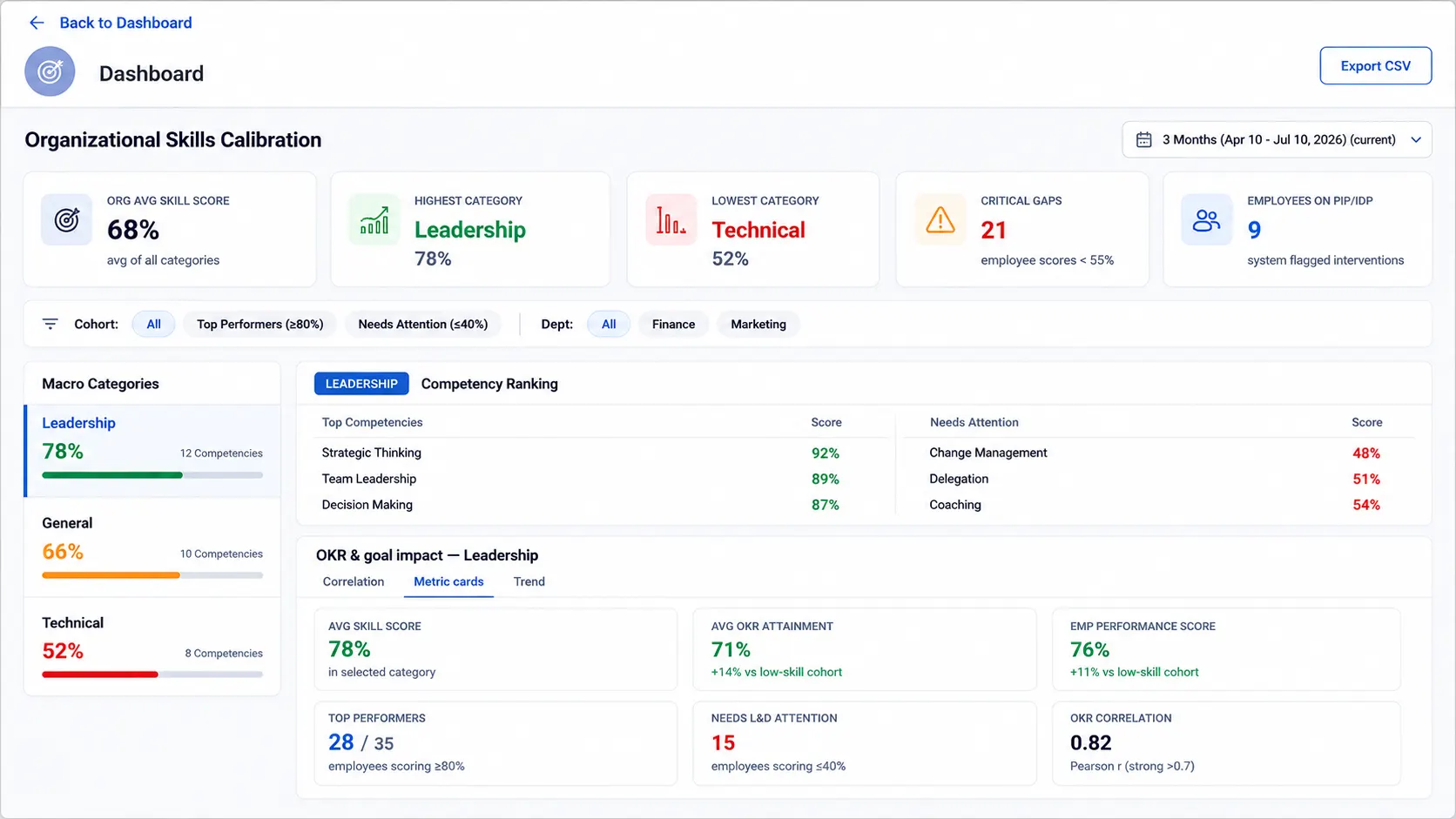
Worxmate is the only platform on this list I can speak to from the inside, and the context matters. It was built after conversations with 135+ HR leaders across fintech, pharma, retail, manufacturing, energy and SaaS- not from a product roadmap someone built in a boardroom. Every structural decision maps back to a failure pattern I watched repeat, regardless of what the company sold or which industry it sat in.
HR gets a live read on who's excelling and who's at risk- without depending on a manager's input or a review cycle. A fundamentally different architecture, not a feature.
Structurally prevents the vague-and-verbal problem by capturing feedback in written, documented form within the flow of work- not as an optional input before calibration.
Skills data drives the recommendation- not a manager's gut sense of what someone needs.
Treated as genuine improvement plans with tracked progress and visible milestones- not a documented off-ramp. That distinction is where the stigma comes from.
A tracked, mandatory part of the cycle- not something that depends on manager discretion or organisational culture to happen.
KRAs are explicitly connected to business objectives through the same DEEP AI framework that powers the OKR product- so "doing the job" versus "moving the business" is visible, not assumed.
The Third Eye layer monitors rating drift and self-assessment friction in real time- before the rating locks, not at the calibration meeting after the damage to trust is done.
Every platform on this list manages performance. Very few connect it to business execution. Here's what I've seen consistently: performance-management programmes run in one lane, OKR programmes run in another, and the two never formally meet. HR tracks who's completing reviews. Strategy tracks whether the business is hitting its goals. Nobody is tracking whether the people delivering the work are actually moving the objectives that matter.
Worxmate closes that gap structurally through its OKR software running on the same platform as performance management, a manager's 1:1 isn't just a check-in on how someone feels- it's visible against whether their key results are on track. A skills gap in a review isn't just an IDP recommendation- it's a signal that a business objective may be at risk. An attrition trigger isn't just an HR alert- it's a strategy risk.
Answers the question every CHRO wants answered but can't today: what is actually happening with my people, right now, without waiting for a manager to tell me? It surfaces early-warning signals across six patterns.
Where Orbit watches people, Axis watches the business-performance connection. It links individual KRA performance to OKR progress at team and org level- so HR can see that a team's goal attainment is declining at the same time two critical key results are at risk, and connect those dots before a missed quarter. L&D stops being gut-feel.
Operates at the cross-team, cross-function level no individual conversation could surface. Where are the accountability gaps across levels? Which dependencies are creating bottlenecks? The tiered accountability design- 100% at senior leadership, 40% at mid-management, 20% at operational- requires exactly the org-wide intelligence Nexus surfaces.
Worxmate is not the right fit if your organisation is at the early stage of formalising performance management for the first time and needs a lightweight, low-overhead setup. The platform's depth is its strength- and that depth requires an org that's ready to use it. If your current state is "we need to run reviews consistently," there are simpler tools on this list Effy AI, ThriveSparrow, or PeopleGoal — that get you there faster.
I didn't design Worxmate to win a feature comparison. I designed it to answer the question I kept hearing from HR leaders who had already bought a platform and still had the same problems. That's what builds a genuine high performance culture — not a single review cycle.
Workday Performance & Talent Management

Feedback capture is genuine. Managers and employees can give, request and document feedback in the flow of work, and it lands on the employee's profile rather than disappearing into a verbal exchange that resurfaces as a dispute at calibration. The Skills Cloud adds real depth for orgs willing to invest in it, and the AI coaching layer for managers is a meaningful step toward structured 1:1 culture. Goal management allows updates throughout the cycle rather than locking at the start- a small thing that matters considerably in fast-moving environments.
Performer visibility is still cycle-dependent- HR isn't getting a live read between quarterly check-ins. 1:1s are recommended structure tied to goal updates, not a tracked, enforced default. The Skills Cloud and AI coaching layer are separate purchase decisions. KRA-to-business-goal linkage depends entirely on how cleanly the org configures cascading. And critically, there's no real-time bias correction before calibration- the platform relies on the meeting itself to surface inconsistency, by which point the damage to trust is often done.
If your org already runs on Workday and consolidation is the primary driver, this is defensible. But it's solving for centralisation and compliance, not for the real-time signal that prevents the conflict-at-calibration problem. If you're buying Workday specifically to fix performance management, you'll spend a significant implementation budget to arrive at outcomes a purpose-built platform delivers on day one. Worxmate's outcome-driven approach gives you real business results without expensive implementation- going beyond Workday's generic capabilities.
SAP SuccessFactors Performance & Goals
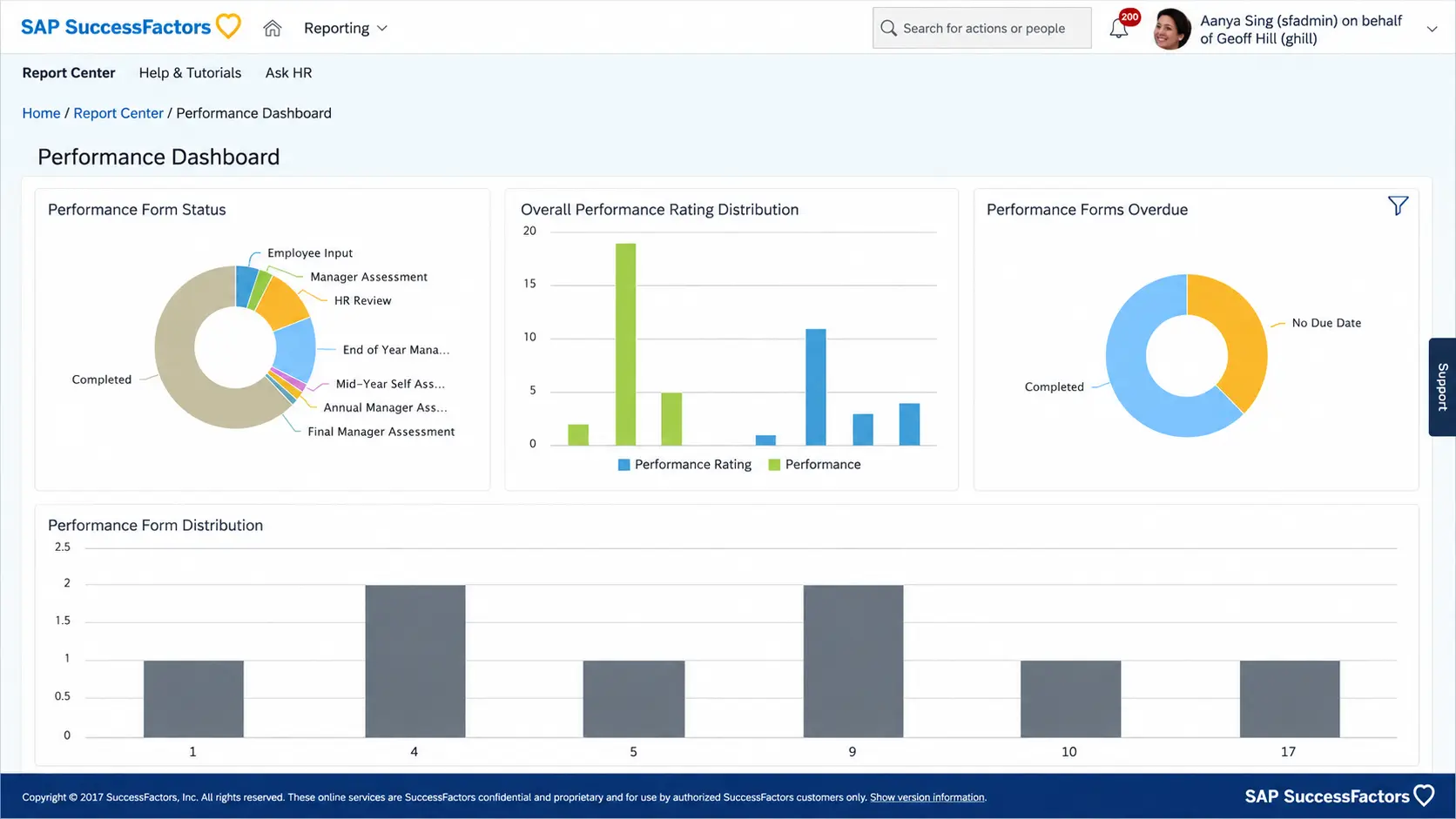
SuccessFactors has invested in the bias problem more directly than most. The Calibration module visualises which managers are rating harder or easier than their peers and flags it before ratings lock- closer to structural bias correction than the "catch it afterward" approach most tools take. The AI writing assistant, Joule, pushes managers toward specific, evidence-based comments rather than generic commentary. Goal management supports cascading from organisational to individual level with flexible alignment and weighting.
This is a module inside a much larger HCM suite, and everything that means comes with it- specialised consulting, extended timelines, heavy configuration before it's usable for a mid-sized HR team. Performer visibility is still largely manager-fed even with the AI layer. Skills intelligence is only as good as data hygiene most orgs don't maintain. PIP and IDP workflows sit wherever the org configures them, baking inconsistency in. The business-outcome link is left entirely to the goal cascade.
Strong for large, compliance-driven enterprises that need global coverage and already run SAP. Not the right answer if you want a fast, opinionated solution to the patterns that surface in every HR conversation. The platform will do what you configure it to do- it just won't tell you what to configure, and that distinction matters more than most buyers realise until they're eighteen months into an implementation.
Oracle Fusion Cloud HCM
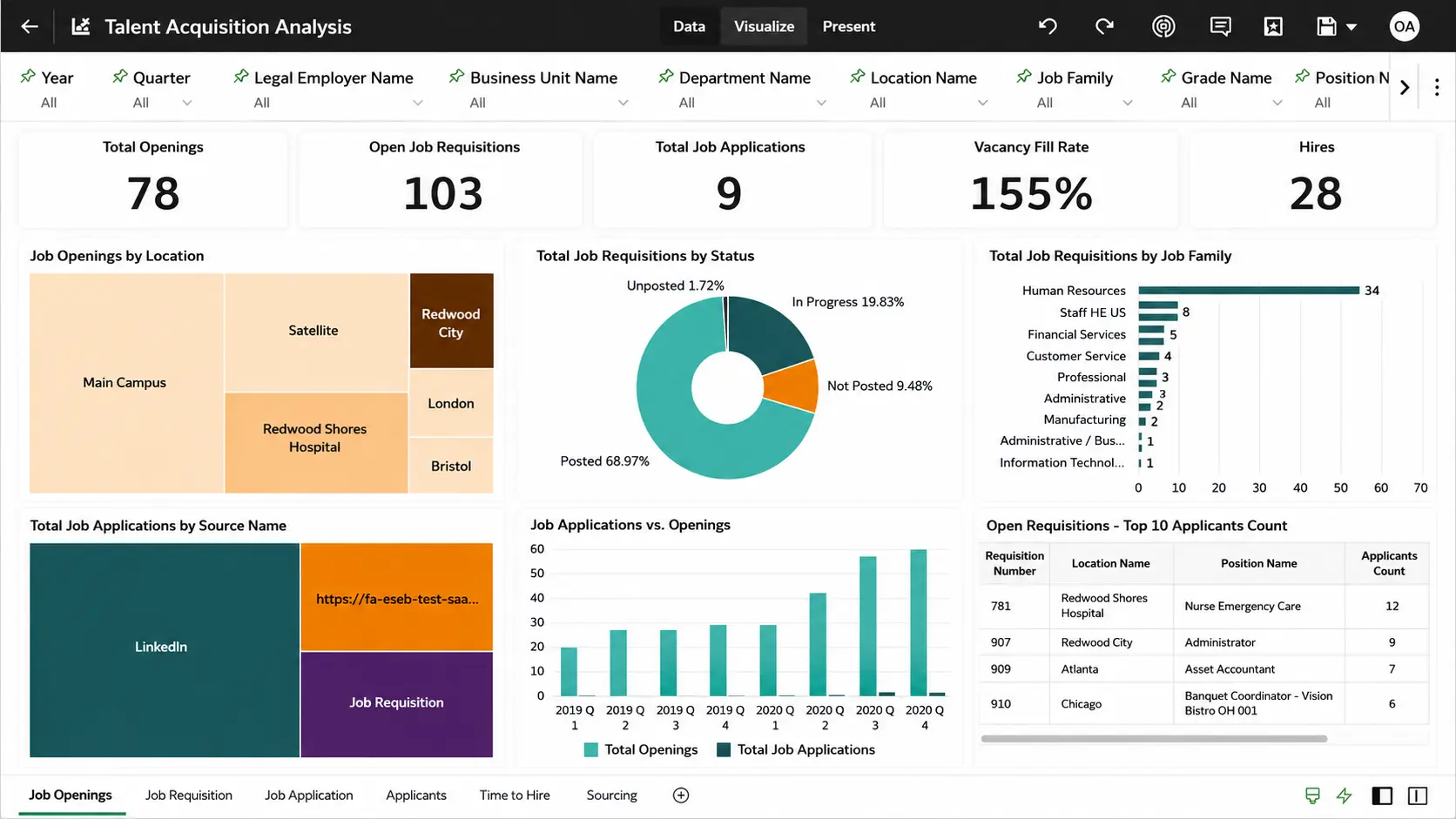
Oracle's most interesting recent move is Manager Edge- an AI coaching assistant launched mid-2026 that pulls from goals, feedback, reviews and team-interaction data to give managers real-time, in-context coaching nudges inside Slack and Teams. That's a direct answer to one of the patterns I see most: managers without the bandwidth to coach well, so feedback stays generic and 1:1s get skipped. The global payroll footprint- native coverage across 60 countries- is a genuine differentiator, and the analytics layer is deep, with over 1,000 embedded KPIs.
The core Performance module is built around Performance Documents- template-driven review artifacts, a fundamentally administrative model rather than a continuous-intelligence one. HR performer visibility is still review-cycle-dependent. Setup complexity is real and well-documented. Manager Edge is promising but brand new, and the rest of the platform hasn't caught up to that ambition. Pricing is entirely quote-based with no published tiers, which makes total cost hard to model before you're deep in a sales conversation.
Oracle is right if you're a large multinational already standardised on Oracle Cloud ERP and the single data model across HR and finance is the business case. Not the right choice if you're buying it to solve real-time performer visibility, bias correction or business-outcome linkage. Watch Manager Edge- it's solving a real problem- but I'd want to see it run through a full cycle before recommending it as a cornerstone.
PeopleFluent (with Reflektive)
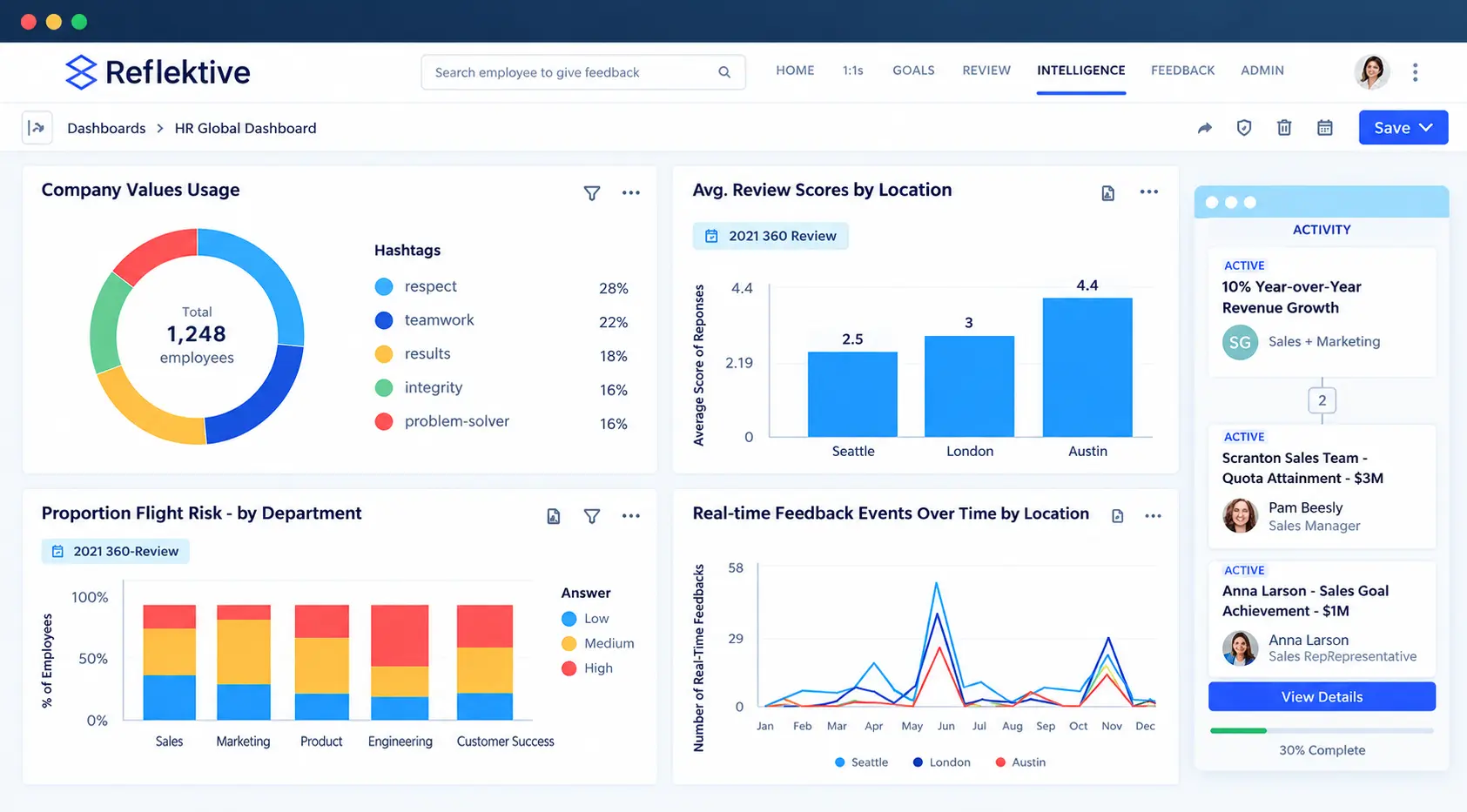
PeopleFluent's parent company, Learning Technologies Group, acquired Reflektive in 2021 and folded its continuous feedback, 1:1s, employee recognition, and collaborative goal/OKR alignment into PeopleFluent's broader talent-management portfolio — applicant tracking, onboarding, succession planning, compensation management and learning. That combination gives HR one system of record spanning the full employee lifecycle rather than performance sitting in isolation, which is genuinely useful for enterprises that want one vendor for the whole talent stack.
Since the Reflektive integration, the standalone product's public innovation cadence has slowed relative to purpose-built performance platforms. Performer visibility is still manager- and cycle-dependent. There's no structural, real-time bias-correction layer comparable to SuccessFactors' calibration module or Betterworks' demographic overlays, and KRA-to-business-goal linkage depends entirely on how cleanly the succession, comp and goals modules are configured against each other.
Reasonable if you're already invested in the broader PeopleFluent/LTG talent ecosystem for recruiting and succession planning and want Reflektive's feedback and 1:1 layer bundled in. If performance intelligence — not talent-suite breadth — is the primary buying driver, a platform purpose-built for that question, like Worxmate's performance management software, answers the seven framework questions more directly.
Betterworks
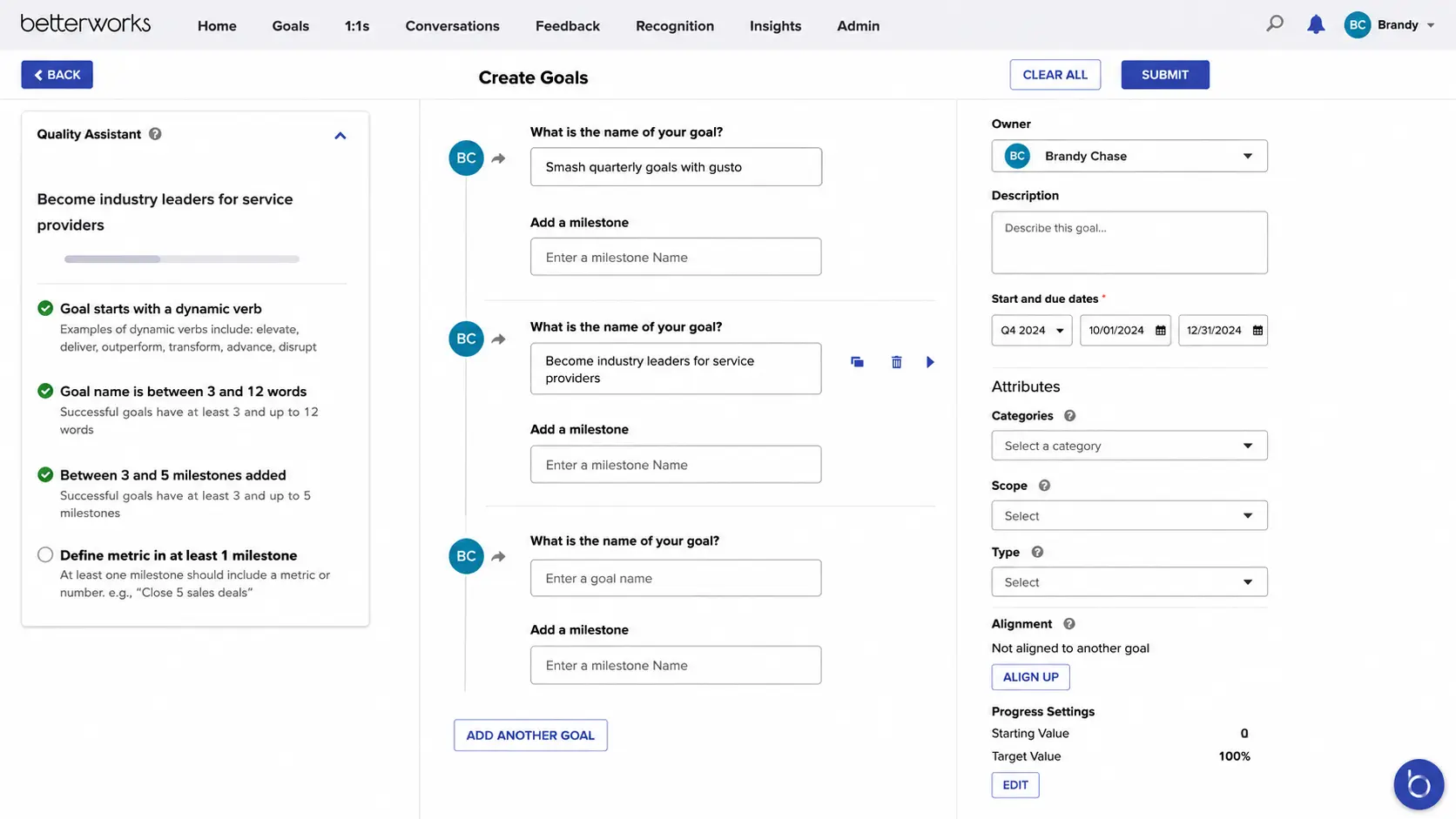
Betterworks is the strongest best-of-breed competitor on this list, and I want to be direct about that. The calibration rebuild in Spring 2026 is genuinely well-designed- it runs from live performance data, skills signals, goals and feedback pulled into a Unified Talent Profile present in the calibration session itself, not a static sheet assembled the week before. Calibration grids support demographic overlays so committees can catch bias patterns before ratings lock. The Manager Command Center gives leadership consolidated visibility without waiting on a reporting cycle. Integration into the flow of daily work- Slack, Teams, Jira, Salesforce, Gmail- is as deep as any platform here.
Betterworks is explicit that it's not built for organisations under 500 employees. Goal-alignment setup is a recurring complaint for complex and matrixed structures. Skills intelligence is AI-inferred from work data- stronger than gut-feel, but still not explicitly tied to a business-outcome model. And the platform still catches bias at the session level rather than monitoring drift continuously before calibration begins.
If I were advising an enterprise client set on best-of-breed and the primary criteria were calibration quality, manager visibility and daily-workflow integration, Betterworks would be in the final round. The gap it leaves is the one an OKR coach notices most: connecting people performance to business execution as a structural default rather than something the org builds on top manually.
Lattice
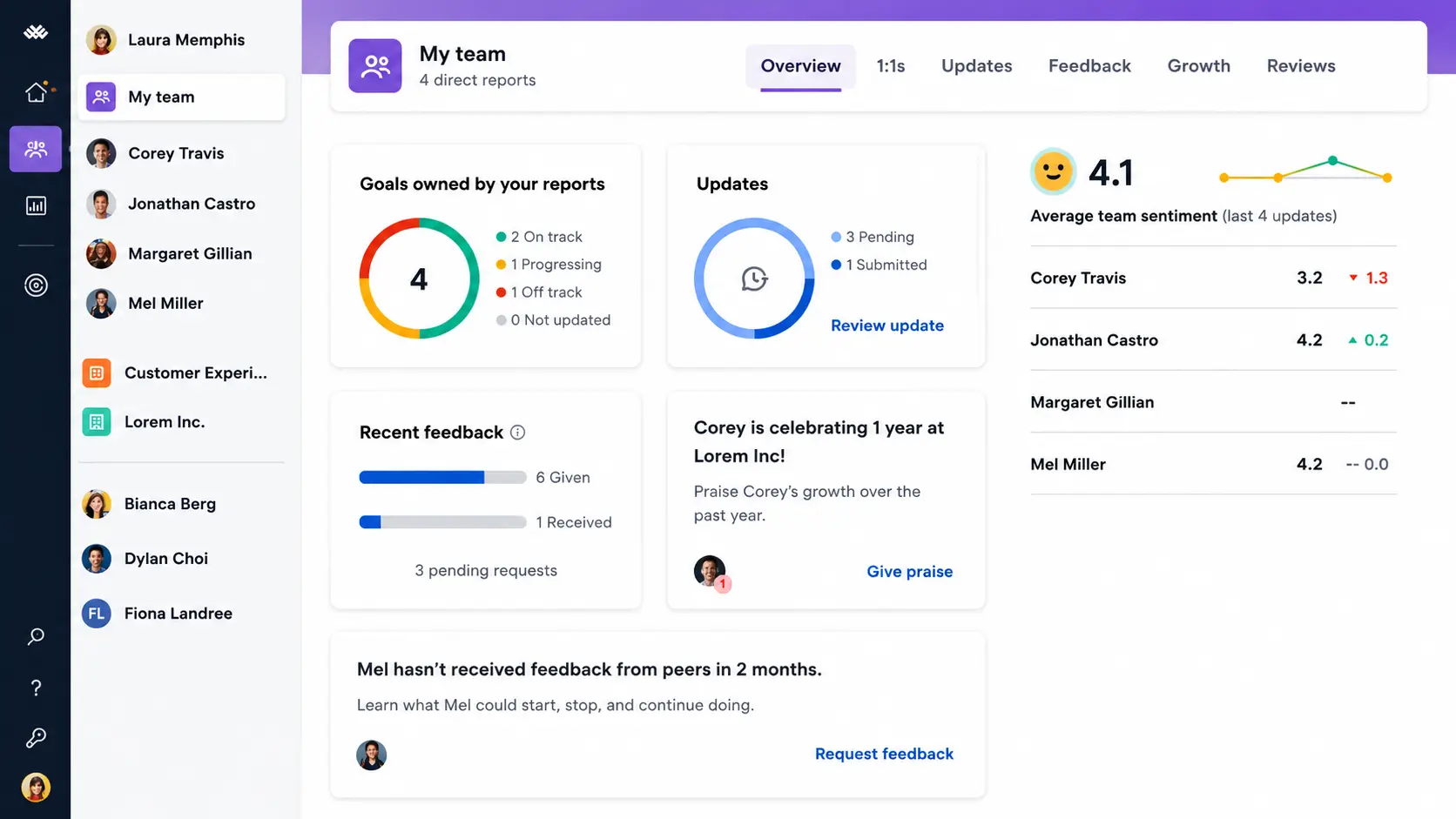
Lattice's PIP module is the most thoughtfully structured PIP feature on this entire list. The platform explicitly frames PIPs as a coaching and alignment tool, gives managers a decision framework for choosing between coaching, an IDP and a formal PIP, and tracks improvement-plan analytics across teams to surface coaching gaps at the org level. Career development through Lattice Grow is similarly strong. 1:1 structure is solid- agenda templates pull in recent goals and feedback automatically. Calibration has been actively invested in through 2026, with bulk settings, participant access management and compensation-planning integration.
Performer visibility is still largely manager-driven. The bias correction layer operates at the calibration meeting stage, not before it. And the gap I keep coming back to: none of the people data is explicitly tied back to business outcomes. Lattice connects performance to compensation and engagement very well, but whether the skills it develops and the goals it tracks are actually moving business objectives is a question the platform doesn't answer.
For HR leaders who want their programme to do a better job developing people, managing underperformance fairly, and connecting outcomes to compensation, Lattice does that well at a reasonable mid-market price point. For leaders who want their programme to also answer the question a CEO would ask, Lattice gives you half the picture very clearly and leaves the other half to you.
Leapsome
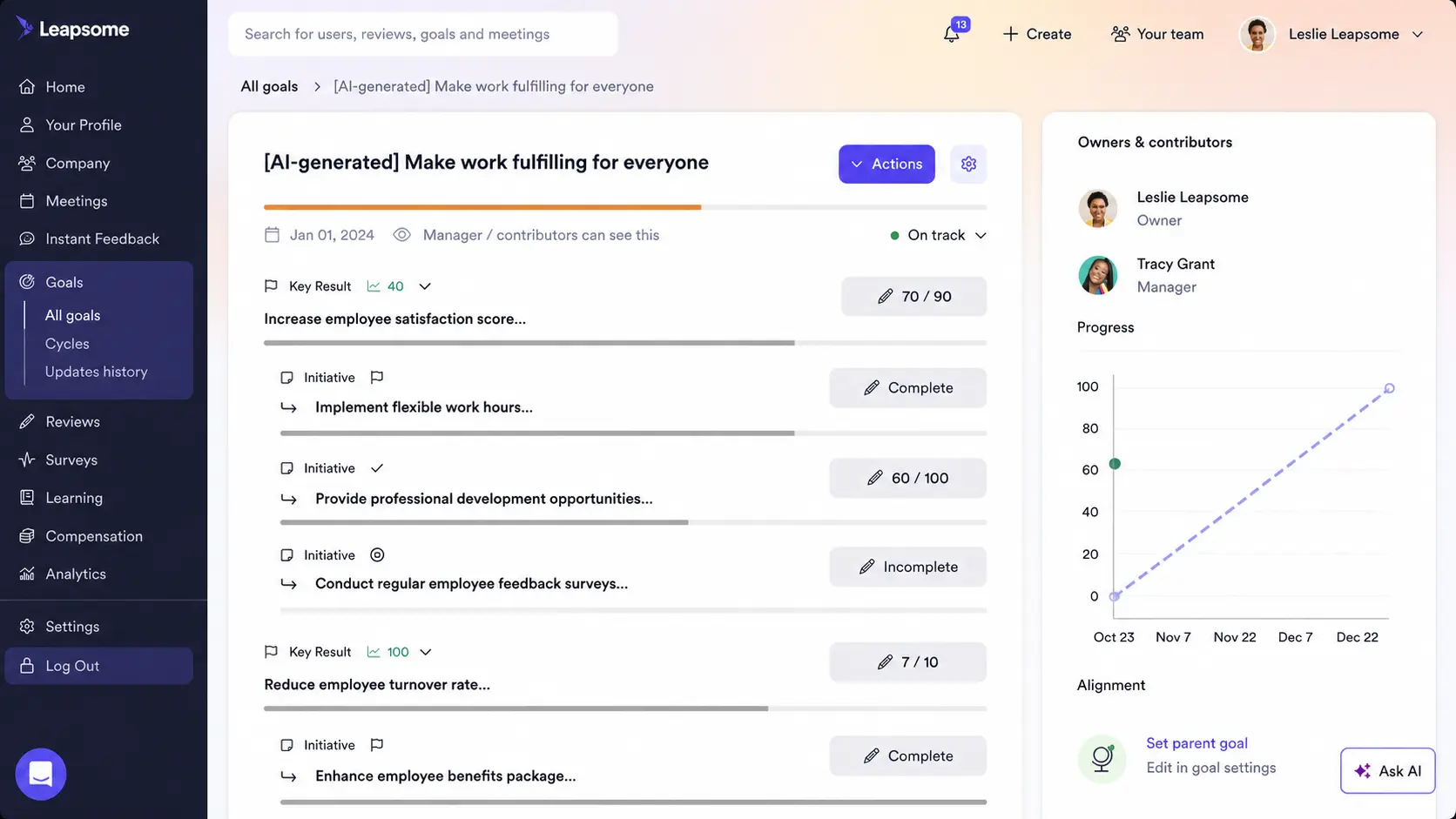
Leapsome has done something most platforms haven't: genuinely built a modular all-in-one people platform rather than bolting modules onto a core product. Performance reviews, OKRs, engagement surveys, 1:1s, learning paths and HRIS capabilities now live in the same system. The AI review assistant drafts feedback using past performance data and goal progress- a meaningful answer to the vague-and-verbal problem. Calibration exists, is paired with AI-generated summaries, and the heatmap dashboards give HR a cross-org view of performance trends and participation in real time.
The breadth that is Leapsome's strength is also where friction appears. User feedback is consistent on two points: goal management requires too many manual steps to stay current, and accessing historical goal data takes more clicks than it should. Calibration tools are noted as insufficient for complex enterprise architectures. Performer visibility is a dashboard view rather than a continuous, proactive signal. PIP workflows aren't a native, structured module, and the business-outcome link is left largely to how the org configures the OKR module.
For a scaling company that needs to reduce HR-stack complexity without losing depth across performance, engagement and learning, Leapsome is a strong shortlist candidate. Where I'd push back: the intelligence layer is reactive rather than proactive. It shows you the picture when you open the dashboard, but doesn't independently surface what's about to break or who's at risk before they raise their hand.
Culture Amp
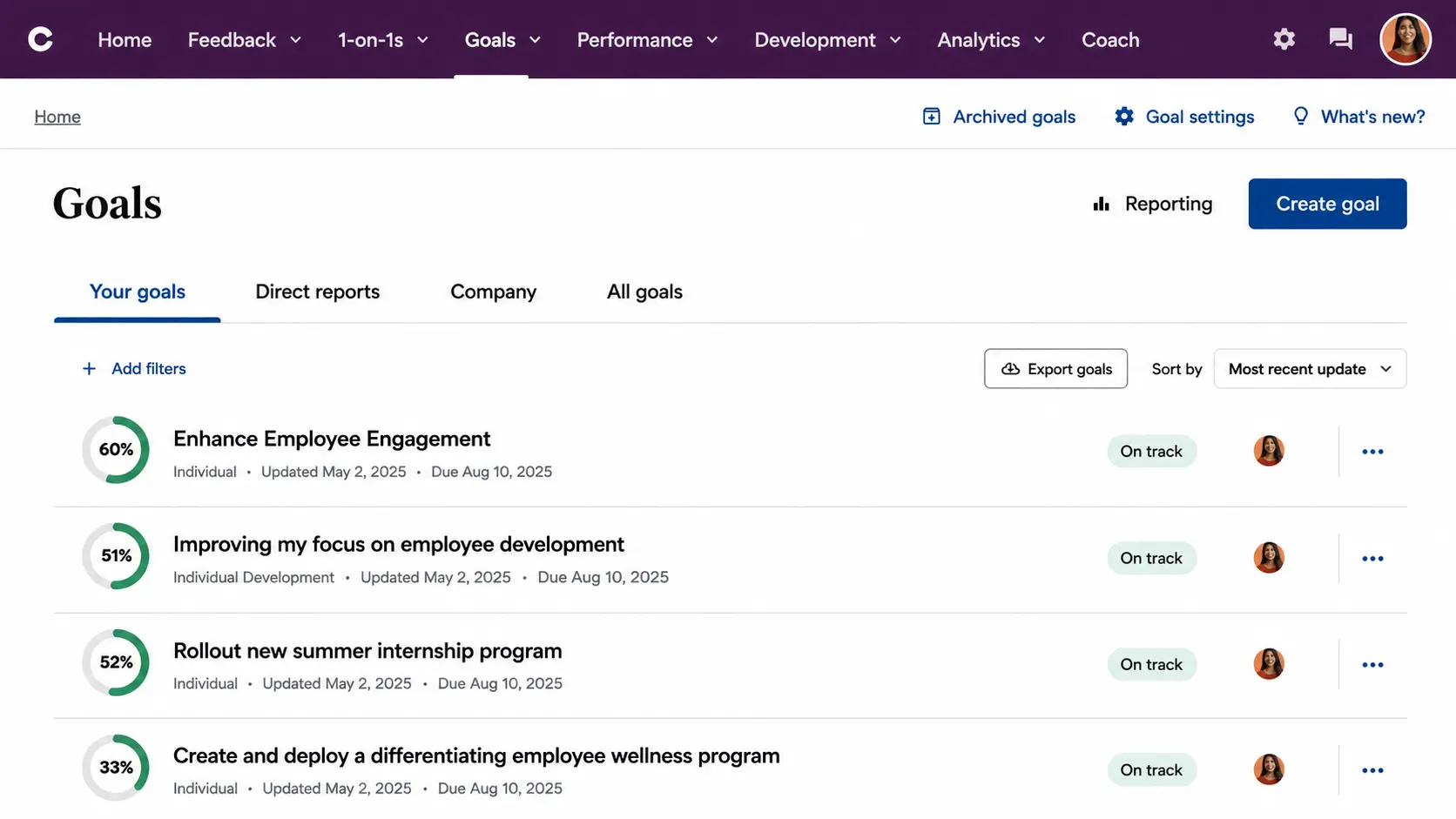
Culture Amp's roots are in survey science, and that shows in everything it does well. The calibration tooling has matured significantly- the Ratings Matrix added in 2025 gives HR a visual view of how ratings distribute across the org, with the ability to adjust in real time and track changes through a calibration activity log. Culture Amp connects engagement data and performance calibration in the same platform, so an HR team can hold both views simultaneously. The AI Coach helps managers write more balanced, specific review feedback.
Calibration is a meaningful but secondary capability here. This is an engagement platform with a performance layer, not the reverse. Users who come primarily for calibration depth consistently find it thinner than purpose-built platforms. Performer visibility is largely survey-and-cycle-driven. PIP workflows aren't a native structured module, and skills intelligence isn't tied to a business-outcome model. Some users note that calibration support requires working through a customer success team rather than directly in the product.
If your primary buying lens is engagement, Culture Amp is one of the best platforms in the market. If you're buying primarily for performance-management depth, calibration rigour or the business-outcome link, it gives you solid foundations and leaves the harder questions unanswered. Buy it for the engagement intelligence- and be clear-eyed about what the performance layer does and doesn't do on its own.
Learn Amp
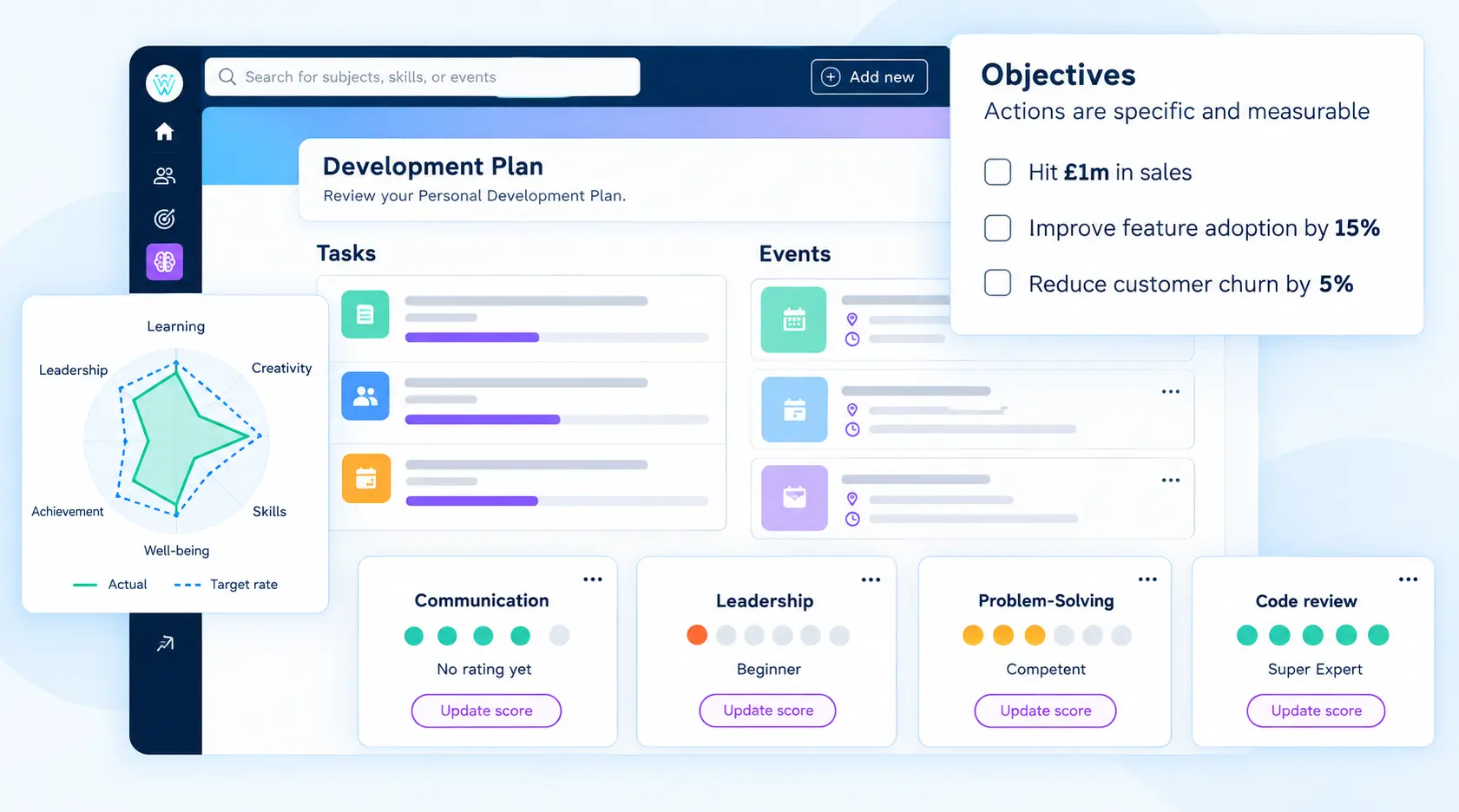
Learn Amp positions itself as a “People Development Hub”, and that framing is genuinely differentiated — it connects learning pathways, coaching, and OKR/goal-setting in the same system, so a manager can see a skills gap and immediately assign or build a learning path against it rather than filing an IDP that L&D acts on weeks later. This is a direct, if partial, answer to the L&D-and-performance integration problem that most PMS platforms leave unsolved. AI-driven content recommendations and modular Spark/Grow/Amplify pricing let an org start small and add performance and engagement layers as it scales.
This is fundamentally an LMS/LXP with performance and OKR features layered on top, not a performance-intelligence platform built from the ground up. Calibration, structured PIP workflows, and real-time bias correction aren't its focus areas, and performer visibility depends heavily on how consistently managers use the coaching and goal-tracking layer.
Strong specifically for question 3 of the framework — connecting skills data to L&D — and weaker on performer visibility, PIPs, and bias correction (questions 1, 4 and 7). A good fit for a scaling company where learning and developmentis the strategic priority and performance tracking is secondary.
15Five
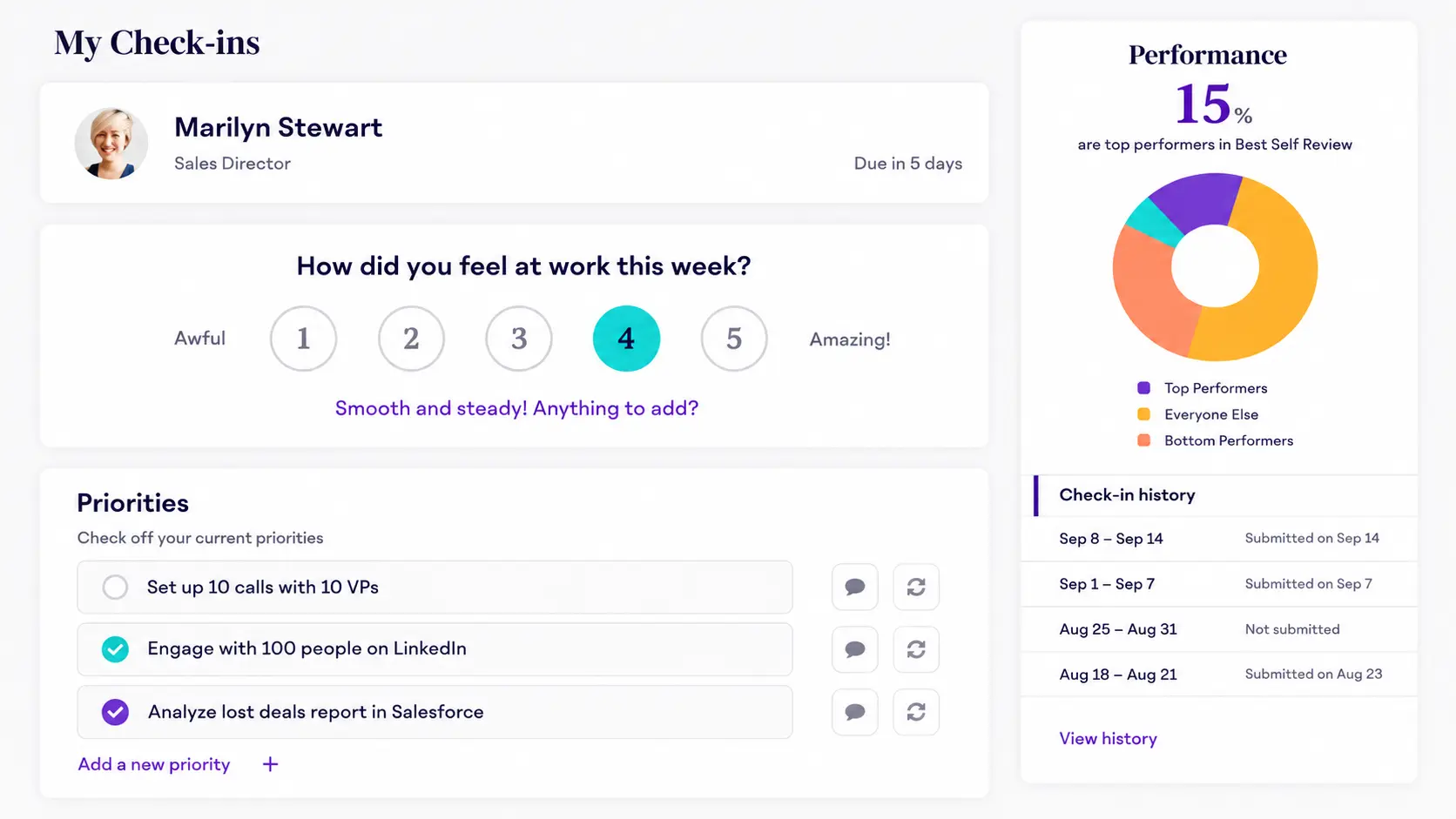
15Five is built on a premise I respect: that the weekly manager–employee conversation is the highest-leverage point in a performance system, and that most platforms ignore it in favour of review-cycle administration. The weekly check-in cadence is the defining feature, and it works- users consistently report that the structured rhythm changes how managers and teams interact and reduces the "surprise rating" problem at review time. The Growth Studio module brings IDPs, PIPs and succession nominations into a 9-box talent matrix where HR can visualise talent and act.
The weekly check-in model is only as strong as manager adoption. Reviews are consistent that when managers treat check-ins as a form to fill rather than a genuine conversation, signal quality drops quickly, and questions become repetitive over time. Calibration tooling exists but isn't the strength. Analytics depth is lighter than Betterworks or Lattice, the reporting layer doesn't surface predictive signals, and skills intelligence isn't a native, data-led capability.
15Five is a strong choice for organisations that want to build a genuine continuous-feedback culture and believe the manager layer is where performance succeeds or fails. It's not the right answer if you need deep calibration, predictive performer visibility, or the business-outcome link between individual performance and strategic execution.
Engagedly
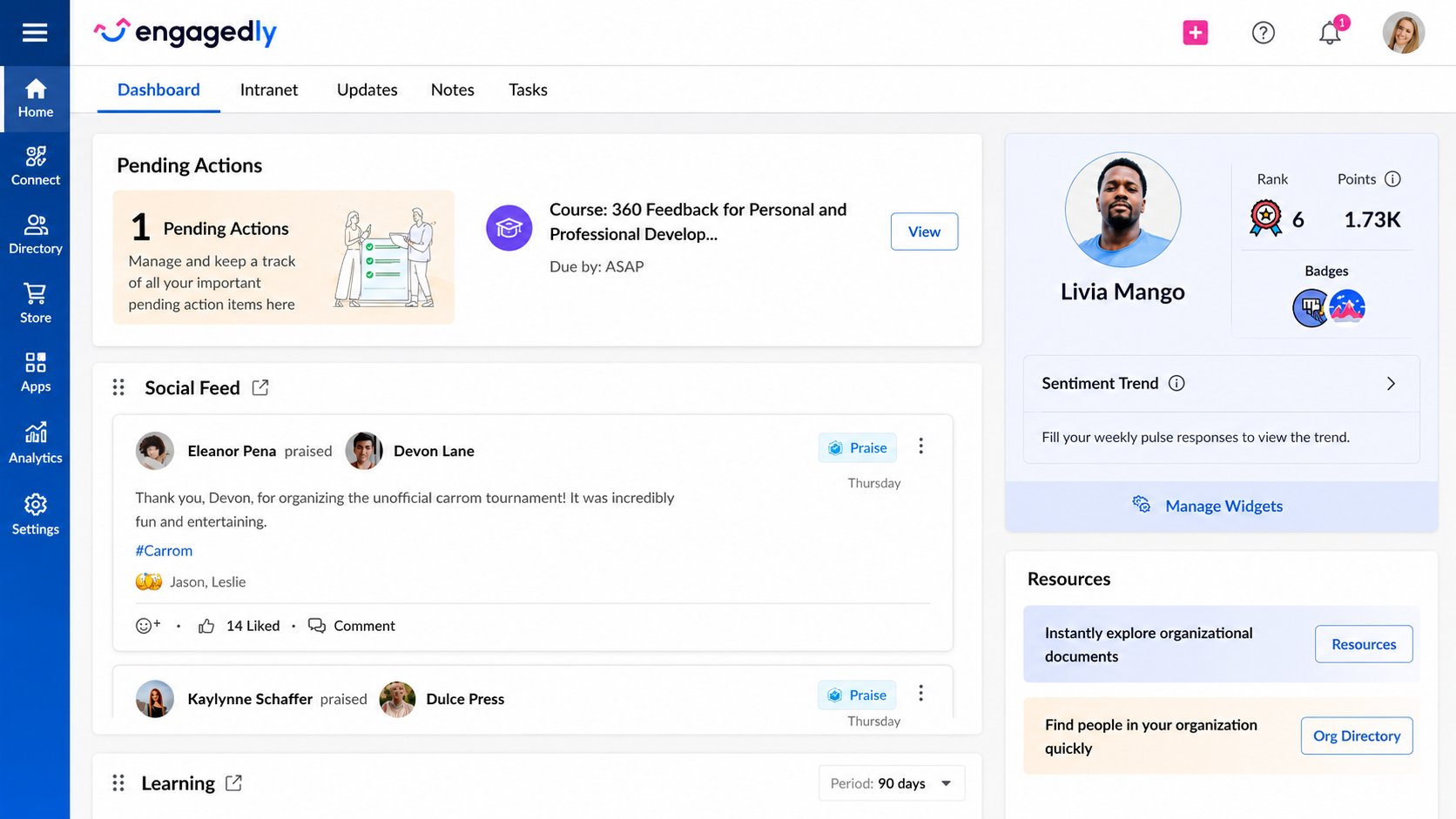
Engagedly brings genuinely wide surface area at a price point most platforms here can't match- starting at $5/user/month for the performance module. For mid-market organisations that need reviews, 360-degree feedback, check-ins, OKR alignment, pulse surveys, recognition and basic learning management in a single system without enterprise pricing, the breadth-to-cost ratio is real. Calibration exists with heatmaps and radar charts for cross-team rating comparison, and the 9-box matrix supports leadership-potential assessment alongside performance ratings.
The user feedback is consistent and worth taking seriously: the interface is complex and unintuitive, causing a steep learning curve that creates adoption risk. Customisation of review templates and feedback forms is more limited than the feature list implies, and reporting depth for advanced analysis falls short of what larger organisations need. Onboarding support has drawn consistent criticism- slow response times and limited hands-on guidance, exactly the wrong experience for a platform that already has a steep learning curve.
Engagedly offers genuine feature breadth at a price point that makes it an accessible entry into structured performance management for mid-market organisations. The adoption risk is real and should be taken seriously. For organisations expecting the tool to drive its own adoption, the experience is likely to disappoint.
PerformYard
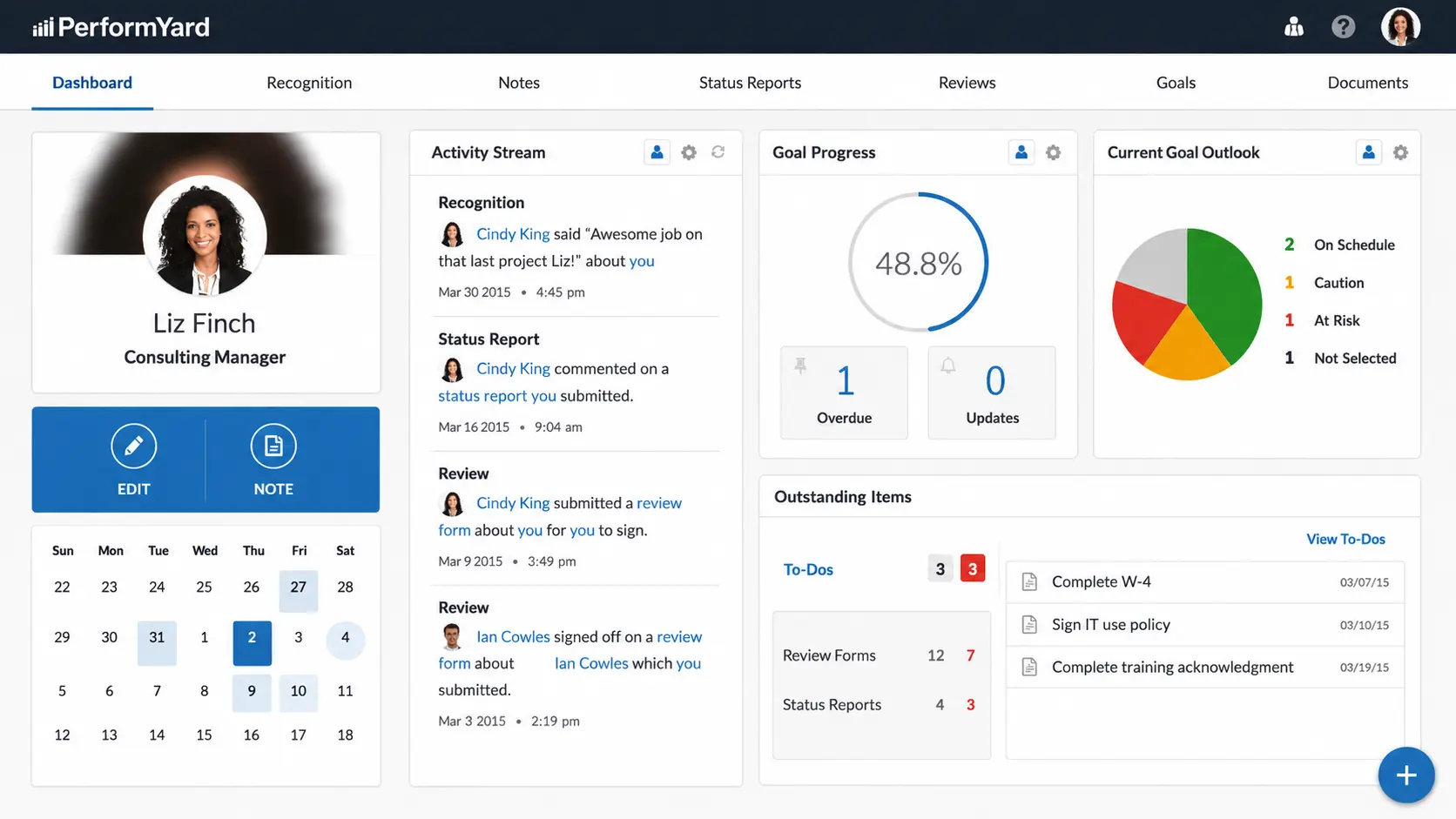
PerformYard's strongest asset is the combination of deep review-workflow customisation and genuine ease of use- a combination most platforms here fail to deliver simultaneously. Admins can configure cycles, templates and timing to match the org's existing process rather than forcing the org to conform to the platform. Automated reminders stay open and outstanding until managers complete reviews rather than closing cycles silently- a small operational detail that drives meaningfully higher completion rates. The dedicated customer success manager included at every tier addresses the adoption problem more directly than most competitors at this price.
PerformYard is a performance-management workflow tool, and it's honest about that. Engagement analytics are basic. Recognition features are minimal. Calibration tools draw user frustration specifically around intuitiveness. The business-outcome link isn't answered, and performer visibility is still review-cycle-dependent and manager-fed. Contract terms have drawn criticism from multiple reviewers who report being locked into multi-year agreements with limited exit options.
If your current state is a manual, spreadsheet-based review process and you need to digitise it with minimal disruption and strong adoption, PerformYard gets you there faster and with better onboarding support than most platforms at this price. If your ambition is to make HR strategic, PerformYard is an honest, well-built step in the right direction- not the destination.
Workleap
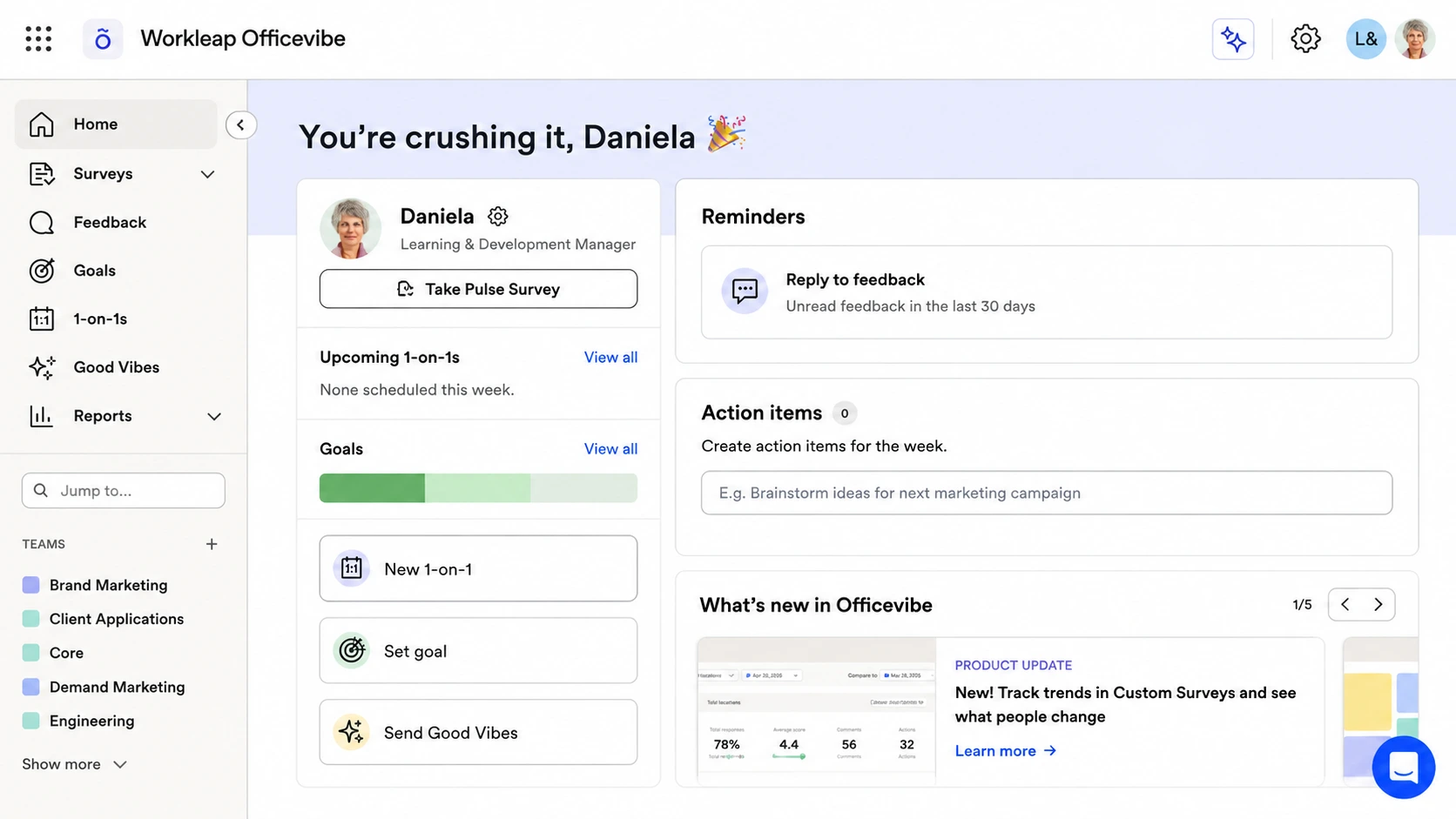
Workleap has made a genuinely interesting architectural bet: position the AI-powered Manager Agent as the centrepiece rather than a feature bolted onto a review tool. The premise- that 82% of HR leaders don't believe their managers have what it takes to lead change, and that the answer is an AI layer that prepares reviews, flags important feedback and preps delicate 1:1s on the manager's behalf- is an honest response to one of the most persistent patterns I see. Engagement signals from Officevibe pulse surveys feed directly into performance workflows, so HR sees sentiment trends and performance data in the same platform.
The heaviest dependency is manager participation- most of what Workleap delivers is only as good as whether managers act on the AI's nudges. Calibration exists as a reporting and distribution view, not the deep, pre-bias-correction layer the framework requires. Third-party integrations are more limited than Lattice or 15Five. Reporting and analytics are basic for larger organisations, and the business-outcome link is directional rather than explicit.
Workleap is one of the most honest products in the mid-market space: it doesn't pretend to be an enterprise platform, and it doesn't pretend any software alone fixes manager behaviour. For a mid-market HR team that wants AI to reduce the administrative burden on managers while keeping engagement and performance in the same system, this is a legitimate option.
Eletive
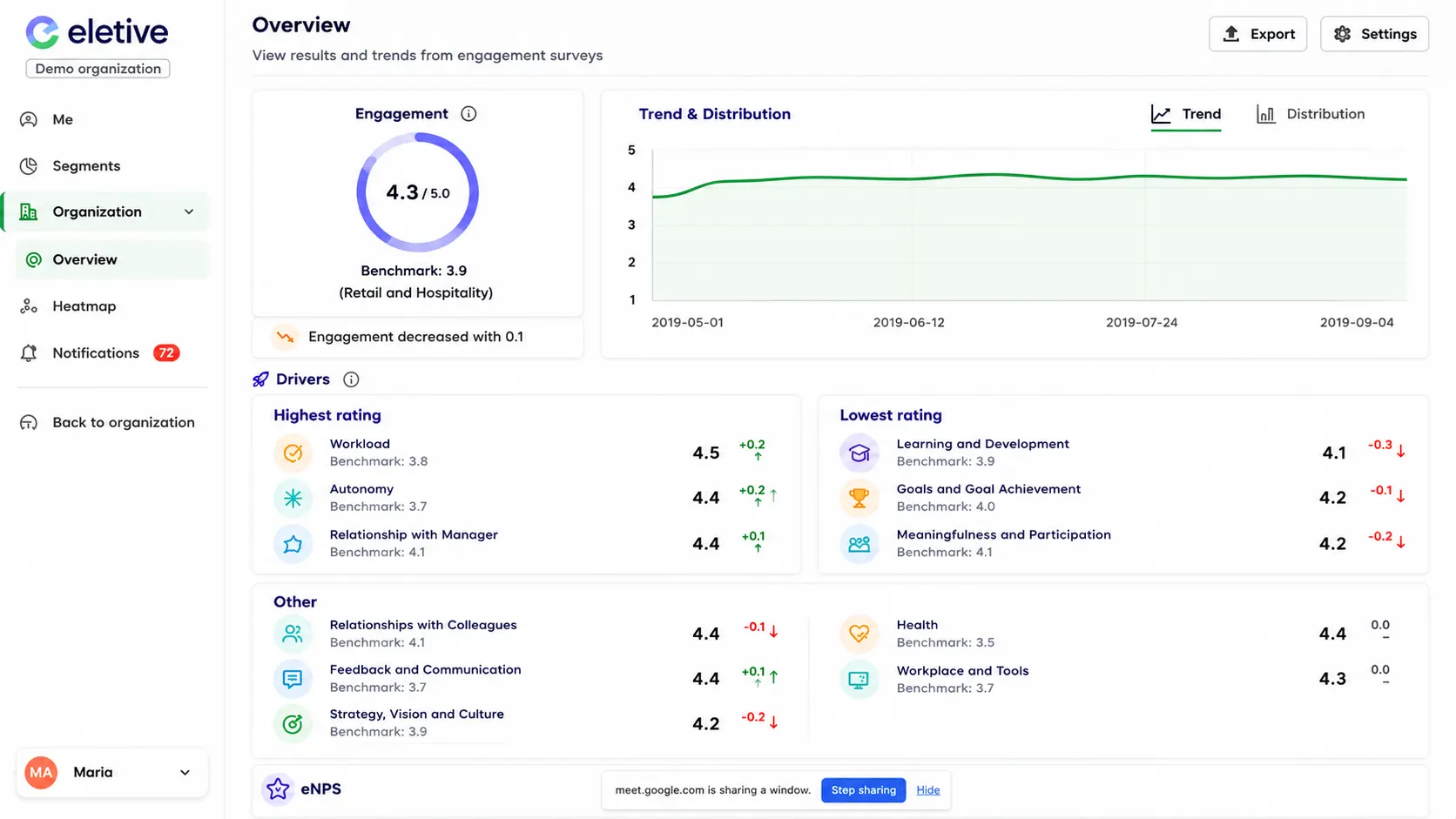
Eletive was built by engineers and behavioural scientists, and that founding logic shows in how it approaches engagement differently. The pulse-survey engine is AI-personalised- it adapts future questions based on each individual's previous responses, producing meaningfully richer signal than the static question banks most platforms recycle until employees disengage. The self-leadership model is a genuine differentiator: individual dashboards give employees their own engagement and performance insights, creating bottom-up ownership. At AkzoNobel, Eletive supports 43,000 employees across multiple countries with a 90% participation rate.
Eletive's core strength is engagement intelligence and self-leadership, not performance-management depth. The 1:1, OKR and 360 features exist but cost extra. Calibration isn't a native, deep workflow. Performer visibility is survey-and-pulse-driven. PIP and IDP workflows as structured native modules are absent. The platform is primarily renowned in UK and European markets- relevant for buyers elsewhere evaluating vendor maturity, support and peer references in their region.
If your primary problem is getting employees to actually engage with the listening system, Eletive's behavioural-science foundation produces better participation and richer signal than most platforms at this price. If your primary problem is formal performance-management depth, calibration rigour, or connecting people data to business execution, Eletive is the wrong starting point.
Microsoft Viva Glint
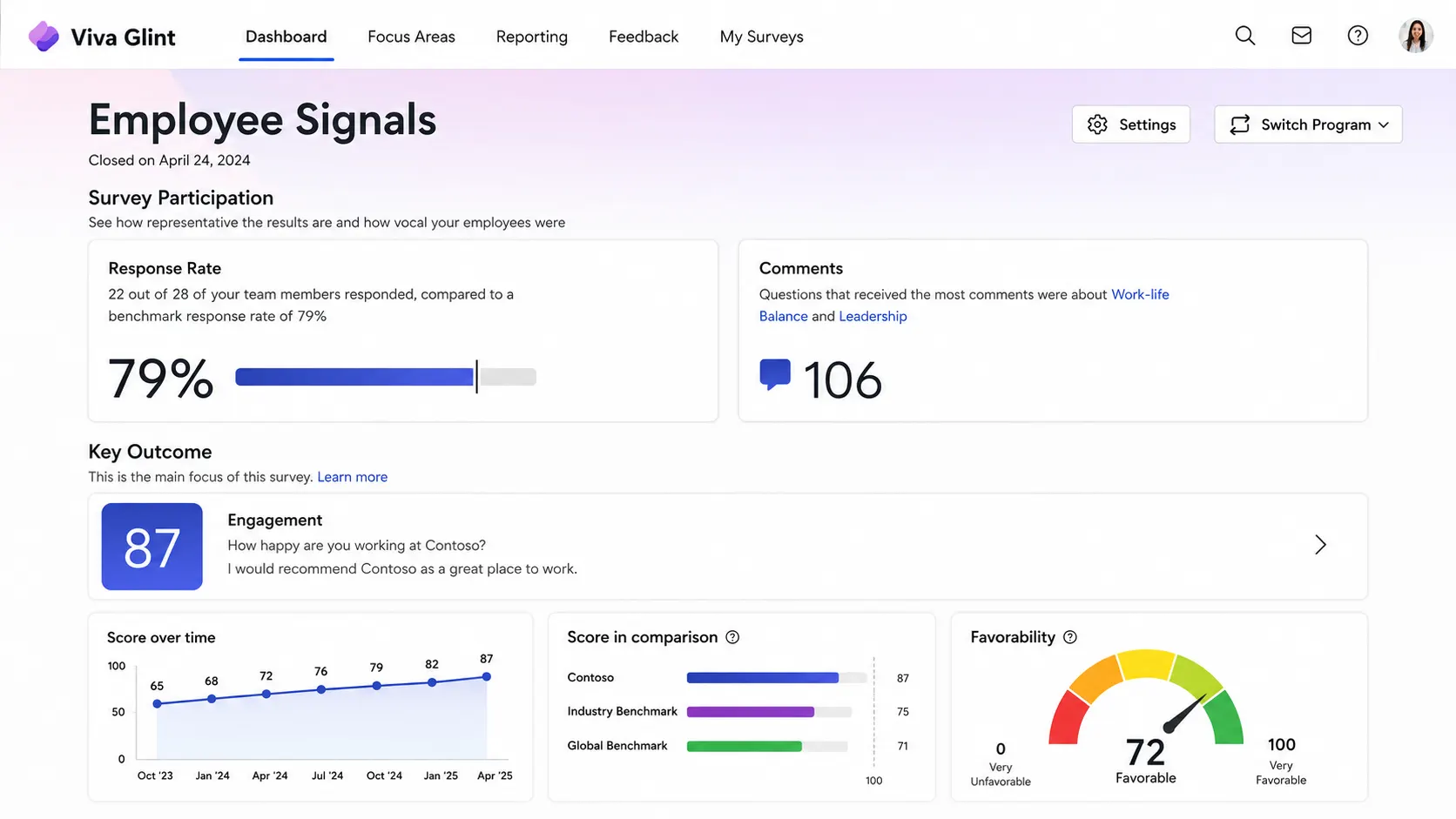
Viva Glint's most important design decision is one most engagement platforms get wrong: it routes data directly to managers rather than filtering everything through HR first. The manager-empowerment model is built for managers who aren't HR professionals- clear language, specific recommended actions rather than data dumps, team discussion guides that make transparent conversations easier. The M365 integration is the deepest in the market for organisations already on that stack. AI-powered NLP summarises thousands of open-ended comments instantly, and attrition-risk monitoring is native rather than an add-on.
The M365 dependency is real- organisations not fully embedded in the Microsoft ecosystem get significantly less value. Viva Glint is an engagement-listening platform, not a performance-management system, and it doesn't answer the seven questions: performer visibility is survey-based not continuous; feedback structuring isn't a native workflow; PIP and IDP management are absent; 1:1 tracking isn't a default; KRA-to-business-outcome linkage isn't built in; and bias correction operates through aggregated survey data rather than individual rating monitoring.
For a large enterprise already standardised on M365 that wants the best enterprise listening and manager-pulse capability within that ecosystem, Viva Glint is the natural choice. For anything beyond that- formal performance management, calibration, skills development, the business-outcome link- you'll need a separate platform alongside it. This is a listening system, not a performance system, and should be bought as one.
Qualtrics EmployeeXM
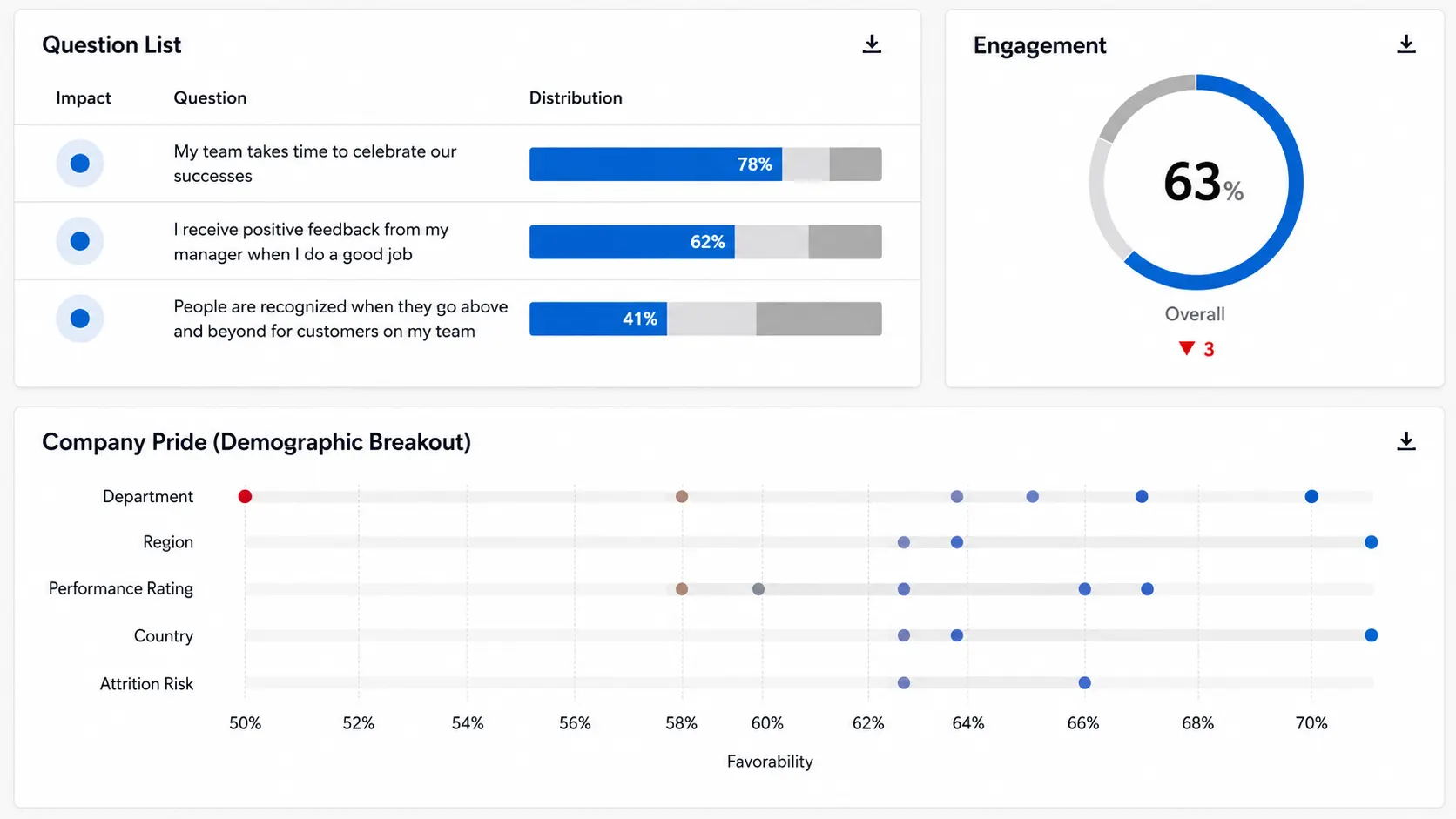
Qualtrics sits at the top of the market for experience-measurement depth, and it earns that through a capability no other platform here can match: it connects employee-experience data to operational and financial data. The iQ analytics engine surfaces patterns and drivers of engagement, wellbeing and retention from survey data automatically. The integration with customer-experience data is uniquely powerful for service-led organisations- seeing the connection between employee engagement in a region and customer satisfaction in the same region is a strategic insight no HR-only platform produces.
Qualtrics is built for research rigour, and the learning curve and cost reflect that. For HR teams without a dedicated people-analytics function, the depth becomes overhead rather than advantage. Performance management as a continuous workflow- structured feedback capture, 1:1 tracking, PIP management, calibration- isn't what Qualtrics is built for. Performer visibility is survey-driven, not continuous or manager-independent, and bias correction operates at the analytics level rather than monitoring individual rating drift in real time.
If you have a people-analytics team, a serious investment in experience management, and the ambition to connect HR data to business outcomes in a way the CFO finds credible, Qualtrics is the most powerful instrument in this category. If you're an HR leader trying to fix the operational problems described here, Qualtrics will measure how well you solve them after the fact- not help you solve them structurally in the first place.
Bonusly
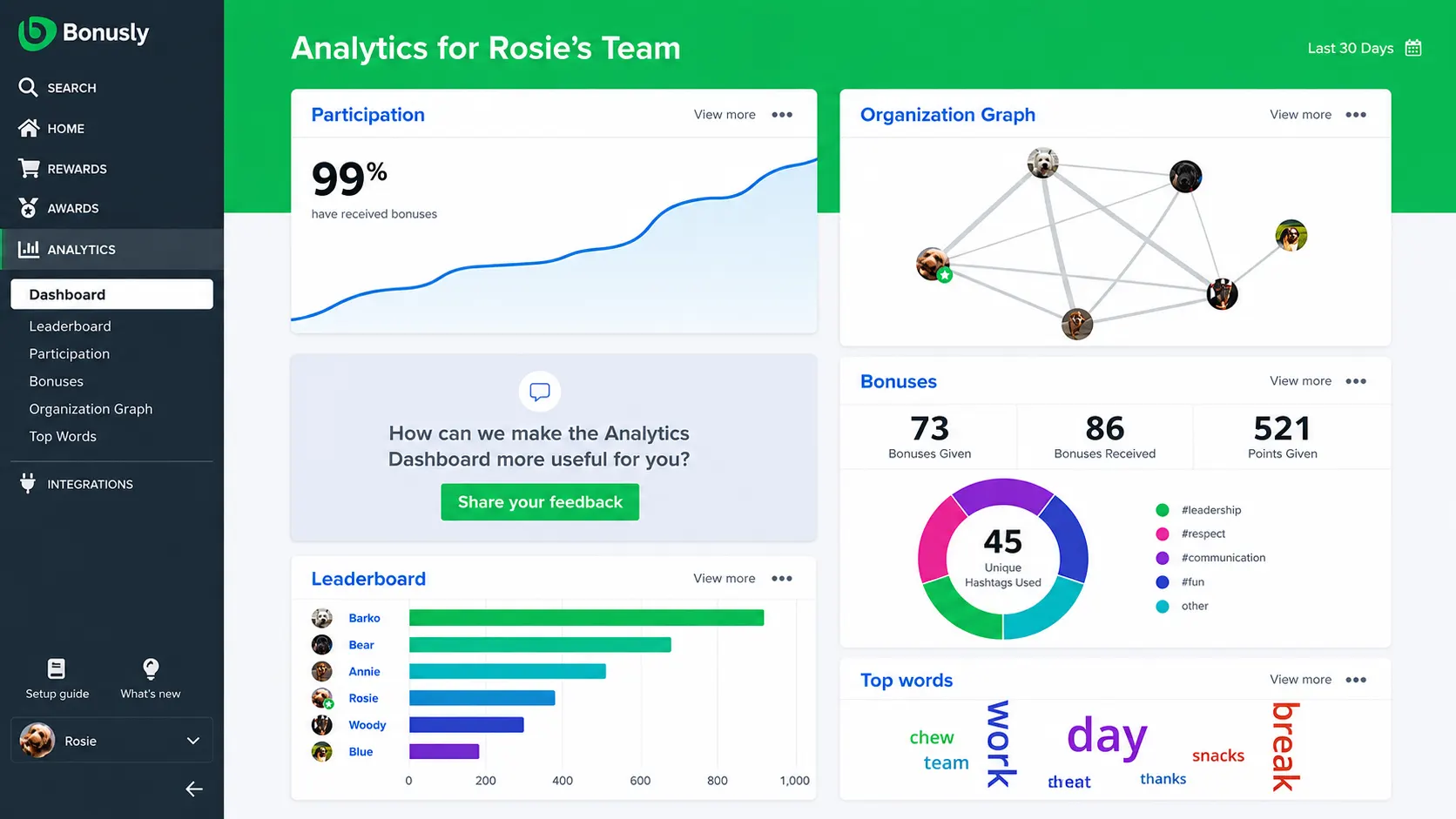
Bonusly has solved a genuinely hard problem: making recognition feel natural and frequent rather than formal and rare. The peer-to-peer points system, integrated directly into Slack and Teams, turns appreciation into something that happens in the flow of work rather than in a separate HR module nobody logs into voluntarily. For organisations where recognition culture is the primary problem- where good work goes unacknowledged and managers are the only channel for visible appreciation- Bonusly changes that dynamic faster and more sustainably than almost any platform here.
Bonusly is a recognition platform, not a performance-management system- evaluating it against the seven parameters is a category mismatch by design rather than a product gap. There are no formal review workflows, no calibration tools, no PIP or IDP management, no skills intelligence, no KRA-to-business-goal linkage, and no structural bias correction. Performer visibility is recognition-frequency-based, not an independent signal on goal attainment, skill health or business-outcome delivery.
Buy Bonusly when you have a recognition-culture problem and a separate performance platform already handling the seven questions. Don't buy it expecting it to replace either. For organisations where recognition is an afterthought, Bonusly solves a real problem quickly- just be clear on what problem you're actually buying it for.
BambooHR
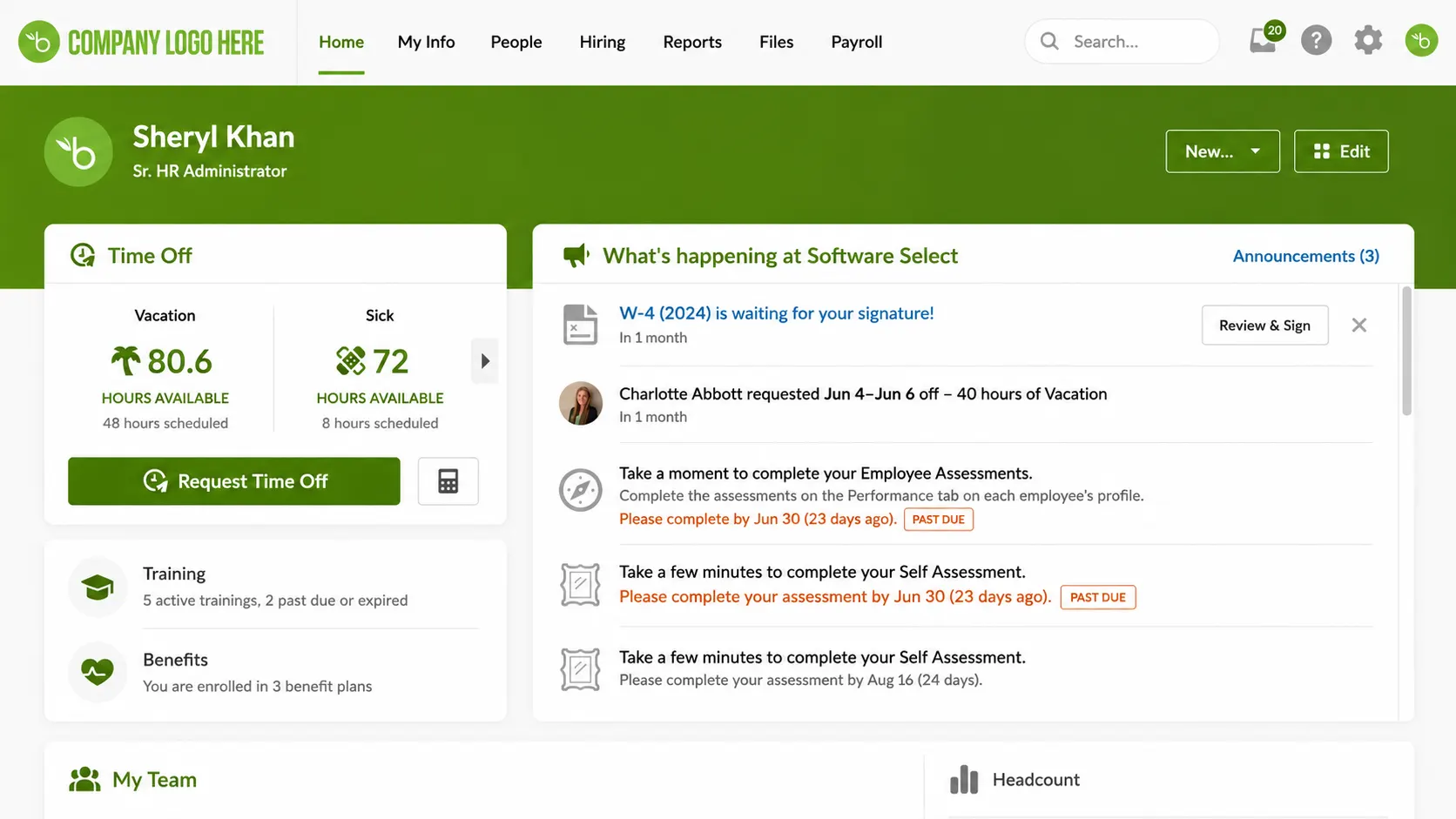
BambooHR has earned its reputation in the SMB space by solving a real problem: giving growing companies that have outgrown spreadsheet-based HR a clean, centralised system of record that employees actually adopt without a steep learning curve. The performance module includes goal tracking, 360-degree feedback, self-assessments, and a four-question manager feedback process that forces directness rather than generic commentary. Automated scheduling of recurring cycles and team-level reporting give HR a consistent view of progress. The 120+ marketplace integrations and strong mobile experience are genuine strengths for distributed teams.
Performance management is a module within a broader HRIS, and that reality defines its limits. Calibration tools are basic compared to purpose-built platforms. Performer visibility is review-cycle-dependent and manager-fed. PIP workflow is template-based guidance rather than a structured, tracked plan. IDP and skills intelligence aren't native. The KRA-to-business-goal link is at the goal-tracking level but doesn't connect to any business-outcome model, and bias correction is absent as a structural feature.
BambooHR is an excellent product for the problem it was designed to solve- giving small and mid-sized businesses a clean, easy-to-adopt people system that covers the HR basics without enterprise overhead. If your ambition is to make HR strategic- real-time performer intelligence, data-led L&D, structural bias correction, the business-outcome link- you'll outgrow it before the implementation is finished.
ThriveSparrow
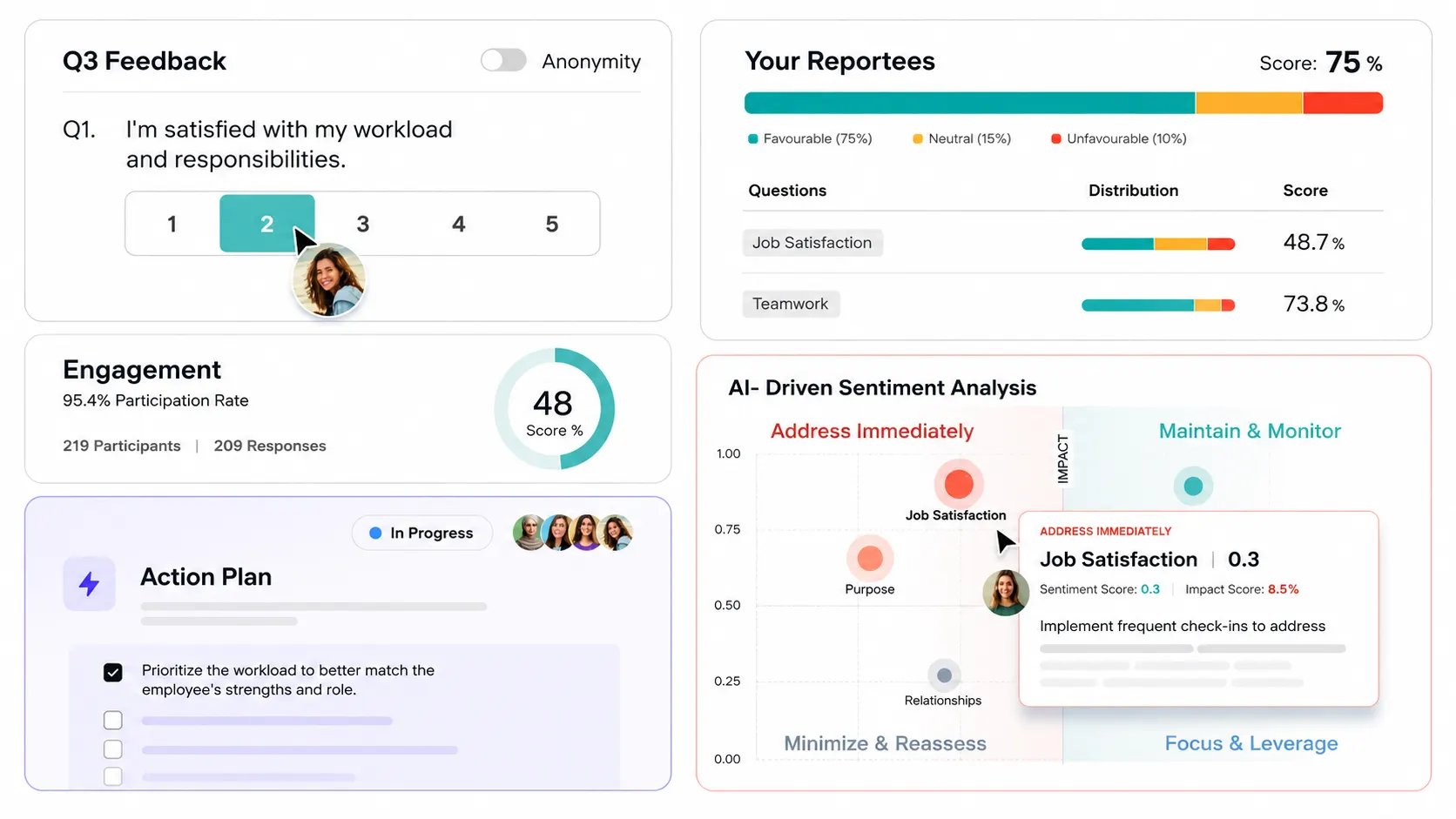
ThriveSparrow has positioned itself as the most complete all-in-one solution for SMB and mid-market HR teams that want to stop running performance, engagement and recognition across disconnected tools. The platform combines 360-degree reviews, customisable templates, goal management with OKR tracking, pulse surveys, peer-to-peer recognition through Kudos, engagement heatmap analytics and AI-powered development plans in one system, starting at $5/user/month. AI-assisted development plans are a more structured answer to the gut-feel L&D problem than most platforms at this price.
ThriveSparrow is a newer entrant, and the depth gaps show in the areas the framework targets most. Calibration exists in the analytics layer but isn't the deep, session-level, pre-bias-correction workflow mature programmes require. Performer visibility is dashboard-and-survey-driven rather than a continuous independent signal. PIP management as a native, tracked workflow isn't a clear feature. Skills intelligence is AI-assisted at the development-plan level rather than tied to a business-outcome model. As a younger platform, enterprise-grade implementation maturity and reference-customer depth are more limited.
For a growing company that wants more than a standalone review tool but less than the complexity and cost of Betterworks or Lattice, ThriveSparrow offers genuine value in one connected package. It's building in the right direction, but earlier in the maturity curve than the framework's most demanding questions require. A strong shortlist candidate for SMB and early mid-market buyers- evaluate it with clear eyes about where the depth stops.
Effy AI
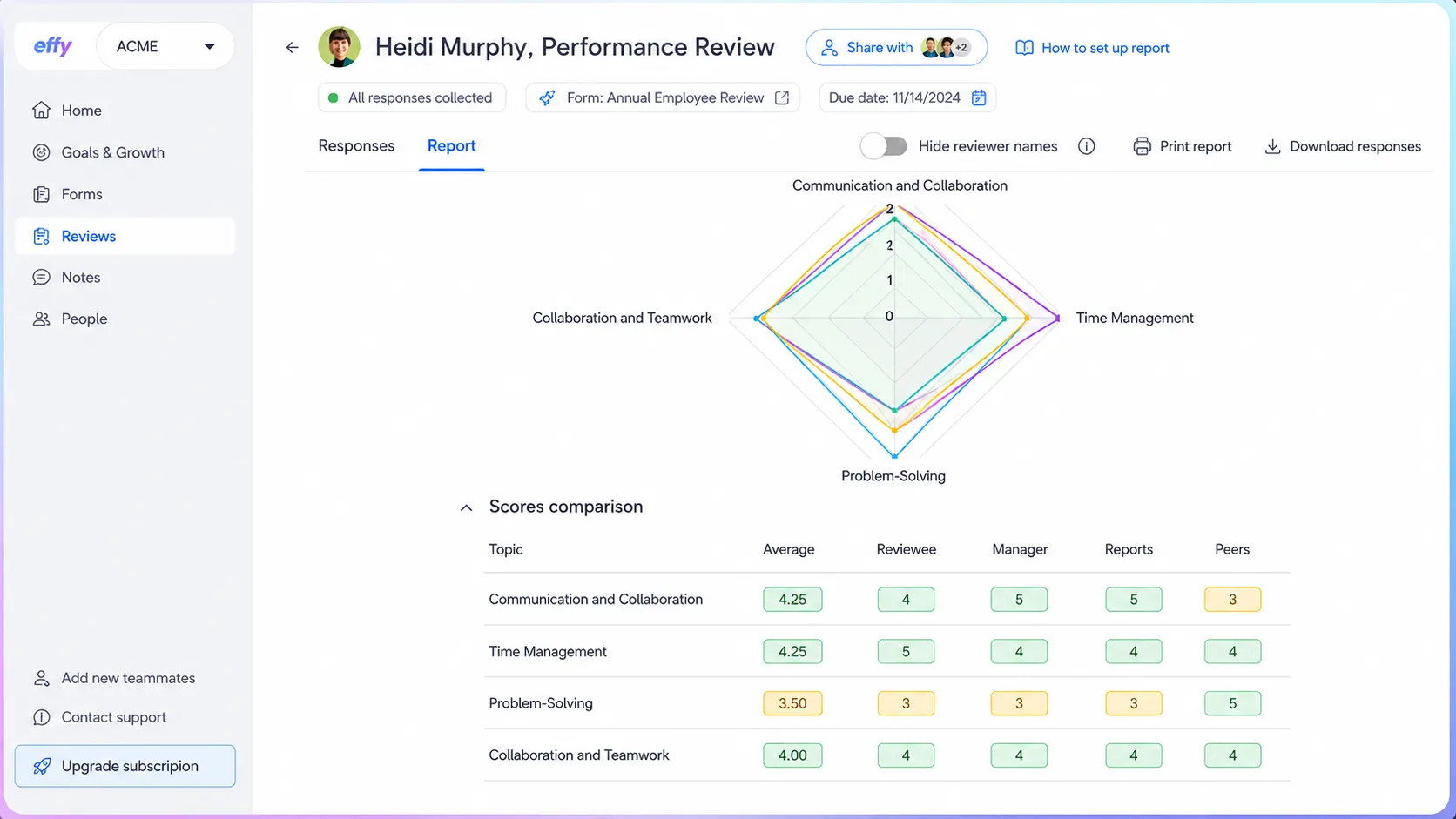
Effy AI has made an honest product bet: not everything, but one thing done exceptionally well. The AI layer generates review forms in 90 seconds, creates dynamic follow-up questions based on open-ended responses, and produces instant written summaries of review cycles- cutting what typically takes days of HR administration down to minutes. Spider charts and company-wide heatmaps give managers a structured visual read on feedback patterns without manual comparison. Native Slack integration means employees complete reviews without logging into a separate system. Setup takes under an hour; 96% of users report onboarding was straightforward.
Effy AI is a focused review tool, and the parameters beyond review quality are largely unaddressed by design. There are no formal goal-management or OKR capabilities. PIP management as a tracked, structured workflow is absent. IDP and skills intelligence aren't native. Calibration exists as a pattern-surfacing layer from AI feedback analysis, but not as a structured session with rating-adjustment workflows. Performer visibility is review-cycle-driven, and the KRA-to-business-goal link isn't built in.
If you're a 50-person company running reviews on spreadsheets and need to upgrade without adding HR overhead, Effy AI solves that faster and more elegantly than anything else here. If you're a 500-person company with a structured HR function trying to solve real-time performer visibility, bias correction or business-outcome linkage, Effy AI wasn't built for you- and that's not a criticism, it's a category statement.
PeopleGoal
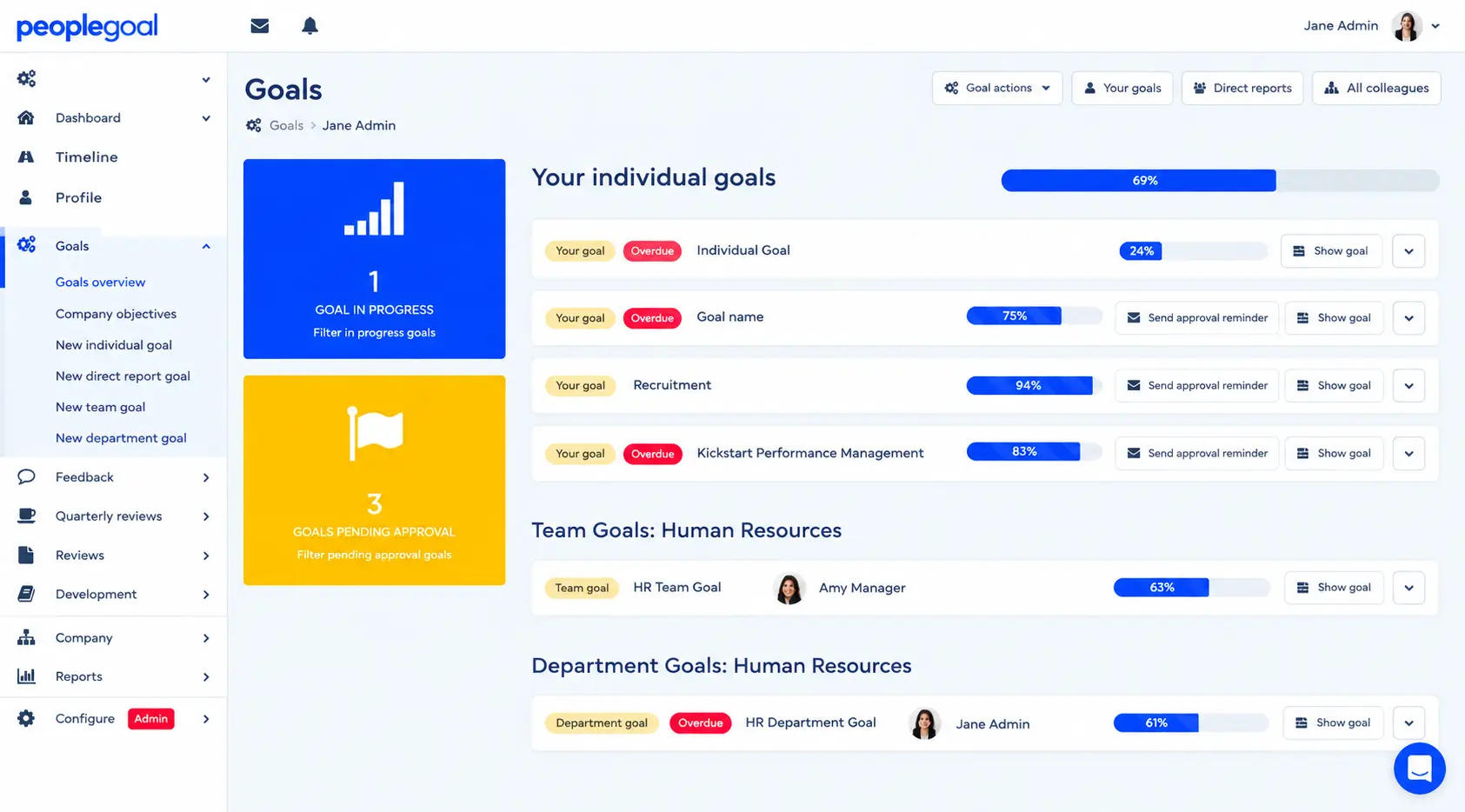
PeopleGoal packs goal setting and OKR tracking, 360-degree feedback, performance reviews, check-ins, and social recognition into one configurable workflow engine that adapts to how an SMB already runs its process rather than forcing a rigid template. Real-time dashboards segment results by department, team, and employee, and integrations with BambooHR, Slack, Workday, and Auth0 cover most SMB tech stacks. It's a fit for the same buyer profile covered in our guide to free and low-cost performance management tools.
Configurability is a double-edged sword: the platform does what you configure it to do, and a small HR team without dedicated admin bandwidth can end up with an under-built process. There's no native structural bias correction, PIP tracking is template-based rather than a genuine improvement-plan workflow, and the business-outcome link is left to how well goals cascade — the same gap found across most tools in the SMB tier.
A legitimate low-cost entry point for a company still running reviews on spreadsheets, similar in spirit to Effy AI and ThriveSparrow but with more workflow configurability at a comparably accessible price. Worth shortlisting alongside our guide to performance management for small business.
Keka
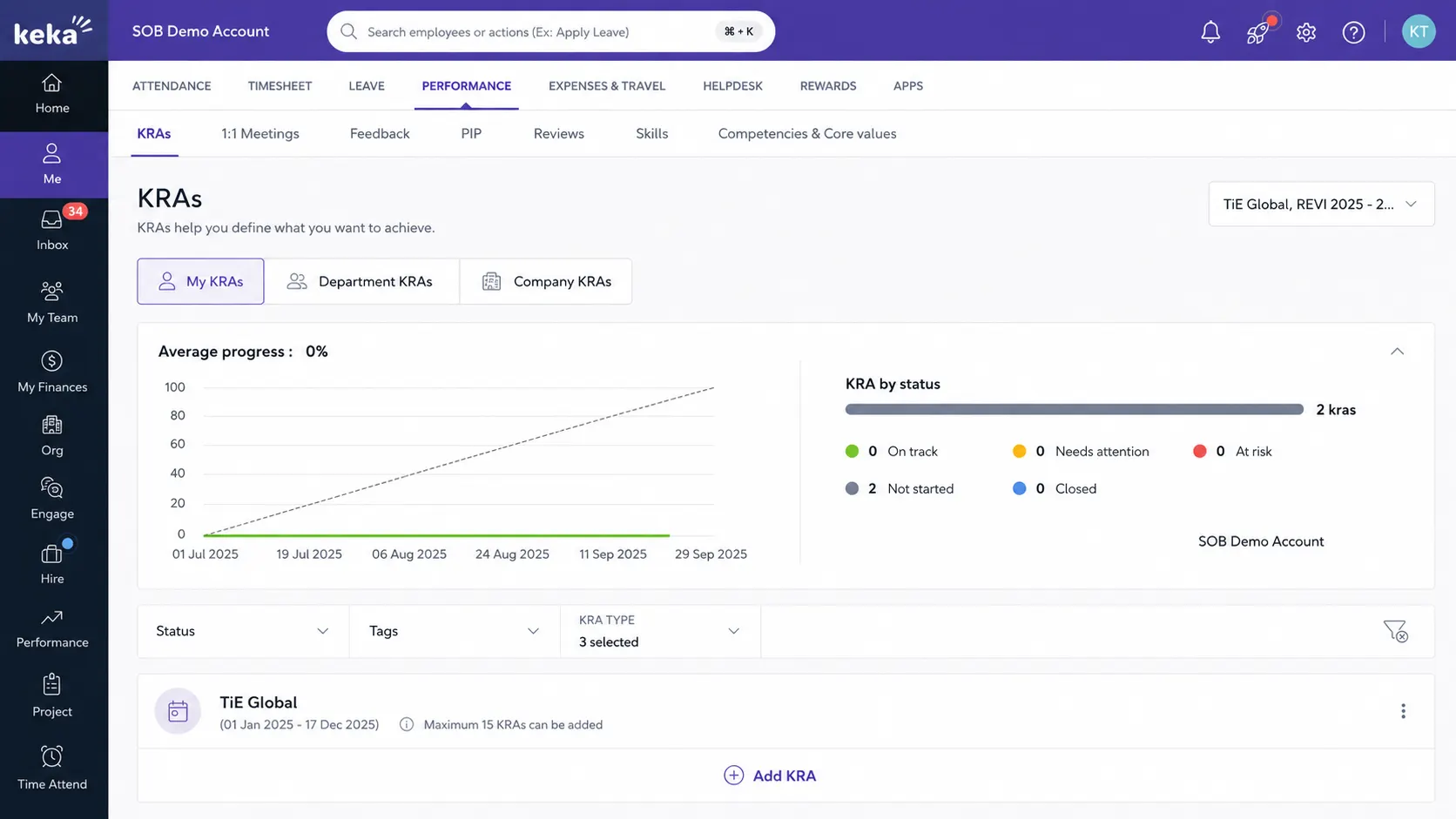
Keka has built a genuinely strong product for the market it serves- growing Indian and APAC organisations that need payroll compliance, attendance and performance management in one platform without the enterprise complexity of Darwinbox or the global pricing of Workday. The performance module includes continuous feedback, 360-degree reviews, calibration tools linked directly to payroll outcomes, skill-gap analysis with career-path templates, personalised development plans, AI-driven upskilling recommendations, structured 1:1s and goal-to-OKR cascade tracking. The payroll-to-performance linkage, where calibration outcomes feed directly into compensation decisions, is a structural connection many pure-play platforms here don't make natively.
Keka is built for the Indian mid-market, and the fit pattern reflects that clearly. Support responsiveness is a recurring buyer complaint, particularly during high-stakes periods like payroll runs. Performer visibility is still largely review-cycle-dependent and manager-fed. Calibration tools exist but are positioned as part of the review cycle rather than a proactive bias-monitoring layer. Skills intelligence is AI-assisted at the recommendation level but not tied to a business-outcome model.
For an Indian or APAC organisation in the 200–800 headcount range that wants a single platform covering payroll compliance, attendance and performance management, Keka is a legitimate and well-built option. If you're a global or multi-geography organisation, the support gaps and geographic concentration of its strongest capabilities are worth weighing carefully before committing.
Darwinbox
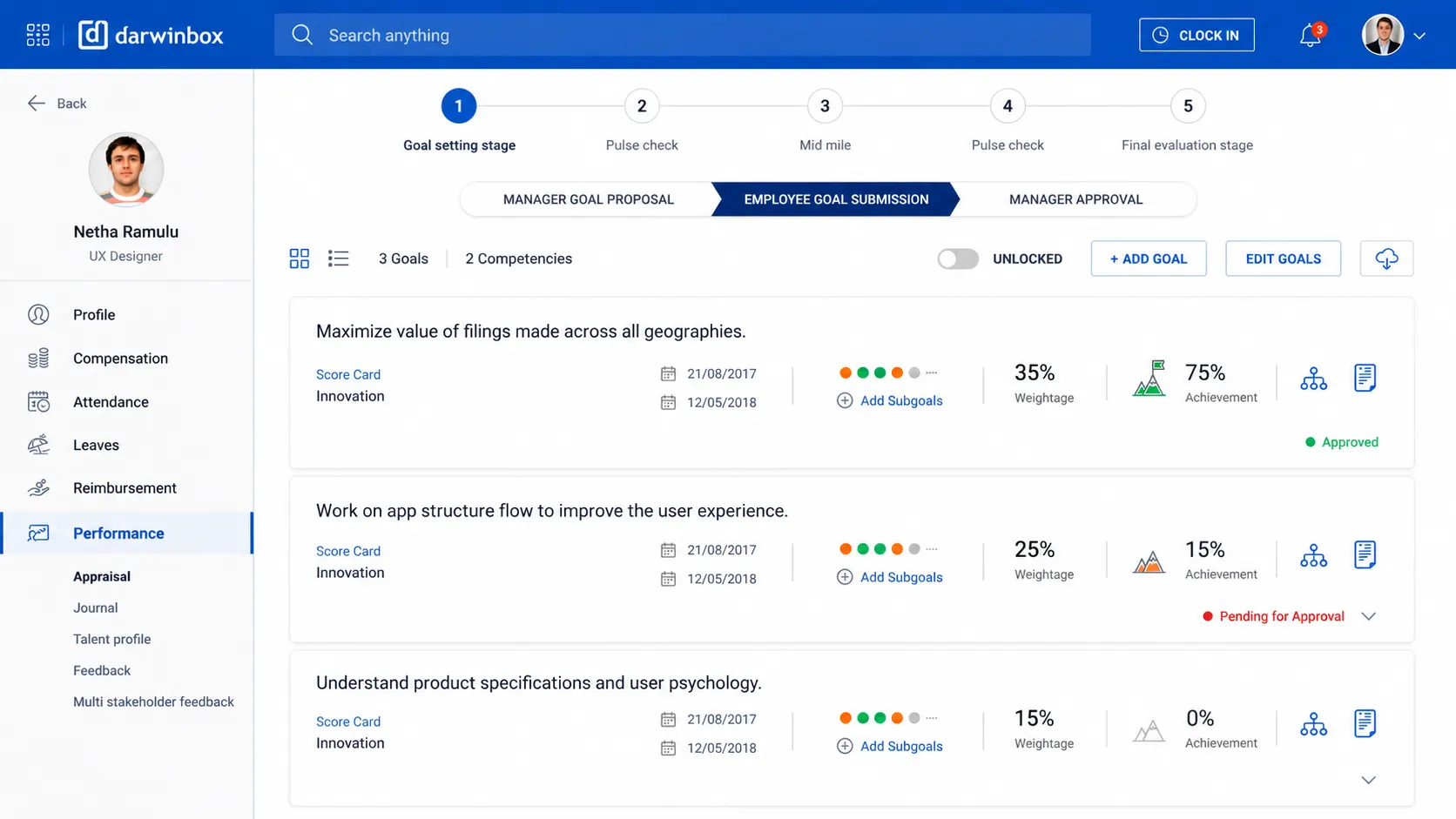
Darwinbox has earned genuine enterprise credibility in the Indian and APAC market, grounded in module breadth few regional competitors can match at comparable scale. The platform covers core HR, recruitment, payroll, time and attendance, performance management, people analytics, engagement and learning in a single cloud-native system. Darwinbox Sense, its embedded AI and agentic-automation layer, triggers workflows, provides recommendations and accelerates routine approvals, meaningfully reducing the administrative burden on HR Ops teams managing large, distributed workforces. The mobile-first experience and WhatsApp integration for employee self-service reflect a genuine understanding of how APAC employees actually access HR systems.
Darwinbox's most honest gap shows up after the contract is signed: implementation timelines routinely stretch across multiple quarters, and the subscription meter runs from day one. Navigation complexity is a consistent complaint. Performer visibility is still largely module-dependent and manager-fed rather than a continuous independent signal across functions. Bias correction operates at the calibration and analytics level rather than monitoring individual rating drift in real time, and the business-outcome link is configurable but not structurally enforced.
Darwinbox is right for Indian enterprises that need a comprehensive HCM suite, have the implementation runway and budget to do it properly, and are buying for a future state of 2,000+ employees. The module breadth is real, the AI layer is maturing, and the APAC market knowledge is genuine. The honest caution: don't underestimate the implementation complexity or the time-to-value gap, and don't mistake breadth for depth on the seven parameters.
Actus
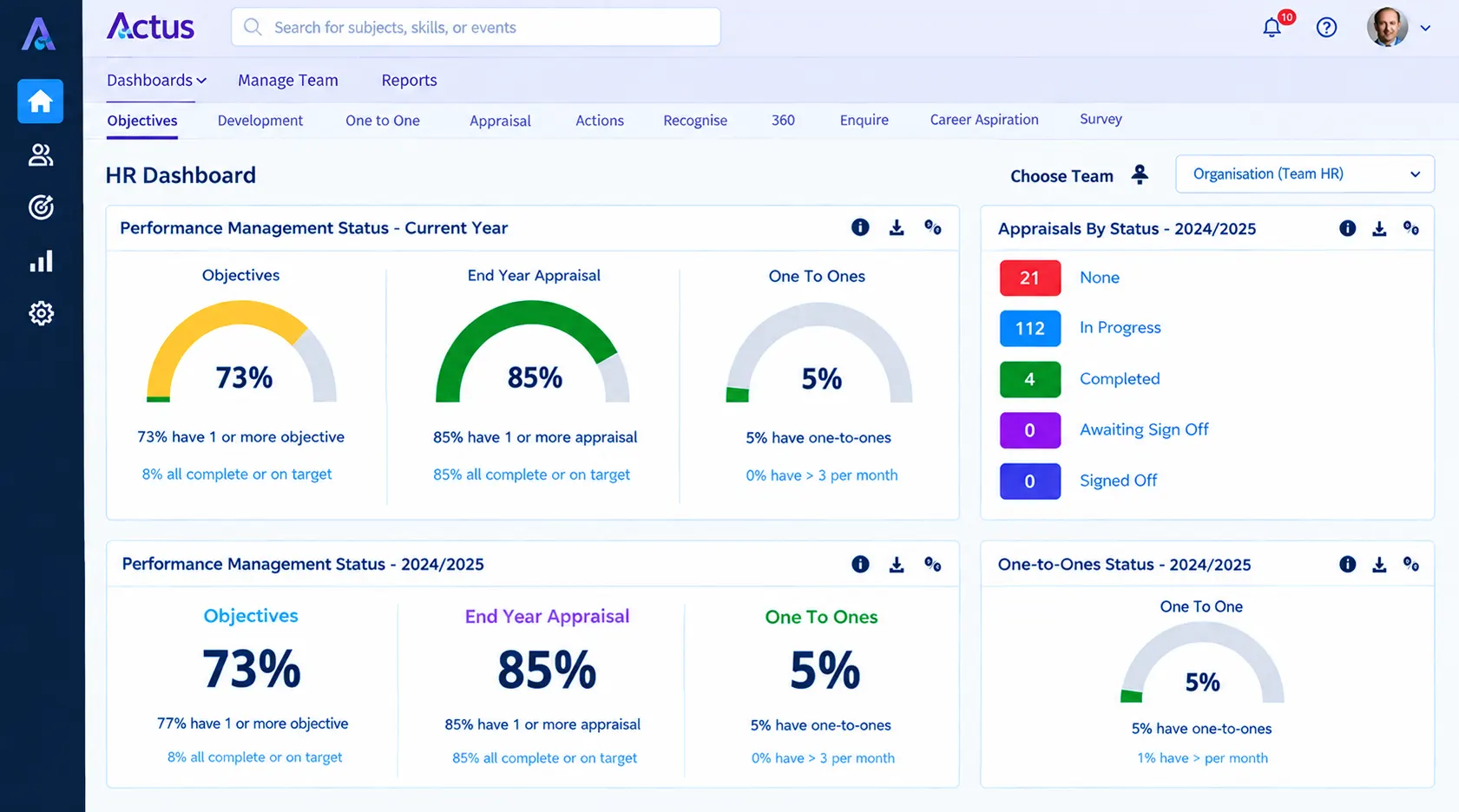
Actus was built around embedding continuous, meaningful conversations rather than digitising a once-a-year form — appraisals, one-to-ones, development and training plans, career aspirations, and recognition all sit in one configurable, ISO-certified system with a UK-based support desk, which matters for buyers who've been burned by US-headquartered vendors' support hours. Bell-curve and organisational benchmark reporting give HR a structured read on rating distribution, and the platform integrates with IRIS Cascade, Ciphr, Azure AD and Okta.
Performer visibility is still cycle- and manager-dependent. There's no AI-driven skills intelligence or real-time bias-drift monitoring comparable to what SuccessFactors or Betterworks have built — Actus's strength is UK-market fit and configurability, not a predictive, always-on intelligence layer.
A strong, trustworthy shortlist option for UK organisations that value local support and configurability over AI-driven prediction. Pairs naturally with our guides to continuous feedback tools for UK teams and employee appraisal tools UK.
Why good software does not guarantee good outcomes
I want to say something most vendors will never tell you, because their business model depends on you not believing it: buying the right platform is the beginning of the work, not the end of it. I've watched organisations buy good software- some on this list- and come back eighteen months later with the same nine problems. Measuring whether that investment actually pays off is its own discipline — see how to calculate performance management ROI properly.
The process gets skipped in the rush to go live
The most common mistake is treating the software implementation as the implementation. The platform goes live, cycles are configured, notifications go out- and nobody has defined what a good KRA looks like, how feedback should be structured, or what a calibration discussion actually is. The tool surfaces whatever the process produces. If the process is vague, the tool makes the vagueness more visible and more efficiently distributed.
HR owns adoption. Managers do not.
HR configures the system, sends the reminders, chases the submissions, closes the cycles. Managers treat the platform as an HR task rather than a management tool. When the 1:1 cadence is optional, managers with a full delivery calendar make the rational choice and skip it. The behaviour change has to happen before the platform goes live- by distributing accountability explicitly and making 1:1 completion visible at the leadership level.
The skills data gets ignored after the first cycle
The platform produces skills-gap data. L&D sees it- and then does what it has always done: runs the programmes managers suggested rather than the ones the data indicates. If your L&D planning process doesn't change after a PMS implementation, your L&D outcomes won't change.
PIPs look the same before and after the tool change
The stigma around PIPs is not a documentation problem- it's a culture problem the tool can't fix alone. Putting a pre-termination formality into a structured digital workflow doesn't change the culture. It documents the existing culture more efficiently. The work is the conversations with managers before launch: what a PIP is for, and how success is defined other than "the employee wasn't terminated."
The 1:1 cadence never becomes structural
Across every implementation, the 1:1 is the feature with the highest stated priority and the lowest actual adoption. Everyone agrees it matters- and yet, without an explicit, tracked, accountability-linked cadence, 1:1s are the first thing that disappears when a deadline approaches. It becomes consistent only when R&R visibility is tied to check-in cadence and that linkage is explicit to the management layer.
What successful implementations have in common
The process was defined before the platform was configured. Manager accountability was explicit, not assumed. The data was acted on within ninety days of the first cycle. And the business-outcome question was asked from the beginning- not "are our reviews complete" but "are our people moving our business forward, and can we see that connection in the data?" The platforms on this list give you the infrastructure to answer that. The work of actually answering it is yours.
Who this review is for- and who it is not
There is a version of this page that ends with a feature-comparison table and a conversion button. This is not that page. I wrote this as an OKR Coach who has spent ten years watching performance-management programmes succeed and fail- not as a marketer trying to sell you software. The decision you're making is not really a software decision. It's a decision about whether HR stays administrative or becomes strategic.
If you're evaluating for the first time
Start with the seven framework questions, not the feature list. Ask every vendor: how does your platform give HR performer visibility without depending on a manager's input? How does it prevent vague, verbal feedback from becoming a calibration dispute? How does it connect skills data to L&D rather than gut-feel? How does it handle PIPs as genuine improvement plans? How does it enforce 1:1 cadence? How does it link individual performance to business objectives? And how does it catch rating bias before calibration, not during it? The answers will tell you more than any demo.
If you've already bought a platform and the nine problems persist
The platform is probably not the problem. In my experience, the gap between a live PMS and a working PMS is almost always a process and accountability gap, not a feature gap. Before you re-evaluate the software, audit the operating model: is manager accountability explicit? Is the skills data being acted on? Are PIPs being used as development tools or off-ramps? Are 1:1s tracked or treated as optional? Fix the operating model first- then ask whether the platform is giving you what you need.
If you're choosing between Worxmate and something else on this list
I am biased, and I should say that directly. Worxmate is what I built after ten years of seeing the same nine problems repeat. The bias is structural, not promotional. What I can tell you honestly: Worxmate is not right for every organisation here. If you're a 50-person company formalising reviews for the first time, Effy AI or ThriveSparrow or PeopleGoal will serve you better, and if you're a global enterprise already on Workday, SAP, or PeopleFluent, the consolidation case probably outweighs the intelligence-layer argument.. If you're a global enterprise already on Workday or SAP, the consolidation case probably outweighs the intelligence-layer argument. Worxmate is built for the HR leader who has already tried a platform, run the cycles, done the calibration meetings- and is still asking why HR always finds out too late.
Explore by geography, size and industry
This guide is Worxmate's global pillar page on performance management software. Use the cluster pages below to go deeper on your specific region, company size, or industry.
By Region
Top Performance Management Software USA · HR Trends USA 2026 · Continuous Feedback Tools UK · Employee Appraisal Tools UK · Affordable OKR Tools UK · Performance Management Software in India · Employee Performance Management Software India · PMS Software for Small Business India · Best PMS for Manufacturing India
By Company Size
Performance Management Software by Company Size · Performance Management for Small Business · Performance Management Software for Startups · Performance Management Software for Enterprise
Frequently asked questions
What is the best performance management software in 2026?
Worxmate is the best overall pick for mid-to-large enterprises that want performance data tied to business outcomes. Workday, SAP SuccessFactors and Oracle lead for HCM-suite buyers, Betterworks leads best-of-breed enterprise, Lattice and Leapsome lead mid-market, and BambooHR, ThriveSparrow, Effy AI and PeopleGoal lead SMB.
What should HR look for in performance management software?
Evaluate against seven questions: manager-independent performer visibility, structured written feedback, skills-data-driven L&D, genuine PIP tracking, mandatory 1:1 cadence, explicit KRA-to-business-goal linkage, and real-time bias correction before calibration — not a feature checklist.
Is Worxmate better than Workday or SAP SuccessFactors?
Worxmate is better suited to organisations that want a purpose-built performance-intelligence layer without an enterprise HCM implementation. Workday and SAP SuccessFactors make more sense if you're already standardised on those suites and consolidation matters more than intelligence depth.
What is the best performance management software for small businesses?
Effy AI, ThriveSparrow, BambooHR and PeopleGoal are the fastest, lowest-overhead options for small businesses formalising performance reviews for the first time, starting from roughly $3–$5 per user per month.
What is the best performance management software for the UK?
Actus is a strong UK-specific pick for its local support desk and configurability. Culture Amp and Eletive are also popular for European and UK engagement-first buyers, while Worxmate suits UK enterprises wanting the business-outcome layer.
How much does performance management software cost?
Pricing ranges from about $3–$5 per user/month for lightweight SMB tools (Effy AI, PeopleGoal, Actus) to $10–$25 per employee/month for mid-market suites (BambooHR, Lattice), up to custom enterprise quotes for Workday, SAP, Oracle, Betterworks and Worxmate.
What changes when performance data finally answers the business question
It was a great experience understanding the deeper aspects of OKR, how different it is based on goal setting and KPI assessment. Maddy demonstrated his teaching of OKRs with humility, patience..., and a deep understanding of the subject. His calm approach and clarity made the learning experience truly impactful.

Worxmate made setting and tracking goals easy, helping our team stay aligned, perform better, and become more accountable.

Worxmate's smart insights improved how we manage our team. It's user-friendly and made our work simpler compared to Zoho People.


See Worxmate AI in action.
We will configure live scenarios tailored to your company size, OKR cycles, and appraisal rhythms — zero generic pitch decks.