
The Worxmate OKR Execution Maturity Framework
Where the world's organizations actually stand on goal execution — and why most are stuck below the level they think they're at.
Most organizations believe they're further along than they are.
That gap — between perceived maturity and actual execution — is the subject of this report.
There is no shortage of OKR advice in the market. What is missing is a way to place your own organization on an honest scale, built from evidence rather than vendor marketing. This report introduces that scale: the Worxmate OKR Execution Maturity Framework, a four-stage model built from over a decade of live OKR implementations across enterprise, SMB, and startup organizations, benchmarked against independent research from Deloitte, PwC, EY, Gallup, and peer-reviewed academic studies — deliberately excluding vendor-commissioned OKR survey data, which dominates most "benchmark" content in this category.
Goal completion rate is the most visible OKR metric and the least meaningful one. The metric that matters is what percentage of your leaders can write a genuine outcome-driven goal without help.
What the data shows
- Alignment, not intent, predicts motivation. PwC's 2025 Global Workforce survey of nearly 50,000 workers found employees who feel aligned with leadership goals are 78% more motivated — yet only 64% of the broader workforce say they understand their organization's goals at all.
- Leadership acknowledges the gap but is not closing it. Deloitte's 2026 Global Human Capital Trends (9,000+ leaders, 89 countries) found 66% of C-suite leaders say traditional management functions must change, but only 7% say they are making real progress.
- Engagement — the precondition for any goal system to work — is falling globally. Gallup's 2026 State of the Global Workplace found engagement down to 20%, the second consecutive annual decline, with manager engagement collapsing from 30% to 22% since 2022.
- Independent academic research confirms OKRs work — when agreement, not just cascade, is present. Peer-reviewed studies from the Journal of Business Research and Harvard Business School document OKRs functioning as genuine coordination mechanisms, but only where middle managers are actively equipped to use them.
Triangulated together, this evidence places the majority of organizations globally in Stage 2 of the framework — Cascade Without Agreement — where the OKR structure exists on paper but the underlying agreement it is supposed to represent does not yet exist in practice.
Built differently from most OKR "benchmark" content
Most publicly available OKR statistics — completion rates, ROI multiples, cycle-over-cycle curves — originate from OKR software vendors surveying their own customers. That data is directionally useful but structurally biased: it measures the vendor's users, not the market, and is rarely independently audited. This report excludes it entirely.
What We Used
- Global workforce research from Deloitte, PwC, EY, and Gallup — independently fielded studies of 15,000 to nearly 50,000 respondents
- Peer-reviewed academic research on OKRs and strategy implementation, including Harvard Business School and Journal of Business Research
- Unfiltered practitioner commentary from Reddit, LinkedIn, and independent newsletters
- Worxmate's own field data from OKR coaching engagements across APAC, the Middle East, and Europe
What We Excluded
- OKR software vendor-commissioned surveys and "state of OKR" reports
- Completion-rate and ROI statistics sourced only from vendor customer bases
- Any claim we could not trace to a named, independent methodology
- Adjacent workforce data presented as if it were OKR-specific (we flag inference explicitly instead)
This is a synthesis of independent evidence, read through a maturity lens built from real implementation experience — not a survey of 300 OKR software customers.
The Worxmate OKR Execution Maturity Framework
Every organization using OKRs sits somewhere on a spectrum between compliance and culture. The determinant of where isn't process sophistication — it's whether leaders can write and execute a genuine outcome-driven goal without help. That capability is what Worxmate calls the Execution Maturity Rate, and it's the spine of the four stages below.
Stage 1 — Compliance Mode
EMR: 5–15%OKRs exist because someone mandated them, not because leaders were sensitised to why they matter. Objectives are written to satisfy a template. Key Results are frequently KPIs in disguise — metrics the team was already tracking, relabelled.
- • OKR ownership sits with HR, and the rest of the leadership team treats it as a performance-appraisal exercise rather than a strategy execution system
- • Goals were pushed with a go-live date and a software login, not chosen after leaders understood what it meant for their teams
- • Most Key Results describe activity ("launch," "complete," "conduct") rather than a measurable change in outcome
Stage 2 — Cascade Without Agreement
EMR: 15–25%The structure is now in place. OKRs cascade visibly from company to team level, dashboards look complete, check-ins happen on schedule. But the cascade is a record of a management decision, not evidence that teams actually agree on what matters and why. This is where most organizations sit — and where most OKR programs quietly stall.
- • Coaching and real conversation stopped at the C-suite; the middle management layer — where OKR programs actually live or die — was never equipped to run meaningful check-ins
- • Leaders can point to a cascaded OKR tree in the tool, but cannot articulate, unprompted, why a team's Key Result matters to the objective above it
- • Goals are reviewed monthly or quarterly rather than weekly, so misalignment surfaces too late to correct within the cycle
Stage 3 — Coordinated Execution
EMR: 25–35%Agreement starts to become real rather than displayed. Cross-functional dependencies are surfaced before the cycle starts, not discovered mid-quarter. Leaders are starting to distinguish output from outcome without being coached through every instance.
- • Cross-functional co-ownership of Key Results appears for the first time — accountability that neither function can quietly hand off to the other
- • Retrospectives produce real changes to the next cycle's goals, rather than a generic "continue as planned"
- • OKR completion is explicitly decoupled from compensation, so teams stop sandbagging targets to protect bonus payouts
Stage 4 — Embedded Outcome Culture
EMR: 30–40%Outcome-thinking has become the default instinct, not a coached behaviour. The organization treats OKRs as a compounding, cycle-over-cycle learning system rather than a quarterly ritual — and is often willing to simplify or even drop individual-level OKRs once company and team-level alignment is genuinely strong.
- • The Execution Maturity Rate becomes the metric leadership actually watches — not completion percentage, which can be high even when goals were never outcome-driven to begin with
- • The organization has stopped treating a stretch-goal miss as a performance failure and started treating it as expected information
- • Where individual OKRs no longer add value beyond company and team-level clarity, mature organizations remove them rather than defending the process for its own sake
Where does your organization sit on this framework?
Most leaders reading this will place themselves a stage higher than the evidence supports — that's the whole reason this report exists. A 20-minute conversation with Worxmate's OKR consulting team will tell you exactly where you actually stand.
What the independent evidence signals
These indicators are not OKR-specific survey statistics, by design — see the methodology above. They are the closest independent, credible signals available for where organizations sit on goal clarity, alignment, and execution capability.
The global centre of gravity: Stage 2
Triangulating the scorecard against the framework produces an uncomfortable but consistent picture: the global centre of gravity sits in Stage 2 — Cascade Without Agreement.
Deloitte finds leaders acknowledge the need for change but are not executing on it. PwC finds a majority of the workforce does not understand the goals they're meant to be aligned to. Gallup finds the manager layer — the layer every OKR program depends on to translate cascade into agreement — is more disengaged than at any point since it began tracking the metric. None of this describes an organization in Stage 1, where structure itself is absent. It describes organizations that built the structure and stalled at the harder problem underneath it.
A smaller share remain in Stage 1 — typically first- or second-cycle adopters, or organizations where OKRs were mandated without prior sensitisation. Stage 4 is rare by design: it requires roughly 12 months of sustained, coached practice, longer than most programs survive.
Two companies, two endpoints
Spotify
Spotify's own HR team said publicly that OKRs worked well at the corporate level but that individual-level OKRs began slowing the business down without adding value. Rather than defending the process for its own sake, Spotify deliberately dropped individual OKRs — freeing people to focus on the work itself. The organization trusted real alignment enough to simplify the system built on top of it. Separately, Rick Klau — who narrated Google's well-known internal OKR training video — later advised most companies, especially smaller ones, to skip individual-level OKRs entirely.
Sears
Sears applied OKRs top-down across every level of the business, from high-level strategy down to granular day-to-day tasks, with limited employee buy-in. Applying the framework to everything diluted its effectiveness and produced OKR fatigue — employees overwhelmed by a system that never distinguished meaningful change from routine work. Structure was mandated without agreement, and the program never progressed past compliance.
“We never hit them.”
What it feels like from inside the stall
Independent research explains why organizations stall. Practitioners describe what it feels like from inside it. Three recurring patterns surface repeatedly in unfiltered commentary — each maps to a specific stage transition.
Pattern 1 — Set and forgotten (Stage 1→2 stall)
OKRs get set with genuine enthusiasm, then disappear into a document, unreviewed, until the quarter is nearly over and nothing has moved. One product leader described the realization, mid-quarter, that a goal set two months earlier had received no attention since.
Pattern 2 — The three traps (Stage 2 ceiling)
A widely shared LinkedIn post identified three recurring traps that cap organizations at Stage 2: cascading objectives top-down without letting teams shape their contribution, refusing to adjust Key Results mid-cycle even when clearly off-track, and — most damaging — tying OKR achievement directly to bonus payments, which quietly incentivizes sandbagging.
The Worxmate field perspective
“When HR drives the OKR program, the rest of the leadership team treats it as one more framework to assess performance — not a strategy execution engine.”
This mirrors what shows up repeatedly across Worxmate's own coaching engagements: the ownership decision determines the outcome before a single OKR is written. In one 70,000-person IT services organization, leadership could not connect day-to-day work to business priorities until a live exercise forced them to distinguish output from outcome using their own real scenarios. That kind of intervention, repeated at the manager layer rather than stopping at the C-suite, is what moves an organization from Stage 2 to Stage 3.
Recognize the pattern?
The stall points above — the Coaching Cliff, HR-owned OKRs, bonus-linked targets — are the three most common reasons OKR programs plateau at Stage 2. Each is fixable, but not with a software switch alone.
Seven consistent differentiators
- Ownership sits with the CEO's office, not HR alone — determining whether OKRs are read as a strategy execution engine or a performance-appraisal exercise
- Coaching continues past the C-suite into the middle management layer, where programs actually live or die
- OKR completion is explicitly decoupled from compensation, removing the incentive to sandbag targets
- Cross-functional Key Results carry joint ownership, forcing dependency conversations single-owner goals let teams avoid
- Leadership tracks capability — the share of leaders who can write a genuine outcome-driven goal unaided — over completion percentage
- The organization is willing to simplify the system, including removing individual-level OKRs, once real alignment no longer needs the scaffolding
- The commitment is measured in cycles, not quarters — 12 months of sustained practice, not a single cycle judged pass or fail
One completed OKR is worth more than five written ones.
Who wrote this
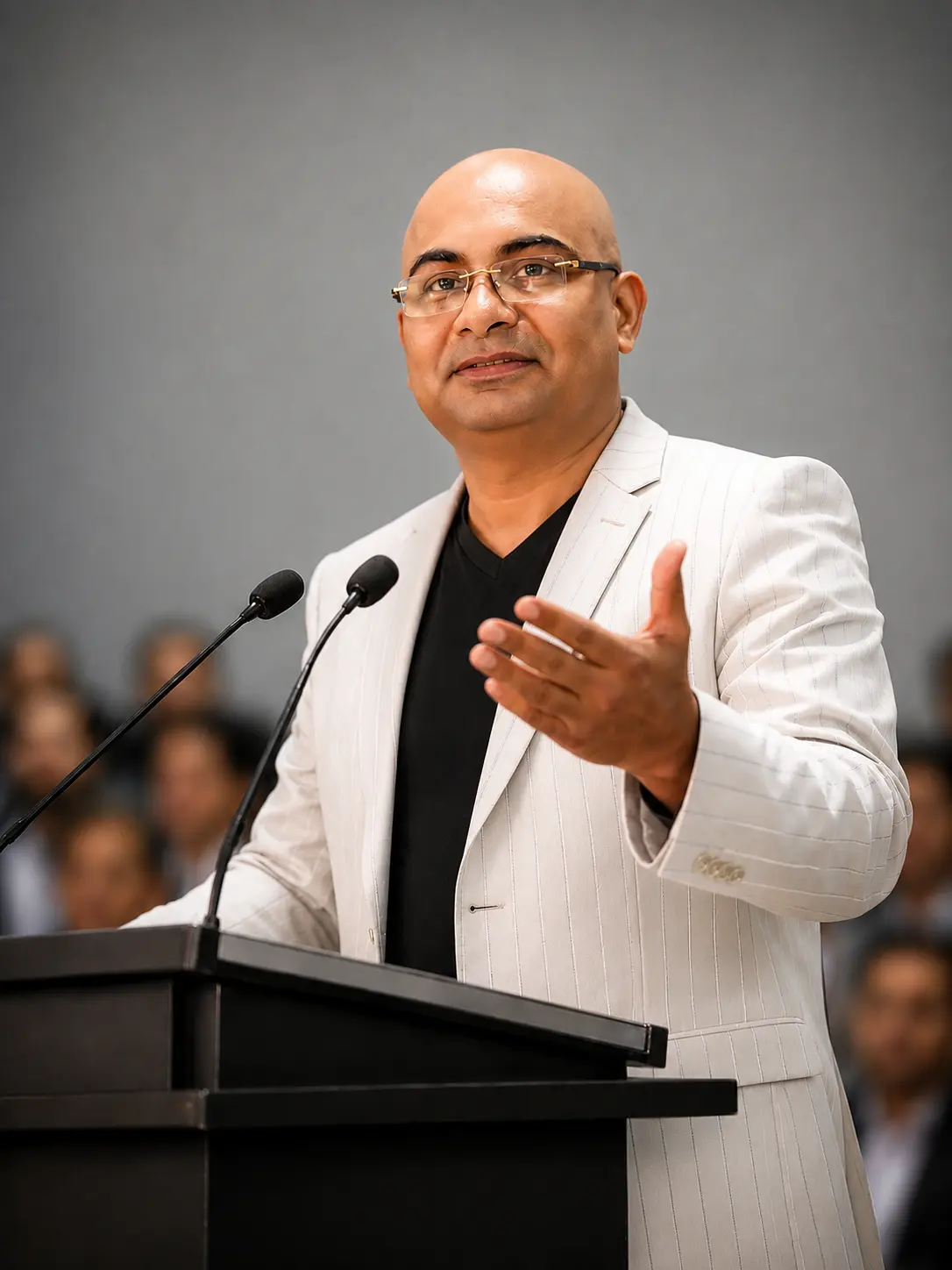
Madhusudan Nayak
Maddy is a strategy execution expert and OKR coach with more than 25 years of experience helping mid-to-large enterprises close the gap between strategic intent and what actually happens on the ground. Over the past decade, he has personally coached OKR implementations across 50+ global organizations spanning technology, pharmaceuticals, manufacturing, retail, financial services, and sports — across APAC, the Middle East, and Europe.
The maturity framework, Execution Maturity Rate, and field observations in this report are drawn directly from that coaching experience — not adapted from secondary sources. Maddy is also the architect of Worxmate's DEEP AI™ execution framework, referenced throughout this report.
Two ways forward
This report was produced by Worxmate.ai, an OKR, performance management, and project execution platform built for growth-stage and enterprise organizations. Worxmate's perspective on OKR maturity is drawn from over a decade of live implementation and coaching experience across 50+ organizations, 500+ leaders trained, and industries spanning IT services, fintech, retail, energy, and manufacturing across APAC, the Middle East, and Europe.
If this report reflects where your organization sits, the next question is usually one of two things.
If the gap is structural
Your organization needs a system that makes weekly check-ins, at-risk detection, and cycle-over-cycle learning the default rather than the exception.
Explore OKR Software →If the gap is capability
The harder problem is that leaders have the tool but not yet the instinct — the Coaching Cliff described in this report.
Explore OKR Consulting →The software is the infrastructure. The coaching is the capability. Most organizations need both, in the right order.
Sources
- PwC. "Global Workforce Hopes and Fears Survey 2025." pwc.com/jg/en/publications/hopes-and-fears.html
- Deloitte. "2026 Global Human Capital Trends: From Tensions to Tipping Points." deloitte.com/us/en/insights/topics/talent/human-capital-trends.html
- EY. "Work Reimagined Survey 2025." ey.com/en_gl/insights/workforce/work-reimagined-survey
- Gallup. "State of the Global Workplace 2026."
- Harvard Business School. Srinivasan, S. and Ni, L. "A Primer on OKRs." HBS Background Note 123-081, 2023.
- Wowerath, C. "Objectives and key results as a tool for middle managers to enhance the process of strategy implementation." Journal of Business Research, Vol. 202, 2026.
- Wowerath, C. "Engaging the entire organization: how OKRs enhance integrative strategy implementation." Journal of Business Research (ScienceDirect), 2025.
- r/ProductManagement community discussion, via Tability, "#OKRfails: Why OKRs suck according to Reddit users," 2025.
- Lane, product leadership newsletter. "What I hate about OKRs, and what to do about it." Substack, 2023.
- OKR Institute. "The Do's and Don'ts of OKRs: Prerequisites and Red Flags" (Spotify and Sears case discussion), 2024.
- Small Improvements. "What HR needs to know about OKRs and employee goals" (Spotify HR statement, Rick Klau statement).
- LinkedIn practitioner post. "3 ways to mess up OKRs (and how to avoid them)."
- Worxmate.ai. Internal field data from OKR implementation and coaching engagements, 2015–2026.
- Worxmate.ai. "OKR Consulting" — Madhusudan Nayak author profile. worxmate.ai/okr-consulting/