 WORXMATE

Summary
Customer support okrs are a strategic goal-setting framework that enables service teams to define ambitious, measurable objectives that go beyond daily ticket management. By focusing on outcomes rather than just activities, these OKRs help teams improve customer satisfaction, streamline internal processes, and align support efforts with broader company growth.
Modern service organizations use this framework to transform support from a cost center into a value driver. By implementing customer support okrs, leadership can foster a culture of continuous improvement and ensure that every support interaction contributes to long-term business success.
Customer support okrs represent a fundamental shift in how service teams measure success and drive performance. In many mid-market companies, support is often viewed through the narrow lens of volume—how many tickets were closed or how fast a phone was answered. However, as customer expectations evolve, simply keeping up with volume is no longer enough to maintain a competitive advantage.
The challenge for many Heads of Customer Experience (CX) is bridging the gap between daily operations and high-level strategy. According to Gartner, 80% of organizations expect to compete mainly on customer experience, yet many struggle to translate that vision into actionable goals for their frontline staff. This is where a structured framework becomes essential for organizational alignment.
This article provides a comprehensive guide on how to design, implement, and track customer support okrs. We will explore the differences between traditional metrics and OKRs, provide real-world examples, and demonstrate how to align your support team’s efforts with global business priorities to drive customer retention and growth.
What are Customer Support OKRs and Why Do They Matter?
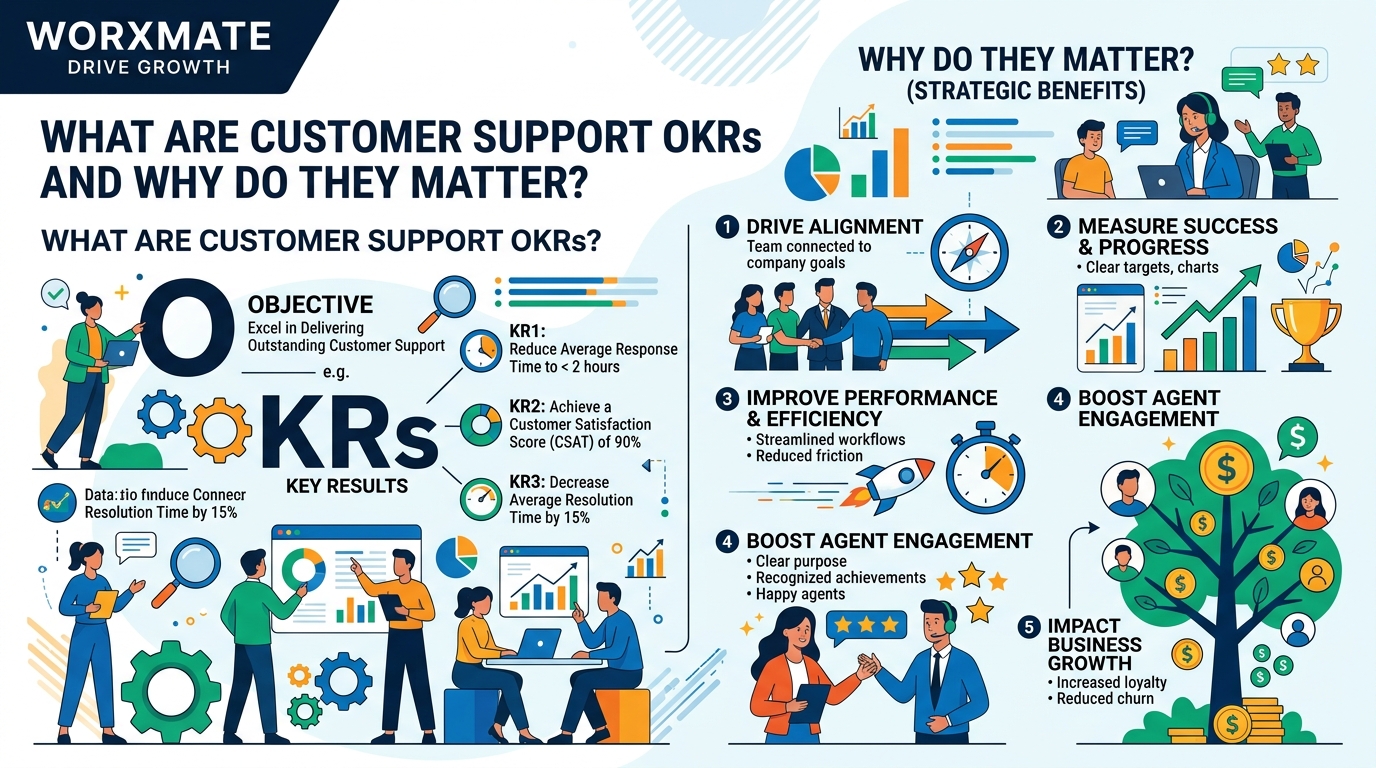
Customer support okrs (Objectives and Key Results) are a collaborative goal-setting tool used by teams to set challenging, ambitious goals with measurable results. While an “Objective” defines what you want to achieve (e.g., “Provide World-Class Technical Support”), the “Key Results” are the specific, quantitative benchmarks used to track the achievement of that objective.
When organizations like Adobe or Microsoft implement customer support okrs, they are looking to move the needle on specific business outcomes. McKinsey reports that companies with high customer satisfaction scores achieve 2x the revenue growth compared to their peers. By using OKRs, support teams can focus on the specific levers—such as self-service adoption or product feedback loops—that lead to these financial gains.
The importance of this framework lies in its ability to provide clarity. In a high-pressure support environment, it is easy for teams to lose sight of the “why” behind their work. OKRs provide that purpose, linking individual contributions to the company’s strategic vision and ensuring that everyone is moving in the same direction.
The Difference Between Support KPIs and Customer Support OKRs
One of the most common points of confusion for support leaders is the relationship between Key Performance Indicators (KPIs) and OKRs. While they are related, they serve different purposes within a strategic performance management system. KPIs are “health metrics” that track the status quo, whereas OKRs are “growth metrics” that track progress toward a specific change or improvement.
Think of KPIs as the dashboard in a car, showing your speed and fuel level. OKRs are the GPS, showing where you are going and how far you have progressed toward your destination. While you need both to reach your goal, they require different management approaches.
| Feature | Support KPIs | Customer Support OKRs |
|---|---|---|
| Purpose | Monitor ongoing operational health. | Drive significant improvement or change. |
| Timeframe | Continuous and ongoing. | Usually quarterly (90-day cycles). |
| Focus | Outputs (Tickets closed, Average Handle Time). | Outcomes (Improved CSAT, Reduced Churn). |
| Example | Maintain First Response Time under 2 hours. | Reduce First Response Time by 30% via AI. |
Effective support team performance management requires a balance. You must maintain your KPIs to keep the lights on while simultaneously pursuing customer support okrs to evolve the department. For instance, you might have a KPI for ticket volume while setting an OKR to increase the effectiveness of your knowledge base to deflect that volume.
How to Align Customer Support OKRs with Global Company Goals
For customer support okrs to be effective, they cannot exist in a vacuum. They must be vertically aligned with the company’s strategic priorities. If the company’s primary goal is rapid market expansion, the support team’s OKRs should focus on scalability and localized support. If the goal is profitability, the focus might shift to efficiency and self-service.
Alignment starts with a “top-down, bottom-up” approach. Leadership sets the high-level objectives, and the support team proposes the key results they can achieve to support those objectives. This ensures that the goals are realistic and that the team has “skin in the game.” Gallup found that engaged employees result in a 10% increase in customer loyalty and a 23% increase in profitability. This engagement is often a direct result of employees understanding how their work impacts the bigger picture.
To achieve this, managers should use measurable goals that clearly indicate success. For example, if the company objective is to “Improve Product Quality,” a support OKR could be to “Increase the percentage of support-driven product bug fixes by 20%.” This creates a direct link between the support desk and the engineering team, fostering cross-functional collaboration.
Unlock Goal Clarity and Accelerate Employee Growth
Looking to drive goal clarity and employee growth? Discover how Worxmate’s AI-powered Performance Management Software can help.
Actionable Customer Support OKR Examples
Setting the right objectives requires a deep understanding of your team’s current maturity and the company’s needs. Below are 6 performance goals examples structured as customer support okrs to help you get started.
-
Objective: Deliver an Effortless Customer Experience
Key Result 1: Increase Customer Satisfaction (CSAT) score from 82% to 90%.
Key Result 2: Reduce Customer Effort Score (CES) from 4.5 to 3.0.
Key Result 3: Achieve a First Contact Resolution (FCR) rate of 75%. -
Objective: Scale Support Operations Through Automation
Key Result 1: Increase knowledge base article views by 50% through SEO optimization.
Key Result 2: Deploy an AI chatbot to resolve 25% of common Tier 1 inquiries.
Key Result 3: Reduce total incoming ticket volume by 15% despite a 10% user growth. -
Objective: Transform Support into a Product Feedback Engine
Key Result 1: Tag 100% of tickets with specific product feature categories.
Key Result 2: Deliver a monthly “Voice of the Customer” report to the Product team with 5 actionable insights.
Key Result 3: Close the feedback loop with 100% of customers who requested a feature that was recently launched. -
Objective: Build a High-Performing and Engaged Support Team
Key Result 1: Ensure 100% of support agents complete advanced technical certification training.
Key Result 2: Maintain an internal eNPS (Employee Net Promoter Score) of +40.
Key Result 3: Conduct weekly one-on-one meetings with 100% attendance to discuss career development. -
Objective: Optimize Technical Support for Enterprise Clients
Key Result 1: Maintain 99.9% SLA compliance for all Priority 1 (P1) incidents.
Key Result 2: Reduce Average Resolution Time for Enterprise tickets from 24 hours to 12 hours.
Key Result 3: Achieve a 95% “Highly Satisfied” rating on technical accuracy audits. -
Objective: Enhance Proactive Customer Success Support
Key Result 1: Identify and reach out to 50 “at-risk” customers based on low usage patterns.
Key Result 2: Increase expansion revenue leads generated by support by 10%.
Key Result 3: Conduct 20 proactive “Health Check” webinars for new users.
Customer Support OKRs for Technical Support vs. Customer Success
It is important to distinguish between the focus areas of technical support and customer success when drafting customer support okrs. While they both aim for improving customer satisfaction, their tactical approaches differ significantly.
Technical support teams usually focus on reactive excellence—solving problems that have already occurred. Their OKRs often center around speed, accuracy, and technical depth. For example, a technical support OKR might focus on reducing the escalation rate to engineering, which directly impacts internal efficiency and product stability.
In contrast, customer success objectives and key results are generally more proactive. Their goals are tied to adoption, retention, and expansion. Success teams look at “health indicators” to prevent churn before a ticket is even opened. By differentiating these customer support okrs, leadership can ensure that the entire post-sale journey is optimized, from troubleshooting a bug to renewing a million-dollar contract.
How to Track and Review Customer Support OKRs in Worxmate
The failure of most goal-setting initiatives isn’t in the setting of the goals, but in the tracking of them. Without a centralized system, customer support okrs often end up forgotten in a spreadsheet. To avoid this, teams should integrate their goals into their daily workflow using performance management software for HR teams and managers.
Regular okr check-ins are the heartbeat of the framework. These should be brief, weekly or bi-weekly meetings where the team reviews progress toward Key Results, identifies blockers, and adjusts tactics. In Worxmate, these check-ins are automated, allowing managers to see real-time progress bars and confidence scores for every objective.
Furthermore, using a platform like Worxmate allows for the “cascading” of goals. You can see exactly how a frontline agent’s key result contributes to the Head of Support’s objective, which in turn contributes to the CEO’s growth goals. This transparency builds trust and ensures that everyone understands the impact of their hard work on the company’s bottom line.
In conclusion, customer support okrs are more than just a management trend; they are a necessary evolution for any service organization aiming for excellence. By moving from reactive metrics to outcome-driven goals, support teams can significantly enhance the customer experience and drive meaningful business value. Whether you are focused on improving CSAT with okrs or scaling operations through AI, the OKR framework provides the structure and clarity needed to succeed.
Ready to accelerate your customer support journey? Start your free trial with Worxmate today and discover how our Performance Management software can transform your strategy into measurable results.


Written by
An OKR Coach with 20+ years of implementation experience, Madhusudan has guided over 50 organisations through successful OKR transformations, training more than 500 leaders. Learn more about Worxmate.