
Summary
Building an effective OKR framework for US tech companies requires a tailored approach that prioritizes agility, outcome-driven metrics, and cross-functional alignment. This framework helps high-growth organizations connect ambitious goals with measurable results, fostering a culture of accountability and innovation.
The dynamic nature of the US tech landscape demands an OKR framework that can adapt quickly to market shifts while keeping distributed teams focused on strategic priorities. This guide outlines six proven steps to construct and implement an OKR framework that drives performance and scales with your tech enterprise.
In the fast-paced world of US tech, traditional goal-setting methods often fall short. Companies need an agile, transparent system to drive innovation and maintain competitive advantage. This is where a robust OKR framework for US tech becomes indispensable, providing clarity and focus for product, engineering, and sales teams navigating rapid change.
CTOs, VPs of Product, and founders in the tech sector face unique challenges, from managing distributed teams to rapidly scaling operations. An effective OKR framework for US tech offers a structured yet flexible approach to ensure that every team and individual contributes meaningfully to the company’s North Star metrics and overarching organizational strategy. It shifts the focus from mere activity to tangible, measurable outcomes.
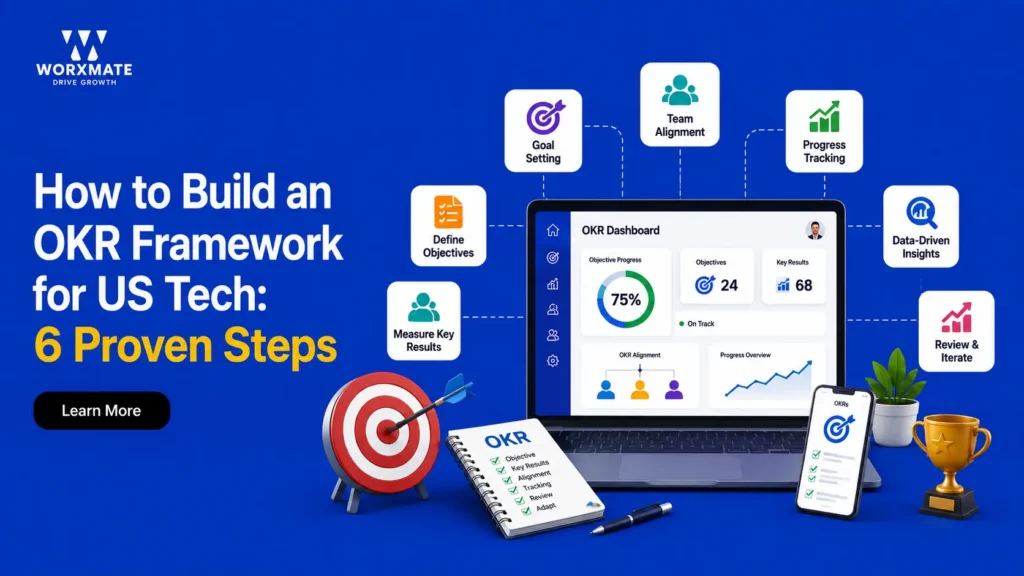
This article provides a practical, step-by-step guide to building and implementing an OKR framework for US tech companies. We’ll cover everything from defining core components to avoiding common pitfalls and leveraging automation for seamless tracking, ensuring your team can effectively implement OKRs that drive real results.
Before diving into implementation, clearly define why your US tech company needs a specialized OKR framework. This involves recognizing the specific challenges and opportunities within the tech sector, such as rapid innovation cycles, intense competition for talent, and the need for continuous product evolution.
Understanding this need helps tailor the framework to your company’s unique context, ensuring it addresses critical areas like engineering team performance management, SaaS growth strategy, and agile goal setting. According to McKinsey, tech companies embracing agile principles can see up to a 30% improvement in time to market, underscoring the importance of a responsive goal-setting system.
Pro Tip: Engage leadership across product, engineering, and sales early to gather their perspectives on current goal-setting pain points and desired outcomes. This co-creation process builds immediate buy-in for the new OKR framework for US tech.
Step 2: Adapt Core OKR Components for High-Growth Tech
While the fundamental Objective and Key Result structure remains, a high-growth tech environment requires specific adaptations. Objectives should be aspirational and inspiring, reflecting the ambition typical of Silicon Valley management frameworks, while Key Results must be unequivocally measurable goals that track outcomes, not just outputs.
For tech startups, this means KRs often revolve around North Star metrics like user engagement, retention, or core revenue growth, rather than simply launching new features. This distinct approach ensures the OKR framework for US tech directly supports scaling tech teams and achieving ambitious business outcomes.
Example: Instead of “Launch Feature X,” an Objective might be “Delight Users with an Intuitive and Performant Platform,” with Key Results like “Achieve 85% user satisfaction for Feature X” or “Reduce average page load time by 20%.”
Step 3: Align Teams with the OKR Framework for US Tech
Cross-functional alignment is paramount in tech, especially when dealing with product, engineering, and sales. The OKR framework for US tech must foster seamless collaboration, ensuring that departmental goals directly contribute to company-wide objectives.
This involves a top-down and bottom-up approach, where company-level OKRs cascade down to teams, and teams propose their own OKRs that support those higher-level goals. According to Harvard Business Review, clear, measurable goals are crucial for maintaining employee engagement and reducing turnover, a significant challenge in the competitive tech landscape.
Practical Tip: Implement regular OKR check-ins and cross-functional review sessions. Companies like Google, pioneers of OKRs, emphasize the importance of transparency and open communication to ensure everyone understands how their work impacts the collective vision.
Unlock Goal Clarity and Accelerate Employee Growth
Looking to drive goal clarity and employee growth? Discover how Worxmate’s AI-powered Performance Management Software can help.
Step 4: Implement Quarterly Tech OKRs for Agile Teams
The agile nature of US tech development necessitates quarterly OKR planning cycles. This allows teams to pivot quickly, learn from data, and adjust their focus in response to market feedback or emerging opportunities. Annual OKRs alone are often too slow for the pace of innovation.
Each quarter, teams should revisit their strategic priorities, set new OKRs, and conduct thorough OKR reviews. This rhythmic approach ensures continuous improvement and maintains momentum for tech startup OKRs. It’s about iterative progress, not rigid adherence to a year-long plan.
Best Practice: Dedicate specific time for OKR setting, review, and reflection at the beginning and end of each quarter. This ritual reinforces the importance of the OKR framework for US tech and prevents it from becoming an afterthought.
Step 5: Avoid Common Pitfalls with Outcome-Based OKRs
A frequent mistake in tech is confusing outputs (e.g., features shipped) with outcomes (e.g., user engagement increased). An effective OKR framework for US tech must rigorously focus on outcomes to avoid becoming a “feature factory” where teams build without clear business impact.
John Doerr, who introduced OKRs to Google, emphasizes that Key Results must be measurable and show whether the Objective has been achieved. A Gartner survey highlighted that only 46% of employees are satisfied with career opportunities, underscoring the need for transparent growth paths and impact, which outcome-focused OKRs can provide.
Pitfall to Avoid: Don’t set too many OKRs. Limit Objectives to 3-5 per team and Key Results to 2-4 per Objective. Overloading teams dilutes focus and makes tracking impossible, undermining the entire OKR framework for US tech.
Step 6: Automate Your OKR Framework with Smart Tools
For distributed tech teams and rapidly scaling operations, manual OKR tracking in spreadsheets quickly becomes unsustainable. Automating your OKR framework for US tech with specialized software is crucial for efficiency, transparency, and real-time insights.
Tools designed for performance management and OKR tracking enable seamless goal alignment, automated reminders for check-ins, and clear dashboards for monitoring progress. This not only reduces administrative burden but also provides leadership with critical data to inform strategic decisions and support scaling tech teams.
Worxmate in Action: Worxmate’s AI-powered platform streamlines the entire OKR cycle, from goal setting to real-time OKR tracking. It integrates with existing workflows, offering a centralized hub for all your performance data and fostering a culture of continuous feedback, essential for any modern strategic performance management system.
Conclusion
Implementing a specialized OKR framework for US tech companies gives leaders a repeatable system to connect daily execution to strategic outcomes. Whether your priority is driving SaaS growth strategy, improving engineering team performance management, or fostering agile goal setting, this process builds the OKR discipline that keeps teams aligned and focused on measurable results.
Teams that follow this process build stronger OKR alignment across functions, maintain momentum through structured OKR check-ins, and power their performance management cycle with real data. The result is a team that moves from activity tracking to outcome ownership – exactly what a modern performance management with OKRs system is built for.
Ready to put this OKR framework for US tech process into action? Explore how OKR software removes the manual effort from goal tracking, use OKRs in strategy to connect every step to company priorities, and manage progress inside a structured OKR alignment. Start your free trial with Worxmate and turn this process into measurable results your team can own.