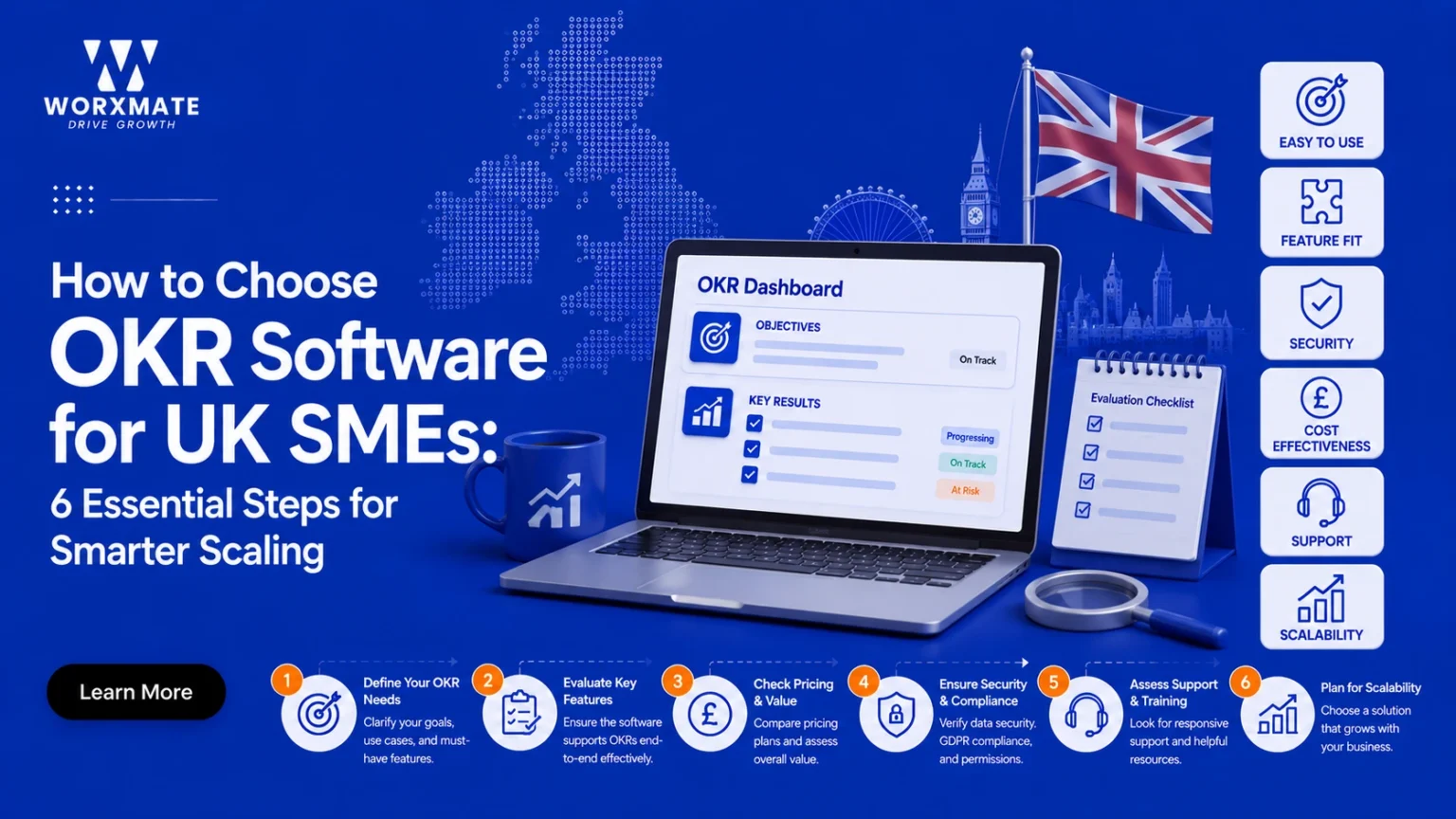
How to Choose OKR Software for UK SMEs: 6 Essential Steps for Smarter Scaling
Actionable insights to align your OKRs with everyday performance management-from proven frameworks to the tools that power them.
Summary
Choosing the right OKR software for UK SMEs involves understanding unique scaling challenges, identifying limitations of traditional goal-setting, and pinpointing key features that drive alignment and execution. The best OKR software for UK SMEs supports business growth strategies by providing clear, measurable objectives and key results, fostering transparency, and enabling real-time performance tracking.
For mid-market companies and startups in the UK looking to scale, implementing a dedicated OKR software for UK SMEs is critical for bridging the gap between strategic vision and daily operational execution, ensuring every team member contributes to overarching organizational goals.
For UK SMEs navigating the complexities of rapid growth, simply having ambitious goals isn’t enough. The challenge often lies in translating those aspirations into measurable actions and ensuring every team member is pulling in the same direction. This is where OKR software for UK SMEs becomes invaluable, providing a structured framework to define, track, and achieve critical business objectives.
Many UK mid-market companies face unique hurdles, from intense market competition to talent retention, making robust performance management for SMEs essential. Without a clear system, growth can quickly lead to disorganization, misaligned efforts, and wasted resources. Effective goal setting strategies are paramount for organizational growth.
This guide will walk you through six essential steps to choosing and leveraging OKR software for UK SMEs, helping you to overcome common scaling challenges and drive your business forward with clarity and precision. We’ll explore how this technology supports strategic alignment, enhances execution, and ultimately, contributes to sustainable business growth strategies UK businesses need.
Step 1: Understand the Unique Scaling Challenges Facing UK SMEs
Before implementing any new system, it’s crucial to identify the specific pain points that OKR software for UK SMEs can address. UK small and medium-sized enterprises often grapple with issues like resource constraints, talent acquisition and retention, and navigating a dynamic regulatory environment.
According to Statista, SMEs accounted for 99.9% of the UK business population in 2023, highlighting their critical role but also the intense competition they face. Understanding these challenges helps tailor your approach to selecting the right OKR software for UK SMEs.
**Pro Tip:** Conduct an internal audit of your current goal-setting and tracking methods. Pinpoint where communication breaks down, where resources are duplicated, and where strategic initiatives lose momentum.
Step 2: Recognize Why Traditional Goal-Setting Fails During Rapid Growth
Traditional goal-setting methods, such as annual reviews or static KPIs, often fall short when a UK small business is experiencing rapid growth. These approaches lack the agility and transparency needed to adapt to changing market conditions and keep diverse teams aligned.
Without a clear and regularly updated framework, employees can lose sight of how their individual efforts contribute to the broader strategic alignment. A Gallup study found that only 23% of employees strongly agree their company’s leaders have communicated a clear vision, a challenge amplified in growing SMEs.
Pro Tip: Evaluate if your current system allows for frequent check-ins, transparent progress visibility, and easy adjustment of goals. If not, you’re likely experiencing the “growth friction” that OKR software for UK SMEs is designed to alleviate.
Step 3: Evaluate How OKR Software for UK SMEs Drives Alignment
Effective OKR software for UK SMEs is a powerful tool for fostering OKR alignment across departments and individuals. It ensures that every team understands the company’s top priorities and how their work directly impacts key results.
This alignment is crucial for scaling a small business UK, especially as teams grow and become more distributed. John Doerr, who introduced OKRs to Google, emphasizes that transparency and regular communication are key to OKR success, both of which are facilitated by dedicated OKR software for UK SMEs.
**Example:** Instead of disparate departmental goals, an OKR platform allows you to link team OKRs directly to company-level objectives, creating a cascaded view of progress and accountability.
Unlock Goal Clarity and Accelerate Employee Growth
Looking to drive goal clarity and employee growth? Discover how Worxmate’s AI-powered Performance Management Software can help.
Step 4: Pinpoint Key Features for an Effective OKR Software for UK SMEs
When selecting OKR software for UK SMEs, focus on features that directly address your scaling needs. Look for intuitive interfaces, easy OKR implementation, and robust reporting capabilities.
Key features include goal cascading, real-time progress tracking, integrated communication tools, and customizable dashboards. Research by Harvard Business Review indicates that UK SMEs often struggle with digital transformation, making user-friendly software paramount.
**Pro Tip:** Prioritize platforms that offer integrations with your existing tools (e.g., Slack, CRM, project management software) to ensure a seamless workflow and consolidate your OKR tracking metrics.
Step 5: Select an OKR Platform to Bridge Strategy and Execution
The ultimate goal of adopting OKR software for UK SMEs is to create a direct link between high-level strategic planning and daily operational execution. A good platform helps leaders communicate the “why” behind objectives, motivating teams to achieve measurable key results.
By providing a single source of truth for all goals, an OKR platform ensures that everyone from the CEO to frontline staff understands their role in achieving company-wide objectives. This clarity is a hallmark of successful UK startup scaling and established mid-market companies.
**Example:** Worxmate’s OKR platform allows UK SMEs to set ambitious objectives, define clear key results, and track progress in real-time, fostering a culture of accountability and continuous improvement. It becomes a central hub for your performance management cycle.
Step 6: Integrate KPIs and OKRs for Comprehensive Success Measurement
While OKRs focus on ambitious, outcome-oriented goals, Key Performance Indicators (KPIs) track the health of ongoing operations. The most effective use of OKR software for UK SMEs involves integrating both for a holistic view of business performance. OKRs drive strategic change and growth, while KPIs monitor existing processes.
Understanding the differences between OKRs and KPIs is crucial for mid-market leaders. A robust OKR software for UK SMEs will allow you to track both, providing a complete picture of your business’s trajectory.
**Example:** An OKR might be “Achieve significant market share in a new segment,” with Key Results like “Increase new customer acquisition by X%.” Complementary KPIs would track ongoing operational metrics like “Customer churn rate” or “Average customer lifetime value.”
Conclusion
Knowing how to choose and implement OKR software for UK SMEs gives founders and HR leaders a repeatable system to connect daily execution to strategic outcomes. Whether your priority is accelerating growth, enhancing team alignment, or fostering accountability, this process builds the OKR discipline that keeps teams focused and performance management on track.
Teams that follow this process build stronger goal alignment across functions, maintain momentum through structured OKR check-ins, and power their performance management cycle with real data. The result is a team that moves from activity tracking to outcome ownership – exactly what a modern OKR and performance management system is built for.
Ready to put this OKR software for UK SMEs process into action? Explore how OKR software removes the manual effort from goal tracking, use OKR alignment to connect every step to company priorities, and manage progress inside a structured performance management cycle. Start your free trial with Worxmate and turn this process into measurable results your team can own.


Written by
An OKR Coach with 20+ years of implementation experience, Madhusudan has guided over 50 organisations through successful OKR transformations, training more than 500 leaders. Learn more about Worxmate.
Frequently Asked Questions
OKR software for UK SMEs is a digital platform designed to help small and medium-sized businesses define, track, and manage their Objectives and Key Results. It facilitates goal alignment, transparency, and accountability, which are critical for scaling a small business UK, especially given that 99.9% of UK businesses are SMEs.
OKR software helps UK SMEs scale by providing a clear framework to connect strategic goals with daily operations. It drives alignment across teams, ensures measurable progress, and enables real-time tracking, allowing businesses to adapt quickly and maintain focus during rapid growth phases.
Yes, investing in OKR software for UK SMEs is highly beneficial for growing businesses. It reduces goal misalignment, improves accountability, and provides data-driven insights into performance, ultimately accelerating business growth strategies UK companies need. This leads to more efficient resource allocation and better strategic execution.
Common mistakes for UK SMEs implementing OKR software include treating OKRs as a to-do list, not involving teams in the goal-setting process, failing to integrate the software with existing workflows, and lacking consistent OKR check-ins. These can lead to low adoption and a failure to realize the full benefits of the OKR software for UK SMEs.
Prioritize features like real-time progress dashboards, automated check-in reminders, and goal cascading capabilities that ensure transparency across the team. The software must also support easy adjustment of goals to provide the agility required for the dynamic UK business environment.
The software translates high-level aspirations into measurable, time-bound actions by linking individual tasks directly to overarching organizational objectives. This structure ensures that every team member understands their contribution, effectively turning strategic intent into daily operational execution.
Integrating both allows leaders to monitor operational health through KPIs while driving strategic growth via OKRs in a single view. This comprehensive measurement ensures that teams maintain business-as-usual efficiency without losing focus on the ambitious goals that drive scaling.
By providing clear goal clarity and showing employees exactly how their work impacts the company’s success, the software fosters a sense of purpose and engagement. This transparency and focus on measurable achievement are critical for retaining top talent in the competitive UK SME landscape.
SMEs should leverage OKR software to move away from static annual reviews toward shorter, quarterly cycles and frequent check-ins. This approach allows businesses to adapt quickly to market shifts and resource constraints, ensuring that strategic initiatives remain relevant and high-momentum.