Summary
OKR examples for L&D teams help align learning and development initiatives directly with overarching business objectives, ensuring that training efforts translate into tangible organizational growth. These frameworks allow L&D professionals to move beyond activity-based metrics to measure the true impact of their programs on employee performance, skill acquisition, and retention.
In today’s dynamic work environment, L&D teams face increasing pressure to demonstrate the strategic value of their programs. Effective OKR examples for L&D provide the structure needed to set clear, measurable goals, foster a culture of continuous learning, and ultimately, prove the return on investment for talent development.
Learning and Development (L&D) teams are at the forefront of building a future-ready workforce, yet they often struggle to quantify their impact. Traditional training metrics—like attendance rates or completion percentages—rarely tell the full story of how L&D initiatives contribute to business success. This gap between effort and demonstrable outcome creates a challenge for L&D leaders aiming to secure resources and prove strategic value.
Objectives and Key Results (OKRs) offer a powerful solution, transforming how L&D teams approach goal setting. By focusing on ambitious objectives and measurable key results, OKRs provide a clear framework to link learning outcomes directly to organizational performance, employee engagement, and talent retention. This shift enables L&D to become a true strategic partner, demonstrating concrete contributions to the bottom line.
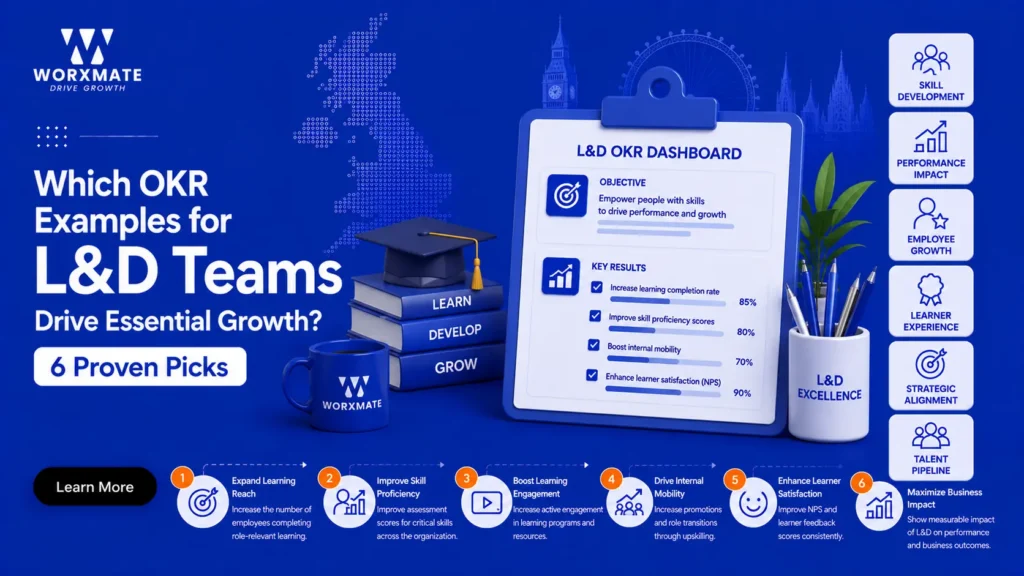
In this article, we’ve compiled 6 powerful OKR examples for L&D teams. These examples are designed to help HR Directors, L&D Managers, and People Operations Specialists create impactful learning programs, measure their effectiveness, and drive a culture of continuous improvement within their organizations.
The Role of OKRs in Modern Learning and Development
Modern L&D is no longer just about delivering courses; it’s about strategic talent development that directly impacts business outcomes. OKRs provide a robust framework for L&D teams to define what success looks like, measure progress, and adapt quickly. Unlike traditional KPIs, which often track past performance, OKRs are forward-looking, driving teams toward ambitious future goals.
For L&D, this means moving beyond simply tracking “training hours delivered” to measuring “impact on sales conversion rates” or “reduction in employee ramp-up time.” According to a McKinsey report, companies that invest strategically in L&D see higher employee retention and productivity. OKRs help translate this investment into verifiable results, creating a clear line of sight from learning initiatives to organizational growth. This is where effective OKR examples for L&D become invaluable.
How to Align L&D Goals with Business Outcomes
The core principle of effective OKRs is alignment. For L&D teams, this means ensuring that every learning objective directly supports broader company goals. For instance, if the company’s objective is to “Increase Market Share,” an L&D objective might be “Enhance Sales Team’s Product Knowledge.”
This alignment starts with understanding the organizational strategy and identifying critical skill gaps or development needs. Tools like Worxmate can facilitate this by providing a platform for transparent goal setting and tracking, ensuring that L&D initiatives are visible and connected to company-wide objectives. This strategic approach to goal alignment ensures that L&D efforts are not isolated but integral to the company’s success. It’s about setting measurable goals that resonate across the entire organization, making OKR examples for L&D powerful tools for strategic planning.
1. OKR Examples for Employee Onboarding and Time-to-Productivity
The goal is to accelerate the integration of new hires into the company and reduce the time it takes for them to become fully productive. This involves optimizing the onboarding process through structured learning paths and early performance feedback. Key results will include improvements in new hire satisfaction, faster achievement of initial performance targets, and reduced early turnover.
-
Objective:
Accelerate New Hire Time-to-Productivity
-
Key Results:
- Key Result 1: Implement a standardized 30-day onboarding curriculum via a new learning management system by Q3.
- Key Result 2: Reduce average time-to-first-contribution for new hires by 15% through mentor-led training sessions.
- Key Result 3: Increase new hire 90-day retention rate to 90% by improving onboarding feedback loops.
2. OKR Examples for Upskilling and Skill Gap Mitigation
The goal is to address critical skill gaps within the workforce and ensure employees have the competencies needed for future roles. This involves identifying key skill deficiencies and deploying targeted training programs. Key results will include a measurable increase in specific skill proficiencies, improved internal mobility, and a reduction in reliance on external hiring for specialized roles. These OKR examples for L&D are critical for future-proofing your workforce.
-
Objective:
Bridge Critical Skill Gaps Across Departments
-
Key Results:
- Key Result 1: Develop and roll out 3 new upskilling programs for AI/ML literacy by end of Q2.
- Key Result 2: Increase average proficiency scores in target skills by 20% for participants via certification programs.
- Key Result 3: Fill 75% of open senior technical roles internally through targeted development pathways.
3. OKR Examples for Leadership Development and Succession
The goal is to cultivate a strong pipeline of internal leaders capable of driving future organizational success. This involves implementing structured leadership training and mentorship programs. Key results will focus on increasing the readiness of potential leaders, improving leadership effectiveness scores, and strengthening internal succession planning. These OKR examples for L&D ensure a sustainable leadership future.
-
Objective:
Build a Robust Internal Leadership Pipeline
-
Key Results:
- Key Result 1: Launch a new 6-month leadership development program for 50 high-potential employees by Q1.
- Key Result 2: Increase average 360-degree feedback scores for participating leaders by 10% through coaching.
- Key Result 3: Identify and formalize succession plans for 80% of critical leadership roles by year-end.
Unlock Goal Clarity and Accelerate Employee Growth
Looking to drive goal clarity and employee growth? Discover how Worxmate’s AI-powered Performance Management Software can help.
4. OKR Examples for Scaling a Continuous Learning Culture
The goal is to embed learning as an ongoing, integral part of the employee experience. This involves fostering self-directed learning, peer-to-peer knowledge sharing, and accessible learning resources. Key results will demonstrate increased engagement with learning platforms, higher rates of internal knowledge sharing, and improved employee perceptions of growth opportunities. These OKR examples for L&D promote an agile workforce.
-
Objective:
Foster a Robust Culture of Continuous Learning
-
Key Results:
- Key Result 1: Integrate a new micro-learning platform with existing HRIS, achieving 80% employee activation by Q4.
- Key Result 2: Increase average monthly engagement with internal knowledge base articles by 25% through gamified challenges.
- Key Result 3: Improve employee perception of career development opportunities by 15 points in the annual engagement survey.
5. OKR Examples for Driving Performance and Engagement
The goal is to directly link learning initiatives to improvements in employee performance and overall engagement. This involves designing programs that enhance job-specific skills and foster a sense of purpose and growth. Key results will include measurable improvements in individual performance metrics, higher employee satisfaction scores, and reduced voluntary turnover. These OKR examples for L&D are crucial for talent retention.
-
Objective:
Enhance Employee Performance and Engagement
-
Key Results:
- Key Result 1: Implement a new performance coaching program for 100% of managers by end of Q3.
- Key Result 2: Increase average employee performance review scores by 10% in areas targeted by training.
- Key Result 3: Reduce voluntary employee turnover by 5% year-over-year through enhanced development paths.
6. OKR Examples for Measuring Training ROI and Impact
The goal is to quantify the financial and strategic return on investment for L&D programs. This involves establishing clear metrics to track the impact of training on business results and cost savings. Key results will demonstrate direct correlations between learning initiatives and improved revenue, reduced operational costs, or enhanced customer satisfaction. These OKR examples for L&D prove the value of your efforts.
-
Objective:
Demonstrate Measurable ROI of L&D Programs
-
Key Results:
- Key Result 1: Develop and implement a new ROI tracking dashboard for all major L&D initiatives by Q2.
- Key Result 2: Achieve a 15% increase in sales revenue for teams completing advanced product training.
- Key Result 3: Reduce customer support resolution time by 10% through specialized customer service training modules.
Common Pitfalls When Setting L&D OKRs
While the benefits of OKRs are clear, L&D teams often encounter challenges. One common pitfall is setting Key Results that are still activity-based rather than outcome-focused. For example, “Deliver 10 training sessions” is an output, not an outcome. Instead, focus on “Increase participant satisfaction by 20% in training sessions.” Another mistake is a lack of alignment with broader organizational goals, leading to disconnected L&D efforts. According to Harvard Business Review, insufficient top-down communication and a failure to integrate OKRs into daily workflows are major reasons for failure. Overcoming these challenges requires clear communication, regular OKR check-ins, and a commitment to iterative improvement. These are crucial aspects to consider when implementing OKR examples for L&D.
How Worxmate Helps L&D Teams Track and Achieve OKRs
Worxmate’s AI-powered performance management software is designed to simplify the entire OKR cycle for L&D teams. From defining ambitious objectives to tracking progress against key results, Worxmate provides the tools necessary to ensure OKR alignment across all levels. Its intuitive interface allows L&D managers to easily create custom learning paths, assign development goals, and monitor employee skill progression in real-time. This visibility helps L&D teams demonstrate the tangible impact of their initiatives on employee performance and business outcomes.
With Worxmate, L&D professionals can move beyond spreadsheets and manual tracking, gaining actionable insights into what truly drives talent development. The platform supports continuous feedback and iterative adjustments, ensuring that L&D strategies remain agile and responsive to evolving business needs. This integrated approach makes it easier to implement and measure the success of OKR examples for L&D, turning strategic goals into measurable achievements.
Setting clear, actionable OKR examples for L&D empowers teams to align their initiatives, measure success, and drive real business impact. Whether you’re aiming to boost employee upskilling, cultivate future leaders, or demonstrate training ROI, the right OKRs keep your strategy focused and your teams accountable.
By implementing these OKR examples for L&D, teams can strengthen OKR alignment across departments, maintain momentum through structured OKR cycles, and pursue stretch goals with full visibility into what’s working. It’s time to move beyond transactional tasks and toward strategic outcomes that directly move the needle for your talent development efforts.
Ready to align your L&D goals with real outcomes? Explore how OKR software brings structure to your goal-setting, use how to write OKRs effectively to connect team efforts to company priorities, and sustain progress through OKR check-ins. Start your free trial with Worxmate and turn your L&D objectives into results that actually move the needle.