
OKRs for Non-Profits: Which OKR Examples Drive Social Impact? 6 Proven Picks
Actionable insights to align your OKRs with everyday performance management-from proven frameworks to the tools that power them.
Summary
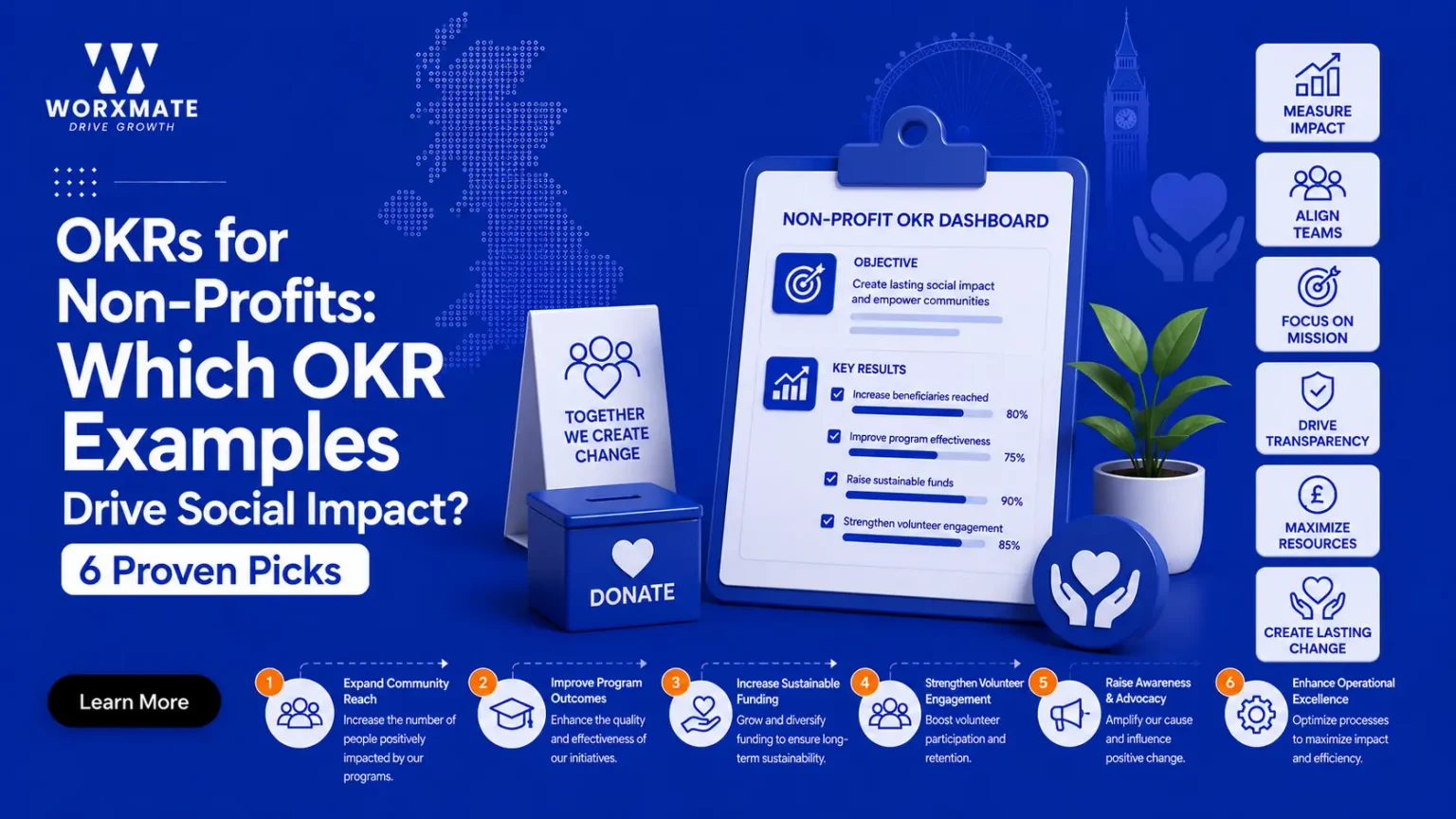
OKRs for non-profits provide a structured framework for mission-driven organizations to set clear, measurable goals and track progress towards their social impact objectives. They help align diverse teams, from fundraising to program delivery, ensuring everyone is focused on outcomes that truly matter.
In today’s dynamic environment, non-profit leaders face the dual challenge of maximizing their impact with limited resources while demonstrating accountability to donors and stakeholders. Embracing Objectives and Key Results (OKRs) offers a powerful solution, bringing strategic clarity and measurable results to their vital work.
Non-profit organizations often grapple with unique challenges in goal setting. Unlike for-profit entities with clear revenue and profit metrics, measuring social impact can be complex and qualitative. This often leads to vague objectives, difficulty in tracking progress, and a struggle to demonstrate tangible results to funders and beneficiaries. The pressure to balance mission fulfillment with operational sustainability demands a robust framework that fosters both ambition and accountability.
This is where OKRs for non-profits prove invaluable. By translating broad mission statements into specific, measurable, and time-bound Objectives and Key Results, non-profits can create a clear roadmap for impact. This framework ensures that every team and individual understands how their work contributes to the organization’s overarching goals, fostering greater transparency and collaboration. In this article, we’ve compiled 6 essential OKR examples for non-profits that address common challenges and drive measurable social impact.
Why Non-Profits Struggle with Goal Setting (and How OKRs Help)
Many non-profits operate with immense passion and dedication, yet often lack a systematic approach to goal setting and performance measurement. Traditional methods can be vague, focusing on activities rather than outcomes, making it hard to assess true impact. This can lead to resource inefficiencies and difficulty in securing sustained funding.
The OKR framework addresses these challenges directly. It forces organizations to articulate ambitious Objectives—what they want to achieve—and then define precise Key Results—how they will measure success. This shift from activity-based planning to outcome-driven execution is transformative. For instance, instead of “Organize more events,” an OKR might be “Increase community engagement by X%,” measured by specific metrics like event attendance, social media mentions, and participant feedback. This clarity is crucial for OKRs for non-profits.
According to a Gallup report, non-profit employees often show lower engagement rates compared to their for-profit counterparts, partly due to a lack of clear direction and impact measurement. Implementing OKRs for non-profits can bridge this gap, providing employees with a direct line of sight between their daily tasks and the organization’s larger mission, thereby boosting motivation and accountability. This structured approach to goal setting ensures that effort translates into demonstrable progress.
1. Fundraising and Development OKR Examples
The goal is to significantly boost fundraising efforts to ensure long-term sustainability and expand program reach. This involves diversifying funding sources, increasing donor engagement, and optimizing grant acquisition processes. Key results will include measurable improvements in donation revenue, donor retention rates, and successful grant applications.
-
Objective:
Increase Sustainable Funding to Expand Program Reach
-
Key Results:
- Key Result 1: Implement a new donor CRM system by end of Q2 to centralize donor data and improve outreach efficiency.
- Key Result 2: Increase total Q3 fundraising revenue by 20% through targeted campaigns and major donor cultivation.
- Key Result 3: Improve donor retention rate by 15% year-over-year via enhanced stewardship and personalized communication.
2. Program Impact and Community Outreach OKR Examples
The goal is to enhance the measurable impact of core programs and expand community reach to serve more beneficiaries effectively. This involves refining program delivery, gathering robust impact data, and increasing community engagement. Key results will focus on beneficiary numbers, program satisfaction, and demonstrated social outcomes.
-
Objective:
Maximize Program Effectiveness and Community Reach
-
Key Results:
- Key Result 1: Develop and implement a standardized impact measurement framework for all core programs by Q2.
- Key Result 2: Increase the number of individuals directly served by programs by 25% through expanded outreach initiatives.
- Key Result 3: Achieve an average beneficiary satisfaction score of 4.5 out of 5 across all programs, as measured by post-program surveys.
3. Volunteer Recruitment and Engagement OKR Examples
The goal is to strengthen the volunteer base and enhance their engagement to support program delivery and organizational operations effectively. This involves streamlining recruitment processes, improving volunteer training, and fostering a strong sense of community. Key results will track volunteer numbers, retention, and satisfaction.
-
Objective:
Cultivate a Robust and Engaged Volunteer Community
-
Key Results:
- Key Result 1: Launch a new online volunteer onboarding portal by Q2, reducing onboarding time by 30%.
- Key Result 2: Recruit 50 new skilled volunteers across key program areas through targeted outreach campaigns.
- Key Result 3: Achieve an 80% volunteer retention rate year-over-year, as measured by exit surveys and active participation.
Unlock Goal Clarity and Accelerate Employee Growth
Looking to drive goal clarity and employee growth? Discover how Worxmate’s AI-powered Performance Management Software can help.
4. Operational Efficiency and Governance OKR Examples
The goal is to enhance internal operational efficiency and strengthen governance practices to ensure responsible and effective resource utilization. This involves streamlining administrative processes, improving financial oversight, and upholding best practices in organizational management. Key results will focus on cost savings, compliance, and process improvements.
-
Objective:
Optimize Operational Efficiency and Strengthen Governance
-
Key Results:
- Key Result 1: Automate 3 key administrative workflows (e.g., expense reporting, data entry) by end of Q3 using new software.
- Key Result 2: Reduce administrative overhead costs by 10% through vendor renegotiations and process improvements.
- Key Result 3: Achieve 100% compliance with all regulatory reporting requirements, with zero late submissions.
5. Advocacy and Policy Influence OKR Examples
The goal is to amplify the organization’s voice and influence policy decisions to create systemic change aligned with its mission. This involves building strategic alliances, engaging with policymakers, and mobilizing public support. Key results will measure legislative progress, media mentions, and coalition growth.
-
Objective:
Advance Policy Influence for Systemic Change
-
Key Results:
- Key Result 1: Secure 5 meetings with key legislative decision-makers on target policy initiatives by Q2.
- Key Result 2: Increase media mentions of our policy positions by 30% through proactive PR and thought leadership.
- Key Result 3: Recruit 3 new organizational partners to join our advocacy coalition, strengthening collective influence.
6. Digital Transformation and Technology Adoption OKR Examples
The goal is to leverage digital tools and technologies to enhance operational capabilities, expand outreach, and improve data-driven decision-making. This involves upgrading existing systems, adopting new platforms, and training staff. Key results will measure adoption rates, system efficiency, and data utilization.
-
Objective:
Drive Digital Transformation for Enhanced Impact
-
Key Results:
- Key Result 1: Migrate all program data to a new cloud-based management system by end of Q2, ensuring data accessibility.
- Key Result 2: Train 90% of staff on the new digital tools and platforms, achieving an average proficiency score of 80%.
- Key Result 3: Increase data-driven decision-making in program planning by 20%, as evidenced by documented use of analytics.
Best Practices: Implementing OKRs in a Mission-Driven Environment
Implementing OKRs for non-profits requires a nuanced approach that respects their unique mission-driven culture. One critical practice is to ensure OKR alignment with the organization’s overarching mission and strategic plan. Every Objective should clearly connect to the ultimate social impact the non-profit aims to achieve. John Doerr, the venture capitalist who popularized OKRs at Google, emphasizes that Objectives should be ambitious, even “stretch goals,” to inspire teams.
Transparency is another cornerstone. Sharing OKRs across all levels of the organization, from board members to program staff, fosters a collective understanding of priorities and encourages cross-functional collaboration. Regular OKR check-ins are essential to monitor progress, identify roadblocks, and make necessary adjustments, rather than waiting for annual reviews. According to a McKinsey report, non-profits that adopt data-driven approaches and agile goal-setting frameworks are significantly more effective at scaling their impact.
Finally, it’s vital to foster a culture where failure to achieve a stretch KR is seen as a learning opportunity, not a punitive event. This encourages teams to set truly ambitious OKRs for non-profits without fear. Focusing on continuous improvement through the OKR cycle helps non-profits adapt to changing environments and maximize their impact. These practices ensure that OKRs serve as a tool for empowerment and growth, not just measurement.
How Worxmate Simplifies OKR Tracking for NGOs
For non-profits, managing OKRs for non-profits effectively often means moving beyond spreadsheets and manual tracking. Dedicated OKR software like Worxmate provides a centralized platform for setting, tracking, and managing Objectives and Key Results. This streamlines the entire process, ensuring that every team member has real-time visibility into their progress and how it contributes to the broader mission.
Worxmate’s intuitive interface simplifies the creation of measurable goals, allowing non-profit leaders to easily define Objectives and their associated Key Results. Its robust reporting features enable executive directors and board members to quickly assess performance, identify areas needing attention, and communicate impact to stakeholders with confidence. This level of transparency and accountability is invaluable for organizations like Doctors Without Borders or World Vision, which rely heavily on demonstrating tangible results to their global donor base.
By automating reminders, facilitating regular check-ins, and offering dashboards that visualize progress, Worxmate reduces the administrative burden of non-profit performance management. This frees up valuable time and resources, allowing non-profit teams to focus more on their core mission: delivering vital services and creating lasting social change. Worxmate helps transform abstract goals into actionable, trackable progress, making it easier for non-profits to achieve their ambitious objectives.
Setting clear, actionable OKRs for non-profits empowers mission-driven organizations to align their teams, measure success, and drive real social impact. Whether you’re aiming to boost fundraising, expand program reach, or enhance operational efficiency, the right OKRs keep your strategy focused and your teams accountable to the communities they serve.
By implementing these OKR examples for non-profits, organizations can strengthen OKR alignment across departments, maintain momentum through structured OKR check-ins, and pursue strategic goals with full visibility into what’s working. It’s time to move beyond transactional tasks and toward strategic outcomes that directly move the needle for your mission.
Ready to align your non-profit goals with real outcomes? Explore how OKR software brings structure to your goal setting, use OKR alignment to connect team efforts to company priorities, and sustain progress through a consistent OKR cycle. Start your free trial with Worxmate and turn your non-profit objectives into results that actually move the needle.

Written by
An OKR Coach with 20+ years of implementation experience, Madhusudan has guided over 50 organisations through successful OKR transformations, training more than 500 leaders. Learn more about Worxmate.
Frequently Asked Questions
OKRs for non-profits are a goal-setting framework that helps mission-driven organizations define ambitious Objectives and measure progress through specific Key Results. This approach ensures clarity, alignment, and accountability towards achieving social impact. According to a Gallup report, clear goal setting can significantly improve employee engagement in non-profits.
To set effective OKRs, non-profits should start by aligning Objectives with their core mission, making them ambitious and inspiring. Key Results must be measurable, specific, and outcome-oriented, not just activity-based. Regular check-ins and transparent communication are crucial for tracking progress and making necessary adjustments.
Yes, investing in OKR software can be highly beneficial for non-profits. It centralizes goal tracking, automates check-ins, and provides real-time progress dashboards, significantly reducing administrative burden. This allows non-profits to focus more resources on their mission and demonstrate measurable impact to donors and stakeholders.
Common pitfalls include setting too many OKRs, making Key Results activity-based instead of outcome-based, and failing to communicate OKRs transparently across the organization. It’s also crucial to avoid using OKRs for performance reviews, as this can discourage setting ambitious “stretch” goals.
Non-profits should treat fundraising OKRs as operational enablers that directly fund and sustain their mission-driven objectives. By cascading high-level social impact goals down to development teams, organizations ensure that every dollar raised is explicitly tied to expanding program reach and community outcomes.
Qualitative social impact can be quantified by tracking proxy metrics such as beneficiary feedback scores, behavioral change percentages, or program graduation rates. Using a platform like Worxmate allows teams to define clear, measurable key results that translate abstract mission statements into tangible, trackable milestones.
Instead of just tracking total sign-ups, effective volunteer OKRs should focus on engagement and retention metrics, such as increasing the volunteer retention rate by 20% or achieving a 90% satisfaction score on post-event surveys. This shifts the focus from simple headcounts to building a dedicated, high-impact volunteer community.
Teams should shift their focus from outputs, like “organizing five community workshops,” to outcomes, such as “increasing community adoption of program resources by 30%.” This ensures that outreach efforts are evaluated by their actual community impact rather than just the volume of activities completed.
OKRs boost non-profit employee engagement by providing clear strategic direction and showing staff exactly how their daily tasks contribute to the broader mission. This transparency fosters a sense of purpose and accountability, directly addressing the alignment gaps highlighted in Gallup’s industry research.