
Most OKR platforms
manage your goals.
the entire lifecycle with you.
DEEP AI™ is Worxmate's proprietary OKR execution framework — Define, Execute, Evaluate, Plan — a closed-loop AI intelligence cycle that connects strategy to daily execution and turns every quarter's data into the intelligence that makes the next quarter sharper.
The OKR cycle was broken
before your platform arrived.
Across 50+ OKR implementations — FinTech, Pharma, Retail, Manufacturing, Energy and IT Services — the same three failure patterns appear in every broken OKR cycle, regardless of which platform the organisation is using.
DEEP AI™ is not a
set of features.
It is a closed-loop
OKR lifecycle.
DEEP stands for Define, Execute, Evaluate, Plan. Four stages. One continuous cycle. Each stage is powered by AI intelligence and each stage feeds the next — so the organisation's OKR capability compounds rather than resets every quarter.
The distinction that matters: most OKR software manages the goals you write. DEEP AI™ manages the entire OKR execution lifecycle — from how goals are written, to how daily work connects to those goals, to how forward-looking intelligence replaces rear-view-mirror reporting, to how this quarter's performance becomes next quarter's intelligence.
"Alignment is agreement — not a configuration in a tool. You cannot set alignment in a platform. You can display it once it exists. DEEP AI™ is built to create the conditions for genuine agreement at every stage of the cycle."
Beneath all four stages, three AI models run continuously: Orbit reading people signals, Axis reading execution signals, and Nexus reading structural signals. They are not separate products used alongside DEEP AI™. They are what makes it intelligent rather than procedural.
Each stage solves a specific failure.
Together, they close the loop.
The failure Define fixes: goals written in isolation, cascaded without agreement, tracked without conviction. In a listed Indian FinTech with 35+ leaders in a workshop, sticky-note exercise revealed that 80% of existing goals were not designed in the right direction — visible to the MD in real time. That moment of visible misalignment was the catalyst for the entire OKR program.
The DEEP AI Co-pilot takes your strategic context — role, business priorities, last quarter's performance — and drafts well-formed Objectives and Key Results that follow the FACTS framework. Not a template. OKR Studio then brings the whole team into the same space: upvote, downvote, thread, escalate, decide. A facilitation timer ensures you reach agreement rather than a meeting.
The failure Execute fixes: tasks in one system, OKRs in another, with no visible connection between them. The Task Co-pilot creates tasks in plain language and links them directly to the Key Results they will move. KR auto-update fires when a task is completed — so progress is visible without requiring a separate update to prove it.
The PCA Review Cycle — Progress, Challenges, Actions — runs the structured check-in cadence that catches blockers before they become missed quarters. Failures and Learnings capture creates the institutional memory most OKR programs lose at quarter-end.
The failure Evaluate fixes: performance data that tells you what went wrong after the quarter is already closed. AI-led OKR Forecasting reads check-in progress rates, confidence score trends, task completion velocity and historical performance patterns to calculate the probability of achieving each OKR while there is still time to act.
The Business Review Dashboard gives leadership a single view across all OKRs. The Department Heatmap surfaces RAG health by team. OKR Scorecards separate genuine progress from compliance-driven check-in scores. KPI Boards are leader-configured — the numbers that matter to this leader's context, not a generic dashboard.
The failure Plan fixes: retrospectives that produce a slide nobody reads in the next planning cycle. The AI Retrospective analyses the full quarter — check-in history, confidence score movement, completion rates, failure patterns — and surfaces root causes, not summaries. In a multi-billion dollar engineering group, the single most powerful realisation was the shift from lagging to leading indicators — seeing why goals were missed before they became the next quarter's blockers.
Next-quarter OKR recommendations feed directly back into the Define stage — so every new cycle begins with the intelligence generated by the one before it. The loop closes. And immediately opens again with a sharper starting point.
Three AI models run beneath every stage of DEEP AI™.
This is what makes it a framework rather than a workflow.
Most OKR software is procedural — it manages the steps of your process. DEEP AI™ is intelligent — it reads what your process is producing and surfaces the signals that determine whether the quarter ends well or not.
"Most platforms execute your process. DEEP AI™ thinks through it with you. The difference is whether the intelligence shows up when you still have time to act — or after the quarter has already told you what went wrong."
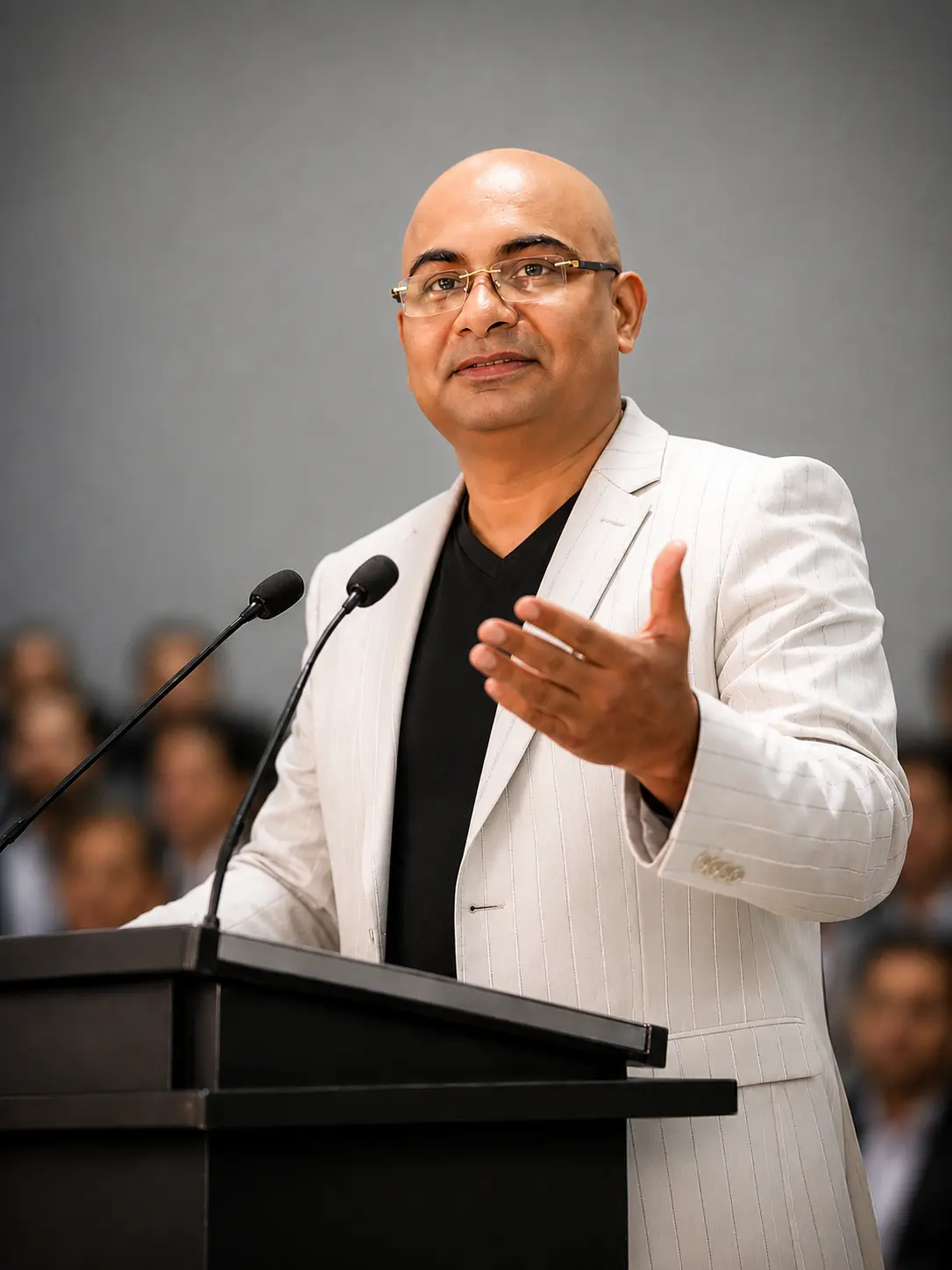
Madhusudan Nayak
Madhusudan — "Maddy" to his clients — is based out of Worxmate's home office in Pune. Unlike engagements delivered remotely into other regions, India is where Worxmate is headquartered — clients work directly with the team building the product. His India work spans a listed fintech company's 35-leader workshop, and coaching across WROGN, UMO, HCL Tech, JBPharma and Tresvista.
I have been inside OKR implementations for over a decade. Across 50+ organisations — enterprise and growth-stage, India and internationally, FinTech, Pharma, Retail, Manufacturing and Energy — the same four failure patterns appear in every broken OKR cycle, regardless of which platform the organisation is using.
Goals get written without genuine agreement. Daily work drifts from strategic intent by week three. Performance data is always a retrospective view, never a forward one. And the learnings from each quarter evaporate before the next cycle begins — because nobody has built the institutional memory to carry them forward.
These are not technology failures. They are structural failures in how the OKR cycle itself is designed. A better interface does not fix a disconnected task layer. A more attractive dashboard does not produce forward-looking intelligence. A retrospective feature does not carry learnings into the next cycle if the two stages are not designed as a closed loop.
DEEP AI™ was built to close each of these failures structurally — at the stage where they originate. The Execution Maturity Rate — the percentage of leaders who can independently write a genuine outcome-driven goal without coaching support — sits between 5% and 15% in first-cycle implementations. In organisations running a well-coached DEEP AI™ program over 12 months, it consistently reaches 30% to 40%. That movement is what DEEP AI™ is designed to produce.
Three outcomes. Specific to the stage that produces them.
What the conventional OKR cycle looks like
without DEEP AI™
| ⚠ Conventional OKR cycle | ✓ DEEP AI™ OKR lifecycle |
|---|---|
| Goals written by leadership, cascaded downward | Goals co-created in OKR Studio with genuine team agreement and upvote/downvote alignment |
| OKR writing from blank page or template | DEEP AI Co-pilot drafts from strategic context — role, priorities, last quarter's performance |
| Tasks in one system, OKRs in another | Task Co-pilot links every task to the Key Result it moves — automatically, on completion |
| Check-ins as status updates with no structured escalation | PCA Review Cycle — Progress, Challenges, Actions — with structured escalation to OKR Champion |
| At-risk goals discovered at quarter-end | AI Forecasting surfaces achievement probability mid-cycle while time remains to course-correct |
| Retrospectives that look backward at what failed | Plan stage produces forward intelligence — root causes, learnings, next-quarter OKR recommendations |
| Learnings lost between cycles | Failures and Learnings captured, attributed and carried directly into the next Define cycle |
| OKR quality flat cycle-over-cycle | Execution Maturity Rate compounds over 12 months: 5–15% in cycle one to 30–40% by month twelve |
| People signals invisible until resignation or exit interview | Orbit reads attrition and burnout risk 4–8 weeks before any manager or HR system can see it |
The software is the infrastructure.
The coaching is the capability.
DEEP AI™ provides both — an AI-powered OKR lifecycle that compounds with every cycle you run, and 10+ years of live implementation experience available to accelerate the capability your organisation needs to run it well.