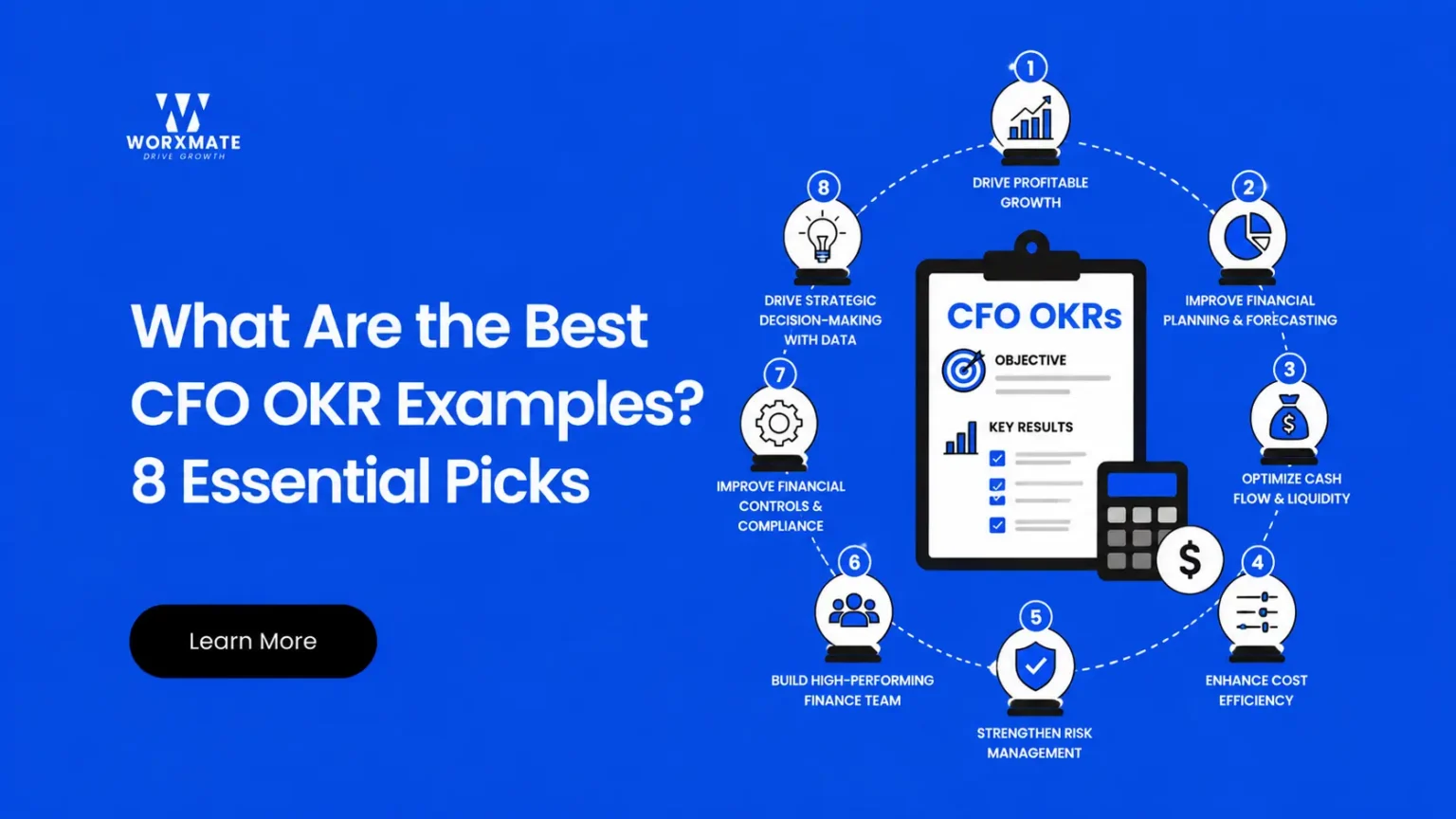
What Are the Best CFO OKR Examples? 8 Essential Picks
Actionable insights to align your OKRs with everyday performance management-from proven frameworks to the tools that power them.
Summary
CFO OKR examples provide a structured framework for finance leaders to move beyond traditional accounting and drive strategic business value. These examples help Chief Financial Officers align financial health, operational efficiency, and capital allocation with the broader organizational vision to ensure sustainable growth.
In today’s volatile economic climate, finance executives are expected to be strategic architects rather than just number crunchers. By utilizing CFO OKR examples, leadership teams can transform the finance department from a cost center into a value-generating engine that prioritizes measurable outcomes over transactional tasks.
The modern Chief Financial Officer faces a unique set of challenges in the mid-market and enterprise sectors. From managing fluctuating interest rates to overseeing complex digital transformations, the pressure to deliver “more with less” has never been higher. Traditional budgeting often fails to capture the agility required to pivot when market conditions shift unexpectedly.
This is where the OKR (Objectives and Key Results) framework becomes indispensable. Unlike static KPIs that only report on the past, OKRs are forward-looking and aspirational. They provide the “why” behind the numbers, allowing finance teams to focus on the most impactful levers of the business. In this article, we’ve compiled 8 essential CFO OKR examples designed to help you bridge the gap between financial theory and executive execution.
Whether you are preparing for a Series C funding round or optimizing your internal audit processes, these examples serve as a blueprint for success. We will explore how to set objectives that drive real business outcomes and key results that provide undeniable proof of progress.
The Evolution of the CFO: From Scorekeeper to Strategic Partner
The role of the CFO has undergone a massive transformation. According to McKinsey & Company, CFOs are now spending 50% more of their time on strategic activities compared to a decade ago. They are no longer just responsible for the “scorecard”; they are now expected to be co-pilots in the cockpit of the company.
This shift requires a new approach to goal setting. Finance leaders must now understand business level strategy as deeply as they understand a balance sheet. By adopting CFO OKR examples, executives can ensure their department is not working in a silo, but is instead actively contributing to the company’s competitive advantage.
Why Traditional KPIs Aren’t Enough for Modern Finance Leaders
While Key Performance Indicators (KPIs) like “Days Sales Outstanding” or “Net Profit Margin” are vital, they are often lagging indicators. They tell you what happened last month, not what you need to do next quarter to beat the competition. Gartner reports that 80% of CFOs plan to increase their investments in digital technology to improve real-time visibility.
OKRs complement KPIs by providing a roadmap for improvement. If a KPI shows that margins are shrinking, an OKR provides the vehicle to fix it. This distinction is critical for strategic performance management systems. Below is a comparison of how these two methodologies interact within a finance department.
| Feature | Finance KPIs | Finance OKRs |
|---|---|---|
| Primary Focus | Stability and “Business as Usual” | Growth, Change, and Transformation |
| Time Horizon | Ongoing / Perpetual | Quarterly / Annual Cycles |
| Measurement | Status Tracking | Outcome Achievement |
CFO OKR examples 1
The goal is to strengthen the company’s foundational financial health and profitability. This involves optimizing the cost structure and improving gross margins through rigorous vendor renegotiations and waste reduction. Key results will include margin expansion, EBITDA targets, and expense reduction percentages.
-
Objective:
Maximize Corporate Profitability Through Cost Optimization
-
Key Results:
- Key Result 1: Implement a new zero-based budgeting framework across all departments within the first 30 days of the quarter.
- Key Result 2: Increase the overall gross margin from 65% to 72% through strategic vendor consolidation and renegotiation.
- Key Result 3: Achieve an EBITDA target of $5M by reducing non-essential operational overhead by 15% via process automation.
CFO OKR examples 2
The goal is to facilitate strategic growth and successful fundraising efforts. This involves preparing a comprehensive investor data room and refining the financial narrative for external stakeholders. Key results will include investor engagement metrics, documentation readiness, and capital secured.
-
Objective:
Secure Series C Funding to Fuel Expansion
-
Key Results:
- Key Result 1: Build a fully audited investor data room with 100% of required compliance documents by end of month one.
- Key Result 2: Deliver 25 high-quality investor pitches to top-tier VC firms through targeted executive networking.
- Key Result 3: Secure $40M in new capital commitments with a minimum valuation of $400M within the current quarter.
CFO OKR examples 3
The goal is to improve risk management and ensure total regulatory compliance. This involves auditing internal controls and deploying new cybersecurity insurance protocols to mitigate financial liability. Key results will include audit completion scores, risk mitigation rates, and compliance training benchmarks.
-
Objective:
Mitigate Financial Risk and Ensure Regulatory Compliance
-
Key Results:
- Key Result 1: Conduct a comprehensive internal audit of all financial controls using a third-party risk assessment tool.
- Key Result 2: Reduce the number of high-risk financial audit findings by 90% through proactive policy updates.
- Key Result 3: Achieve 100% compliance with new international tax regulations via the implementation of automated tax software.
CFO OKR examples 4
The goal is to drive operational excellence through finance automation. This involves migrating manual spreadsheets to an integrated ERP system to reduce human error and increase speed. Key results will include time-to-close metrics, automation percentages, and data accuracy scores.
-
Objective:
Streamline Finance Operations Through Digital Transformation
-
Key Results:
- Key Result 1: Launch an AI-driven accounts payable automation tool to eliminate 80% of manual data entry tasks.
- Key Result 2: Reduce the monthly financial close cycle from 10 days to 4 days through process re-engineering.
- Key Result 3: Improve the accuracy of cash flow forecasts by 20% using predictive analytics and real-time data feeds.
Unlock Goal Clarity and Accelerate Employee Growth
Looking to drive goal clarity and employee growth? Discover how Worxmate’s AI-powered Performance Management Software can help.
CFO OKR examples 5
The goal is to optimize cash flow management and liquidity. This involves tightening collections processes and extending payables without damaging vendor relationships. Key results will include DSO reduction, cash reserve growth, and working capital ratios.
-
Objective:
Optimize Working Capital and Cash Liquidity
-
Key Results:
- Key Result 1: Implement an automated collections workflow to target overdue accounts within 48 hours of missed payments.
- Key Result 2: Reduce Days Sales Outstanding (DSO) from 45 days to 35 days through optimized invoicing terms.
- Key Result 3: Increase the free cash flow margin by 10% via a 5% reduction in non-capitalized operational spending.
CFO OKR examples 6
The goal is to enhance investor relations and transparency. This involves creating a more robust reporting cadence and engaging more deeply with current shareholders. Key results will include reporting speed, investor satisfaction scores, and participation rates.
-
Objective:
Enhance Investor Transparency and Market Confidence
-
Key Results:
- Key Result 1: Develop a quarterly investor dashboard that tracks 100% of key SaaS metrics in real-time.
- Key Result 2: Achieve a 95% “satisfactory” rating from existing board members regarding the clarity of financial reporting.
- Key Result 3: Increase the number of proactive analyst briefings from 1 to 4 per quarter to improve market visibility.
CFO OKR examples 7
The goal is to improve strategic capital allocation across business units. This involves evaluating the ROI of various departments and re-allocating funds to the highest-growth areas. Key results will include ROI benchmarks, budget reallocation percentages, and growth acceleration.
-
Objective:
Maximize Returns on Strategic Capital Investments
-
Key Results:
- Key Result 1: Complete a comprehensive ROI analysis for all internal product development projects by the mid-quarter review.
- Key Result 2: Re-allocate 15% of the total budget from low-performing legacy products to high-growth AI initiatives.
- Key Result 3: Achieve a 1.5x increase in internal rate of return (IRR) for new capital projects through stricter vetting.
CFO OKR examples 8
The goal is to foster talent development within the finance team. This involves upskilling staff in data science and strategic analysis to prepare the next generation of leaders. Key results will include certification completions, internal promotion rates, and skill competency scores.
-
Objective:
Build a Future-Ready Finance Team Through Upskilling
-
Key Results:
- Key Result 1: Enroll 100% of the finance leadership team in an advanced data analytics certification program through a recognized provider.
- Key Result 2: Increase the internal promotion rate for senior finance roles by 20% through a structured mentorship initiative.
- Key Result 3: Achieve an 85% employee engagement score within the finance department via improved career development paths.
Best Practices for Aligning Finance OKRs with Company Strategy
Setting CFO OKR examples is only half the battle; the real value comes from alignment. According to the Harvard Business Review, 95% of a company’s employees are unaware of or do not understand its strategy. To avoid this, CFOs must ensure their goals are visible and interconnected with other departments.
Start by having the finance team review the CEO’s long-term vision examples. If the company’s goal is global expansion, the finance OKRs should focus on international tax compliance and currency hedging. This top-down and bottom-up approach creates a cohesive strategic planning environment where everyone understands how their work impacts the bottom line.
How to Track and Manage Finance OKRs in Worxmate
Spreadsheets are the enemy of effective OKR tracking. They are static, prone to error, and lack the transparency needed for high-growth companies. Using a dedicated platform like Worxmate allows CFOs to see progress in real-time, link financial performance to individual effort, and facilitate better OKR check-ins.
With Worxmate, you can automate data feeds from your ERP or CRM directly into your key results. This ensures that your CFO OKR examples are always updated with accurate, verifiable data. This level of automation allows the finance team to stop chasing numbers and start chasing outcomes.
Setting clear, actionable CFO OKR examples empowers finance leaders to align their teams, measure success, and drive real business impact. Whether you’re aiming to optimize profitability, secure new funding, or automate complex operations, the right OKR framework keeps your strategy focused and your teams accountable. By moving from static reporting to dynamic goal setting, CFOs can lead their organizations toward a more resilient and prosperous future.
By implementing these CFO OKR examples, executives can strengthen OKR alignment across the C-suite, maintain momentum through structured OKR check-ins, and pursue measurable goals with full visibility into what’s working. It’s time to move beyond transactional tasks and toward strategic goals that directly move the needle in a competitive market.
Ready to align your CFO OKR examples and strategic financial goal setting with real outcomes? Start your free trial with Worxmate today and discover how our AI-powered OKR and Performance Management software can transform your strategy into measurable, trackable results.

Written by
An OKR Coach with 20+ years of implementation experience, Madhusudan has guided over 50 organisations through successful OKR transformations, training more than 500 leaders. Learn more about Worxmate.
Frequently Asked Questions
CFO OKR examples are specific, measurable goals used by finance leaders to drive strategic value. According to McKinsey, top-performing CFOs use these frameworks to spend 50% more time on strategy than their peers.
Start by identifying a strategic objective, such as “Improving Capital Efficiency.” Then, define 3 key results that are quantified, such as reducing DSO by 10% or increasing gross margin by 5% through specific actions.
Yes, because they bridge the gap between financial data and business execution. Companies using OKRs often see higher alignment scores, with Gartner noting that digital-first CFOs see 20% better forecast accuracy.
A common mistake is setting too many key results or using “binary” goals (yes/no). Effective OKRs should be ambitious, measurable, and limited to 3-5 key results per objective to maintain focus.
While enterprise finance OKRs are typically set on quarterly or annual horizons, high-performing finance leaders conduct bi-weekly or monthly check-ins to monitor momentum. Connecting OKR tracking to real-time financial data allows CFOs to pivot capital and operational resources before quarter-end when market conditions shift.
CFO OKRs cascade by aligning macro-level financial targets—like gross margin expansion or cost optimization—with operational key results in Sales, Operations, and IT. Utilizing a strategic goal-cascading platform like Worxmate ensures every business unit clearly understands its direct impact on overall enterprise financial health.
For major liquidity events like Series C funding or M&A, CFO OKRs break down overwhelming transaction tasks into measurable strategic milestones, such as optimizing cash burn rates or completing due diligence audits. This structured approach provides investors and board members with verifiable proof of disciplined execution and operational governance.
Enterprise-grade strategy execution platforms like Worxmate are ideal because they bridge the gap between static financial spreadsheets and dynamic business execution. By integrating financial KPIs with goal management workflows, leadership teams get a centralized, automated system for tracking strategic impact across all business units.
Complex initiatives like ERP modernization or automated financial forecasting are measured by pairing strategic objectives with quantifiable outcome metrics, such as reducing monthly close cycles by 40%. This ensures major technology investments are evaluated on delivered business value rather than just project completion.