
How to Set Quarterly Finance OKRs? 7 Essential Steps for Smarter Financial Performance
Actionable insights to align your OKRs with everyday performance management-from proven frameworks to the tools that power them.
Summary
Quarterly finance OKRs help finance leaders align departmental goals with overarching business strategy, driving measurable improvements in financial health and operational efficiency. They break down ambitious annual financial objectives into manageable, actionable key results, fostering accountability and transparency across the organization.
In today’s dynamic business environment, CFOs and Finance Directors face constant pressure to not only manage finances but also to drive strategic growth. Quarterly finance OKRs offer a robust framework to navigate these challenges, ensuring that financial initiatives are outcome-focused and contribute directly to the company’s long-term success.
The modern finance department is no longer just a cost center; it’s a strategic partner integral to business growth and sustainability. However, translating high-level financial visions into actionable, measurable steps can be a significant challenge for finance leaders. Traditional annual budgeting and reporting cycles often lack the agility needed to respond to rapid market changes or internal shifts, leading to potential misalignment and missed opportunities.
This is where well-crafted quarterly finance OKRs become indispensable. They provide a structured approach to focus efforts, drive accountability, and ensure that every financial initiative is directly tied to a tangible business outcome. By adopting an OKR framework, finance teams can move beyond mere task completion to proactive, value-generating activities that enhance organizational performance.
In this article, we’ve compiled 7 practical quarterly finance OKRs designed to help your team achieve greater clarity, focus, and measurable success. We’ll explore how to set these objectives and key results effectively, integrate them into your broader strategy, and leverage them to drive smarter financial performance.
The Strategic Importance of Quarterly Finance OKRs
Quarterly finance OKRs are more than just a goal-setting tool; they are a strategic framework that empowers finance teams to become true business partners. By defining clear business objectives and measurable key results every three months, finance departments can maintain agility, respond quickly to market shifts, and ensure continuous alignment with the company’s strategic vision. This approach, championed by companies like Google and Intel, transforms finance from a reactive function into a proactive driver of value.
For CFOs and Finance Directors, implementing quarterly finance OKRs means gaining clearer visibility into financial performance, fostering a culture of accountability, and enabling data-driven decision-making. It ensures that critical financial initiatives, from revenue optimization to cost management, are not only pursued but also rigorously tracked for impact.
Why Quarterly Cycles for Finance OKRs? Benefits and Rationale
While annual financial planning remains crucial, a quarterly OKR cycle offers distinct advantages for finance teams. The shorter cycle length promotes greater agility and responsiveness, allowing teams to adapt to economic fluctuations, new market opportunities, or internal changes without losing sight of the long-term strategic vision. According to a Gartner study, companies that review and adjust their strategic plans quarterly outperform those that only do so annually by 20% in terms of profitability.
Quarterly cycles also facilitate more frequent check-ins and feedback loops, which are essential for maintaining momentum and addressing challenges proactively. This continuous engagement helps keep teams motivated and ensures that goal alignment is maintained throughout the year. For finance, where market conditions and internal priorities can shift rapidly, this iterative approach to setting quarterly finance OKRs is invaluable for sustained performance.
Deconstructing Finance OKRs: Objectives vs. Key Results for Financial Success
Understanding the fundamental difference between Objectives and Key Results is critical for effective quarterly finance OKRs. An Objective is an aspirational, qualitative goal that defines what you want to achieve. It should be inspiring, clear, and challenging. For a finance department, objectives might focus on areas like profitability, cash flow, or operational efficiency.
Key Results, on the other hand, are quantitative, measurable metrics that define how you will achieve the Objective. They must be specific, time-bound, and verifiable. Each Objective should have 2-5 Key Results that, if achieved, definitively indicate the Objective has been met. For instance, if an Objective is “Optimize Cash Flow Management,” Key Results would quantify improvements in DSOs (Days Sales Outstanding) or cash conversion cycles.
This clear distinction ensures that finance teams are focused on outcomes and not just activities, providing a powerful framework for measuring financial performance with OKRs.
A Step-by-Step Guide to Setting Effective Quarterly Finance OKRs
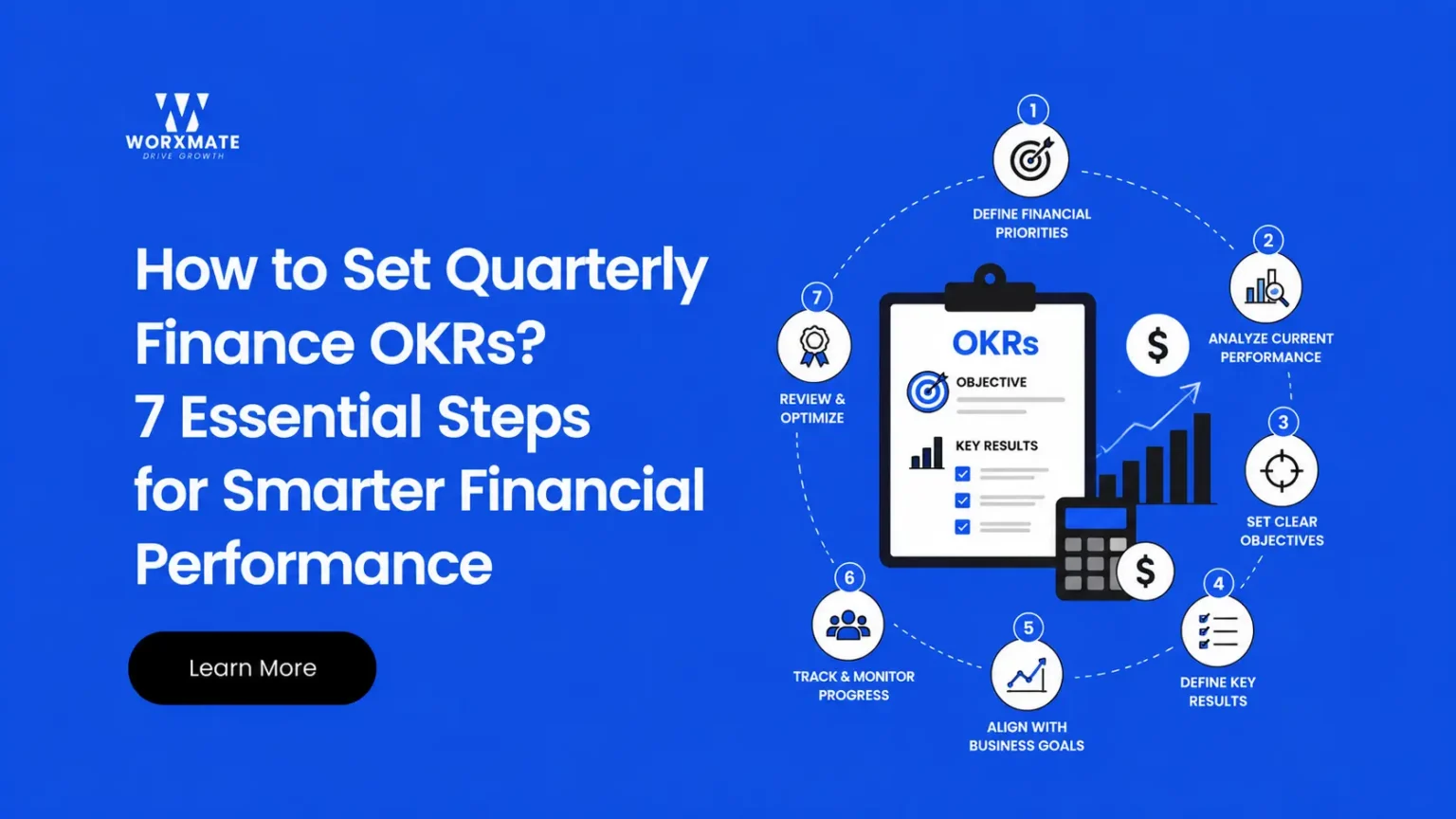
Setting impactful quarterly finance OKRs requires a structured approach. Follow these steps to ensure your finance team’s objectives are clear, aligned, and actionable:
- Review Strategic Priorities: Begin by understanding the company’s overarching strategic priorities and annual goals. Your quarterly finance OKRs must directly contribute to these larger organizational ambitions.
- Draft Aspirational Objectives: Brainstorm 3-5 high-level, qualitative Objectives for the quarter. These should be challenging yet achievable, focusing on areas where finance can make the biggest impact.
- Define Measurable Key Results: For each Objective, identify 2-5 Key Results that are quantifiable and demonstrate progress. Ensure each KR includes a metric, a target, and a method.
- Ensure Alignment: Cross-reference your finance OKRs with other department OKRs to identify synergies and potential conflicts. Strong organizational alignment is crucial for success.
- Assign Ownership: Clearly assign an owner for each Objective and Key Result. While OKRs are often team efforts, individual accountability drives commitment.
- Communicate Transparently: Share your quarterly finance OKRs widely within the finance department and with relevant stakeholders. Transparency fosters understanding and collaboration.
- Regularly Track and Adjust: Establish a cadence for weekly or bi-weekly OKR check-ins. Be prepared to adjust Key Results if external conditions change or initial assumptions prove incorrect. Remember, OKRs are a living document.
Quarterly Finance OKRs 1
The goal is to enhance overall profitability by optimizing revenue streams and controlling expenses more effectively. This involves analyzing existing financial models, identifying areas of inefficiency, and implementing targeted improvements. Key results will include measurable improvements in gross profit margin, a reduction in operational costs, and an increase in revenue from existing customer segments.
-
Objective:
Increase Profitability and Financial Efficiency
-
Key Results:
- Key Result 1: Implement a new cost-tracking system to categorize and monitor departmental expenses, achieving 95% data accuracy by end of Q3.
- Key Result 2: Improve gross profit margin by 2 percentage points through strategic pricing adjustments and supplier negotiations, by the end of the quarter.
- Key Result 3: Reduce operational expenditure by 8% across non-essential categories via vendor contract renegotiations and process automation.
Quarterly Finance OKRs 2
The goal is to optimize cash flow management to ensure liquidity and support strategic investments. This involves accelerating receivables, streamlining payables, and forecasting cash positions more accurately. Key results will include improvements in the cash conversion cycle, reductions in Days Sales Outstanding (DSO), and a higher percentage of on-time payments.
-
Objective:
Optimize Cash Flow and Liquidity Management
-
Key Results:
- Key Result 1: Implement a new automated invoicing and collections system to reduce manual processing time by 30%.
- Key Result 2: Decrease Days Sales Outstanding (DSO) by 5 days through improved credit control and proactive customer communication.
- Key Result 3: Increase the percentage of early payment discounts captured from suppliers by 15% via optimized payment scheduling.
Quarterly Finance OKRs 3
The goal is to enhance financial reporting accuracy and timeliness, providing stakeholders with reliable insights for decision-making. This involves refining data collection processes, improving reporting tools, and reducing errors. Key results will include a higher accuracy rate in financial statements, faster closing times, and positive feedback on report clarity.
-
Objective:
Improve Financial Reporting Accuracy and Timeliness
-
Key Results:
- Key Result 1: Develop and implement new validation checks in the ERP system to reduce data entry errors by 25%.
- Key Result 2: Shorten the monthly financial close process from 7 to 5 business days through process automation and cross-functional coordination.
- Key Result 3: Achieve an average stakeholder satisfaction score of 4.5/5 on the clarity and utility of quarterly financial reports, as measured by a post-report survey.
Quarterly Finance OKRs 4
The goal is to strengthen internal controls and compliance measures to mitigate financial risks and ensure regulatory adherence. This involves conducting thorough internal audits, updating policies, and implementing new control mechanisms. Key results will include a reduction in audit findings, successful completion of compliance training, and improved adherence to financial policies.
-
Objective:
Strengthen Financial Controls and Compliance
-
Key Results:
- Key Result 1: Roll out a new internal control framework, achieving 100% adoption by all finance team members by month’s end.
- Key Result 2: Reduce the number of identified audit deficiencies by 40% through proactive internal reviews and remediation efforts.
- Key Result 3: Ensure 100% of finance staff complete mandatory compliance training on new regulatory requirements, achieving an average score of 90% or higher.
Quarterly Finance OKRs 5
The goal is to enhance the finance team’s analytical capabilities and strategic support for business units. This involves investing in data analytics tools, providing training, and fostering closer collaboration with other departments. Key results will include increased utilization of financial models, higher satisfaction from business partners, and the development of new analytical reports.
-
Objective:
Enhance Finance Business Partnering and Analytics
-
Key Results:
- Key Result 1: Implement a new business intelligence (BI) dashboard for key financial metrics, achieving 80% adoption by cross-functional leaders.
- Key Result 2: Conduct 3 workshops for business unit heads on financial literacy and budget management, with an average attendance rate of 90%.
- Key Result 3: Increase the average satisfaction score of internal business partners with finance’s strategic support from 3.5 to 4.2 out of 5, as measured by an internal survey.
Unlock Goal Clarity and Accelerate Employee Growth
Looking to drive goal clarity and employee growth? Discover how Worxmate’s AI-powered Performance Management Software can help.
Quarterly Finance OKRs 6
The goal is to drive significant revenue growth through strategic financial planning and collaboration with sales and marketing. This involves identifying new revenue opportunities, optimizing pricing strategies, and supporting key business development initiatives. Key results will include an increase in new revenue streams, improved conversion rates, and better ROI on marketing spend.
-
Objective:
Drive Revenue Growth and Business Expansion
-
Key Results:
- Key Result 1: Establish a cross-functional revenue council with sales and marketing, meeting bi-weekly to identify and track new growth opportunities.
- Key Result 2: Increase average revenue per user (ARPU) by 7% through a revised pricing model and upsell strategies, implemented this quarter.
- Key Result 3: Generate $500,000 in new revenue from a pilot program for a new product/service line, supported by financial modeling and tracking.
Quarterly Finance OKRs 7
The goal is to enhance forecasting accuracy and budgeting processes to support more reliable strategic planning. This involves implementing advanced forecasting models, integrating data from various sources, and fostering a culture of continuous improvement in financial projections. Key results will include a reduced variance between forecast and actuals, faster budget cycles, and increased confidence in financial predictions.
-
Objective:
Improve Forecasting Accuracy and Budgeting Processes
-
Key Results:
- Key Result 1: Implement a new predictive analytics tool for revenue forecasting, achieving full integration with existing systems by month two.
- Key Result 2: Reduce the average variance between forecasted and actual revenue by 10% through enhanced data models and scenario planning.
- Key Result 3: Decrease the time spent on the quarterly budgeting cycle by 15% via process automation and improved departmental input mechanisms.
Best Practices for Implementing and Tracking Finance OKRs
Successful implementation of quarterly finance OKRs extends beyond just setting them. It requires consistent effort and adherence to best practices:
- Leadership Buy-in: CFOs and finance leadership must champion the OKR process, demonstrating commitment and integrating it into the team’s operational rhythm.
- Transparency: Make finance OKRs visible across the department and to relevant cross-functional teams. This fosters collaboration and understanding of financial priorities.
- Regular Check-ins: Conduct weekly or bi-weekly OKR check-ins to review progress, identify roadblocks, and make necessary adjustments. According to a Deloitte study, organizations with frequent performance check-ins are 2.5 times more likely to have engaged employees. (Source: Deloitte)
- Focus on Outcomes, Not Tasks: Ensure Key Results measure actual business impact, not just activities. For instance, instead of “Process 100 invoices,” use “Reduce invoice processing time by 20%.”
- Iterate and Learn: The OKR framework is designed for continuous improvement. At the end of each quarter, conduct an OKR retrospective to analyze what worked, what didn’t, and apply those learnings to the next cycle.
Common Pitfalls in Finance OKR Adoption and How to Avoid Them
While the benefits of quarterly finance OKRs are clear, several common pitfalls can derail successful adoption:
- Setting Too Many OKRs: Overloading the team with too many objectives dilutes focus. Aim for 3-5 Objectives per quarter, each with 2-5 Key Results.
- Lack of Alignment: OKRs set in isolation from company-level or other departmental goals lead to fragmented efforts. Ensure strong strategic alignment from the outset.
- “Set It and Forget It” Mentality: OKRs are not static. Without regular tracking and adjustments, they lose their effectiveness. Consistent continuous feedback and iteration are vital.
- Confusing Tasks with Key Results: Key Results must be measurable outcomes, not simply a list of tasks. If a KR doesn’t have a number, it’s likely a task.
- Top-Down Mandates Without Buy-in: While leadership sets the strategic direction, involving the finance team in the OKR-setting process fosters ownership and commitment.
Integrating Finance OKRs with Your Overall Business Strategy
The true power of quarterly finance OKRs emerges when they are seamlessly integrated into the organization’s broader strategic planning. Finance OKRs should cascade from company-level objectives, providing the measurable financial foundation for achieving enterprise-wide goals. For example, if the company’s Objective is “Achieve market leadership in X segment,” a finance OKR might be “Optimize capital allocation to support market expansion initiatives.”
This integration fosters a holistic view of performance, where every department understands its contribution to the financial health and strategic direction of the company. It also enables CFOs to provide more impactful insights to the CEO and board, clearly demonstrating how financial initiatives are directly driving business outcomes.
Leveraging Worxmate for Seamless Finance OKR Management
Managing quarterly finance OKRs effectively requires robust tools that facilitate setting, tracking, and reporting. Spreadsheets, while common, quickly become cumbersome and prone to errors, especially for complex financial metrics. This is where a dedicated OKR software like Worxmate proves invaluable.
Worxmate provides a centralized platform for finance teams to clearly define their Objectives and Key Results, link them to company-wide goals, and track progress in real-time. Its intuitive dashboards offer immediate visibility into financial performance, enabling proactive adjustments and fostering greater accountability. With Worxmate, finance leaders can move away from manual tracking and focus on strategic analysis, ensuring their quarterly finance OKRs are not just set, but successfully achieved.
Conclusion: Driving Financial Excellence with OKRs
Setting clear, actionable quarterly finance OKRs empowers finance leaders to align their teams, measure success, and drive real business impact. Whether you’re aiming to boost profitability, optimize cash flow, or enhance financial reporting, the right OKRs keep your strategy focused and your teams accountable within a robust OKR framework. This approach ensures measurable outcomes and goal clarity across all financial initiatives.
By implementing these strategic quarterly finance OKRs, finance departments can foster transparency, enhance cross-functional collaboration, and pursue ambitious goals with confidence. It’s time to move beyond tasks and toward strategic outcomes that directly move the needle, ensuring objective clarity and an effective OKR cadence.
Ready to align your financial goals with real outcomes? Start your free trial with Worxmate today and discover how our AI-powered OKR and Performance Management software can transform your strategy into measurable, trackable results.


Written by
An OKR Coach with 20+ years of implementation experience, Madhusudan has guided over 50 organisations through successful OKR transformations, training more than 500 leaders. Learn more about Worxmate.
Frequently Asked Questions
Quarterly finance OKRs are a goal-setting framework that helps finance teams define ambitious objectives and measurable key results for a three-month period. They ensure financial initiatives align with broader business strategy, driving accountability and measurable improvements in financial health, with companies reviewing plans quarterly outperforming annual reviewers by 20% in profitability, according to Gartner.
To set effective quarterly finance OKRs, start by aligning with strategic priorities, then draft 3-5 aspirational objectives. Define 2-5 measurable key results for each objective, ensure cross-functional alignment, assign ownership, and communicate transparently. Regular check-ins and iterative adjustments are crucial for success.
Implementing quarterly finance OKRs can significantly boost ROI by improving strategic alignment, fostering accountability, and enabling data-driven decision-making. This leads to better resource allocation, enhanced profitability, and quicker adaptation to market changes, driving substantial financial performance improvements.
Common mistakes include setting too many OKRs, lacking alignment with company goals, adopting a “set it and forget it” mentality, confusing tasks with key results, and implementing top-down mandates without team buy-in. Avoiding these pitfalls ensures more effective and sustainable OKR adoption within the finance department.
Quarterly finance OKRs do not replace annual financial budgeting; instead, they operationalize those financial targets into dynamic, 90-day strategic priorities. While budgets establish annual resource constraints and financial projections, quarterly OKRs drive the specific, measurable behavioral shifts needed to hit those targets. Using enterprise strategy execution software like Worxmate ensures annual financial forecasts remain continuously aligned with quarterly execution.
Finance teams should conduct weekly or bi-weekly check-ins to update Key Result metrics and resolve emerging financial bottlenecks early in the 90-day cycle. Frequent cadences ensure quantitative targets—such as Days Sales Outstanding (DSO) or gross margin thresholds—remain top of mind rather than being evaluated only at quarter-end. Automated execution platforms provide CFOs real-time dashboards to streamline these updates without administrative burden.
While spreadsheets suffice for basic tracking, enterprise finance teams quickly encounter version control issues, data silos, and a lack of goal visibility when scaling OKRs across departments. Purpose-built platforms like Worxmate automate goal cascading, integrate with core business systems, and provide AI-driven insights into strategy execution. This transition ensures seamless cross-functional alignment and eliminates the manual effort of consolidating disconnected financial spreadsheets.
Finance leaders achieve alignment by co-creating shared or cascading Key Results that connect financial health to operational metrics, such as linking sales velocity to revenue recognition goals. Providing transparent visibility across departments ensures non-finance managers understand how operational activities directly drive corporate margin and cash flow targets. Modern OKR software simplifies this process by visually mapping cross-departmental dependencies and shared metrics.
The quarterly OKR cycle provides built-in agility, enabling finance teams to recalibrate Key Results mid-quarter if macroeconomic shifts or business priorities change unexpectedly. Rather than abandoning long-term objectives, finance leaders can adjust quantitative targets or reprioritize underlying Key Results during formal mid-quarter reviews. Utilizing an enterprise strategy platform allows CFOs to re-cascade updated financial goals instantly across the entire enterprise.