 WORXMATE

In a $45 billion energy company in the Middle East — 8,000 people, one of the most significant industrial organisations in the region — I sat in a room with six of the most senior leaders in the business.
Each of them was sharp. Each of them had a clear view of what the organisation needed to do. Each of them, when asked directly, could articulate strategic priorities with precision and conviction.
The problem was that no two of them were articulating the same ones.
Not because they were in conflict. Not because the organisation lacked direction. But because nobody had ever put all six of them in a room and asked them to agree — not present, not share, not cascade — but genuinely agree on the two or three things that mattered most right now.
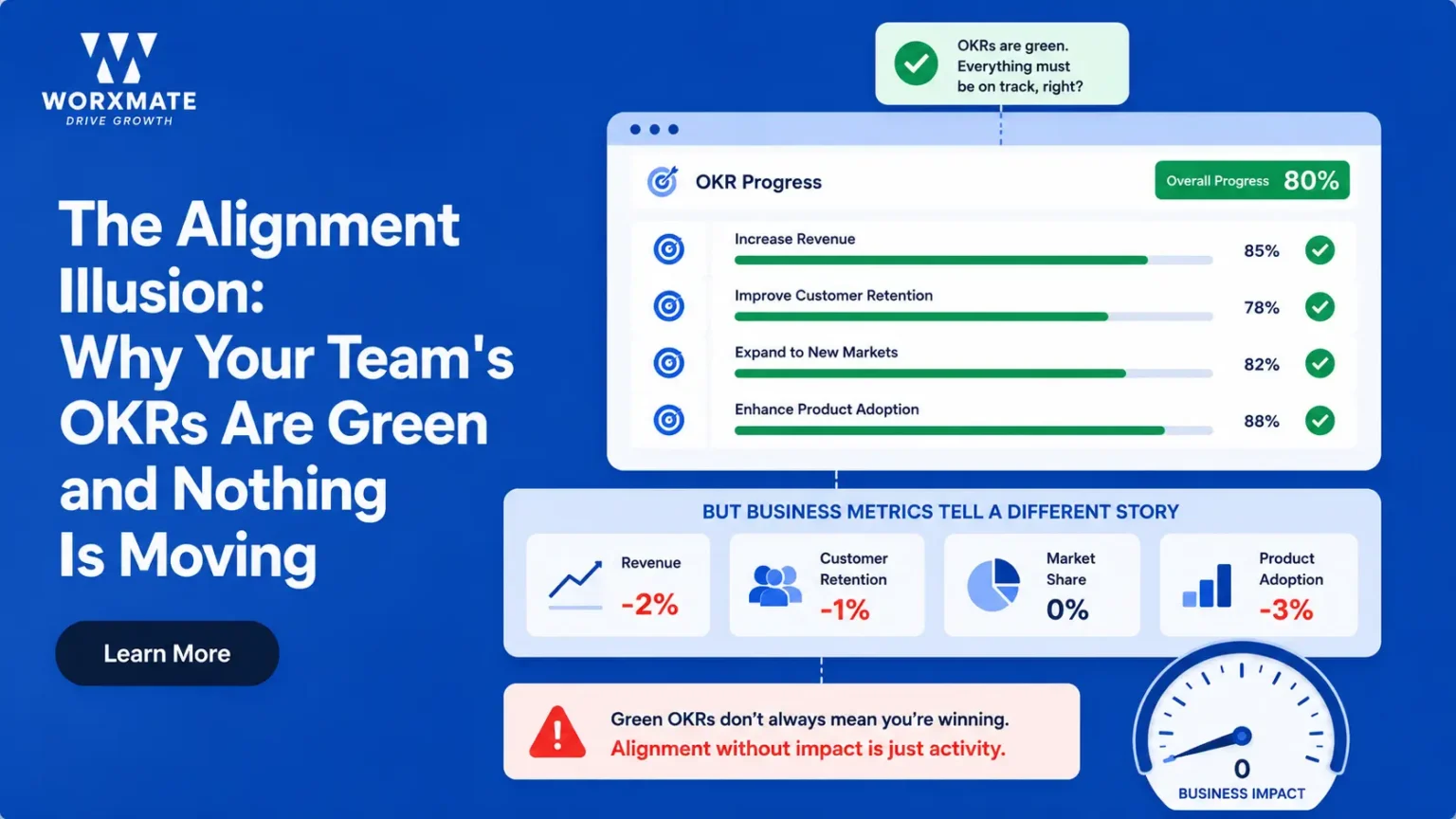
That organisation had an OKR program. It had a platform. It had dashboards. It had quarterly reviews. By every operational measure, the program was running.
What it did not have was alignment. And in my experience across 50+ implementations, the gap between a running OKR program and a genuinely aligned one is the most expensive gap in business. Not because it is dramatic. Because it is invisible.
About the Author
I am Madhusudan Nayak — Maddy. Twenty years in strategy execution. Ten years specifically in OKR implementation. Fifty-plus organisations coached across enterprise, SMB and startup contexts spanning APAC, the Middle East and Europe — from a 70,000-person IT services business unit to a three-day auditorium workshop with 35 senior leaders of a listed fintech company. Five hundred leaders trained across more than ten industries. Before co-founding Worxmate, I served as Business Head at Profit.co through its early funding journey. Every observation in this article comes from being in the room — not from research, not from a framework I read. From watching alignment claimed and alignment achieved, and learning to tell the difference between the two.
What Is OKR Alignment — and Why Most Organisations Don’t Actually Have It?

Ask ten leaders in any organisation whether their teams are aligned and nine of them will say yes.
Ask those same leaders to write down, independently and without consulting each other, the organisation’s top three strategic priorities for the current quarter — and then compare what they wrote.
In my experience, you will get between four and seven different answers. Sometimes more.
This is not a hypothetical exercise. I have run it, in some form, in the majority of the engagements I have led over the last decade. The results are consistent enough that I now treat the gap between “we are aligned” and “we can independently state the same three priorities” as one of the most reliable diagnostic tools available — more useful than any dashboard metric, more honest than any leadership survey.
The gap is not a failure of intelligence. It is not a failure of commitment. It is a failure of definition.
Most organisations treat alignment as a structural property — something that exists because a cascade has been built. The company OKRs are set. The department OKRs are derived from them. The team OKRs are derived from those. The hierarchy is visible in the platform. Therefore, alignment exists.
This is the alignment illusion. And it is the most expensive mistake an OKR program can make — because it looks exactly like success until it is too late.
Real OKR alignment is not structural. It is not the presence of a cascade. It is a shared understanding — across functions, across levels, across the individuals who have to execute — of what matters, why it matters right now, and how each team’s work connects to the work of the teams around them. That understanding is not produced by a planning session. It is not installed by a platform. It is produced by conversation — specifically, by the kind that forces people to disagree in the room, surface where their understanding diverges, and work through that divergence until genuine collective understanding exists.
Most OKR planning processes skip that conversation entirely. They move from strategy to cascade without stopping at the one step that actually creates alignment — the step where leaders sit together, compare their understanding, discover where it differs, and agree on what is true. What they produce instead is not alignment. It is the appearance of alignment. And the difference only becomes visible when the quarter ends and the business has not moved the way it was supposed to.
The Alignment Illusion Looks Exactly Like Success

This is what makes it dangerous.
A misaligned OKR program does not look like a failing program. It does not produce red dashboards or missed check-ins or empty quarterly reviews. It produces exactly the opposite — a well-functioning operational rhythm that is moving in slightly different directions at every level of the organisation, simultaneously, without anyone noticing until the cumulative drift becomes impossible to ignore.
Here is what it looks like from the inside. The company OKRs are ambitious and well-written. The leadership team is proud of them. The cascade looks complete — every department has derived their OKRs from the company level, every team has derived theirs from the department level. The platform shows a clean hierarchy. The quarterly review deck looks solid.
And then the CEO asks one question — not about the OKRs, but about the business. A specific question about a specific market, or a specific customer segment, or a specific product decision. And the answers from around the table are subtly, meaningfully different. Not wrong. Not careless. Just not the same.
That is the moment the alignment illusion breaks. Not in a dramatic way. In the quiet way of a leadership team realising, mid-conversation, that they have been operating from slightly different maps of the same territory.
The Sticky Note Moment
I saw the clearest version of this I have ever encountered in a listed fintech company in India 35 senior leaders, three-day in-person workshop, MD in the room.
Before the program began, I ran an exercise I have used in various forms across dozens of engagements. I gave every leader a sticky note and asked them to write their current goals, the impact they expected those goals to have, and the challenges they were facing. Then I asked them to put those notes on the wall.
When the exercise was over, I asked the MD to walk through every note and share what he saw. He was quiet for longer than I expected.
Eighty percent of the goals on that wall were not designed in the right direction. Not because the leaders were not capable — they were exceptional people. But because each of them had been deriving their goals from their own interpretation of the company’s priorities, independently, without the conversation that would have surfaced where those interpretations diverged.
The MD had assumed alignment existed because the cascade existed. The cascade existed because everyone had written OKRs. But the OKRs reflected six different versions of what the company was trying to achieve — and until that moment, nobody had seen them side by side.
Why Misalignment Is Structurally Rewarded
The reason this failure mode is so persistent is that it is structurally rewarded. When an organisation measures OKR program success by completion rate and check-in compliance which most do a misaligned program scores well. Teams complete their goals. They update their check-ins. They participate in quarterly reviews. The metrics that are measured look healthy.
The metrics that are not measured — the convergence of strategic understanding across the leadership population, the quality of cross-functional conversation, the degree to which each leader can independently articulate how their work connects to the function next to them — are invisible to any dashboard. So the program runs. The dashboards stay green. And the business drifts.
In the $45 billion energy company, the misalignment was not visible in performance numbers. What made it visible was the first session — six senior leaders in the room, each with excellent individual thinking, none of it collectively agreed upon. When asked to converge on two or three priorities that, if not addressed immediately, would have the most significant impact on business performance, the room could not do it without days of prior work. The OKR program had structure. The cascade had been built. The alignment had never been created — because the conversation that creates alignment had never been had.
What Does Real Alignment Feel Like in the Room?

Most leaders have experienced the absence of alignment. Fewer have experienced its presence — because genuine alignment is rarer than the OKR literature suggests, and it feels different enough from the structured version that it is immediately recognisable when it happens.
Here is what it feels like. A leadership team is in a room. Someone raises a cross-functional problem — a dependency that is blocking progress, a trade-off between two functions’ priorities, a resource allocation question that requires two department heads to agree on what matters more. And instead of the usual dance of diplomatic non-commitment, someone says directly: based on what we agreed our priorities are, the answer is this. And the room nods. Not because they were told to. Because they actually agree — because the conversation that produced the priorities was honest enough that everyone in the room genuinely understands and accepts them.
That is aligned leadership. It is not common. But it is entirely buildable — if you approach it the right way.
The Chain From Ground to Strategy
I saw it built in real time in a multi-billion dollar mining engineering company working across the Middle East and European divisions. When the workshop began, the leadership team’s instinct — as it is in almost every enterprise engagement — was to think in KPIs. Current performance. Variance from target. Operational metrics. The language of lagging indicators that tells you where you have been but not where you need to go.
The shift happened when I introduced the distinction between lagging and leading indicators — and more specifically, when I showed the chain from a ground-level daily action to a regional expansion goal.
| The Chain | On-time service delivery → Customer renewal rates → Regional revenue stability → Capacity to fund expansion into new markets |
That chain — from a field technician’s daily behaviour to a board-level strategic priority — had never been made visible to the leadership team in that form. The moment it was, something shifted. Not in the strategy. In the understanding of the strategy. Leaders who had been thinking about their function’s performance in isolation suddenly saw how their work was structurally connected to the work of every other function in the room.
That is what real alignment feels like. Not a cascade diagram. Not a platform view. A leadership team that can independently trace the connection between their daily work and the organisation’s strategic direction — and can do it without a consultant in the room to draw the lines for them.
Alignment Built Through Collective Goal-Setting
The contrast with the listed fintech auditorium is instructive. In that engagement — 35 leaders, three days, MD present — the sticky note exercise revealed the absence of that connection at scale. The intervention that built alignment was deceptively simple. The MD was asked to state his vision, his roadblocks and what he needed from the organisation to address them — in front of the room, not in a pre-circulated document.
Then the next level of leadership was asked to collectively identify only three to five goals they believed would contribute to the business. Not individually. Together. In a room. With everyone’s thinking visible to everyone else.
What that process produced was not just a set of goals. It produced an agreement. Leaders surfaced dependencies naturally — because when you are building goals collectively, you immediately see who you need and who needs you. The conversation about priorities became, simultaneously, the conversation about alignment. Not because alignment was the agenda. Because genuine collective goal-setting cannot happen without it.
That is the difference between alignment as a structural output and alignment as a conversational achievement. The first is what most OKR programs produce. The second is what actually moves organisations.
Alignment = Agreement: The Definition That Changes Everything
I have said this in every client engagement for the last decade. I will say it here as directly as I know how.
Alignment is not something you set in a tool. Alignment is not something you produce by building a cascade. Alignment = Agreement — between teams, between functions, between the individuals who have to execute — on what matters, why it matters right now, and how each team’s work connects to the work of the teams around them.
That agreement is the product of conversations. Not planning sessions. Not workshops where everyone fills in their OKRs and the facilitator declares the cascade complete. Conversations — the kind where people disagree, where the divergence in understanding becomes visible, where the discomfort of not being on the same page has to be worked through rather than papered over.
Until that agreement exists, everything built on top of it is built on assumption. The cascade looks connected. The platform shows alignment. The quarterly review runs smoothly. And the organisation is executing against six slightly different versions of its own priorities simultaneously — each team optimising for their interpretation of what matters, none of them wrong, none of them the same.
Achieve Your Goals Faster
See how Worxmate can help your team set clear goals and achieve faster results. Book your free demo today and experience the power of AI-driven OKRs in action.
What This Definition Actually Means in Practice
It means the platform cannot create alignment. It can display the record of an agreement that already exists. It cannot create the agreement itself. A beautifully cascaded OKR tree is either the record of genuine agreement — in which case it is genuinely valuable — or it is a structural representation of assumed agreement that was never tested. In my experience, the second is far more common than the first.
It means the most important work in any OKR program happens before anyone opens the platform. The honest conversation about what the organisation is actually trying to achieve this quarter — not the strategy document version, not the all-hands presentation version — is the alignment-building work. Everything that follows is documentation.
It means alignment requires maintenance. Specifically, the kind of honest check-in conversation that asks not just “what percentage complete is this goal?” but “does everyone in this room still have the same understanding of why this goal matters and what we are willing to trade to achieve it?”
The HR Ownership Problem
There is a specific failure mode this definition exposes — one that is almost universal in OKR programs where HR owns the initiative.
When HR drives an OKR program, the rest of the leadership population — almost without exception, across every industry and geography I have worked in — treats it as one more performance framework. Something to comply with. Something that will be used to assess them. Not something that is genuinely theirs.
The fear underneath that compliance is real. If I commit to an ambitious outcome and do not deliver it, will that be used against me? That fear produces exactly the kind of goal-writing that alignment cannot be built from — output-heavy, safely completable Key Results that score green regardless of whether the business moved.
Real alignment requires the opposite psychological condition — a room where people feel safe enough to say what they genuinely believe about priorities, safe enough to disagree, safe enough to commit to an ambitious outcome without fear of what the score will mean for their career. That condition is created by the CEO making it explicitly clear, from the very first session, that this is a transformational journey, not a performance assessment. Until that clarity exists at the top, the alignment conversations below it will be performances rather than genuine agreements.
How Do You Build Alignment That Actually Holds?
The organisations I have seen build genuine alignment — the kind that survives a CEO missing two check-ins, a key leader leaving mid-cycle, and a market shift that makes one of the top three priorities suddenly less relevant — all did the same things in roughly the same order.
Before Anyone Opens the Platform — Have the Honest Conversation First
The single highest-leverage action in any OKR program is a conversation that most organisations skip entirely because it feels redundant. The leadership team already knows the strategy. Why do they need to sit together and agree on priorities again?
Because reading a strategy and agreeing on priorities are not the same thing.
The conversation I run at the start of every engagement — before a single OKR is written, before the platform is opened — asks the leadership team to answer three questions together:
| Q1 | What is the one thing that, if we do not address it this quarter, will have the most significant impact on business performance? Not the most important thing on everyone’s individual list — the one thing the room can genuinely agree on. |
| Q2 | What would have to be true at the end of this quarter for us to say, honestly, that it was a successful quarter? Not the optimistic version — the honest version that accounts for real constraints and real uncertainties. |
| Q3 | What are we going to stop doing to create the focus this requires? This question is the most revealing — it surfaces assumptions about priorities that were never explicitly stated and never explicitly agreed upon. |
In the $45 billion energy company, it was this conversation — run as an agile one-week exercise rather than a months-long consulting engagement — that produced the collective buy-in that six months of cascaded OKRs had not. Not because the conversation was sophisticated. Because it forced the room to agree rather than assume.
During the Planning Session — Make the Disagreement Visible Before It Becomes Invisible
The most valuable moment in any OKR planning session is not when everyone agrees. It is when someone says: I understood that priority differently.
Most OKR planning processes are designed to suppress that moment — to move quickly from strategy to cascade, to treat the goal-writing exercise as the point rather than the conversation that should precede it. The result is a planning session that feels productive and produces goals that reflect six slightly different interpretations of the same strategy.
The intervention that surfaces the disagreement is simple: before anyone writes a single OKR, ask every leader to state, in one sentence, what they believe the organisation’s most important outcome this quarter is — and why. Put all those statements in the room simultaneously and look at them together.
In the listed fintech workshop, this was the sticky note exercise. Thirty-five leaders. Three minutes each. Notes on the wall. MD walking through them in real time. That exercise cost twenty minutes. The clarity it produced was worth more than the entire three-day program that followed it. The goal-writing happens after that conversation. Not before.
During the Cycle — Maintain Alignment Through the Right Check-In Question
Most OKR check-ins ask one question: what percentage complete is this goal? That question measures progress. It does not measure alignment.
The check-in question that maintains alignment is different: does everyone in this room still have the same understanding of why this goal matters and what we are willing to trade to achieve it?
That question, asked once a month in a leadership check-in, surfaces the drift before it compounds. In the mining engineering company, this kind of conversation — connecting operational performance to strategic direction in real time — transformed the check-in from a reporting exercise into a genuine alignment maintenance conversation. Leaders stopped reporting on their function’s performance and started connecting it to everyone else’s.
The Structural Piece Nobody Discusses
There is one more dimension to alignment that most OKR programs never address — because it requires a decision that sits above the OKR program itself. If the organisational strategy is not reflected in the organisational design, no amount of conversation will produce sustained alignment. A sales function structured around short-term revenue and a product function structured around long-term platform investment will misalign on every cross-functional OKR they write — not because they do not understand each other’s priorities, but because their structural incentives are in genuine tension.
This is why I ask, at the start of every enterprise engagement, whether the organisation is designed to deliver its strategy. When the answer is yes, alignment conversations produce durable agreement. When the answer is no, they produce temporary clarity that structural incentives erode within weeks. Worxmate’s Nexus Organisational Intelligence model exists specifically to surface this — mapping where cascade health is breaking down, where cross-functional dependencies are creating structural friction, and where the organisation’s design is actively working against the alignment its OKR program is trying to build.
Where to Go From Here
Alignment is the word every OKR program uses and the thing almost none of them actually build. The gap between claiming alignment and having it — between a cascade that looks connected and a leadership team that genuinely agrees on what matters — is where most of the value of an OKR program either exists or does not.
If you recognise your organisation in this article — if the dashboard is green and the business is not moving the way it should — the starting point is not the platform. It is the conversation. Our how-to guides and articles on goal alignment walk through the practical steps for running that conversation, including the diagnostic exercises that surface misalignment before it becomes invisible in a cascade.
If you need structured support building genuine alignment — our OKR consulting programs are built specifically around this problem. The engagement does not produce a set of OKRs. It produces a leadership team that has done the genuine agreement work — and a program structure that maintains that agreement across cycles rather than allowing it to drift.
If you are ready to evaluate the platform — Worxmate is built by someone who has spent a decade watching the difference between structural alignment and real alignment. The Nexus model surfaces structural misalignment before it compounds. The DEEP AI™ Define stage builds goal quality infrastructure that makes the alignment conversation more precise. And the Execute stage is designed around the check-in questions that maintain alignment mid-cycle rather than just measuring completion. Explore pricing or book a demo — no sales call required to see the platform.
Alignment = Agreement. It is built in conversation, maintained in check-ins, and made visible by the right platform. You need all three — and in that order.

Written by
An OKR Coach with 20+ years of implementation experience, Madhusudan has guided over 50 organisations through successful OKR transformations, training more than 500 leaders. Learn more about Worxmate.