 WORXMATE
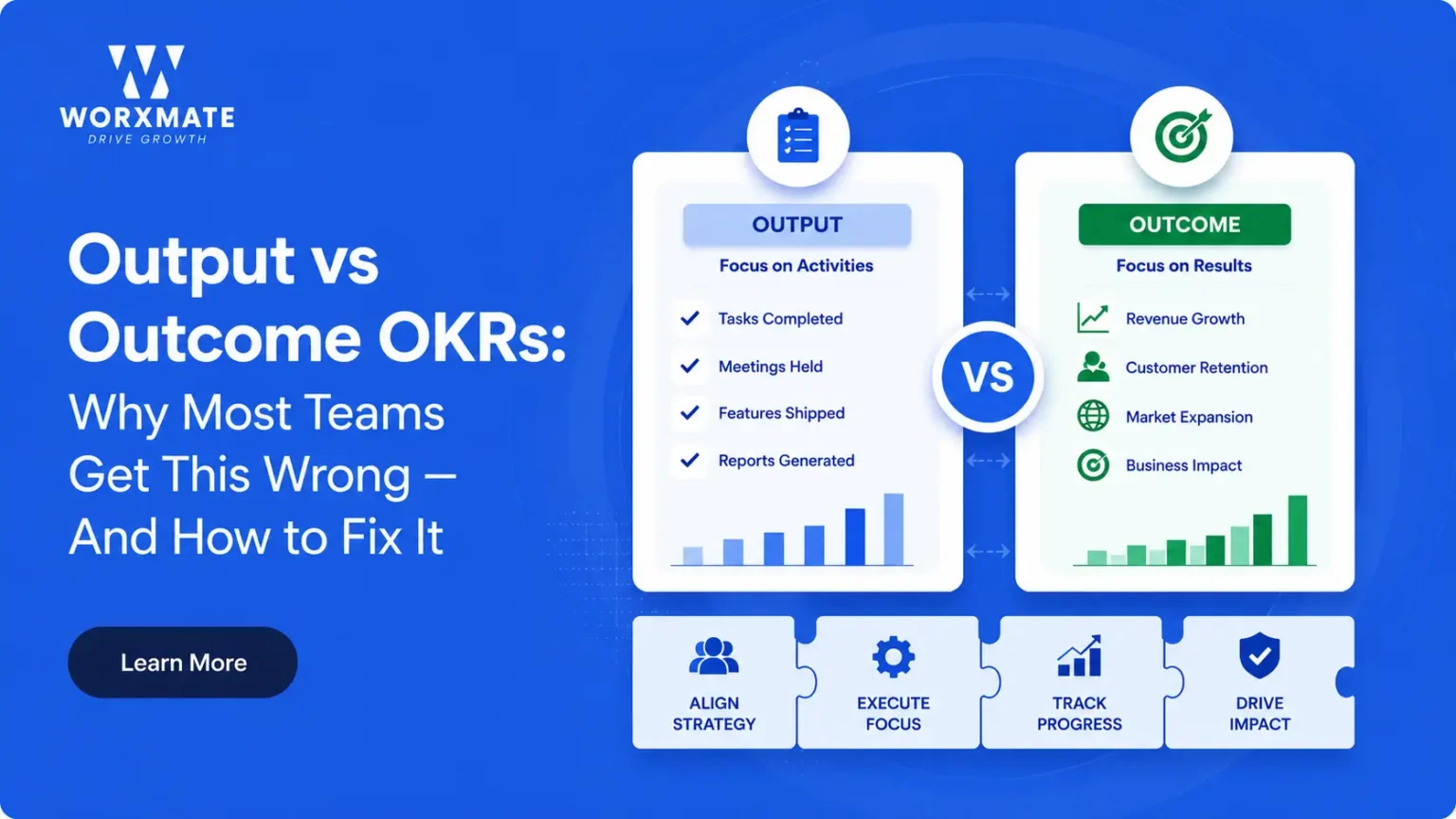

At the end of last quarter, your team completed 80% of their OKRs.
The dashboard was mostly green. The scores looked solid. The quarterly review went smoothly no difficult conversations, no red flags, no goals that needed explaining away.
And yet when the CEO asked what had actually changed in the business, the room went quiet.
Revenue had not moved the way it was supposed to. The product problem that had been sitting there for two quarters was still sitting there. The customer metric that leadership had talked about in the planning session the one that was supposed to be the whole point of the quarter had barely shifted.
If this sounds familiar, the problem is almost certainly not your people. It is not your ambition. It is not even your OKR process. It is what your team thought they were measuring.
The single most common reason OKR programs produce activity without results is also the least talked about — most teams are writing outputs and calling them outcomes.
This article is about seeing that distinction clearly — and developing the thinking process that makes outcome-based goal writing the default rather than the exception. For a practical step-by-step guide to implementation, visit our OKR how-to guides.
About the Author
I am Madhusudan Nayak — Maddy. I have spent 20+ years in strategy execution and the last 10 specifically in OKR implementation — 50+ organisations, 500+ leaders trained, across enterprise, SMB and startup contexts spanning APAC, the Middle East and Europe. Before co-founding Worxmate, I served as Business Head at Profit.co through its early funding journey. The observations in this article come from coaching leadership teams through the output trap in real cycles — and from building the DEEP AI™ framework that is now designed to catch this problem before it survives a planning session.
What Is the Difference Between Output and Outcome in OKRs?

An output is something your team produces. A deliverable. A piece of work that can be completed and checked off regardless of whether it changed anything in the world outside your organisation.
An outcome is a change in the world that results from your work. A shift in customer behaviour. A movement in a business metric. A measurable improvement in an operational result.
The distinction sounds clean on paper. In practice it is genuinely difficult — because outputs and outcomes are causally connected, which makes them easy to confuse. You ship the feature because you believe it will increase adoption. The output is the mechanism. The outcome is the point. But when you write your Key Result, which one are you measuring?
Most teams measure the mechanism. They write the Key Result around the thing they control — the deliverable — rather than the thing that matters — the change the deliverable is supposed to create. And because the deliverable is completable, the Key Result gets scored green. And because the outcome was never measured, nobody notices that the change never happened.
That is the output trap in its simplest form. Here is how it looks in practice across four common functions:
| Function | ❌ Output Key Result | ✓ Outcome Key Result |
| Sales | Complete sales enablement training for all 24 reps by end of Q2. | Increase average deal size from $18,000 to $24,000 by end of Q2. |
| Product | Launch the redesigned onboarding flow by March 31. | Increase user activation rate from 34% to 52% within 30 days of signup by end of Q1. |
| Finance | Deliver the new financial reporting dashboard to leadership by end of Q1. | Reduce time spent on monthly financial review preparation from 3 days to 4 hours by end of Q2. |
| Operations | Implement the new supplier onboarding process across all three regions by end of Q3. | Reduce average supplier onboarding time from 14 days to 6 days by end of Q3. |
The pattern across all four examples is identical. The output KR measures whether the work happened. The outcome KR measures whether the work worked. Both are legitimate things to track — but only one of them tells you whether the quarter was worth running.
The Output Trap Compounds With Every Cycle
In cycle one, output-heavy OKRs are understandable. The organisation is learning the framework. The instinct is to write what they know — deliverables, projects, initiatives — because that is the language their careers have rewarded. A coach in the room can catch the worst offenders and redirect them. The damage is contained.
But here is what happens next.
The output KRs get completed. The scores come in green. The quarterly review goes smoothly. Nobody connects the green scores to the business outcomes that did not move because the business outcomes were never written into the OKRs in the first place. There is no evidence of failure. There is only evidence of completion.
So in cycle two, the team writes similar goalsv. Why would they not? The approach worked last time. The behaviour is now reinforced by the system designed to measure it.
By cycle three, something more serious has happened. The organisation now has a well-functioning OKR process — strong check-in compliance, consistent scoring, regular reviews — that is measuring the wrong things. The infrastructure is solid. The foundation is rotten.
I have been the second consultant more times than I would like to count. The archaeology is always the same — well-written C-suite OKRs from cycle one, progressively weaker goal quality at each level below, and a leadership team that is genuinely confused because the process looks healthy and the business has not moved.
Changing that lesson in cycle three requires unlearning something that the system itself validated twice. It takes significantly more coaching effort, significantly more disruption to the existing rhythm, and a willingness from leadership to acknowledge that two cycles of green dashboards were measuring the wrong things. That conversation is uncomfortable — which is why most organisations avoid it until the frustration becomes impossible to ignore.
What Does This Look Like Across Different Teams?

The output trap does not have a favourite function. In 10 years of OKR implementation across industries, I have seen it appear with equal frequency in leadership teams, commercial functions, technical teams, support functions and everything in between. What changes is the specific form it takes — because each function h as its own version of “the work we do” that it defaults to measuring.
| Function | ❌ Output Key Result | ✓ Outcome Key Result |
| Leadership & Strategy | Launch the new market expansion strategy for Southeast Asia by Q2. | Achieve $2.1M in revenue from Southeast Asian markets by end of Q3, up from $0. |
| Human Resources | Roll out the new performance review framework across all business units by end of Q1. | Increase manager effectiveness scores from 61% to 75% by end of Q2, measured through quarterly pulse survey. |
| Customer Success | Complete quarterly business reviews with all 47 enterprise accounts by end of Q3. | Increase net revenue retention from 104% to 112% across enterprise accounts by end of Q3. |
| Marketing | Launch the Q2 content marketing campaign across LinkedIn, email and the blog by April 15. | Generate 340 qualified pipeline opportunities from inbound content channels by end of Q2, up from 190 in Q1. |
| Technology & Engineering | Complete the API integration with the three priority enterprise customers by end of Q2. | Reduce enterprise customer time-to-integration from 34 days to 12 days by end of Q2. |
The pattern underneath all of these is identical. Every function has a version of “the work we do” that it defaults to measuring because that work is visible, completable and within the team’s direct control. Outcome measurement requires something harder: defining the change the work is supposed to create, measuring whether that change actually happened, and being honest when the work was completed but the change did not occur.
That honesty is what makes outcome-based OKRs uncomfortable. And that discomfort is exactly why they work — when they are written correctly.
The Thinking Process That Actually Fixes This

Every intervention I have tried over 10 years of OKR coaching to solve the output trap — explanations, frameworks, templates, writing guides, review checklists — produces the same result. Teams understand the concept in the session and revert to output thinking when they sit down to write their goals alone.
The one intervention that actually changes the behaviour is not an explanation. It is a process. Specifically, it is a sequence of questions that forces outcome thinking rather than teaching it.
I call it the Thinking Process. Here is where it came from.
The “So What” Chain — A Real Coaching Sequence
In the early stages of working with a European fintech startup — around 100 people, generating revenue, introducing OKRs for the first time — I asked the CEO and CPO the question I ask at the start of every engagement: what is the one big thing you want to resolve this quarter?
The answer came quickly: product demo experience. At that point, most coaches would move to goal writing. I did not. Instead I asked the first question in the sequence:
“So what?” — Not dismissively. Genuinely. So what if the demo experience improves? What changes in the business if that happens?
| Question | Answer | What It Reveals |
| “So what if demo experience improves?” | More prospects stay engaged through the full demo rather than dropping off halfway. | The real problem is engagement, not experience. |
| “So what if more prospects stay engaged?” | Conversion from demo to paid trial increases. | The outcome is conversion, not engagement. |
| “So what if trial conversion increases?” | Monthly revenue from new customers increases. | The business metric is revenue, not conversion. |
| “So what if monthly revenue increases?” | We hit growth targets and unlock the next funding conversation. | The strategic context behind the entire chain. |
That sequence — four “so what” questions from “improve demo experience” — produced the outcome that the entire quarter’s work was actually in service of. The Key Result that mattered was not “improve demo experience.” It was “increase demo-to-trial conversion from 18% to 31% by end of Q2.” That Key Result cannot be faked. It cannot be completed regardless of outcome.
The Game Format — When Theory Is Not Enough
In the large IT services organisation I worked with — 70,000+ employees — the leadership team understood the “so what” question intellectually. But when they sat down to write their own Key Results, they reverted to outputs. The missing piece was not understanding. It was practice — specifically, practice in their own context, with their own business scenarios.
The intervention that worked was a game. I put a set of goals on the screen — some output-led, some outcome-driven — all drawn from scenarios the team recognised from their own business. The debate that followed was the most valuable part. Not my explanation of which goals were outputs and which were outcomes — but their argument with each other about goals that sat in the grey area.
That productive confusion — in the messy reality of goals that could be written either way — is where outcome thinking actually develops. Not in a training session where the examples are clean and the answers are obvious.
The Three Diagnostic Questions
Once a leader has written a draft Key Result, run it through these three questions in sequence — as a conversation, not a checklist:
| Q1 | If your team delivers this perfectly and nothing changes in the business, is that acceptable?
If yes, it is an output. Name it as such before deciding whether to keep it. Output KRs are not wrong — but they must be deliberate. |
| Q2 | What is the “so what” of this Key Result — what business reality changes if this number moves?
If the answer is clear and direct, the KR is probably outcome-oriented. If it requires several inferential steps, it is probably still an output. |
| Q3 | What number specifically — from where to where, by when?
“Improve customer satisfaction” is an output disguised as an outcome. “Increase NPS from 34 to 51 by end of Q3” is an outcome. The precision of the measurement is the fastest way to expose whether a KR is genuinely outcome-oriented. |
Achieve Your Goals Faster
See how Worxmate can help your team set clear goals and achieve faster results. Book your free demo today and experience the power of AI-driven OKRs in action.
One Important Reminder About Output Key Results
Output Key Results are not inherently wrong. There are situations where writing an output KR is the right call — when the team is genuinely early-stage, when the output itself is the uncertainty, when the question is whether we can build this at all rather than whether building it will produce a specific outcome.
The Thinking Process does not eliminate output KRs. It makes them deliberate. A team that writes an output KR after running the three questions above — and can articulate what outcome it is in service of — is making a sound judgment. A team that writes an output KR because it felt like the right format is making a mistake that will compound. The difference between those two teams, practised consistently across cycles, is what moves an organisation’s Execution Maturity Rate from the 5–15% range of a first-cycle implementation toward the 30–40% range of an organisation that has genuinely learned to execute.
How Do You Know If It’s Working?
The instinct after reading an article like this is to audit last quarter’s OKRs, identify which Key Results were outputs, rewrite them as outcomes, and consider the problem solved. That instinct is understandable. It is also insufficient.
Rewriting Key Results is a one-cycle fix. The output trap is a thinking pattern — and thinking patterns do not change because the words in a planning document changed. They change when the people writing the goals develop a different instinct about what they are trying to measure.
So how do you measure whether it is actually happening? Not by looking at goal completion rates. The metric that actually tells you whether the thinking has changed is this:
What percentage of your leaders can write a genuine outcome-driven goal independently — without a coach in the room, without a template, without a quality review before it goes live? I call this the Execution Maturity Rate.
| Stage | Execution Maturity Rate | What It Means |
| First OKR cycle | 5% – 15% | Most leaders can write outcome-based goals when coached. Very few can do it alone. |
| After 2–3 coached cycles | 15% – 25% | Outcome thinking is developing. Internal champion can support peers. |
| After 12 months well-coached | 30% – 40% | Leadership population thinks differently about success. Program is self-sustaining. |
| Target state | 40%+ | Outcome thinking is the default, not the exception. Compound execution improvement begins. |
Track this number from cycle one. Measure it simply — at the end of each planning session, count how many leaders produced genuine outcome-driven goals without coaching intervention versus how many needed significant redirection. Set a target for where that percentage should be in twelve months. Everything else — completion rates, check-in compliance, dashboard colours — is a proxy for this number.
Where to Go From Here
The output trap is solvable. But it is not solved by a better template, a more sophisticated platform, or a one-day workshop on how to write outcome-based Key Results. It is solved by developing a thinking process — across your leadership team, across cycles, with honest feedback at every stage.
| Where You Are | Recommended Next Step | Resource |
| Want to develop the capability internally | Use the Thinking Process tools, diagnostic questions and cycle-by-cycle coaching frameworks | worxmate.ai/resources/how-to-guide/ |
| Need structured support through the first two cycles | OKR consulting program built around the output trap and other first-cycle failure modes | worxmate.ai/okr-consulting/ |
| Ready to evaluate the platform | Worxmate Define stage — AI-assisted goavl writing that scores KR quality in real time | worxmate.ai/product/ai-okr-writing-tool-define/ |
Explore pricing, book a demo, or start with our OKR ebooks and articles — whichever is the right next step for where your organisation is right now.
The software is the infrastructure. The coaching is the capability. Get both right — in the right order — and OKRs work. Every time.

Written by
An OKR Coach with 20+ years of implementation experience, Madhusudan has guided over 50 organisations through successful OKR transformations, training more than 500 leaders. Learn more about Worxmate.