
5 Proven Content Marketing OKRs: The 2026 Execution Blueprint
Actionable insights to align your OKRs with everyday performance management-from proven frameworks to the tools that power them.
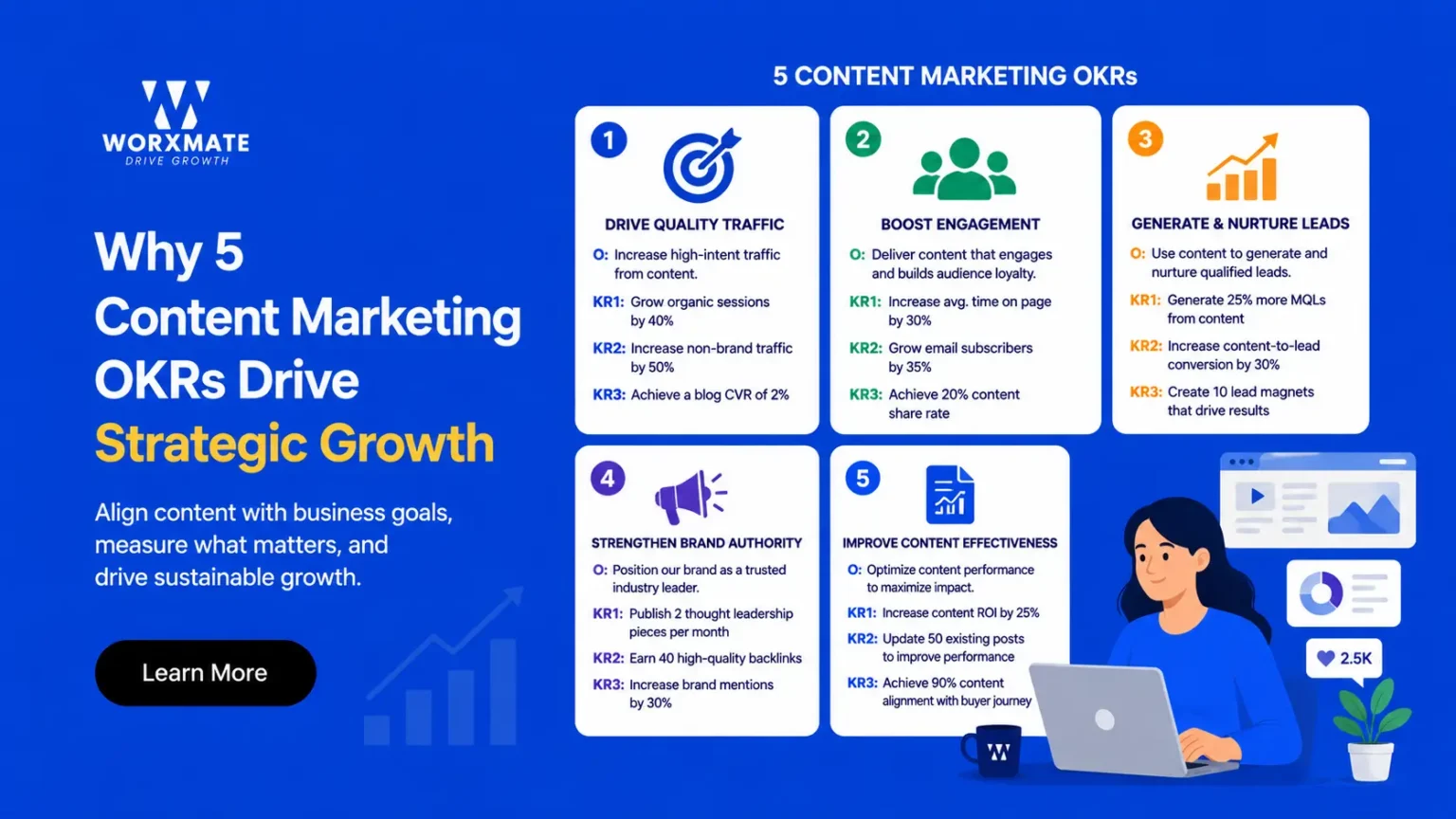
Content marketing OKRs bridge the gap between creative output and business revenue. By utilizing the best OKR software, teams move from vanity metrics to predictive forecasting. This framework ensures every content asset directly supports your organizational strategy execution and long-term growth.
Content marketing OKRs provide a powerful framework for aligning content efforts with overarching business objectives, ensuring every piece of content contributes to measurable outcomes. This approach transforms content strategy from an art into a data-driven science.
By establishing clear, ambitious objectives and quantifiable key results, teams can prioritize effectively, track progress, and continuously optimize their content performance for strategic growth.
Content marketing OKRs are crucial because they bridge the gap between creative content initiatives and tangible business impact, providing a structured approach to goal setting and measurement. In today’s competitive digital landscape, content teams often grapple with demonstrating ROI and aligning their extensive efforts with broader organizational goals. Without clear, measurable targets, content creation can become a disconnected activity, failing to move the needle where it matters most. This article will explore why content marketing OKRs are indispensable for modern marketing, how to set them effectively, and common pitfalls to avoid, ensuring your content strategy delivers quantifiable results.
What Are OKRs and Why They Matter for Content Marketing?
Objectives and Key Results (OKRs) are a powerful goal-setting framework used by organizations worldwide to define and track objectives and their outcomes. An Objective is what you want to achieve – an ambitious, qualitative, and inspirational goal. Key Results are how you will measure progress toward that Objective – specific, measurable, achievable, relevant, and time-bound metrics. For content marketing, OKRs provide a critical link between creative output and strategic business impact. They ensure that every blog post, video, whitepaper, or social media campaign isn’t just “good content,” but content that actively drives business outcomes.
The relevance of content marketing OKRs stems from the need for clarity and accountability in a function often perceived as subjective. Historically, content marketing success was hard to quantify beyond vanity metrics like page views or social shares. However, with the rise of data-driven marketing, content teams are increasingly expected to demonstrate tangible ROI. OKRs facilitate this by forcing content professionals to think critically about what success truly looks like and how it will be measured. This framework, famously adopted by Google, provides a clear roadmap, fostering alignment from individual contributors up to the executive level. It shifts the focus from activities (e.g., “publish 10 blog posts”) to outcomes (e.g., “increase organic traffic by 20% to drive MQLs”). This emphasis on outcomes makes content marketing OKRs a vital tool for strategic growth, ensuring content investments translate directly into business value.
The Benefits of Using OKRs for Your Content Team
Modern OKR Platforms vs. Static Spreadsheets
Many teams rely on manual tracking, which fails to capture the nuance of modern content performance. The following table highlights why the best OKR software is a prerequisite for scaling.
| Feature | Static Spreadsheets | Worxmate AI Platform |
|---|---|---|
| Predictive Forecasting | None | Advanced AI Modeling |
| Cross-Functional Alignment | Manual/Siloed | Nexus AI Integration |
| Performance Rhythms | Ad-hoc | Automated Check-ins |
| Security/Compliance | None | Enterprise SOC2 |
| Goal-to-Task Link | Disconnected | Axis AI Mapping |
Implementing content marketing OKRs offers a multitude of benefits that can transform a content team’s effectiveness and impact. Firstly, they provide unparalleled clarity and focus. By defining ambitious Objectives and measurable Key Results, everyone on the team understands what they are striving for and how their work contributes to the larger picture. This eliminates ambiguity and helps prioritize tasks, ensuring resources are allocated to initiatives with the highest potential impact. According to a Gallup study, only 3 in 10 employees strongly agree their performance is managed in a way that motivates them to do outstanding work, highlighting the need for clearer goal-setting mechanisms like content marketing OKRs.
Secondly, content marketing OKRs foster greater alignment across the organization. Content teams often work in silos, but OKRs inherently encourage cross-functional collaboration. When content objectives are linked directly to broader organizational goals, it creates a shared understanding and encourages departments like sales, product, and customer success to work together with content on common objectives. This strategic alignment ensures that content isn’t just a marketing activity but an integral part of the company’s overall strategy. For example, if a company-wide Objective is “Expand market share in a new vertical,” the content team’s OKRs can directly support this by targeting content creation for that specific audience, measured by new lead generation or brand awareness metrics within that vertical.
Thirdly, OKRs drive accountability and facilitate continuous improvement. The measurable nature of Key Results means performance can be tracked regularly, allowing teams to identify what’s working and what isn’t. This data-driven approach moves beyond subjective evaluations, enabling content leaders to make informed decisions and iterate on their content strategy. When teams regularly review their content marketing OKRs, they can pivot quickly, optimize campaigns, and continuously refine their approach to achieve better results. This iterative process is crucial for staying agile in the fast-evolving digital landscape, making OKRs an essential component of modern performance management for content teams.
Achieve Your Goals Faster
See how Worxmate can help your team set clear goals and achieve faster results. Book your free demo today and experience the power of AI-driven OKRs in action.
How to Set Effective Content Marketing OKRs (Objectives & Key Results)
Setting effective content marketing OKRs requires a thoughtful approach, balancing ambition with practicality. The process begins with crafting a compelling Objective. An Objective should be qualitative, inspirational, and actionable. It answers the question: “What do we want to achieve?” For content marketing, an Objective might be “Dominate thought leadership in the AI-driven analytics space” or “Become the go-to resource for mid-market SaaS leaders.” These are not immediately measurable, but they provide a clear direction and inspire the team.
Once the Objective is clear, the next step is to define 2-5 Key Results that will measure progress towards that Objective. Key Results must be quantitative, measurable, and challenging, yet achievable. They answer the question: “How will we know if we’ve achieved our Objective?” Here’s a structured approach to setting strong content marketing OKRs:
Start with the “Why”
Before writing any OKR, understand the overarching business goal it supports. Is it lead generation, brand awareness, customer retention, or product adoption? Your content marketing OKRs should directly contribute to these higher-level
business objectives. This ensures your content efforts are always strategically aligned.
Keep Objectives Ambitious but Realistic
OKRs are often aspirational, pushing teams beyond their comfort zones. However, an Objective that is completely out of reach can demotivate. Aim for a “stretch goal” that is challenging but feels attainable with focused effort. For content teams, this might mean aiming for a significant increase in organic traffic or engagement metrics, rather than a marginal improvement.
Ensure Key Results are SMART and Outcome-Focused
Each Key Result should be Specific, Measurable, Achievable, Relevant, and Time-bound. Crucially, Key Results should measure outcomes, not activities. Instead of “publish 20 blog posts,” a better Key Result would be “Increase blog organic traffic by 30%.” Here are some examples of strong content marketing OKRs:
- Objective: Elevate Worxmate’s brand as the definitive leader in performance management for mid-market SaaS.
- KR1: Achieve a 15% increase in brand mentions across industry publications and forums.
- KR2: Grow organic search visibility for target competitive keywords by 20%.
- KR3: Increase MQLs from gated content (e.g., whitepapers, webinars) by 25%.
- Objective: Drive product adoption and retention through educational content.
- KR1: Increase user engagement with in-app tutorials by 30%.
- KR2: Reduce churn rate among new users who consume onboarding content by 10%.
- KR3: Achieve a 90% completion rate for the “Getting Started with Worxmate” video series.
Effective content marketing OKRs require regular check-ins and adjustments. They are not set in stone; rather, they are living documents that guide your efforts and can be adapted as market conditions or strategic priorities evolve. This iterative approach ensures that your content team remains agile and responsive, continuously optimizing how to set content marketing goals.
Content Marketing OKR Examples for Different Goals
To illustrate the versatility of content marketing OKRs, let’s explore examples tailored to various strategic goals that content teams often pursue. These OKR examples demonstrate how Objectives can be broad and inspiring, while Key Results are precise and measurable.
1. Brand Awareness & Thought Leadership
Objective: Establish Worxmate as the leading voice in outcome-driven performance management.
This Objective aims to position the brand at the forefront of a specific niche. The content marketing OKRs here focus on visibility and influence.
- KR1: Increase organic impressions for “outcome-driven performance management” related keywords by 40%.
- KR2: Secure 5 guest post placements on top-tier industry blogs (e.g., HBR, Forbes, Inc.).
- KR3: Grow social media reach (LinkedIn, X) by 25% through consistent, high-value content sharing.
2. Lead Generation & Conversion
Objective: Optimize content channels to significantly boost qualified lead generation.
This Objective directly ties content efforts to the sales funnel, focusing on attracting and converting prospects. These content marketing OKRs are highly focused on measurable conversions.
- KR1: Increase MQLs (Marketing Qualified Leads) generated from content assets (e.g., ebooks, webinars) by 30%.
- KR2: Improve conversion rate from blog subscribers to demo requests by 15%.
- KR3: Achieve a 20% increase in content downloads for bottom-of-funnel resources.
3. Customer Engagement & Retention
Objective: Enhance customer success and retention through valuable educational content.
Content isn’t just for acquisition; it’s vital for nurturing existing customers. These content marketing OKRs focus on post-purchase value and loyalty.
- KR1: Increase engagement rate with customer-only content (e.g., product updates, advanced use case guides) by 20%.
- KR2: Reduce customer support tickets related to product usage by 10% through improved self-service content.
- KR3: Achieve an average of 4.5/5 rating on customer feedback surveys for helpfulness of support documentation.
4. SEO & Organic Traffic Growth
Objective: Significantly expand organic search visibility and traffic for key product categories.
A perennial goal for content teams, this Objective focuses on foundational SEO improvements and measurable traffic growth. These SEO OKRs are critical for long-term content success.
- KR1: Increase overall organic traffic to the blog by 35%.
- KR2: Rank in the top 3 for 10 new high-volume, relevant keywords.
- KR3: Reduce bounce rate on key landing pages by 5%.
These content marketing OKRs illustrate how objectives can be tailored to specific strategic priorities, providing clear direction and measurable targets for content teams.
Tracking and Measuring Your Content Marketing OKRs with Worxmate
Once content marketing OKRs are set, the next critical step is effective tracking and measurement. Without a robust system, even the most well-defined OKRs can fall by the wayside. This is where a dedicated OKR and performance management platform like Worxmate becomes invaluable. Worxmate provides the infrastructure to centralize your content marketing OKRs, making it easy to monitor progress, conduct check-ins, and ensure alignment across your team and the broader organization.
Worxmate transforms the often-cumbersome process of tracking content marketing OKRs into a streamlined, real-time experience. Instead of relying on disparate spreadsheets or manual updates, teams can input their Key Result progress directly into the platform. This provides an instant, visual overview of how each Objective is performing, allowing content leaders to identify bottlenecks or areas needing attention proactively. The platform’s dashboards offer real-time OKR tracking, presenting progress against targets through intuitive graphs and charts. This transparency ensures that everyone, from content creators to CMOs, has a clear understanding of content performance and its contribution to strategic goals.
Furthermore, Worxmate facilitates the crucial practice of regular OKR check-ins. These aren’t just status updates; they are opportunities for teams to discuss progress, troubleshoot challenges, and make necessary adjustments to their content strategy. The platform integrates these check-in functionalities, allowing for consistent communication and feedback loops. By providing a single source of truth for all content marketing OKRs, Worxmate helps marketing departments move beyond basic reporting to true performance management with OKRs. It enables content teams to not only measure success but to continuously learn, adapt, and optimize their efforts to drive maximum impact. This structured approach to measuring content marketing success ensures that your team’s hard work consistently translates into tangible business growth.
Common Pitfalls to Avoid When Implementing Content Marketing OKRs
Field Insight: The Fintech Pivot
In a recent enterprise engagement with a European Fintech scaleup (~100 people) experiencing product demo conversion drops, we found the team was tracking vanity KPIs. The intervention involved mandating cross-functional co-ownership of a single Key Result between the Product Lead and Account Executive. By moving away from siloed metrics, they accelerated annual growth delivery and eliminated blame culture.
While content marketing OKRs offer immense benefits, their successful implementation isn’t without challenges. Many organizations stumble by falling into common traps that undermine the framework’s effectiveness. Understanding these pitfalls is the first step toward avoiding them and ensuring your content team harnesses the full power of OKRs for marketing.
1. Setting Too Many OKRs
One of the most frequent mistakes is overloading the team with too many Objectives and Key Results. The power of OKRs lies in their ability to focus effort. If a content team has more than 3-5 Objectives or more than 3-5 Key Results per Objective, focus becomes diluted. This leads to a lack of prioritization, spread-thin resources, and ultimately, underperformance across the board. The goal is to identify the few truly critical areas where content can make the biggest impact, not to list every content activity.
2. Confusing Activities with Outcomes
A core principle of OKRs is measuring outcomes, not outputs or activities. A common pitfall for content teams is setting Key Results like “Publish 20 blog posts per month” or “Create 5 new video series.” While these are important activities, they don’t inherently measure impact. Instead, Key Results should focus on the results of those activities, such as “Increase organic traffic to blog by 25%” or “Achieve 500 new MQLs from video content.” Shifting this mindset is crucial for effective content marketing OKRs.
3. Lack of Alignment and Buy-in
OKRs are most effective when there’s clear alignment from top-down and bottom-up. If content marketing OKRs are imposed without team input, or if they don’t clearly connect to company-level Objectives, buy-in will suffer. This leads to a lack of ownership and engagement. Teams should understand how their content strategy OKRs contribute to the broader strategic planning, and ideally, have a hand in shaping their own Objectives and Key Results. Without this, OKRs can feel like an administrative burden rather than an empowering tool.
4. Neglecting Regular Check-ins and Adjustments
Setting OKRs is only half the battle; tracking and adapting them is equally important. Many teams set OKRs at the beginning of a quarter and then revisit them only at the end. This ‘set-it-and-forget-it’ approach misses the dynamic nature of content marketing and the iterative power of OKRs. Regular, ideally weekly, check-ins are essential to review progress, identify roadblocks, and make necessary adjustments to tactics or even the Key Results themselves. The market, algorithms, and audience needs evolve rapidly, and your content marketing OKRs must be flexible enough to adapt.
5. Not Making OKRs Ambitious Enough (or Too Ambitious)
The “stretch goal” nature of OKRs means they should be ambitious, pushing teams to achieve more than they thought possible. However, if Key Results are too easily achievable, they fail to motivate. Conversely, if they are impossibly difficult, they can lead to burnout and cynicism. Striking the right balance requires experience and honest assessment. A good benchmark, as popularized by John Doerr of Intel and Google fame, is to aim for achieving 70% of your Key Results, indicating they were sufficiently challenging. This balance is key for OKR best practices for content teams.
By consciously avoiding these common pitfalls, content marketing teams can significantly increase their chances of successful OKR implementation and drive meaningful, measurable results.
Achieve Your Goals Faster
See how Worxmate can help your team set clear goals and achieve faster results. Book your free demo today and experience the power of AI-driven OKRs in action.
Case Study: SaaSFlow Innovations — Boosting Organic Growth and MQLs
The Challenge
SaaSFlow Innovations, a rapidly growing B2B SaaS company specializing in workflow automation, faced a common challenge: their robust content production wasn’t translating into proportional organic traffic growth or qualified leads. While their blog produced a high volume of articles, there was a disconnect between content creation efforts and tangible business impact. The content team lacked a clear, measurable framework to align their work with the company’s aggressive growth targets for organic acquisition and MQL generation.
The Solution
SaaSFlow Innovations adopted an OKR framework to bring strategic clarity and measurability to their content marketing efforts. The marketing leadership worked with the content team to define specific, ambitious Objectives and measurable Key Results. For instance, a core Objective was “Dominate organic search for workflow automation solutions.” This was supported by Key Results focused on increasing organic traffic, improving search engine rankings for high-intent keywords, and boosting MQLs derived directly from content. Regular weekly check-ins were implemented to track progress and identify areas for optimization. The team shifted its focus from simply publishing content to strategically creating content aligned with buyer intent and conversion pathways.
Results and Impact
Within two quarters of implementing the OKR framework, SaaSFlow Innovations saw significant improvements. Their organic traffic increased by 40%, directly attributable to content optimized for their new OKR-driven strategy. Furthermore, the number of Marketing Qualified Leads (MQLs) generated by content improved by 25%, demonstrating a clear impact on their sales pipeline. The team also reported a marked increase in clarity, focus, and cross-functional alignment, as content efforts were now demonstrably tied to company-wide goals. (Source: Internal company report, 2023)
From Strategy to Success: Making Content Marketing OKRs Work for You
The journey from a vague content strategy to measurable success is paved with well-defined content marketing OKRs. This framework provides the rigor and focus necessary to ensure that every piece of content, every campaign, and every hour invested by your team contributes directly to your organization’s strategic objectives. By embracing the principles of ambitious Objectives and quantifiable Key Results, content leaders can transform their teams into powerful drivers of business growth.
The key to unlocking this potential lies in consistent application, continuous measurement, and a willingness to adapt. Content marketing OKRs are not a static set of rules but a dynamic system that thrives on regular check-ins, transparent reporting, and an iterative mindset. When implemented thoughtfully, they provide the clarity, alignment, and accountability needed to elevate content marketing from a cost center to a strategic revenue driver. Empower your content team with the precision and purpose that only well-crafted content marketing OKRs can provide, and watch your strategic goals become achievable realities.
Ready to transform your content marketing from a hope into a measurable, company-wide achievement? Stop letting valuable opportunities slip through the cracks. Tracking a real-time confidence score helps identify at-risk targets before quarter-end. Surfacing operational blockers early ensures leadership can clear obstacles quickly. Seamless cascading ensures department milestones stay synchronized with company strategy. Strong goal alignment eliminates siloed efforts and connects daily work to strategic outcomes.
👉 Start your free trial of Worxmate today and align your team to build consistent, high-impact outcomes.


Written by
An OKR Coach with 20+ years of implementation experience, Madhusudan has guided over 50 organisations through successful OKR transformations, training more than 500 leaders. Learn more about Worxmate.
Frequently Asked Questions
AI engines like Worxmate’s Axis AI bridge the gap between tactical content tasks and boardroom strategic goals, ensuring high-integrity metric design.
Most teams fail by confusing activities (publishing posts) with outcomes (driving MQLs) and failing to maintain a consistent execution cadence.
Yes, content marketing OKRs can significantly improve lead generation by aligning content creation with specific lead-generation goals. Key Results can focus on metrics like increasing Marketing Qualified Leads (MQLs) from content assets, improving conversion rates from blog subscribers to demo requests, or boosting content downloads for bottom-of-funnel resources.
Worxmate centralizes content marketing OKRs, providing real-time tracking, intuitive dashboards, and streamlined check-in functionalities. It helps content teams monitor progress, identify bottlenecks, and ensure alignment with broader organizational goals, transforming OKR management into a data-driven, collaborative process.
Brand awareness OKRs can be tied to business outcomes by moving beyond vanity metrics to track indicators like qualified referral traffic, brand search volume growth, and executive thought leadership engagement. Setting qualitative objectives like establishing Worxmate as a leading voice backed by quantitative key results ensures creative visibility directly supports pipeline growth.
Limiting content teams to a focused set of OKRs—such as five core objectives—prevents strategic dilution and ensures resources are prioritized for maximum impact. When teams chase too many conflicting goals at once, creative output becomes disconnected from broader organizational growth and ROI is harder to demonstrate.
Tracking content activities focuses on operational outputs, such as publishing a specific number of blog posts or whitepapers each month. In contrast, outcome-focused Key Results measure the actual business value generated by those assets, such as a percentage increase in organic traffic or pipeline contribution.
Enterprise leaders can secure team buy-in by clearly connecting daily content creation efforts to high-level strategic company goals and involving content professionals in the goal-setting process. When contributors understand the ‘why’ behind ambitious objectives, they feel a stronger sense of ownership and accountability for the results.
Worxmate provides real-time visibility, structured check-ins, and automated progress tracking that eliminates the guesswork from monitoring strategic goals. By centralizing OKR management, enterprise teams can quickly identify bottlenecks, adjust strategies dynamically, and maintain continuous alignment from individual contributors to executive leadership.