
Summary
OKRs for manufacturing help U.S. production facilities set measurable goals aligned with strategic business objectives, moving beyond simple output tracking to focus on impactful outcomes. They translate high-level vision into actionable, transparent steps, ensuring every team and individual contributes directly to the company’s success.
In today’s dynamic industrial landscape, U.S. manufacturing leaders face intense pressure to boost productivity, innovation, and global competitiveness. OKRs provide a robust framework to align operational excellence with strategic imperatives, fostering accountability and driving continuous improvement across the entire value chain.
The U.S. manufacturing sector is undergoing a profound transformation, driven by technological advancements, evolving supply chain dynamics, and a renewed focus on domestic production. COOs, Plant Managers, and Operations Directors are no longer just managing output; they’re navigating complex ecosystems demanding agility, efficiency, and continuous innovation. Traditional performance metrics, while valuable, often fall short in capturing the strategic impact needed to thrive in this new era.
This is where Objectives and Key Results (OKRs) become indispensable. They offer a dynamic, outcome-oriented framework that bridges the gap between high-level strategy and daily operational execution. By clearly defining what success looks like and how to measure it, OKRs for manufacturing empower teams to prioritize initiatives that truly move the needle, rather than just keeping the production line running.
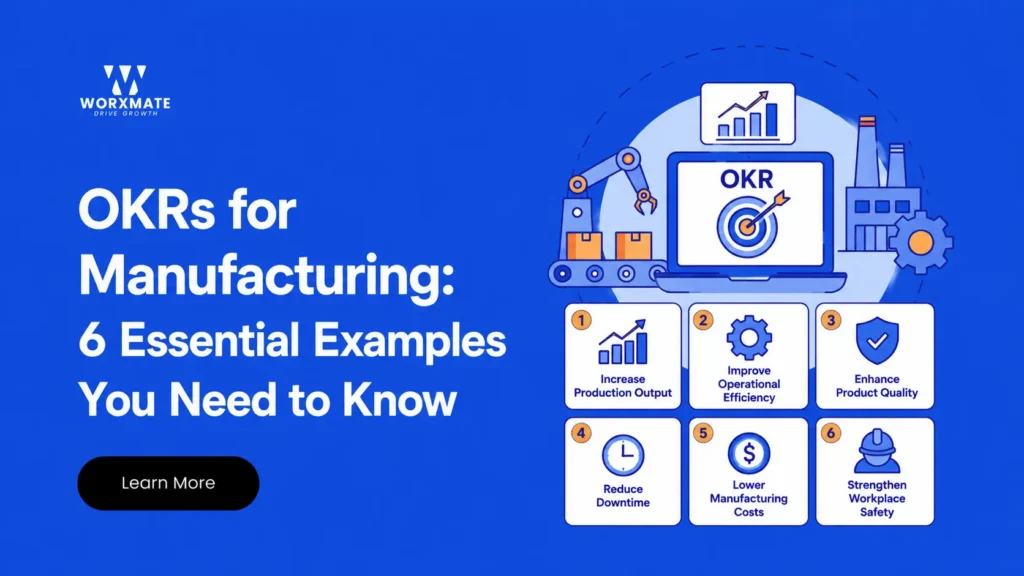
In this article, we’ve compiled 6 essential OKRs for manufacturing, designed to help U.S. firms enhance operational efficiency, foster innovation, and achieve sustainable growth. These examples provide practical blueprints for translating strategic intent into measurable results across various aspects of your manufacturing operations.
The Shift Toward Agile Manufacturing in the USA
The landscape of U.S. manufacturing is rapidly evolving, moving away from rigid, mass-production models towards more agile, responsive, and customer-centric operations. This shift is fueled by demands for customization, faster time-to-market, and resilience against supply chain disruptions. According to a McKinsey report, manufacturers are increasingly adopting advanced technologies and agile methodologies to stay competitive. This necessitates a performance management system that can adapt just as quickly.
Traditional top-down goal setting often struggles to keep pace with this dynamism. Agile manufacturing requires continuous feedback, rapid iteration, and decentralized decision-making. OKRs for manufacturing provide the framework for this, allowing organizations to set ambitious yet adaptable goals that cascade from the executive level down to the shop floor. This ensures that every team is aligned with the broader US manufacturing strategy and can pivot quickly when market conditions change.
Why Traditional KPIs Aren’t Enough for Modern Factories
Key Performance Indicators (KPIs) are vital for monitoring the health of manufacturing operations. Metrics like OEE (Overall Equipment Effectiveness), defect rates, and cycle times provide snapshots of current performance. However, while KPIs tell you “what happened,” they often don’t tell you “why” or “what to do next” to achieve a transformative outcome.
Modern factories need more than just tracking; they need a system that drives strategic improvement. OKRs for manufacturing differ from KPIs in a crucial way: OKRs are aspirational and outcome-focused, defining what you want to achieve (Objective) and how you’ll measure its success (Key Results). KPIs are often ongoing operational metrics. For instance, while “Maintain OEE at 85%” is a KPI, “Improve production efficiency by 15% through automation” is an OKR. The OKR drives a specific, time-bound initiative, whereas the KPI monitors baseline performance. Understanding KPI vs OKR in manufacturing is key to modern performance management.
How OKRs Complement Lean and Six Sigma Methodologies
Lean and Six Sigma are powerful methodologies for optimizing processes and eliminating waste in manufacturing. Lean focuses on maximizing value and minimizing waste, while Six Sigma aims for near-perfect quality by reducing variation. OKRs for manufacturing don’t replace these; they amplify their impact by providing strategic direction and alignment.
For example, a Lean manufacturing OKR might be to “Reduce lead time for product X by 20%.” The Key Results would then measure specific Lean initiatives, such as “Implement single-piece flow in Assembly Line 3” or “Reduce WIP inventory by 30%.” Similarly, a Six Sigma-driven OKR could be “Achieve a 99.9% first-pass yield for critical components.” The KRs would track DMAIC (Define, Measure, Analyze, Improve, Control) project milestones and their impact on defect rates. OKRs provide the “north star” for these continuous improvement efforts, ensuring they are always tied to a larger business objective and contribute to overall operational excellence.
Bridging the Gap: Aligning the Shop Floor with Corporate Strategy
A persistent challenge in manufacturing is ensuring that daily activities on the shop floor are directly contributing to the company’s overarching strategic goals. Often, a disconnect exists between executive vision and frontline execution. This is where OKRs for manufacturing excel, fostering organizational alignment from top to bottom.
By cascading OKRs, corporate objectives can be translated into departmental and even individual goals. For instance, a company-level Objective to “Dominate market share for sustainable products” could lead to a manufacturing Objective to “Optimize sustainable production processes.” This, in turn, could lead to a shop floor team’s Objective to “Reduce energy consumption in production line A.” Each layer contributes measurably to the strategic business outcome, ensuring that every shift, every machine operator, and every process improvement effort is moving the organization in the same direction. This strategy implementation and monitoring becomes transparent and accountable.
Real-World Examples of Manufacturing OKRs
These OKRs for manufacturing provide actionable blueprints for driving performance and achieving strategic objectives across various facets of your operations.
1. Enhance Production Efficiency and Throughput
The goal is to significantly boost the speed and volume of production without compromising quality. This involves optimizing machine utilization, reducing bottlenecks, and streamlining workflows. Key results will include improvements in overall equipment effectiveness, reduced cycle times, and increased output per shift.
-
Objective:
Achieve World-Class Production Efficiency
-
Key Results:
- Key Result 1: Increase Overall Equipment Effectiveness (OEE) across all production lines by 15% through predictive maintenance implementation.
- Key Result 2: Reduce average production cycle time per unit by 10% via process automation and workflow redesign.
- Key Result 3: Increase daily output of flagship product by 20% without additional labor, achieving 98% on-time delivery.
2. Improve Product Quality and Reduce Defects
The goal is to elevate the quality of manufactured goods, minimizing errors and ensuring customer satisfaction. This involves implementing stricter quality controls, enhancing operator training, and investing in advanced inspection technologies. Key results will focus on reducing defect rates, improving first-pass yield, and decreasing customer returns.
-
Objective:
Deliver Superior Product Quality Consistently
-
Key Results:
- Key Result 1: Reduce the Defect Per Million Opportunities (DPMO) by 25% across critical product lines through Six Sigma projects.
- Key Result 2: Increase First Pass Yield (FPY) to 98% for all new product launches via enhanced quality control gates.
- Key Result 3: Decrease customer reported quality issues by 15% by improving final product testing protocols.
3. Optimize Supply Chain Resilience and Cost
The goal is to create a more robust and cost-effective supply chain, capable of withstanding disruptions while maintaining efficiency. This involves diversifying suppliers, improving inventory management, and leveraging technology for better visibility. Key results will measure reductions in lead times, inventory costs, and supplier-related delays.
-
Objective:
Build a Resilient and Efficient Supply Chain
-
Key Results:
- Key Result 1: Implement a new supplier diversification strategy, increasing critical component supplier base by 20% through new partnerships.
- Key Result 2: Reduce raw material inventory holding costs by 10% through advanced demand forecasting software.
- Key Result 3: Decrease average supplier lead time by 7 days by optimizing logistics and communication channels.
Unlock Goal Clarity and Accelerate Employee Growth
Looking to drive goal clarity and employee growth? Discover how Worxmate’s AI-powered Performance Management Software can help.
4. Foster a Culture of Safety and Employee Engagement
The goal is to create a safer work environment and significantly boost employee morale and involvement. This involves implementing new safety protocols, providing comprehensive training, and actively soliciting employee feedback. Key results will measure reductions in incident rates, increased participation in safety programs, and improved employee satisfaction scores.
-
Objective:
Cultivate a Zero-Incident and Engaged Workforce
-
Key Results:
- Key Result 1: Reduce OSHA recordable incident rate by 25% through mandatory monthly safety drills.
- Key Result 2: Increase employee participation in continuous improvement initiatives by 30% via a new suggestion program.
- Key Result 3: Improve employee engagement score by 10 points in the annual survey by implementing feedback-driven changes.
5. Drive Innovation in Manufacturing Processes
The goal is to integrate cutting-edge technologies and innovative practices to enhance competitiveness and future-proof operations. This involves exploring automation, AI, and sustainable technologies. Key results will measure the successful adoption of new tech, efficiency gains from innovation, and new product development cycles.
-
Objective:
Lead the Industry in Manufacturing Innovation
-
Key Results:
- Key Result 1: Successfully pilot 2 new AI-driven quality inspection systems on key production lines within the quarter.
- Key Result 2: Reduce energy consumption by 12% across the plant by implementing smart manufacturing technologies.
- Key Result 3: Launch 1 new product iteration developed using advanced manufacturing techniques, achieving 20% faster time-to-market.
6. Enhance Workforce Skill Development and Readiness
The goal is to equip the manufacturing workforce with the skills needed for advanced operations and future technologies. This involves developing comprehensive training programs and fostering a culture of continuous learning. Key results will measure training completion, skill certifications, and improved operational flexibility.
-
Objective:
Develop a Future-Ready Manufacturing Workforce
-
Key Results:
- Key Result 1: Implement a new digital skills training program for 100% of production line supervisors by end of quarter.
- Key Result 2: Increase the number of cross-trained operators by 30% to enhance production line flexibility.
- Key Result 3: Reduce critical skill gaps by 15% as identified in the annual talent assessment by launching targeted upskilling initiatives.
Best Practices for Implementing OKRs in a Production Environment
Implementing OKRs for manufacturing requires careful planning and execution. Start with clear, top-level company OKRs that reflect your long-term business goals. Then, cascade these down to departmental and team levels, ensuring each layer contributes to the overarching objectives. Transparency is paramount; everyone should understand how their work connects to the bigger picture. Regular OKR check-ins are crucial for monitoring progress and making necessary adjustments. According to Harvard Business Review, the true power of OKRs lies in their ability to foster continuous improvement and adaptability, which is essential for manufacturing performance management.
Overcoming Cultural Resistance on the Factory Floor
Introducing new performance management systems, especially on the factory floor, can encounter resistance. Operators and supervisors might view OKRs as additional bureaucracy or a tool for micromanagement. To overcome this, focus on communication and involvement. Explain the “why” behind OKRs for manufacturing – how they empower teams, provide clarity, and contribute to shared success. Involve frontline employees in setting their own Key Results, fostering a sense of ownership. Training and ongoing support are also critical. According to a Gallup study, highly engaged teams show 21% greater profitability, underscoring the importance of bringing everyone on board.
Leveraging Worxmate to Scale Manufacturing Performance
Managing OKRs for manufacturing across multiple plants, departments, and shifts can be complex. Worxmate’s AI-powered OKR software simplifies this process, providing a centralized platform for setting, tracking, and aligning goals. It offers real-time visibility into progress, facilitates seamless communication, and helps identify bottlenecks before they impact production. With Worxmate, COOs and Plant Managers can move beyond spreadsheets, gaining actionable insights to drive measurable goals and ensure every part of the manufacturing operation is performing at its peak potential. It allows for efficient real-time OKR tracking and fosters a culture of accountability and continuous improvement.
Setting clear, actionable OKRs for manufacturing empowers operations leaders to align their teams, measure success, and drive real business impact. Whether you’re aiming to boost efficiency, enhance quality, or foster innovation, the right OKRs keep your strategy focused and your teams accountable to achieving strategic goals.
By implementing these OKRs for manufacturing, leaders can strengthen OKR alignment across departments, maintain momentum through structured OKR check-ins, and pursue ambitious goals with full visibility into what’s working. It’s time to move beyond transactional tasks and toward strategic outcomes that directly move the needle in the U.S. manufacturing sector.
Ready to align your manufacturing goals with real outcomes? Explore how OKR software brings structure to your goal-setting, use OKR alignment to connect team efforts to company priorities, and sustain progress through a consistent OKR cycle. Start your free trial with Worxmate and turn your manufacturing objectives into results that actually move the needle.