
Why OKRs for SaaS Companies Drive Growth? 7 Essential Examples
Actionable insights to align your OKRs with everyday performance management-from proven frameworks to the tools that power them.
Summary
OKRs for SaaS companies help align fast-growing teams with ambitious strategic goals, ensuring every department contributes measurably to the company’s North Star Metric. They break down overarching business objectives into actionable, time-bound key results, fostering accountability and transparent progress tracking across the organization.
In the dynamic US SaaS market, C-suite executives and founders face immense pressure to achieve rapid scale while maintaining efficiency and customer satisfaction. Implementing effective OKRs for SaaS companies provides a robust framework to navigate these challenges, drive innovation, and sustain competitive advantage by focusing efforts on what truly matters for growth.
The US SaaS market is characterized by relentless innovation, intense competition, and a constant imperative for rapid, sustainable growth. For C-suite executives, founders, product leaders, and HR managers at US-based SaaS startups and mid-market firms, translating visionary goals into tangible, measurable outcomes is a perennial challenge. Without a clear, aligned framework, teams can easily lose focus, leading to dispersed efforts and missed opportunities in a landscape where speed and precision are paramount.
This is where a well-implemented OKR framework becomes indispensable. Objectives and Key Results provide the clarity and strategic alignment needed to propel organizational growth, ensuring every team and individual understands their contribution to the bigger picture. They are not just about tracking tasks, but about driving outcome-driven performance management.
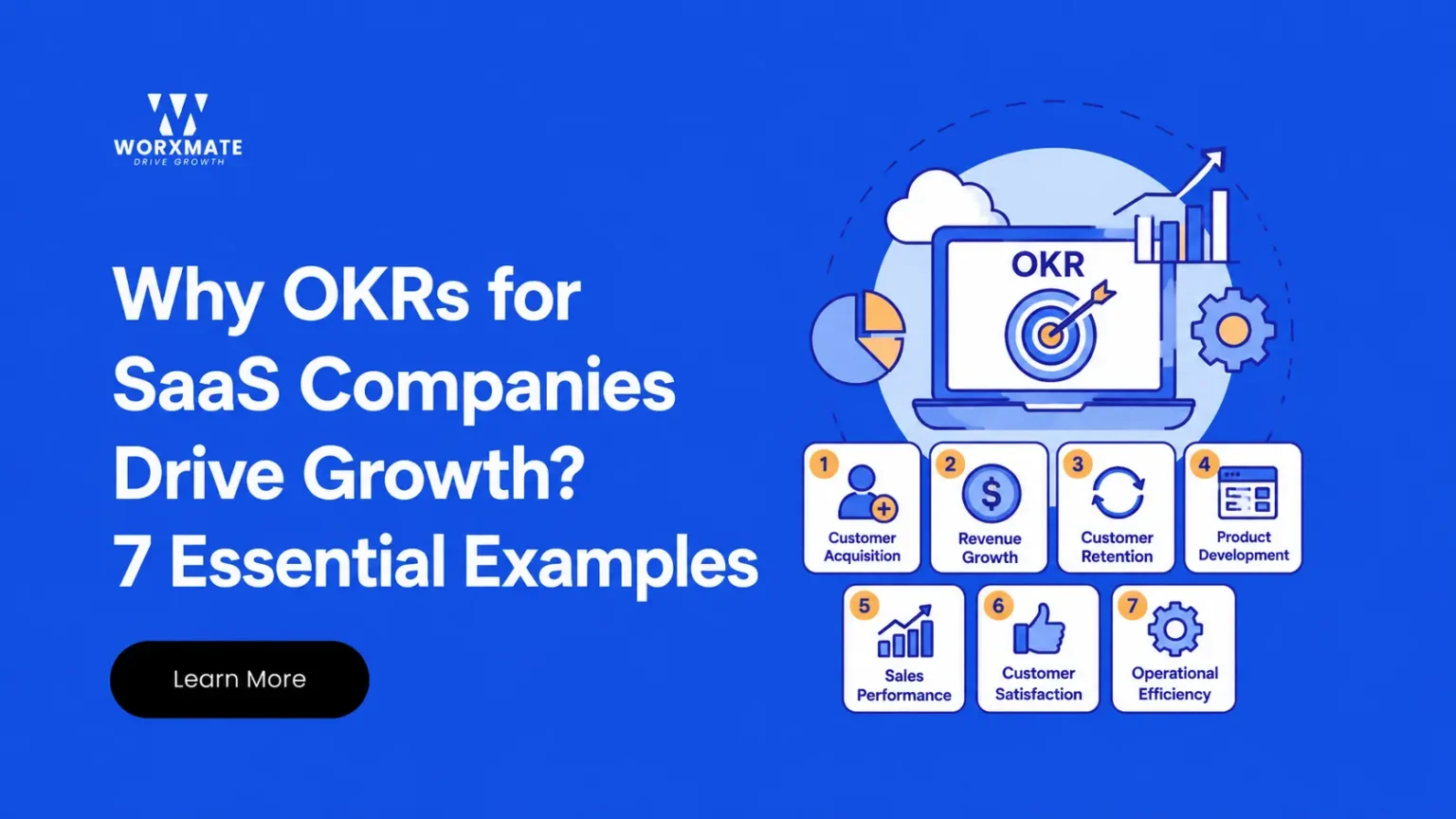
In this article, we’ve compiled 7 essential OKRs for SaaS companies, offering practical examples across various departments—from product and engineering to marketing and customer success. These examples are designed to help your US SaaS company achieve critical milestones, foster accountability, and maintain a sharp focus on your strategic priorities, ultimately driving sustained success in a competitive environment.
Why OKRs Are the Growth Engine for US SaaS Companies
For US SaaS companies, OKRs serve as a critical operating system that bridges the gap between ambitious vision and day-to-day execution. Unlike traditional goal-setting methods, OKRs encourage stretch goals, promoting a culture of continuous improvement and innovation. This framework ensures that every team’s efforts are explicitly tied to the company’s strategic objectives, fostering OKR alignment that is crucial for rapid scaling. According to Gallup, highly engaged teams, often facilitated by clear goal structures like OKRs, show 21% greater profitability. This direct link between clear goals and business outcomes makes OKRs for SaaS companies a powerful tool for growth.
Aligning the North Star Metric with Departmental OKRs
A key aspect of successful OKRs for SaaS companies is the integration of a North Star Metric (NSM). This single, overarching metric represents the primary indicator of a company’s long-term success and customer value. For example, Spotify’s NSM might be “time spent listening,” while for Airbnb, it’s “nights booked.” Each departmental OKR should ideally contribute directly or indirectly to this NSM, creating a cascaded and unified strategic direction. This ensures that engineering, product, marketing, and sales teams are all pulling in the same direction, optimizing resources and accelerating progress toward the company’s ultimate vision. This focus is particularly vital for SaaS OKR examples.
SaaS-Specific OKR Examples: From Engineering to Customer Success
1. Product Development OKRs for SaaS Companies
The goal is to enhance product stickiness and user engagement. This involves introducing new features that address core user needs and improve the overall user experience. Key results will include adoption rates of new features, time spent in-app, and user satisfaction scores.
-
Objective:
Boost Product Engagement and User Retention
-
Key Results:
- Key Result 1: Launch 2 new high-impact features through agile development within the quarter.
- Key Result 2: Increase average weekly active users by 15% via targeted in-app onboarding flows.
- Key Result 3: Improve customer satisfaction (CSAT) score for new features from 7.5 to 8.5 by collecting in-app feedback.
2. Engineering Excellence OKRs for SaaS Companies
The goal is to enhance the platform’s reliability and performance. This involves optimizing code, improving infrastructure, and reducing critical bugs. Key results will include system uptime, page load speed, and the resolution rate of high-priority issues.
-
Objective:
Ensure Robust and Scalable Platform Performance
-
Key Results:
- Key Result 1: Implement automated performance testing for 80% of critical features by end of quarter.
- Key Result 2: Reduce average page load time for key user flows by 20% through backend optimizations.
- Key Result 3: Achieve 99.99% system uptime by mitigating critical incidents through proactive monitoring.
3. Marketing Growth OKRs for SaaS Companies
The goal is to significantly expand market reach and generate high-quality leads. This involves diversifying marketing channels and optimizing conversion funnels. Key results will include website traffic, marketing-qualified leads (MQLs), and conversion rates from lead to customer. These OKRs for SaaS companies are vital for business growth strategy.
-
Objective:
Accelerate Inbound Lead Generation and Market Awareness
-
Key Results:
- Key Result 1: Launch 2 new content marketing campaigns focused on key industry pain points within the quarter.
- Key Result 2: Increase organic website traffic by 25% through improved SEO and content distribution.
- Key Result 3: Generate 150 new marketing-qualified leads (MQLs) per month via optimized landing pages.
4. Sales Performance OKRs for SaaS Companies
The goal is to drive significant revenue growth through new customer acquisition and expansion within existing accounts. This involves refining sales processes and empowering the sales team with better tools. Key results will include new bookings, average contract value (ACV), and win rates. These are critical OKRs for SaaS companies focused on the bottom line.
-
Objective:
Maximize New Revenue and Expand Customer Base
-
Key Results:
- Key Result 1: Implement a new CRM integration for automated lead nurturing by the end of the quarter.
- Key Result 2: Increase new monthly recurring revenue (MRR) by 20% through targeted outreach campaigns.
- Key Result 3: Improve sales win rate by 10% through enhanced sales enablement and training.
Unlock Goal Clarity and Accelerate Employee Growth
Looking to drive goal clarity and employee growth? Discover how Worxmate’s AI-powered Performance Management Software can help.
5. Customer Success OKRs for SaaS Companies
The goal is to cultivate an exceptional customer experience, leading to higher retention and advocacy. This involves proactive support, effective onboarding, and gathering customer feedback. Key results will include churn rate, Net Promoter Score (NPS), and customer lifetime value (CLTV). These are paramount OKRs for SaaS companies looking to sustain growth.
-
Objective:
Elevate Customer Satisfaction and Loyalty
-
Key Results:
- Key Result 1: Roll out a new customer onboarding program to 100% of new clients by month-end.
- Key Result 2: Improve Net Promoter Score (NPS) from 45 to 55 through enhanced support and engagement.
- Key Result 3: Reduce quarterly customer churn rate by 1.5% via proactive health checks and success planning.
6. HR and People Operations OKRs for SaaS Companies
The goal is to build a high-performing culture that attracts, develops, and retains top talent. This involves streamlining HR processes and fostering employee growth. Key results will include employee engagement scores, retention rates, and time-to-hire. For HR strategy, these OKRs for SaaS companies are fundamental.
-
Objective:
Cultivate a Thriving and Engaged Workforce
-
Key Results:
- Key Result 1: Implement a new mentorship program for 100% of new hires within their first 90 days.
- Key Result 2: Increase overall employee engagement score by 10% through pulse surveys and feedback loops.
- Key Result 3: Reduce voluntary employee turnover by 5% in critical roles by optimizing career development paths.
7. Financial Health OKRs for SaaS Companies
The goal is to ensure robust financial stability and efficient capital utilization to fuel future growth. This involves meticulous budgeting, revenue forecasting, and cost optimization. Key results will include gross margin, burn rate, and customer acquisition cost (CAC). These are essential OKRs for SaaS companies to maintain profitability while organizational productivity is scaling.
-
Objective:
Optimize Financial Performance and Efficiency
-
Key Results:
- Key Result 1: Develop and implement a new automated expense tracking system within the quarter.
- Key Result 2: Improve gross margin by 2% through strategic vendor negotiations and cost reductions.
- Key Result 3: Decrease Customer Acquisition Cost (CAC) by 15% via optimized marketing spend and sales efficiency.
Balancing Rapid Scaling with Retention: The SaaS OKR Framework
The unique challenge for US SaaS companies is balancing aggressive business growth strategy with the imperative of customer retention. OKRs provide the framework to manage this duality effectively. For instance, while marketing and sales focus on new user acquisition, product and customer success teams use their OKRs to enhance user experience and reduce churn. This balanced approach, where different departments have distinct but interconnected strategic goals, ensures that scaling efforts are sustainable. According to Gartner, only 5% of organizations effectively measure customer value, highlighting a critical area where well-defined OKRs for SaaS companies can make a significant difference.
Navigating the US SaaS Landscape: Common Implementation Challenges
Implementing OKRs for SaaS companies in the fast-paced US market comes with its own set of challenges. These often include resistance to change, difficulty in defining measurable goals, and maintaining consistency across rapidly expanding teams. Many companies struggle with distinguishing OKRs vs KPIs, leading to confusion. Overcoming these hurdles requires strong leadership commitment, continuous communication, and the right tools. Companies like Google, a pioneer in OKR adoption, emphasize that the framework is a journey of continuous learning and adaptation, not a one-time implementation. This iterative approach is particularly relevant for quarterly planning in software companies.
Leveraging Worxmate to Automate and Scale Your SaaS OKRs
For US SaaS companies aiming to streamline their goal-setting and performance management, dedicated OKR software is invaluable. Worxmate provides an AI-powered platform that simplifies the creation, tracking, and alignment of OKRs. It helps C-suite executives and HR managers ensure that every team’s efforts contribute to the overall strategic vision, facilitating real-time OKR check-ins and performance reviews. This automation reduces administrative burden, allowing teams to focus on achieving their objectives rather than managing spreadsheets. By providing clear visibility into progress and potential roadblocks, Worxmate empowers SaaS companies to make data-driven decisions and adapt quickly to market changes, ensuring their OKRs for SaaS companies are always on track.
Setting clear, actionable OKRs for SaaS companies empowers leaders to align their teams, measure success, and drive real business impact. Whether you’re aiming to boost product engagement, accelerate lead generation, or optimize financial performance, the right OKRs keep your strategy focused and your teams accountable. This framework is essential for navigating the complexities of the US SaaS market.
By implementing these OKRs for SaaS companies, organizations can strengthen OKR alignment across departments, maintain momentum through structured OKR cycles, and pursue organizational growth with OKRs with full visibility into what’s working. It’s time to move beyond transactional tasks and toward strategic outcomes that directly move the needle, leveraging the power of SaaS OKR examples to guide your path.
Ready to align your SaaS company goals with real outcomes? Explore how OKR software brings structure to your goal-setting, use OKR alignment to connect team efforts to company priorities, and sustain progress through a consistent OKR check-ins. Start your free trial with Worxmate and turn your SaaS company objectives into results that actually move the needle.


Written by
An OKR Coach with 20+ years of implementation experience, Madhusudan has guided over 50 organisations through successful OKR transformations, training more than 500 leaders. Learn more about Worxmate.
Frequently Asked Questions
OKRs for SaaS companies are a goal-setting framework that helps align teams around ambitious, measurable objectives. They translate high-level strategic goals, often tied to a North Star Metric, into concrete, quantifiable key results for departments like product, engineering, marketing, and sales. This ensures focused execution and measurable progress in a fast-paced market.
To implement OKRs effectively for rapid scaling, SaaS companies should start with a clear North Star Metric, then cascade departmental OKRs that directly support it. Focus on ambitious yet achievable objectives, ensure key results are measurable and outcome-focused, and conduct regular OKR check-ins. Leveraging dedicated OKR software like Worxmate can automate tracking and improve alignment across growing teams.
The ROI of implementing OKRs for SaaS companies includes improved strategic alignment, increased employee engagement, faster decision-making, and enhanced accountability, all contributing to accelerated growth and higher revenue. Companies with clear goal-setting frameworks often experience better profitability and market share. This structured approach helps ensure resources are directed towards high-impact initiatives, reducing wasted effort.
Common pitfalls when setting OKRs for SaaS companies include setting too many objectives, making key results output-focused rather than outcome-focused, and failing to regularly check in on progress. Other issues include a lack of clear ownership, not integrating OKRs into daily workflows, and confusing OKRs with traditional task lists or KPIs. These can lead to team disengagement and a perceived lack of value from the framework.
SaaS companies align their North Star Metric by cascading it into specific, measurable outcomes for each team, such as Engineering focusing on system uptime or Marketing on trial-to-paid conversion rates. This ensures that every department’s daily efforts directly contribute to the company’s primary long-term growth indicator.
While a roadmap lists specific features to be built, Product Development OKRs focus on the measurable impact of those features, such as increasing user retention or reducing onboarding friction. This shifts the team’s focus from simply shipping code to delivering validated business value and solving core customer pain points.
Engineering OKRs should balance speed with stability, focusing on key results like deployment frequency, mean time to recovery (MTTR), and the reduction of technical debt. This framework ensures the underlying infrastructure remains robust and scalable as the company pursues ambitious growth targets.
Focusing on growth outcomes, such as Customer Acquisition Cost (CAC) efficiency and expansion revenue, ensures Marketing is aligned with the company’s bottom line rather than just top-of-funnel metrics. This approach drives higher-quality traffic and supports sustainable scaling by prioritizing the most profitable customer segments.
Worxmate automates the cascading process and provides real-time visibility into progress, eliminating the manual overhead and lack of transparency found in spreadsheets. By centralizing strategy execution, it empowers SaaS leaders to identify execution bottlenecks early and maintain high levels of accountability across distributed teams.
