 WORXMATE
Objectives and Key Results serve as indispensable tools in modern organizations, providing a framework for setting and tracking goals. When implemented effectively, OKRs drive alignment, focus, and performance improvement across teams.
However, the journey towards achieving consistent OKR adoption can be fraught with challenges. Nearly 60% of companies use OKRs as part of a change or transformation initiative, yet many struggle without standardized tooling. Implementing the best okr software provides the automated governance and structured workflows needed to enforce consistency across every department.
Inconsistent Adoption
While the promise of OKRs is compelling, the reality often presents a different picture. Inconsistencies in OKR adoption can manifest in various forms across different teams and departments.
For instance, some teams may set vague objectives or fail to establish measurable key results, while others might struggle to align their OKRs with broader organizational goals. These inconsistencies can stem from factors such as differing interpretations of the OKR methodology, resistance to change, or inadequate training and support.
Key Challenges with Inconsistent OKR Adoption
-
Lack of alignment with organizational goals:
When teams set objectives that are not aligned with the overarching goals of the organization, it leads to disjointed efforts and wasted resources.
-
Resistance to change and lack of buy-in:
Introducing OKRs often requires a cultural shift within an organization. Resistance to change and a lack of buy-in from key stakeholders can impede the adoption process.
-
Misunderstanding of OKR methodology:
Without a clear understanding of the OKR methodology, teams may struggle to set meaningful objectives and KRs, resulting in ineffective goal-setting practices.
-
Communication breakdowns between teams:
Effective OKR adoption relies on transparent communication and collaboration between teams. Communication breakdowns can hinder alignment and coordination efforts.
-
Inadequate training and support:
Without proper training and support, teams may struggle to grasp the nuances of OKR implementation, leading to inconsistent adoption and suboptimal results.
Achieve Your Goals Faster
See how Worxmate can help your team set clear goals and achieve faster results. Book your free demo today and experience the power of AI-driven OKRs in action.
Consequences of Inconsistent OKR Adoption
The repercussions of inconsistent OKR adoption can be grave and detrimental to organizational performance. Without alignment and clarity, teams may find themselves adrift, lacking direction and purpose.
Inefficient resource allocation, decreased morale, and impaired decision-making processes are just a few of the consequences that organizations may face as a result of inconsistent OKR adoption.
Strategies for Overcoming Inconsistencies
- Leadership buy-in is crucial for driving consistent OKR adoption. Leaders must demonstrate their commitment to the OKR process and provide the necessary support and resources for its successful implementation. Deploying the best okr software alongside clear guidelines ensures that cross-functional teams operate within a single, unified execution framework.
- Effective communication and comprehensive training programs are essential for ensuring that teams understand the OKR methodology and its importance. Clear guidelines and best practices can help teams navigate the complexities of OKR implementation.
- OKR implementation is an iterative process that requires ongoing evaluation and adjustment. Organizations must be willing to adapt their approach based on feedback and performance data to ensure continuous improvement.
- A culture of transparency and accountability is foundational to successful OKR adoption. By fostering a culture where teams are encouraged to openly communicate, collaborate, and hold each other accountable, organizations can overcome barriers to consistency.
Case Study: Successful Implementation of an OKR Automation Framework
Adobe, a global leader in digital experiences and software solutions, faced challenges with data and analytics inconsistencies and varying frequencies of metric updates within its OKR framework.
To address these issues and achieve overall consistency in OKR reporting, strategy communication, and team performance standards, Adobe implemented an OKR automation framework.
Background
Adobe recognized the importance of OKRs in driving alignment and focus across its organization. However, inconsistencies in data and analytics, as well as discrepancies in metric updates, hindered the effectiveness of its OKR framework. To overcome these challenges and streamline OKR processes, Adobe developed an automation framework.
Achieve Your Goals Faster
See how Worxmate can help your team set clear goals and achieve faster results. Book your free demo today and experience the power of AI-driven OKRs in action.
Implementation
The Digital Imaging organization at Adobe spearheaded the implementation of the OKR automation framework. Adobe automated over 60 OKRs and facilitated over 1,000 key result updates. This automation enabled faster execution and delivery for both employees and executives.
Impact
-
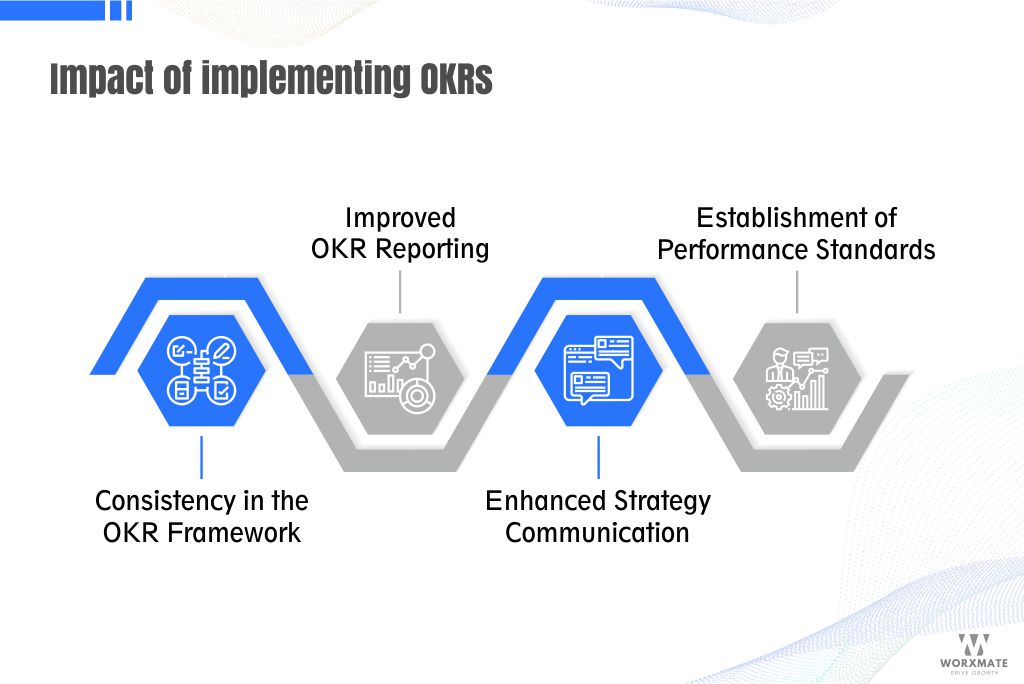
Consistency in the OKR Framework
Implementing the automation framework ensured consistency in the OKRs across teams and departments. By automating OKR processes, Adobe minimized the risk of human error and ensured that objectives and key results were aligned with organizational goals.
-
Improved OKR Reporting
The automation of OKR reporting led to more accurate and timely updates on team performance. With real-time access to OKR data, executives could make informed decisions and track progress more effectively.
-
Enhanced Strategy Communication
The automation framework facilitated seamless communication of strategy and objectives across the organization. Teams better understood their roles and responsibilities, leading to better alignment with overall business objectives.
-
Establishment of Performance Standards
The rigorous automation of OKR processes enabled Adobe to establish standards for team performance. By setting clear expectations and benchmarks, Adobe promoted accountability and drove organizational performance improvements.
Adobe’s successful implementation of an OKR automation framework demonstrates the transformative potential of technology in optimizing organizational processes. By addressing data inconsistencies and streamlining metric updates, Adobe achieved greater consistency in its OKR framework, reporting, and strategy communication.
Conclusion
Inconsistent OKR adoption poses significant challenges for organizations striving to achieve their goals and objectives. By understanding the root causes of inconsistency and implementing targeted strategies for overcoming these challenges, organizations can unlock the full potential of OKRs as a driver of alignment, focus, and performance improvement.
Inconsistent OKR adoption poses significant challenges for organizations striving to achieve their goals and objectives. By understanding the root causes of inconsistency, leveraging the best OKR software for automated tracking, and implementing targeted strategies, organizations can unlock the full potential of OKRs as a driver of alignment, focus, and performance improvement.
💡 Looking to standardize OKRs across your organization?
Explore our comprehensive best OKR platform guide to compare top platforms that streamline cross-departmental alignment and eliminate inconsistencies.


Written by
An OKR Coach with 20+ years of implementation experience, Madhusudan has guided over 50 organisations through successful OKR transformations, training more than 500 leaders. Learn more about Worxmate.