 WORXMATE
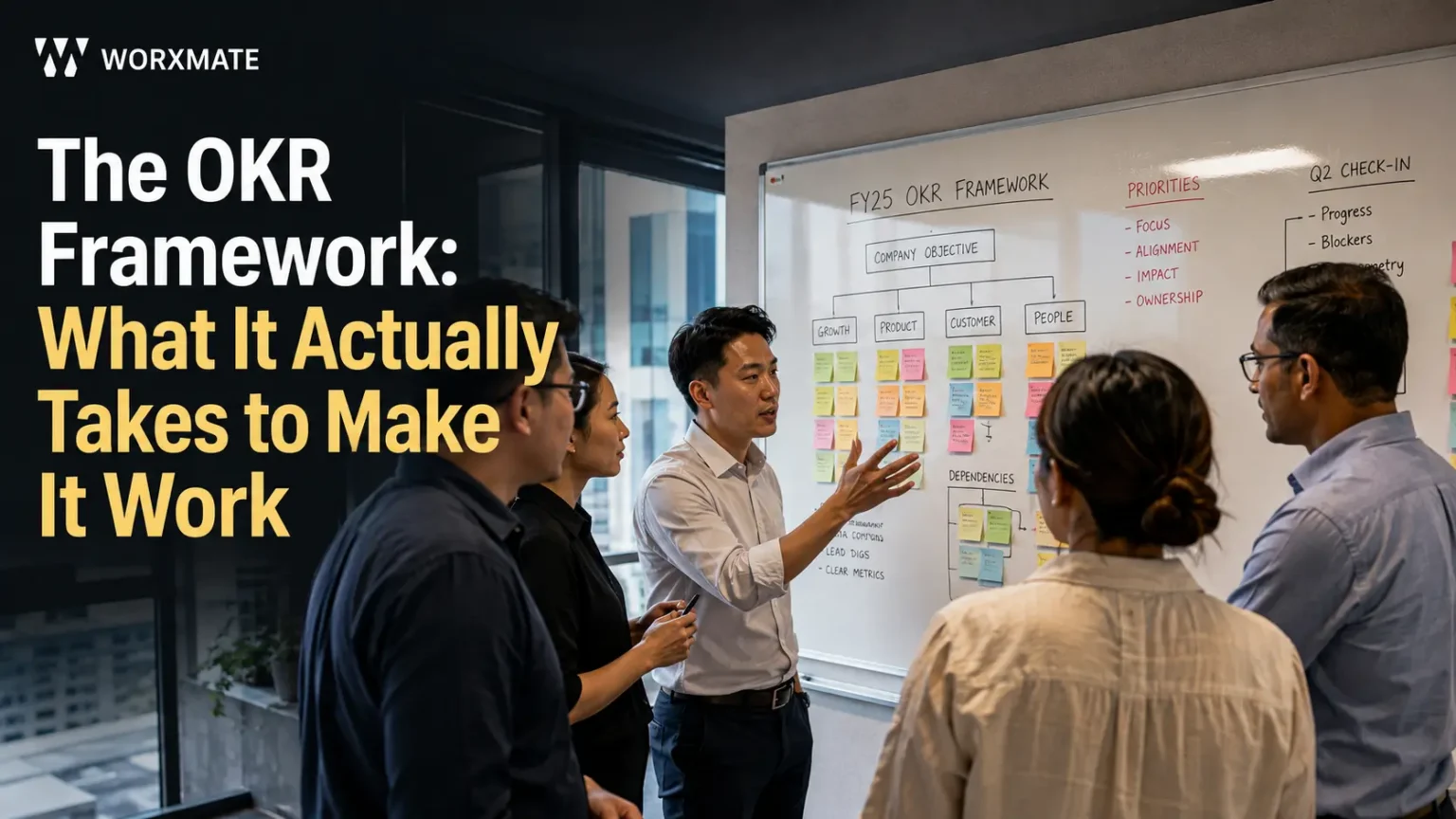
The OKR framework only works when a leadership team can first agree on two to three genuine priorities before a single Key Result is written. Most OKR programs don’t fail because the framework is wrong they fail because of three structural gaps that show up before anyone opens a template: an org structure that doesn’t match the strategy, a bottom-up rollout introduced before the organisation has the capability for it, and leaders who cannot yet tell an output from an outcome. Fix those three, in that order, and the framework does exactly what it was designed to do.
In the first alignment call with the leadership team of a fast-growing APAC retail company, I asked the CEO one question: what are your top three priorities? Forty-five minutes later, he still could not answer it. Not because he wasn’t sharp. Because nobody had ever asked him to compress his vision into three outcomes an entire organisation could cascade from. The meeting ended without a conclusion. It took a two-day war room before a single OKR got written.
That is the OKR framework in its true form – not a template, not a quarterly ritual, but the discipline of forcing clarity that most leadership teams have never been asked to produce. Everything that follows in this article is built from what I have seen work, and fail, across 50+ implementations over the last ten years.
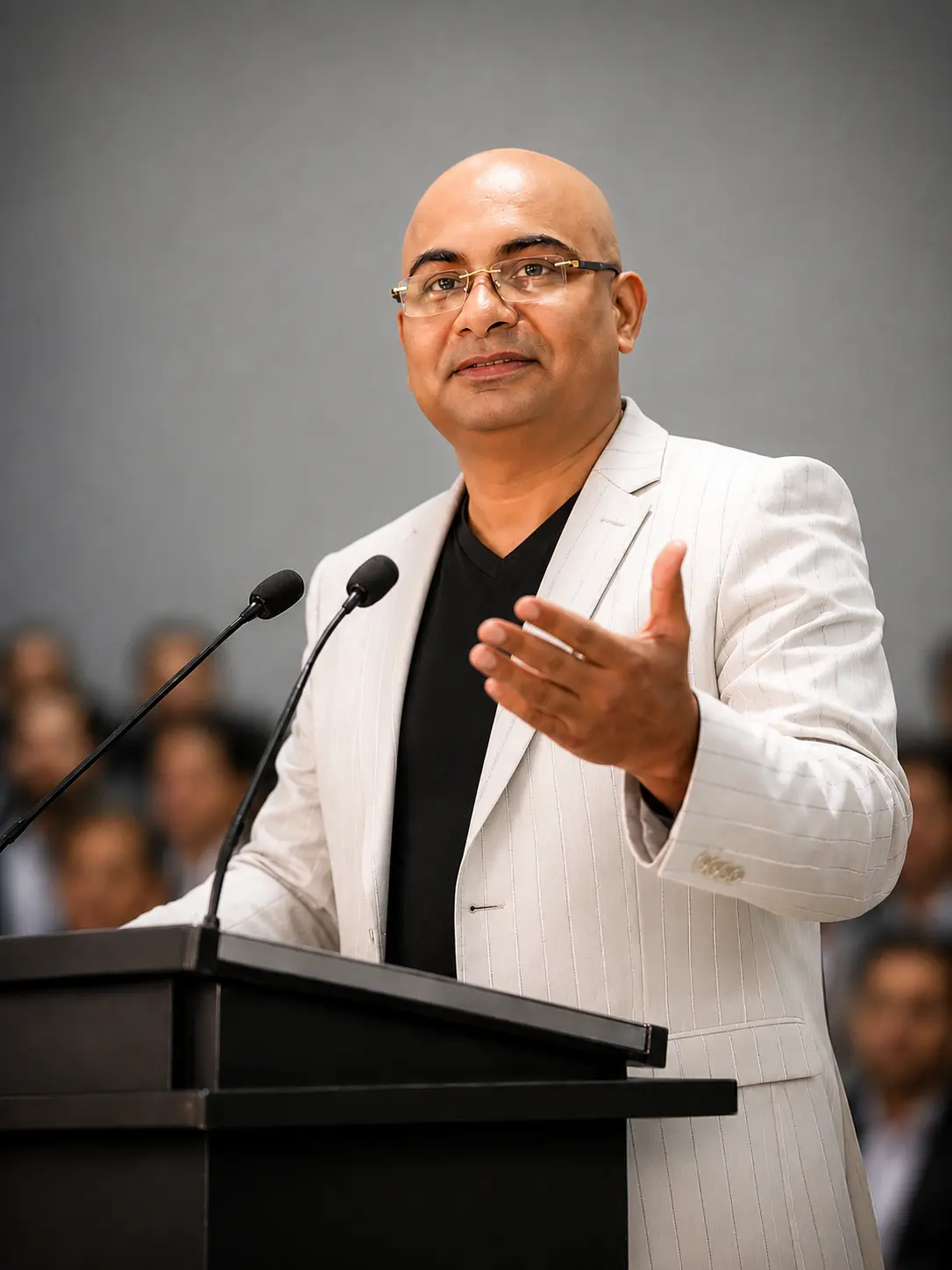
About the author: Madhusudan Nayak (Maddy) is Co-Founder and CEO of Worxmate, and has spent 20+ years in strategy execution and 10+ years implementing OKRs across 50+ organisations and 500+ leaders trained, spanning APAC, the Middle East, and Europe. Before Worxmate, he was Business Head at Profit.co. He is the creator of the DEEP AI™ framework.
The Framework Everyone Learns, and the Problem Nobody Names
Objectives and Key Results is simple to explain. An Objective is a qualitative, ambitious statement of where you want to go. Key Results are the measurable outcomes that tell you whether you got there. Set them quarterly, cascade them across the organisation, review them regularly. If you’re new to the concept, the full Objectives and Key Results primer covers the mechanics in more depth than this article will. Most articles on this topic stop at the mechanics, as if understanding them is the same as being able to run the program.
It is not. I have sat with leadership teams who could recite the Objective-Key Result structure correctly and still could not write a single genuine OKR without heavy coaching. The framework’s mechanics are the easy 10%. The other 90% is what most OKR content never covers: whether your organisation structure can actually deliver the strategy you are cascading, whether your leaders can tell the difference between an output and an outcome, and whether the agreement your OKR tree displays is real or just displayed.
That last distinction matters more than anything else in this article. Alignment is agreement between teams on what matters, why it matters, and how each team’s work connects to the teams around them. You cannot set that in a tool. You can only display it once it already exists. A platform showing a beautifully cascaded OKR tree is showing you the record of an agreement – it does not create the agreement itself. We go deeper on what this looks like day-to-day in goal alignment across teams.
“You cannot set alignment in a tool. You can display it. You cannot create it.”
Why the Framework Breaks Down in Practice
The most common failure I see has nothing to do with the framework being wrong. It has to do with three structural mistakes that happen before a single OKR is written.
Mistake 1: The organisation structure was never checked against the strategy.
If your org structure does not reflect your leadership team’s actual growth priorities, you are cascading goals into a broken architecture. Most OKR coaches never raise this question, because it comes from strategy execution experience, not from an OKR certification. Cascading through a misaligned structure does not expose the misalignment – it embeds it deeper.
Which of these mistakes is already inside your OKR program?
The Common Pitfalls of Implementing OKRs walks through the structural failures I see most often before a single Key Result gets written — and how to catch them early.
Mistake 2: Bottom-up was introduced before the organisation was ready for it.
Every OKR book recommends bottom-up goal-setting as empowerment, and the principle is sound. The timing is usually wrong. In the first two quarters of a new program, bottom-up produces noise, not alignment, because teams have not yet developed outcome-oriented thinking. What works: top-down with active coaching for the first two quarters, then a deliberate, managed transition to bottom-up as capability develops. Empowerment without capability is not empowerment. It is misalignment dressed as autonomy.
Mistake 3: Nobody could tell an output from an outcome.
This is the single most common gap across every organisation I have coached, regardless of industry or size. In the 70,000-person IT services organisation I worked with, the entire leadership team was operating on outputs disguised as goals – until a single game-format exercise, using their own real business scenarios, broke the myth. Leaders were asked to identify which of their own goals were output-led and which were outcome-driven. That one exercise unlocked outcome-oriented thinking that ten years of prior reporting cycles had never produced.
Output Key Results are not inherently wrong, and the OKR coaching community has caused more confusion than clarity by insisting they are. OKRs work best with a deliberate combination of output and outcome Key Results – used with full understanding of which type you are writing and why. The failure is not that teams write output KRs. The failure is that they cannot tell the difference, and therefore cannot use either type correctly.
Achieve Your Goals Faster
See how Worxmate can help your team set clear goals and achieve faster results. Book your free demo today and experience the power of AI-driven OKRs in action.
OKR Framework vs. KPI: Where the Confusion Actually Comes From
This is the question I get asked most often, and the confusion is not really about definitions – it is about direction.
| OKR Framework | KPI | |
|---|---|---|
| What it is | A goal-setting framework connecting ambition to measurable outcomes | A performance metric that tracks an ongoing process |
| Direction | Forward-looking — where are we trying to go | Backward-looking — where do we currently stand |
| Time horizon | Typically quarterly, tied to strategic cycles | Continuous, tracked indefinitely |
| Purpose | Drives change and stretch | Monitors stability and health |
| Relationship | Can use KPIs as Key Results when tracking is the actual goal | Can feed into an OKR as supporting data, not a substitute for it |
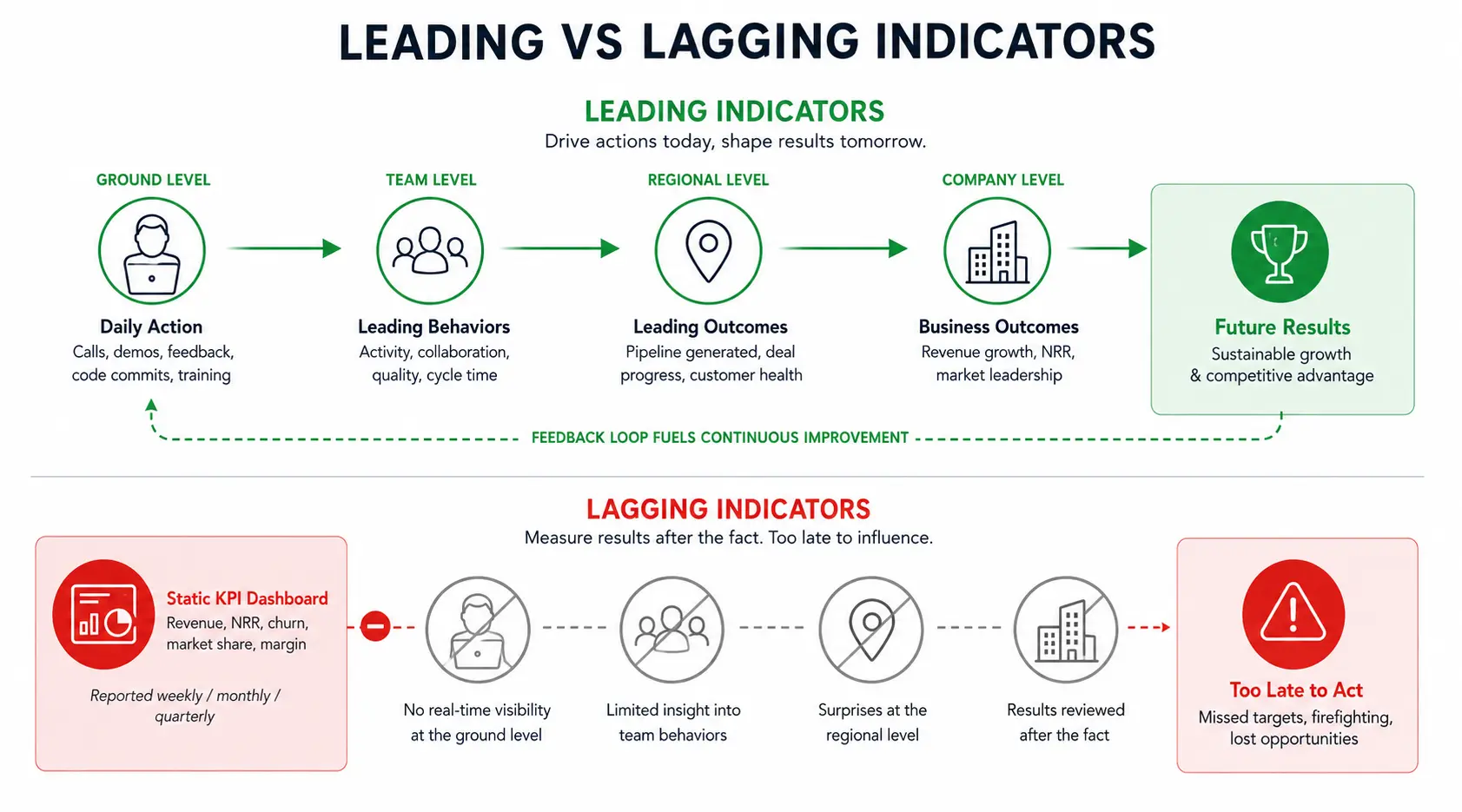
The distinction that changes how leadership teams actually use this: KPIs are lagging indicators – they tell you your current state, not where to go next. OKRs, done correctly, surface leading indicators – the early signals that let you see a blocker before it becomes a crisis, and connect a ground-level daily action to a regional or company-level goal. I watched this exact realisation change how a European fintech’s leadership team thought about their own goals. The CEO and CPO were tracking metrics that produced numbers without providing clarity about what actually needed to change — activity everywhere, none of it clearly connected to what the organisation needed to achieve. In the first coaching session, I asked one question: what is the one big thing you want to resolve? The answer was product demo experience. Then came a sequence of “so what” questions — if you implement this, so what, what happens next — repeated until the team reached a genuine outcome statement. That process changed the quality of every goal written after it, including a Key Result the Product Lead and the Account Executive ended up co-owning jointly, something that had never happened in that organisation before.
KPIs are not the enemy of OKRs. Treating them as interchangeable is the actual problem – because a leadership team that mistakes tracking activity for driving outcomes will hit every number on the dashboard and still not know if the business moved.
What Successful Implementation Actually Requires
If you take one thing from this article, take this: setting the C-suite’s OKRs is the beginning of implementation, not the deliverable. This is the assumption that implicates the consulting industry most directly. Most engagements run a leadership workshop, help the C-suite write their OKRs, and end there. Within one quarter, the program dies below the leadership layer, because the people responsible for carrying it forward were never coached on how to do that. I call this the Coaching Cliff – the point where coaching stops at the C-suite and the organisation is left to cascade independently. It is the most common and least discussed reason OKR programs fail.
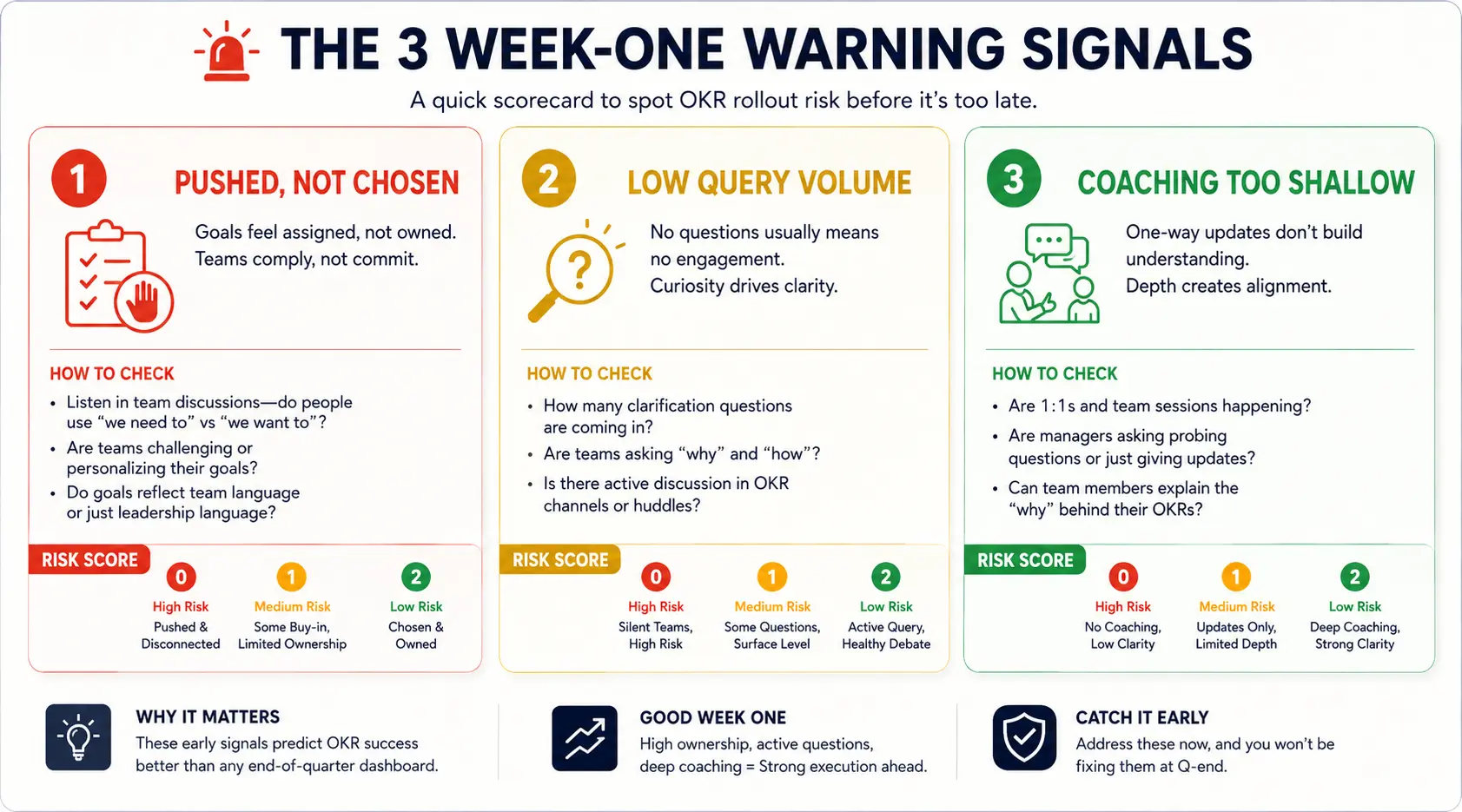
Three signals predict whether an implementation will hold, and I check for all three in the first week of every engagement:
Was this pushed, or was this chosen? An organisation that has been sensitised to OKRs – where leaders understand why, have had real conversations about what it means for their team, and have chosen to commit – behaves entirely differently from one where OKRs were announced with a go-live date and a software login. The second scenario collapses between weeks four and six, not from resistance, but because nobody answered the question every employee is silently asking: what is in it for me.
How many product queries is the team raising in week one? Fifteen to twenty support queries a day in the first week signals a mismatch between the tool and the team’s current OKR literacy. That mismatch will break adoption within weeks, and no customer success call fixes it after the fact.
Does the coaching stop at the C-suite? If it does, the clock on the Coaching Cliff has already started.
The metric I use to track real progress is the Execution Maturity Rate – the percentage of leaders who can independently write a genuine outcome-driven goal, without coaching support, without a template, without a quality review. In a typical first-cycle implementation, this sits between 5% and 15%. In organisations that run a well-coached program consistently for 12 months, it reaches 30% to 40%. Goal completion rate looks better on a dashboard. Execution Maturity Rate is the number that actually tells you whether the framework took hold.
None of this happens in three months, regardless of how senior the leadership team is. Most careers are built inside output-led frameworks – roles defined by deliverables, performance reviewed against activity. Asking an organisation to shift to outcome-led thinking in a single quarter is not ambitious. It is unrealistic. Organisations that understand this invest in the journey. Organisations that do not keep switching consultants and platforms, looking for a shortcut that was never there.
The OKR Framework Adoption Timeline: What to Realistically Expect
Leadership teams almost always underestimate how long genuine adoption of the OKR framework takes. This is the timeline I set expectations against at the start of every engagement, so nobody mistakes quarter one for the finish line.
| Phase | What’s Actually Happening | Execution Maturity Rate |
|---|---|---|
| Quarter 1 | Top-down OKRs with heavy 1:1 coaching; leaders still confusing output KRs with outcome KRs | 5–10% |
| Quarter 2-3 | Org structure and priorities re-checked; output-vs-outcome exercise repeated with real business scenarios | 10–20% |
| Quarter 4-6 | Managed transition toward bottom-up; cross-functional dependencies surfaced proactively | 20–30% |
| Quarter 12+ | Leaders write genuine outcome-driven OKRs unassisted; coaching shifts from C-suite to middle management | 30–40% |
How Worxmate Operationalises the OKR Framework
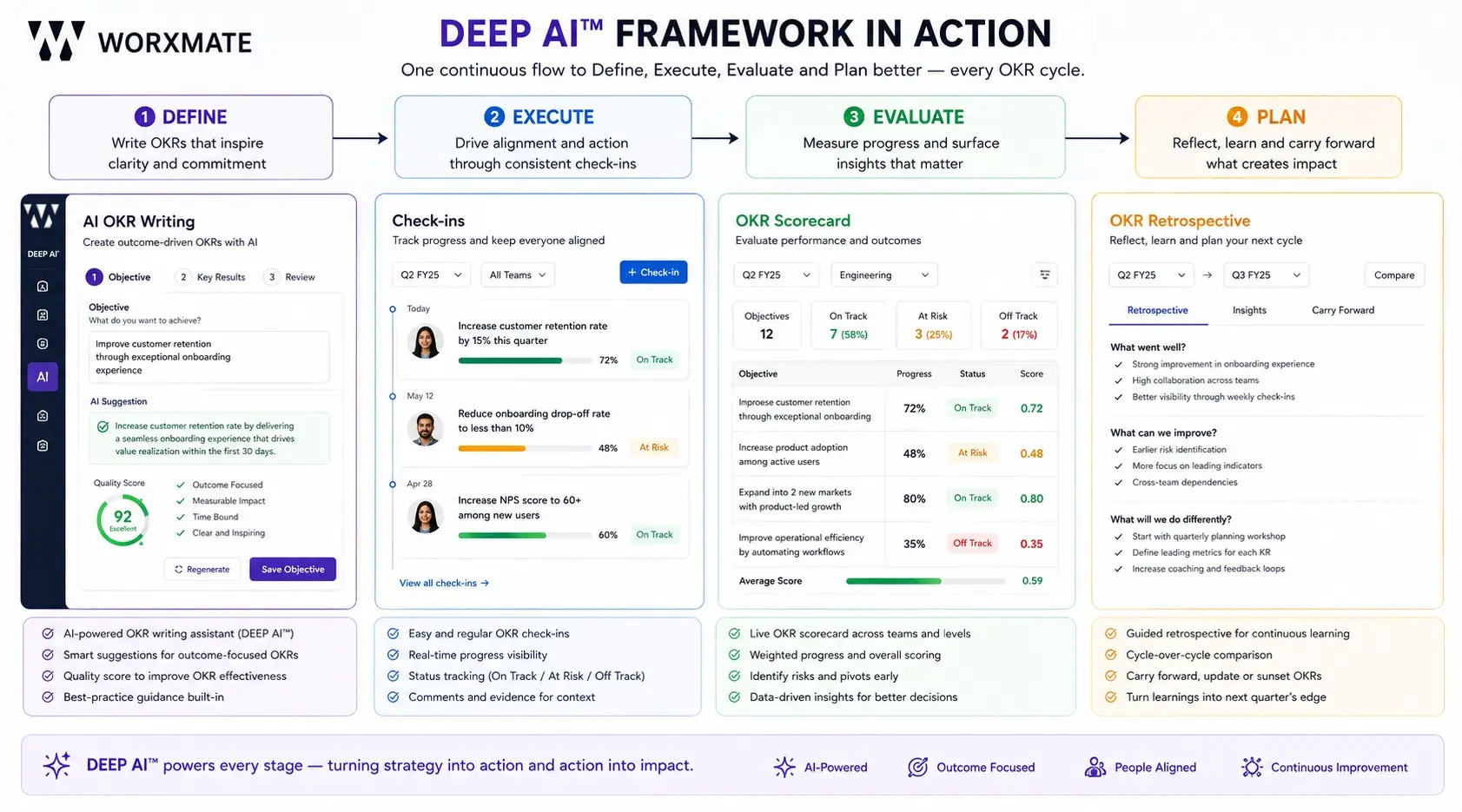
Everything above is a coaching and organisational discipline problem before it is a software problem – which is exactly why Worxmate’s DEEP AI™ Framework is built around the same four stages I use in live implementations: Define, Execute, Evaluate, Plan.
Define uses AI-assisted goal writing to catch output-disguised-as-outcome before it gets written into the system. Execute runs automated check-ins and at-risk detection, so a stalled Key Result surfaces in week three, not in the retrospective. Evaluate turns check-in data into a real retrospective instead of a status report. Plan carries what the organisation learned into the next cycle, instead of resetting to zero every quarter.
The platform does not replace the coaching work described in this article. It is built to hold the discipline in place once the coaching has done its job — which is the order most OKR software implementations get backwards. Underneath DEEP AI™ sit three purpose-built intelligence models that map to where OKR programs actually break: Orbit AI for people-level performance signals that a CHRO or L&D head needs to see, Axis AI for the business-performance view a CEO or CFO reads in an MBR, and Nexus AI for the organisation-wide structural view that tells you whether the cascade you are looking at is a real agreement or a display of one.
None of this replaces task management for daily execution or the integrations that keep OKR data connected to the tools your teams already use. It sits above them, holding the outcome-oriented thinking the coaching built.
Choosing Your Path Forward
The software is the infrastructure. The coaching is the capability. You need both — and in the right order.
If your leadership team already has genuine clarity on its top priorities and needs infrastructure to hold the cascade, check-ins and retrospectives in place, start with the OKR software platform and the pricing page to see what fits your team’s stage.
If you recognise your organisation in the CEO who couldn’t name three priorities in forty-five minutes, the platform is not the first problem to solve. Start with OKR consulting for organisations in India and APAC, or run an organisational performance audit first to see exactly where the structural gaps sit before a single OKR is written.

Written by
An OKR Coach with 20+ years of implementation experience, Madhusudan has guided over 50 organisations through successful OKR transformations, training more than 500 leaders. Learn more about Worxmate.